Project 1
Forearm crutch
You make a report on human forearm crutch, taking in to account of (a) types of crutches, (b) parts of crutch (c) materials used in making the main crutch (d) brief description of how each part is made
- Introduction
- Main Parts of the crutch..
- Materials used for the main parts
- A sketch of a crutch
- Main parts of the crutch
- Materials used for the main parts
- Brief description of how each part is manufactured.
- What are the testing methods for the materials used in crutch
- Conclusions
- Suggestions for improving the crutch
- If your new design is innovative, how do you proceed to acquire IP rights?
- Report submission
Forearm crutches, also known as elbow crutches, are a type of mobility aid commonly used by individuals with lower limb injuries or disabilities. They provide support and stability to the user while walking, and are designed to take weight off the hands and wrists. In this report, we will discuss the different types of forearm crutches, the main parts of a forearm crutch, the materials used in their construction, and the manufacturing process for each part. We will also discuss testing methods for the materials used in the crutches, and provide suggestions for improving the design.
Crutches are medical devices designed to aid in ambulation, by transferring body weight from the legs to the torso and arms. They are mainly used to assist individuals with lower extremity injuries and/or neurological impairment. This activity describes the types of crutches, their indications, and contraindications and highlights the role of the interprofessional team in proper evaluation and training of patients needing ambulatory devices. Axilla crutches are the most common type. Their ease of use makes them an excellent option for most individuals. They are best for short-term use. The design is intended to transfer most of the user’s body weight to the arms and torso. Axilla crutches are not ideal for individuals with wrist problems, weak upper body strength, or impairment of coordination. Most health care facilities discharge patients with axilla crutches for immediate use. Forearm crutches are better for long-term use. The weight of the user is transferred mainly to their entire upper arms. The user needs good upper body strength to use these crutches properly. Individuals with long-term disabilities looking to be more active or participate in sports may choose forearm crutches as an option. Platform crutches are the least common of the three. The weight of the patient is transferred mainly to the user’s forearms. The platform allows the user more stability than the axilla and forearm crutches, but the platform crutch has less maneuverability. They are intended for long-term use. Individuals with long-term disabilities from severe neurological impairment of their lower extremities with decreased stability may choose platform crutches as an option.
Patients can receive training for different gait patterns depending on their current injury and coordination level.
One crutch gait: This pattern utilizes only one crutch. Crutch positioning is on the side of the uninjured lower extremity. The crutch and the injured leg are advanced forward. Then the uninjured leg proceeds while the crutch supports the user's weight.
Two-point gait: The left crutch and right leg move forward followed by the right crutch and left leg.
Three-point gait: This is the most used technique. The left and right crutch along with the injured leg are both advanced while the uninjured leg supports the body weight. Next, the uninjured leg is advanced.
Four-point gait: This technique provides the most support. The left crutch is advanced followed by the right leg, right crutch and at last the left leg.
Swing-to gait: The left and right crutch are advanced. Then the left and right legs are advanced.
The user’s strength and coordination should undergo evaluation before issuing them a set of crutches. The use of the wrong crutches can lead to injury. Most injuries are a direct result of falling. Crutch palsy is observable in axilla crutch users who rest their weight on the shoulder rest. The pressure on the brachial plexus can result in palsy to the radial and ulnar nerves. Extra padding on the shoulder rest can aid in preventing crutch palsy. Education should be provided to patients to discourage supporting body weight on the shoulder rest. With treatment, this can be a repairable injury.
Types of crutches:
There are several types of crutches available, including:
-
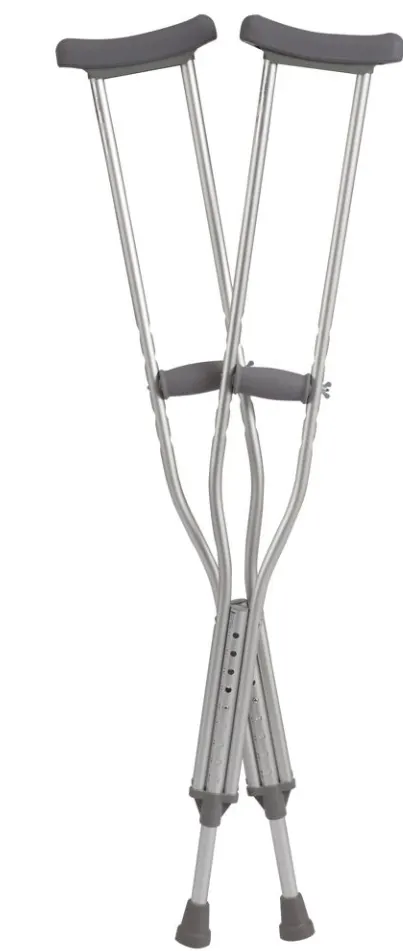
Forearm crutches: These crutches are also known as elbow crutches or Lofstrand crutches. They are designed to be held under the arms, with the weight of the body being supported on the palms of the hands and the forearms.
-
Underarm crutches: These crutches are also known as axillary crutches. They are designed to be held under the arms, with the weight of the body being supported on the hands and the underarms.
-
Platform crutches: These crutches are designed to be stood on, with the weight of the body being supported on a platform.
-
Knee crutches: These crutches are designed to be stood on, with the weight of the body being supported on the knee.
Parts of crutch:
-
Handgrip: This is the part of the crutch that is held by the user. It should be comfortable and easy to grip.
-
Armrest: This is the part of the crutch that rests on the user's arms. It should be padded and comfortable.
-
Shaft: This is the main body of the crutch. It should be sturdy and able to support the weight of the user.
-
Ferrule: This is a rubber tip at the bottom of the crutch. It helps to provide traction and stability.
Materials Used for the Main Parts:
The materials used for the main parts of a forearm crutch include aluminum, carbon fiber, rubber, foam, and plastic. Aluminum is commonly used for the upper and lower shafts as it is lightweight and durable. Carbon fiber is also commonly used for the upper and lower shafts as it is even lighter than aluminum and also provides high durability. Rubber and foam are commonly used for the handgrip as they provide a comfortable grip and reduce the chances of hand fatigue. Plastic is commonly used for the forearm cuff as it is durable and easy to mold into the desired shape.
A sketch of a crutch
Brief description of how each part is manufactured:
- The handgrip is typically made by molding plastic or rubber into the desired shape.
- The forearm cuff is made by shaping a piece of metal or plastic into a loop that fits around the user's forearm.
- The shaft is made by extruding aluminum alloy or carbon fiber into a long tube.
- The tips or feet are usually made by molding rubber into a shape that is suitable for providing support and traction on various surfaces.
Testing methods for the materials used in crutch:
- The materials used in the construction of a crutch are typically tested for strength, durability, and stability.
- Tensile testing, compression testing, and impact testing are commonly used to evaluate the strength and durability of the materials.
- The crutch may also be tested for stability by simulating different walking scenarios and observing how it performs.
Conclusions:
- Human forearm crutches are an essential assistive device for individuals with mobility issues.
- The materials used in the construction of a crutch are carefully selected to ensure that they are lightweight, durable, and stable.
- Proper testing methods are used to ensure that the materials used in the crutch are safe and reliable for use.
Suggestions for improving the crutch:
- The use of lightweight, durable and corrosion-resistant materials in the construction of the crutch.
- The design of the crutch can be improved by incorporating ergonomic features such as adjustable handgrip and forearm cuff.
- The use of new technologies such as 3D printing can be used to improve the design and manufacturing process.
If your new design is innovative, how do you proceed to acquire IP rights:
- If the new design is innovative and meets the criteria for patentability, a patent application can be filed with the relevant patent office.
- For Trade secret and Copyright, a non-disclosure agreement can be signed before sharing the information with others.
Report submission:
- The report can be submitted to the appropriate department within the company, and can also be submitted to relevant industry organizations or publications for review and feedback.