Project 1 - Design and Develop a IOT based Wireless Wearable Health Monitoring System or a Home Healthcare System to monitor the physiological parameters of ECG, Heart Rate, Pulse Oximetry, Cuffless Blood Pressure and Body Temperature.
Wearable technology is any kind of electronic device designed to be worn on the user's body. Such devices can take many different forms for medical devices. Here we are designing a wearable watch which is worn on wrist of a person and it monitors the physical health parameters to acquire ECG, Heart Rate, Pulse Oximeter, Blood Presure and Body Temperature.
Patient monitoring is a pivotal part of the health care system nowadays, either at hospitals or at home. This paper proposes an intelligent patient monitoring system that automatically screens the patient’s health condition through various sensors. The data is then processed using a Raspberry Pi and useful information is saved to the IoT cloud. Primarily the system would be extracting the bio signal, ECG using an ECG sensor. Through continuous monitoring and graphical representation of the patient’s information can remotely check the patient’s condition. Furthermore, if the condition becomes critical, a notification is sent to the doctor/nurse/relative to inform them and either party will have the opportunity to start a video call.
IoT based patient health monitoring system is a generic term given to any medical equipment that has internet capability and can measure one or more health data of a patient who is connected to the device such as heartbeat, body temperature, blood pressure, ECG, steps etc. The equipment can record, transmit and alert if there is any abrupt change in the patient’s health.
By this definition, it includes devices such as smart-watches, fitness trackers, smart-phones to expensive hospital equipment which can connect to internet.
IoT based health monitoring system is used where the patient and heath expert(s) are at different locations. For example, a patient can stay at home and continue his/her routine life and a doctor can monitor patient’s heath. Based on the received data the heath expert can prescribe a best treatment or take an immediate action in case of an emergency.
Specifications
- On-board Sensors: Light, Temperature, Pressure, Acceleration, Acoustic, and Magnetic
- Microcontroller: 8bit Central Processing Unit (CPU) MPR2400 based on ATMEL Atmega 128L architecture, 8MHz
- Onboard Memory: 2 kB of RAM, 1 kB of ROM, flash memory of 32 kB
- Onboard Communication: Wireless Radio, 250 kbps, 400 MHz–2.4 GHz, DS-SS (ZigBee), 100m range
- Onboard Operating System: Raspberry Pi, Arduino Uno
- Power Supply: 2.5 A, Lithium Battery
- USB cable
- 5V micro USB
- Arduino UNO
- Pulse sensor/ Heartbeat sensor
- Temperature sensor
- ESP8266
- LCD display
Design procedure:
- The sensor pins are connected to the corresponding pins of ESP8266 NODE MCU as per the circit diagram.
- USB mini adapter cable used to power up the ESP8266 Module.
- Create the channel in the ThingSpeak app and channel API key copied in the program.
- Set WiFi connection to the NODE MCU type SSID and Password in the program.
- The analog voltage received from the temperature sensor and converted into temperature in degree Celsius by using the ADC with the following conversion formula.
The proposed design of IoT based heath monitoring system is built around Arduino microcontroller which is the brain of the project.
Arduino collects real time health data from pulse sensor which measures heartbeat in minutes or BPM (beats per minute). A digital temperature sensor connected to Arduino measures body temperature of the patient.
A buzzer produces auditory beeps when the patient’s heartbeat occurs / detected. This gives a brief insight to a healthcare professional how a patient’s heart is performing in a particular health condition. Abnormal heartbeats can be detected by just listening to the beeps.
A generic ESP8266 IoT module is connect to Arduino via UART, it is responsible for connecting the machine to internet and also for sending health data to a IoT server (Thingspeak) for storing and monitoring.
This circuit is not only capable of sending patient’s health data to a server but also can show real time data on a 16×2 LCD display. This is useful for a healthcare professional who is actively monitoring a patient on site.
Arduino board:
As mentioned earlier Arduino is the brain of the project and you may use any Arduino board that is available with you and you can connect to the same pin numbers that are shown in the schematic The arduino is responsible for collecting, displaying and sending the data to ESP8266. The whole circuit can be powered using USB or via “Vin” pin (9V-12V).
Generic ESP8266:
- The generic ESP8266 module is a miniature microcontroller board which has RAM, ROM, clock, communication protocols and I/O pins just like any other microcontrollers and it need to be programmed to make it functional.
- It does not come with a USB port so we need to use its UART pins to upload a code which will be discussed in the later part of this post.
- It operates at 3.3V (5V can kill) and it supports UART / serial communication protocol and it has (only) two GPIO pins which we are not going to use.
- Arduino collects and sends patient data to this ESP8266 over its UART pins. ESP8266 will connect to its designated server which is programmed to it and passes the data.
Pulse sensor:
- The generic ESP8266 module is a miniature microcontroller board which has RAM, ROM, clock, communication protocols and I/O pins just like any other microcontrollers and it need to be programmed to make it functional.
- It does not come with a USB port so we need to use its UART pins to upload a code which will be discussed in the later part of this post.
- It operates at 3.3V (5V can kill) and it supports UART / serial communication protocol and it has (only) two GPIO pins which we are not going to use.
- Arduino collects and sends patient data to this ESP8266 over its UART pins. ESP8266 will connect to its designated server which is programmed to it and passes the data.
The sensors used are:
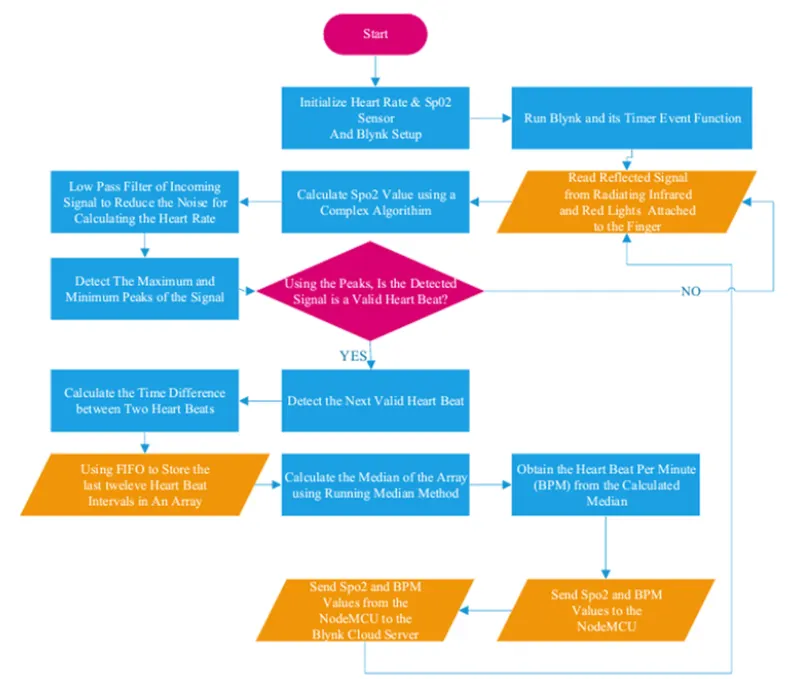
Heart rate sensor: A non-invasive optical instrument called a heart pulse rate sensor is used to detect the heartbeats and measure the peripheral capillary oxygen saturation (Spo2). The transmitted mode and reflected mode are two non-invasive techniques for determining the heart rate and Spo2 levels. The project's sensor operates in reflected mode.
This sensor uses both red and infrared lamps to measure the reflected light. The infrared light's wavelength is 950 nm, while the red light's wavelength is 650 nm. Hemoglobins that are oxygen-saturated (oxygenated blood) and those that are not (deoxygenated blood) absorb various amounts of each type of light. As a result, the sensor will catch the reflected light and use an algorithm to calculate the final Spo2 measurement.
The flowchart describes the process of calculating the heart rate beats per minute.
Data Transmission procedure/protocols: Now comes the question how will the data be transmitted and how will the devices be communicated. What if the WiFi goes down? Connectivity downtime is a major problem in a country like India. So what can be done to prevent that? To prevent thisiisue we will have a sim service connected to the Monitoring board. This way there will be connectivity issue. The data will be transmitted to the hospitals via the server system and hourly report via email in the mailbox. The sim service will send an update sms to the family members every hour to notify them of the patient's condition. So the services that will be used for connection are LTE data and WiFi.
Data encryption and security method: The Internet of Things (IoT) utilises both symmetric and asymmetric encryption methods. Symmetric encryption is a way of encrypting and decrypting data with the use of a single cryptographic key. Since only one key is required to do both tasks, doing so is easy. The main benefit of symmetric encryption is this. This encryption process is simple, which means it works quickly, consumes little energy, and won't slow down your Wi-Fi or internet connection. As opposed to symmetric encryption, which uses a single key for both encryption and decryption, asymmetric encryption uses a set of keys. The "public key" and the "private key" are two separate keys that are mathematically related to one another. Asymmetric encryption's main benefit is the increased security it offers. The data is encrypted using the public key and decrypted using the private key, which is kept in a safe place. One other perk of asymmetric encryption is that it is authenticated, meaning that the data may be viewed by no one but the intended recipient. Blowfish encryption will be used to secure the data. To that end, Blowfish was developed as an alternative symmetric encryption technique to DES. It encrypts data one block at a time, using a 64-bit key. Being in the public domain has helped keep Blowfish's popularity high. This, however, does not detract from the fact that it is still a solid encryption choice. Many people argue that it has never been defeated. Blowfish has found widespread application in protecting sensitive information, including passwords and online transactions. It's one of the most adaptable and simple encryption methods out there.
Certification of IoT devices ensures:
- Devices are safe and dependable to use.
- Devices don't disrupt neighbouring wireless networks or the cellular network in any way
- Device interoperability, or the ability of devices to function properly when accessed through a carrier's network
Cloud Computing: Since, we would be using two servers it will be wise to have a method which can work seamlessly between these two. Thus hybrid cloud will be used for this method. The term "hybrid cloud" refers to a computing environment where an organization's private cloud services located on-premises are combined with public cloud services located in the cloud provided by a third party to create a single, adaptable infrastructure for running mission-critical applications and workloads. This novel combination of public and private cloud resources simplifies the process of determining which cloud is best suited for each application or workload and then transferring those workloads between clouds as needed. In comparison to using either a public or private cloud exclusively, a hybrid cloud infrastructure provides greater efficiency and lower costs in meeting technical and business goals. The cloud will have an AI program already in place for it work from and the data can be compared and data be sent timely to the hospital.