Project 1
Design a Multi-Parameter Patient Monitoring System to acquire physiological signals and display them on a color LED screen. The system should have capability to work on mains and battery. The following are the design parameters:
- Design a multi-parameter physiological monitoring system and what physiological signals do you propose to choose. Give the details of the parameters, specifications, sensors or transducers proposed to be used.
- Draw the detailed block schematic of the multi-parameter monitoring system with all the features required as a monitoring system.
- What types of processing is requirement is required to catered in the design? Explain them briefly.
- What are the safety requirements to be catered in the design?
- How is the device proposed to be qualified? How is device calibration proposed to be done?
- Draw the screen layout for displaying the parameters on the display?
- How is the data proposed to acquired and stored in the database?
- Design ICU with 8 beds using the multi-parameter monitor and how is it proposed to be networked. How is the Central Nursing station proposed to be designed and explain in detail?
- What type of network connectivity is proposed if the system is planned for remote monitoring?
- Since this device is planned to be used in ICU, what types of alarms are proposed and when are they going to be generated.
- How to export or copy or transfer the data to a pen drive or external storage device, what type of data formats are proposed?
Deliverables:
- Document explaining the Physiological signals selection criteria and their specifications.
- Design parameters and their specifications of multi-parameter monitor
- Block diagram level design of the multi-parameter monitor
- Qualification procedure for the medical device
- Design of GUI layout for the multi-parameter monitor
- Document on design of ICU with 8 bedside monitor and central nursing station.
- Scheme for alarm generation and alert system
- Document for Data storage, retrieval and transmission methodology
Patient Monitoring System (PMS)
A patient monitoring system is an evaluative monitoring system Monitoring physiological signals is done with a patient monitoring system. Among other things, it computes the ECG, respiration, blood pressure, and body temperature Making fast and informed decisions is essential to provide care for severely ill patients so that necessary life-saving therapy can be given. Typically, a computer system is needed in an ICU to monitor patients Sensors and electrodes are employed in patient monitoring systems to collect physiological Information from the human body.
The first group of coronary heart disease wards (CCU) was established in North America in 1962, which is when the monitoring system initially began to take shape. The monitoring system has advanced significantly since then. The functional needs of CCU/ICU monitoring systems have gotten more complex as a result of the ongoing advancements in computer andsignal processing technology as well as the ongoing development of clinical monitoring standards for critically and possibly dangerous patients. The monitor screen display is also constantly updated and improved, beginning with the original LED display, progressing to the CRT display, the LCD display, and now to the more.
Patient Monitoring System (PMS) is a very critical monitoring systems it is used for monitoring physiological signals including Electrocardiograph (ECO), Respiration, Invasive and Non-Invasive Blood Pressure, Oxygen Saturation in Human Blood (SpO2), Body Temperature and other Gases etc. in PMS, the multiple sensor and electrodes is used for receiving physiological signals like as ECG Electrodes, Sp02 Finger Sensor, Blood Pressure Cuff and Temperature Probe to measure the physiological signals. During treatment, it is highly important to continuously monitor the vital physiological signs of the patient. Therefore, patient monitoring systems has always been occupying a very important position in the field of medical devices. The continuous improvement of technologies not only helps us transmit the vital physiological signs to the medical personnel but also simplifies the measurement and as a result raises the monitoring efficiency of patients.
Patient monitoring system allows continuous monitoring of patient vital signs, support decision making among medical personnel and help enhance patient care. This system can consist of devices that measure, display and record human's vital signs, including body temperature, heart rate, blood pressure and other health-related criteria. This paper proposes a system to monitor the patient's conditions by manitoring the body temperature and pulse rate. The system consists of a pulse rate monitoring software and a wearable device that can measure a subject's temperature and pulse rate only by using a fingertip. The device is able to record the measurement data and interface to PC via Arduino microcontroller. The recorded data can be viewed as a historical file or can be archived for further analysis. This work also describes the preliminary experimental results of the selected sensors to show the usefulness of the sensors for the proposed patient monitoring system.
advanced color TFT display. It can ensure high resolution and sharpness, eliminate perspective issues, and fully observe patient monitoring parameters and waveforms from any angle. The monitoring system currently needs additional improvements in the quality of monitoring and hospital monitoring networks in addition to the previous intelligent alarm with multiparameter vital signs monitoring, in order to better meet the demands of clinical monitoring, drug evaluation, and contemporary hospital management.
THE PARAMETER OF PATIENT MONITORING
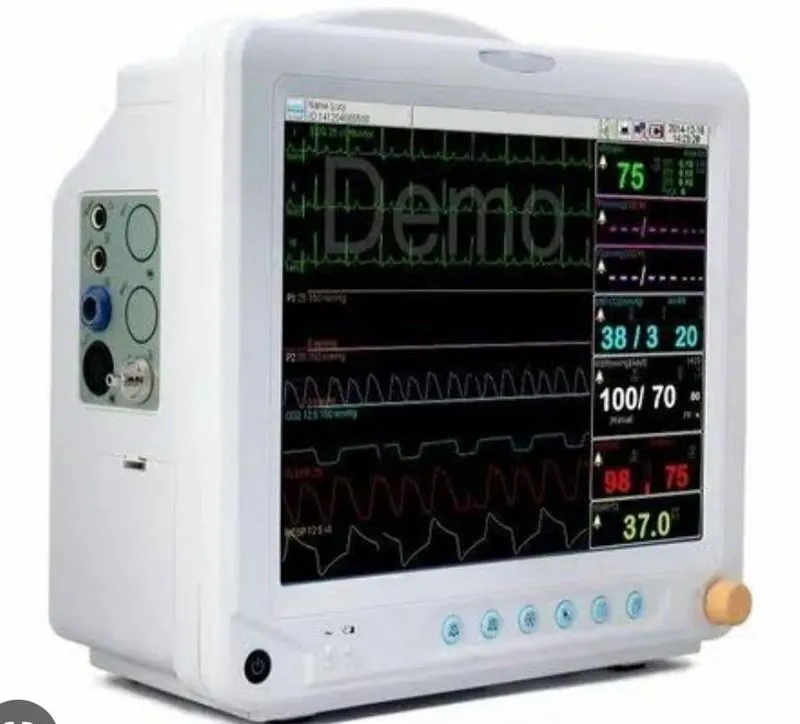
i. ECG-
The signals are shown as waves on an attached computer monitor or printout. An ECG can show if the heart is beating too slow, too fast or not at all. An electrocardiogram records the electrical signals in your heart. It's a common and painless test used to quickly detect heart problems and monitor your heart's health. On most patient monitors, the ECG is represented with a green line. In this example, the two windows are an extension for displaying the historical readout of the waveform. ECG's are very complex in themselves, so we won't go into any more detail here.
ii. Respiration-
Respiratory monitoring in polysomnography uses airflow detection and respiratory effort to evaluate for sleep-related breathing disorders. Capnography, pulse oximetry, and snore detection are not direct measurements of sleep but are additional tools used during polysomnogram to assist in the diagnosis. The Information is displayed on separate channels and assesses the respiratory pattern throughout the night. One of the modalities alone is unable to create a complete picture. These channels used in combination can aid in diagnosing a certain type of sleep apnea in addition to a certain type of respiratory event. In addition, sleep-related hypoventilation is recognized using a combined input from multiple channels. The proper use of respiratory monitoring in sleep can Improve diagnostic capabilities and can improve patient quality of life with the treatment of the sleep-related breathing disorder.
The respiration waveform is not common in standard patient monitors, but is quite common in the critical care areas. The wave simply measures the breaths the patient is taking, and can be used to identify apnea (sudden cessation of breathing) or dyspnea (difficulty breathing).
iii. Temperature and spo2
Patient monitor is an apparatus med to monitor the patient's condition in real-time, hence the patient's physiological conditions can be identified at that time. The purpose of this study is to design a patient monitor for SpO2 and temperature parameters based on computer with Delphi progaming. In this work, the author developed patient monitor with two parameters (SpO2 and Temperature). The workings of this tool are very simple by installing the finger sensor on the finger and the temperature sensor in the armpit area will then be detected by the two sensors that will be displayed on the PC and LCD Characters, analog data from the ADC Atmego is received by the personal computer (PC) via Bluetooth HC-05 and values per parameter are also displayed on the Character LCD. After measuring get an error in the tool, the biggest SpO2 error of this tool is 1.02% and get the smallest error of 0.8%. And for the biggest error of Temperature of 1.02% and the smallest error of 0.8%.
iv. Blood pressure-
Blood pressure (BP) is the pressure of circulating blood against the walls of blood vessels. Most of this pressure results from the heart pumping blood through the circulatory system. When used without qualification, the term "blood pressure refers to the pressure in the large arteries. Blood pressure is the force of blood against the arteries. An individual should maintain a normal blood pressure from 90-120/60-80 mmHg. Blood pressure is given by two numbers, with one above or before the other - 120/80.120-This is called systolic pressure and 80- This is called diastolic pressure. Systolic Blood Pressure High blood pressure can damage your health in many ways. It can seriously hurt important organs like your heart, brain, kidneys, and eyes. The good news is that, in most cases, you can manage your blood pressure to lower your risk for serious health problems.
What are the different types of patient monitoring systems? There are two main types of patient monitoring systems.
They are as follows:
1 Single Parameter Monitoring Systems: These kind of patient monitoring systems measure the blood pressure of the human body, SpO2, ECG etc.
2. Multi Parameter Monitoring Systems: These patient monitoring systems monitor multiple critical physiological vital signs like respiration rate, electrocardiography, blood pressure etc. Within Multi Parameter (or Multi Para) patient monitors, there are different types of systems like 2 Para Patient Monitor, 3 Para Patient Monitor, 5 Para Patient Monitor and 7 Para Patient Monitor
Design a multi-parameter physiological monitoring system
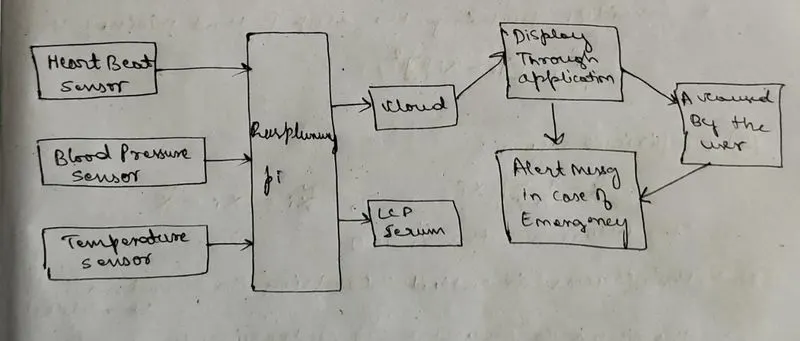
• In 1OT based patient health monitoring system project, we are monitoring various parameters of the patient using the internet of things in the patient monitoring system based on the internet of things project, the real-time parameters at a patient's health are sent to the cloud using Internet connectivity. These parameters are sent to a remote internet location so that users can view these detalls from anywhere in the world.
• There is a major difference between SMS based patient health monitoring and 101 based patient monitoring system. In the 101 based system, details of the patient's health can be seen by many users. The reason behind this is that the data needs to be monitored by visiting a website or URL Whereas In OSM based patient monitoring the health parameters are sent using GSM via SMS
• This is one of the Latest Electronics Project Ideas related to Medical applications which engineering students can select as their final year project. One more benefit of using IOT is that this data can be seen using a desktop computer, laptop, using Android smartphone comma using a tab or Tablet. The user just needs a working Internet connection to view this data. There are various cloud service providers that can be used to view this data over the Internet. Things speak, Spardun and 101Geek are a few famous and easy-to-use service providers among these.
• IOT patient monitoring has 3 sensors. The first one is a temperature sensor, the second is the Heartbeat sensor and the third one is a humidity sensor. This project is very useful since the doctor can monitor patient health parameters just by visiting a website or URL. And nowadays mony OT apps are also being developed. So now the doctor or family members can monitor or track the patient's health through Android apps
• To operate on 101 based health monitoring system project, your need a WiFi connection. The microcontroller or the Arduino board connects to the Wi-Fi network using a WI-FI module. This project will not work without a working WIFI network. You can create a WIFI zone using a WiFi module or even a WIFI zone using Hotspot on your smartphone. The Arduino UNO board continuously reads input from these 3 senses. Then it sends this data to the cloud by sending this data to a particular URL/IP address. Then this action of sending data to iP is repeated after a specific interval of time. For example in this project, we have sent data after every 30 seconds.
• The Arduino UNO board continuously reads input from these 3 senses. Then it sends this data to the cloud by sending this data to a particular URL/IP address. Then this action of sending data to IP in repeated after a specific interval of time. For example in this project, we have sent data after every 30 seconds
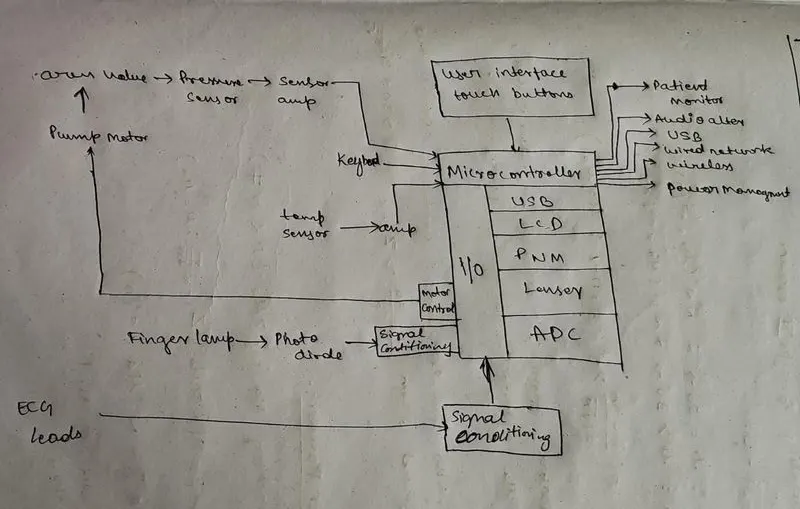
Patient monitors measure, record, distribute and display combinations of biometric values such as heart rate, SPO2, blood pressure, temperature and more. High-capability, multi-function monitors are typically used in hospitals and clinics to ensure a high level of quality patient care. Portable patient monitors are designed to be compact and power efficient. This allows them to be used in remote areas or by paramedics to aid diagnosis in the field, enable monitoring and transmitting data to healthcare providers in other locations
To meet the demands faced by designers of patient monitors, we offer a broad portfolio of highly integrated microcontrollers (MCUs), graphics technology, software libraries and connectivity solutions. This broad offering enables Innovation in the design of stand-alone blometric devices such as blood pressure monitors, pulse oximeters, ECG/EKG, and other products. Our solutions support patient monitoring functions like low-noise analog signal conditioning, touch- sensing technology, LCD control, wired and wireless connectivity. motor control and high-speed memory.
Electrocardiogram (ECG) or photoplethysmograph (PPG) wearable monitoring systems have become increasingly popular in recent years: Heart rate monitors, pulse oximeters and activity trackers are commercially available and already play an important role in everyday life. A wearable monitor significantly improves patient comfort by replacing long, cumbersome cards with much less obtrusive dry electrodes that enhance mobility.
The wearable monitor market is experiencing rapid growth, fuelled by an increase in health awareness and the advent of improved monitoring services. Of specific importance is the Internet of Things (lol) concept of tracking vital signs via mobile apps, with dota transmission through the cloud to a doctor or health service. This
concept, combined with machine learning and artificial intelligence, is
expected to take fitness tracking and health monitoring to the next
level by contributing to predictive analytics (and thus preventive care)
to Improve health and reduce health care costs
A PPG takes optical measurements of an organ's volume to estimate the oxygen saturation level in the blood (Spoz). There are two types of optical arrangements transmissive and reflective. The transmissive case uses a bulky finger clip to transmit light through a light-emitting dlade (LED) on one side of the finger and measures the absorption by placing a sensitive photodiode on the other side. The finger clip applies some pressure, which causes discomfort over time, in the reflective arrangement, the photodiode and LED are on the same side and the photodiode collects the light reflected from various depths underneath the skin without using the finger clip. This type of mechanism is easily incorporated into watches and other wearable devices that touch the body and do not cause any discomfort.
Conventional ECG monitoring uses a coupling gel on the sensing electrodes, which must be placed correctly on the patient's body by a professional. Some patients develop allergic reactions and skin irritation when these electrodes are used for long-term ambulatory monitoring. Moreover, the gel also dries out over time, reducing signal quality and performance. In recent years, there has been a growing interest in using dry or ungelled electrodes for long-term physiological monitoring
Ti's extensive portfolio supports emerging market trends. For example, the Wearable, Wireless, Multi-Parameter Patient Monitor Reference Design uses the AFF4000 single-chip bio-sensing front end for synchronized ECG and PPG measurements (see Figure 1). It Integrates flexible LED drivers with complete receiver chains for the photodiodes. It communicates with the CC2640R2F SimpleLink Bluetooth low energy Wireless MCU, which has an integrated Arm Cortex-13 and 2.40Hz radio-frequency (RF) transceiver, over Serial Peripheral Interface (SPI) (or 12C). The design supports wired data capture using a Joint Test Action Group (TAG) connection, as well as wireless data capture, by sending it over Bluetooth 5
Features
> Checks patient vital signs and uploads them to the cloud
> Quick alerts if the patient is in danger
> Gathers the information of all the sensors in the human body
> Secure wireless connections
> Displays vital signs
What is Regular Monitoring?
Keeping your body in good health is a difficult task. No one can be in good health for long if he/she does not monitor the core vital signs of good health. Eating healthy and exercising are not the only essentials to maintaining good health but, monitoring vitals using a health monitoring device regularly is also essential. Continuous monitoring helps patients and doctors react appropriately by keeping records of blood pressure, blood glucose, body temperature, pulse, heart rate, and respiratory rate. Keeping records aid doctors to know about the real condition of a patient and help them take action smartly. While regular monitoring of one's health is important, it can also be very challenging if you prefer to go to only to hospitals for check-ups because:
> There is always overcrowding in hospitals
> lack of doctors
> Huge number of patients with complicated conditione
> Unavailability of monitoring devices
Why choose Philips bedside monitors?
The entire Philips family of bedside and transport monitors, central station and mobile applications provide aesthetic consistency to reduce complexity. Advanced clinical decision support tools and smart alarms work together to identify and alert caregivers to critical events at the earliest possible stage.
What are the uses and applications of patient monitoring systems?
There are a number of applications where patient monitoring systems are used. Patient monitoring systems are crucial to any surgical operation Inside hospital and clinical walls
During an operation, the surgeon must have continuous access to a patient's vital signs to mitigate the risk of something negative happening in an operating room, you will typically find some form of thermometer to track a patient's temperature, a pulse oximeter to measure oxygen levels, a capnography machine for monitoring CO2 levels, and a sphygmomanometer to measure blood pressure.
After an operation, many of these same monitoring devices are used by doctors, nurses, and other healthcare providers to ensure that post-operative recovery is going smoothly. Beyond the clinical setting. remote patient monitoring systems are used in a variety of applications, such as diabetes care. Glucose monitoring devices have been used outside of the hospital by diabetes patients for years, enabling both the patient and their physician to prevent dangerous health events
How are patient monitoring systems improving patient care?
During treatment, it is highly imperative to continuously monitor the vital physiological signs of the patient. Patient monitoring systems hold an important position in patient care. The consistent developments in technology not only help us in transmitting the crucial physiological signs to healthcare workers and also simplities the measurement and therefore results in raising the monitoring efficiency of patients Multi parameter Patient Monitoring Systems are used to transmit vital data lixe electro cardiographs, respiration rate, blood pressure etc.
Medical treatments delivered in the intensive care unit make it necessary for constant monitoring of patients. For constant observation of the patient, patient monitoring systems provide continuous visibility of the subject's physiological condition and provide immediate treatment whenever required.
In today's complex healthcare environment, the demands on clinicians are immense, Phillips Patient Monitoring system is designed to help clinicians make informed decisions, reduce variation in care delivery and lower costs.
The entire Phillips family of bedside and transport monitors, central station and mobile applications provide aesthetic consistency to reduce complexity. Advanced clinical decision support tools and smart alarms work together to identify and alert caregivers to critical events at the earliest possible stage
This integrated system captures a steady stream of patient data from monitors and medical devices, feeding it securely to your emergency medical record (EMR). Our process allows for virtually gap-free patient records from admission to discharge, even during transport. Now you can stay connected to what's vital and help deliver consistent, quality patient care-everywhere it's matters.
Key Benefits of Regular Health Monitoring
According to Michael J. Fox, "Medical science has proven time and again that when resources are provided, great progress in the treatment, cure, and prevention of disease can occur. Continuous monitoring is beneficial for patients who are under intensive care in hospitals, it is associated with the stay of a patient in the hospital as it leads to earlier detection of real health issues and helps doctors in effective treatment. Traditionally, you needed to go to o hospital to see a doctor for health checkups, which was a time and money consuming task. However, with the technological advent, all this has changed significantly. Nowadays remote health monitoring is helping patients in recording their health vitals in non-clinical set-ups or on the go. Easy to use devices can be operated in the home with no technological knowledge to prevent multiple illnesses. Decreased cost, less hassle, improved experience and better results are key benefits of regular home monitoring. These devices
• Reduce hospitalization related cost, time and efforts
• Reduce time needed for taking appointment
• Detect serious illness early for quick treatment
• Rapid diagnosis that helps to reach a logical conclusion
• Better adherence to prescribed medications:
If you think you have no time to visit your doctor or clinic for regular health check ups, you can buy a regular health monitoring system to use at home. Fitness Tracker, Glucometers, weight scales ECG machines and lots more. Moreover, portable monitoring devices.com change your life as they allow you to conduct a basic testing at home. These devices record, store and analyze data through sensors and software. Regular use of these devices leads to better outcome as they provide assistance through data storage, alarms, reminders, and easy sharing of data with the doctor.