Project 1
Introduction :
Crutches help people who have injuries or illnesses that affect their legs walk. They can be used short term, such as during recovery from an accident or surgery, or long term, such as for a lifelong disability.
Types of crutch :
There are three primary types of crutches:
- Underarm Crutches. Underarm crutches are also called axilla crutches and are the most common type of crutch. These crutches are placed in your underarm for use and can be adjusted for height. They are easy to use and balance but can lead to discomfort and fatigue.
- Forearm crutches. Forearm crutches are also called lofstrand or elbow crutches. These crutches have a cuff that goes around your forearm and handles for your hand to grip. Forearm crutches are most often used by people who need long-term crutches.
- Forearm support crutches. Forearm support crutches are also called adjustable arthritic crutches, platform crutches, or gutter crutches. They have padded forearms and adjustable handles that can help people who need more support from their crutches.
Main parts of the crutch :
The design includes an axilla bar, a handpiece and double uprights joined distally by a single leg. They are adjustable in height; both the overall height and handgrip height can be adjusted (adjustable approximately 48 to 60 inches / 12 to 153 cm).
Materials used for the main parts :
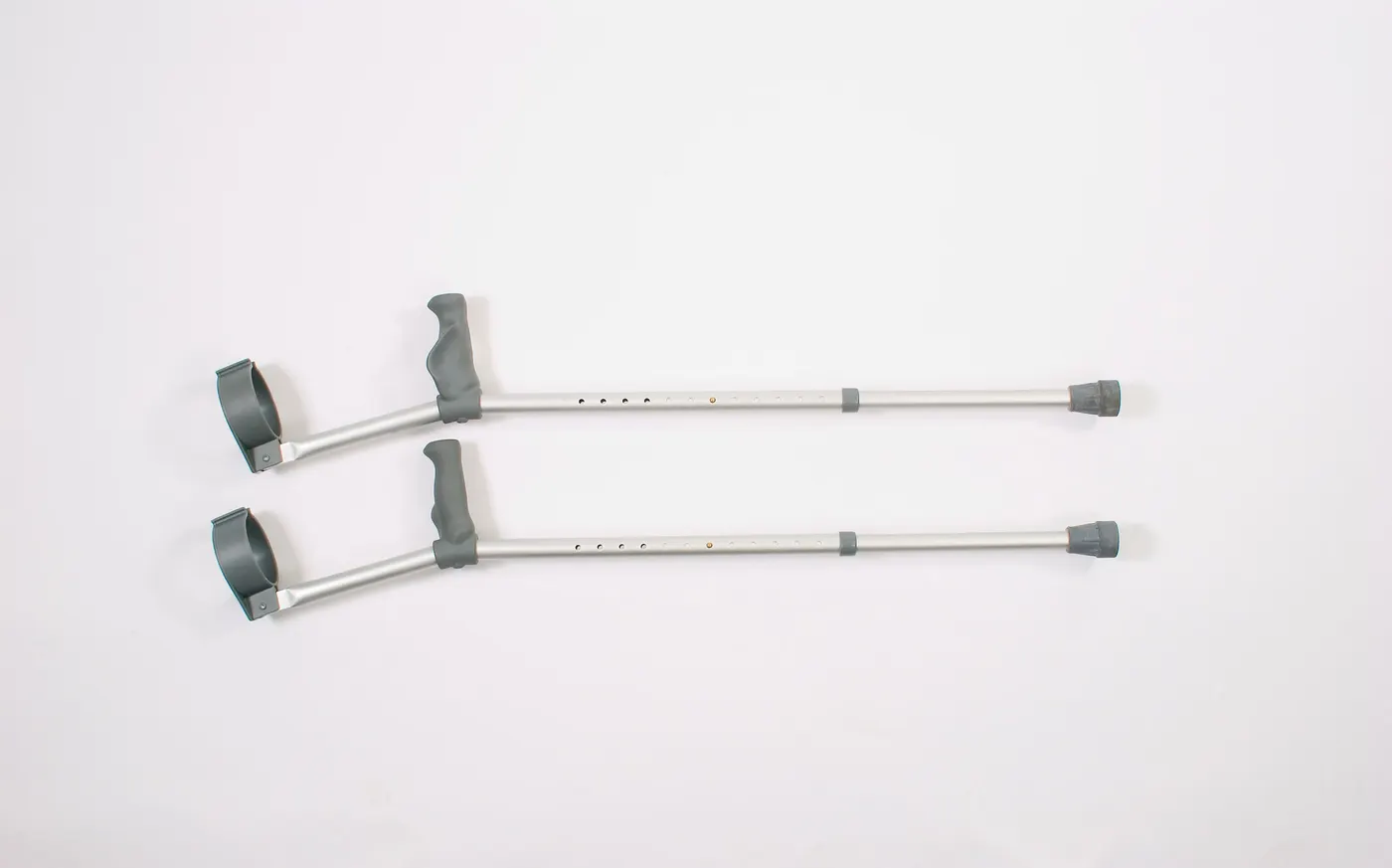
The frame of the forearm crutch is usually made from an aluminium alloy. Aluminium has a low density and thus a low weight, to make it mobile and easily manoeuvrable. It also has high strength so that the crutch will support the full weight of a person without bending or buckling. Aluminium is also easy to machine and corrosion resistant to ensure a long life.
Plastic cuffs are used on the forearm crutch. It is usually made from a plastic – such as Nylon-6/6. It has good abrasion and hydrocarbon resistance, to handle the repeated friction and contact to skin when walking. It also has high strength and stiffness to provide sufficient support to the user.
The grip handles of the forearm crutch can be made from either the same plastic as the cuffs or from rubber. The plastic provides more wear resistance and durability, but the rubber is more comfortable and can also absorb more shock.
The tip of the forearm crutch is made from rubber. The rubber provides plenty of grip and stability to prevent slipping when walking. It also has good shock absorption to dampen the shock of walking.
Manufacturing process :
- The manufacturing process of making forearm crutches can be divided into two main operations:
The making of the aluminium hollow tubes and of the plastic arm cuffs, hand grips and the replaceable rubber tips. - Although a few crutch manufacturers prefer buying readymade hollow tubes which are available in different sizes and shapes, many other prefer manufacturing them themselves to achieve the precision and quality they desire.
- The aluminium hollow tube is made through a process called drawing, through which a highly heated starting billet (stock) is drawn through a die to reduce its diameter and stretch its length by applying high pressure. This requires the starting billet to be hollow initially and the process improves the dimension accuracy of the desired tube and its surface finish. The initial heating process allows for the material to be soft but still retain its solid property, consequently keeping the internal properties intact. Once this drawing process is finished, the tube is rapidly cooled through water quenching.
- Depending on the desired shape of the crutch, the hollow tube is then bent and holes punched through at various points along its length. This is for the final assembly when the other parts need to be attached.
The arm cuffs, the hand grips as well as the rubber tips are manufactured through an injection moulding process, making use of an IMM (injection moulding machine) or injection press. This machine can be mounted with different types of mould cavities for the different shapes desired of the parts to be made. - The process starts with feeding the plastic polymer into the heating unit of the machine to melt it, the molten material is then pressed through high pressure injection into the specific mould cavities to form either the arm cuff, the hand grip or rubber tip, the material goes through an opening called sprue. The cavities are then filled and more material is poured into the machine than just to fill the moulds, this is to compensate for the shrinkage that will occur once the material starts to solidify. The moulds are then held together until the part is fully shaped and cooled, thereafter the moulds are opened and the part is ejected from the machine.
conclusion :
This specific manufacturing is best suited for making plastic materials such as the arm cuffs and hand grips as well as rubber because of its precision and accuracy of shaping parts and also for the complexity of shapes of the parts it can make.
Once all the parts are finalised and checked for quality inspection, they are then assembled to form the actual forearm crutch as a finished product.
Alternative method :
The crutch that we analyzed is the standard aluminum under arm crutch with rubber padding on the handle and plastic cuffs at the top. These crutches are effective but do have a few problems; firstly these crutches have extremely high energy expenditure, and secondly they cause injuries to the hands and wrists of the user due to the repetitive impacts. An alternative design to the aluminum crutches would be one piece, curved, graphite crutches.
Below this design alteration will be analyzed according to; functionality, cost, and sustainability.
Functionality
Curving the crutches
By curving the crutches, they in essence become shock absorbers which will reduce the impact on the user’s upper body immensely. It will also allow for energy retention to propel the user forward ounce the crutch straightens which will save the user a lot of effort and make traveling longer distances with crutches less painful and tiring.
One Piece design
The fact that the crutch is now only one piece means that there are fewer parts, which simplifies manufacturing and will extend the life of the crutch as there are less parts which can break.
Graphite
Graphite is also more durable than aluminum and is able to bend without yielding, which is a big advantage for the energy retention. The graphite is also lighter than the aluminum which will save the user energy.
Cost
The aluminum, priced at 1990 USD/ton, is slightly cheaper than the graphite, priced at 2000 USD /ton. Even though the aluminum is cheaper than the graphite, the design advantages of implementing aluminum far outweigh the extra cost. The user would prefer paying a small amount more for the added benefits of the graphite crutches over the aluminum crutches.
Sustainability / Environment
Aluminum is an easily recycled material, therefore it seems illogical to replace the aluminum in the design with graphite, which is not easily recycled, but sustainability is not only about recycling.
Graphite is a very durable material which will not be greatly affected by wear and tear. Therefore the crutches can be reused multiple times without any drop in performance or appearance.