Project 1
Question 1
Design a battery pack for a car roughly 150 Kw with 120 V. Use 3500 mAh 3.6V nominal NMC chemistry cell.
Given Parameters
Power = 150kW
Voltage = 120V
Cell specifications :
Rated capacity = 3.5Ah
Nominal voltage = 3.6V
1.a)Design the battery pack configuration.
To design a battery pack, we must know the number of cells in series and number of cells in parallel.
1.Number of cells in series = Rated voltage/cell nominal voltage = 120/3.6 = 33.33
Rounding off the cells :
Case 1 (rounding off to 33)
Nominal voltage of battery = number of cells in series * nominal voltage of each cell = 33*3.6 = 118.8V
Case 2 (rounding off to 34)
Nominal voltage of battery = number of cells in series * nominal voltage of each cell = 34*3.6 = 122.4V
It is always better to have more voltage. Hence case 2 is considered. Therefore the number of cells in series are 34.
2.Number of cells in parallel = continuous current/cell nominal capacity
Continuous current = power/voltage = 150kW/120V = 150000/120 = 1250A
Number of cells = 1250/3.5 = 357.1
Rounding off the cells :
Case 1 (rounding off to 357)
Battery capacity = number of cells in parallel * cell nominal capacity = 357*3.5 = 1249.5
Case 2 (rounding off to 358)
Battery capacity = number of cells in parallel * cell nominal capacity = 358*3.5 = 1253
Battery capacity in case one is approximately equal, so we can go with case one, that is the number of cells in parallel are 357.
Total number cells = number of cells in series * number of cells in parallel = 34*357 = 12138.
1.b)Draw the BMS topology for this battery pack.
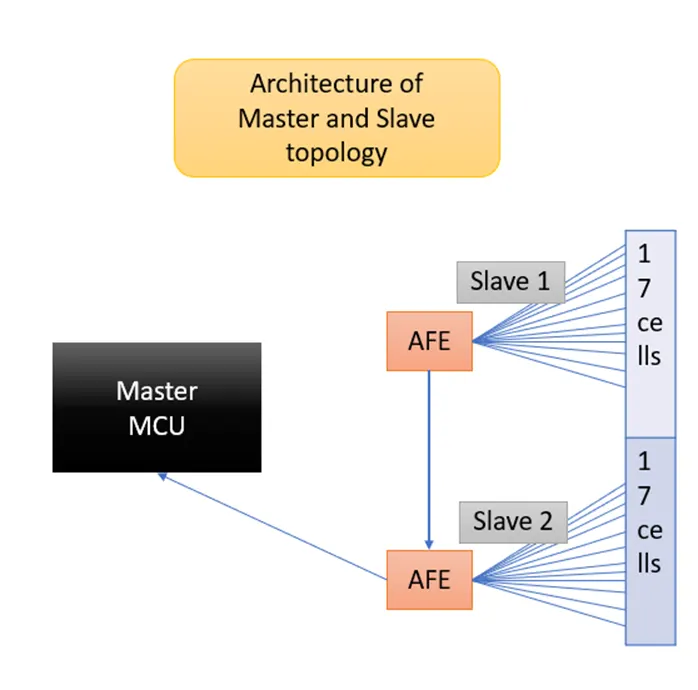
I will choose Master and Slave topology.
- In centralised topology or in distributed topology we connect maximum of 18 cells in series. Here the number of cells in series are 34. So we cannot use these 2 types of topologies.
- The remaining are Master and Slave topology and Modular topology. We can choose both of them but if we choose Modular topology implementation becomes hard compared to Modular and Slave topology. Cost and complexity also increases which is not good. That’s why I chose Master and Slave Topology.
Question 2
Build a 3S2P battery pack configuration with generic battery block using Matlab/Simulink.
Total number of cells in battery pack = number of cells in series * number of cells in parallel
= 3*2 = 6 cells
Steps
- Place total number of cells in battery pack in simulink.
- Connect the batteries in series connection (positive terminal of one battery is connected to the negative terminal of other battery and negative terminal of one battery is connected to the positive terminal of other battery)
- Connecting the batteries in parallel (positive terminal of one battery is connected to the positive terminal of other battery and negative terminal of one battery is connected with the negative terminal of other battery). This makes the combination of series and parallel connection.
Simulink model :
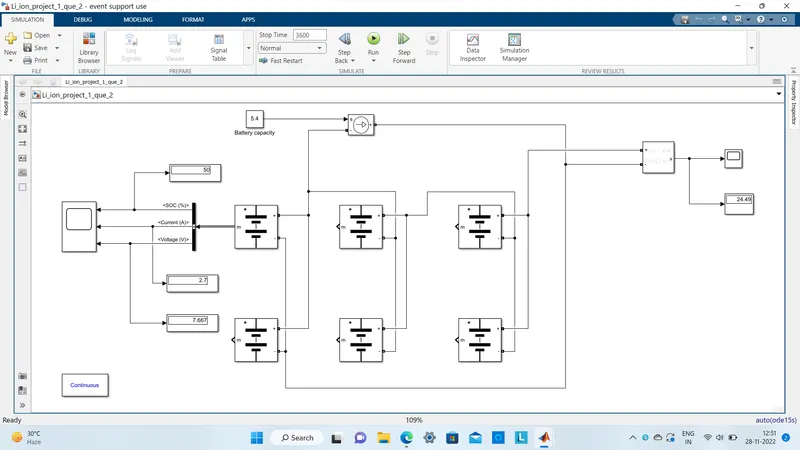
Voltage measurement block is connected across the battery pack to measure voltage of battery pack. Scope is used to analysis SOC, current and voltage. Controlled current source is given as load to the battery and the constant block represents how much current is drawn from the battery pack.
Parameters:
Nominal voltage of cell = 7.2V
Rated capacity of cell = 5.4Ah
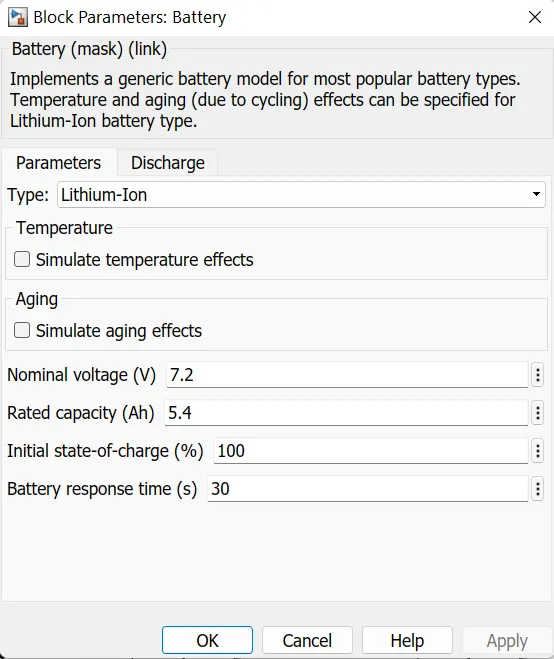
Maximum voltage of cell = 8.3V
Nominal voltage of battery pack = number of cells in series * nominal voltage of a cell
= 3*7.2 = 21.6V
Rated capacity of Battery pack = number of cells in parallel * rated capacity of a cell
= 2*5.4 = 10.8Ah
This model is for 21.6V, 10.8Ah battery.
Results
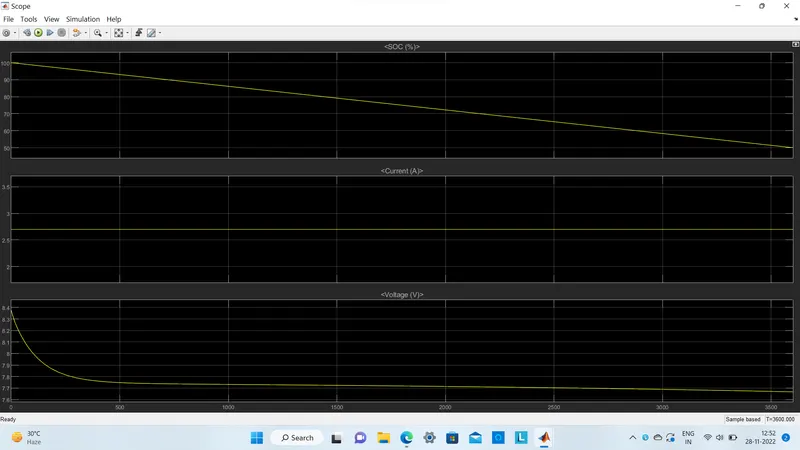
- Plot 1 SOC is decreased from 100% to 50%
- plot 2 & 3 shows the current and voltage discharge from single cell