Identification of Cracks
What is the mode of failure or damage of the beams in the figure above? Would you characterize the case as damage or as a failure? Are the damages repairable? Elaborate
1
a).
Ans:
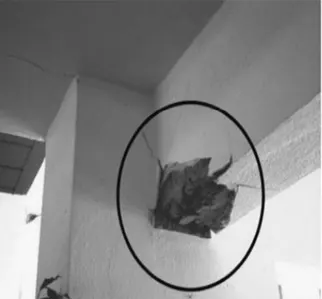
Failure, with concrete crushing and bar buckling at the bottom flange next to the column Flexural damage, is mostly associated with cracking and spalling of concrete and yielding of the reinforcement. By contrast, flexural failure comes with the disintegration of concrete beyond the cover, often with buckling (or even rupture) of bars. Such effects, shown in the figure above, happen only at the bottom flange of a beam because the slab provides the top flange with abundant cross-sectional areas of concrete and steel reinforcement. The vertical crack at the face of the support, across the full depth of the beam, tends to remain open and increase in width for each cycle of deformation; bottom bars may buckle and then rupture under the large cyclic excursions of strain across the open crack.
b).
Ans:
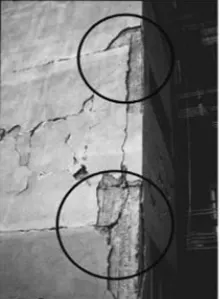
Pullout of beam bars from narrow corner column, due to short straight anchorage there - Beam bars with insufficient anchorage in a joint may pull out in an earthquake. Such a failure of bond and anchorage shows up at the end section as a crack through the full depth of the beam. A characteristic feature of a pull-out crack is its large width, well in excess of the residual crack width typical of yielding of the steel (which is a fraction of a millimeter or around 1 mm). The impact of this type of bond failure on the global behavior is not dramatic: the beam cannot develop its full moment resistance at the end section and the force resistance and stiffness of the frame it belongs to drops accordingly. The loss of beam anchorage prevents a proper plastic hinge from forming at the ends of the beams. The damage is reparable, although the original deficiency, namely the poor anchorage of beam bars in the joint, cannot be corrected easily.
c).
Ans:

The above figure shows the failure of a beam-column connection in the reinforced concrete frame, the joint was not intended to become the weak link between the four components. Such elements are usually subjected to very high shear forces during seismic activity, and if inadequately reinforced, result in an excessive loss in strength and stiffness of the frame, and even collapse.
2).
a).
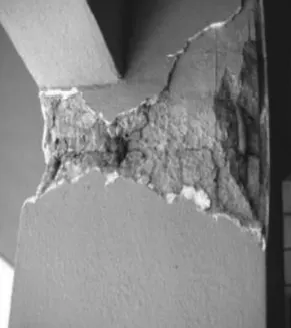
Failure due to Flexural compression in the column. This type of failure occurs due to very high axial load in multi-story buildings and also due to bending moments. This type of failure can be avoided by providing high compressive strength concrete and by providing proper longitudinal and lateral ties throughout the column.
b).
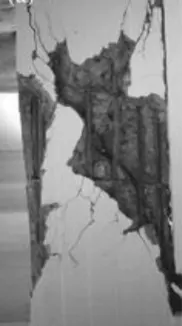
Shear forces increase during an earthquake, especially at columns and beam–column joints. Consequently, special attention should be paid to the construction and design of beam–column joints and columns. Seismic design requires increasing of ductility of structures for a performance-based design approach. In particular, columns of buildings can be having insufficient transverse reinforcement in the plastic hinge region. Therefore, structural elements which have such details show low performance against dynamic loads and lost their shear and axial load carrying capacity. Shows this failure below.
c).
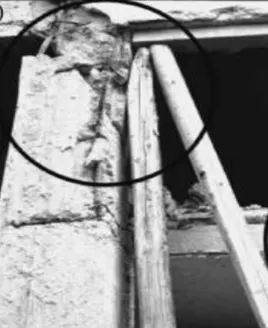
This type of mechanism can be developed due to structural adjustments and/or to continuous openings at the top of infill walls between columns. Lateral forces that occurred by an earthquake are carried by columns and shear walls. The length of the column is an important factor for the dissipation of these loads. When the length of the column decreases, the column becomes stiffer and brittle than the other columns and this column attracts more shear forces. Thus, shear failure which is a critical type of concrete column damage occurs at these columns.