Identification of Cracks
What is the mode of failure or damage of the beams in the figure above? Are the damages repairable? Elaborate ?
1 (A)
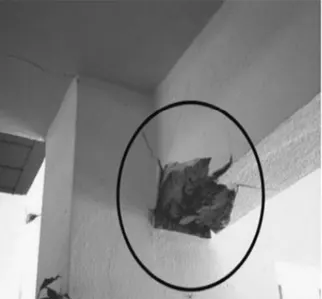
ANSWER :
Type: Damage
Cause: Flexural cracks developed at bottom of beam
Explanation: - Damage have occurred at the beam column joint. The beam have undergone severe damage as compared to Column. Here the beam will yield prior to the column. The beam has insufficient cover at the bottom of the beam.
- This can be repaired before becoming a failure. Can be rectified by providing proper cover at the joints.
- Mode of failure is given below :
- It is the form of flexural failure and it is developed at the bottom of the beam shown in above picture .
- this failure is occuer due to reversal of stress during earthquake .
- we see that above picture the only beam failure at bottom and column is not disturbed .
- During the stress reversal support top experiences copmpession and bottom experriences tension .
- The top compression is managed by slab advantages as shown above picture and bottom compression is not satisfied by provided reinforcement
- the reinforcement is yielded
- This is non repairable
1 (B)
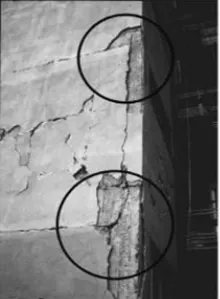
ANSWER :
Type: Damage
Cause: Honeycombing in concrete
Explanation: - may have happened due to use of high slump concrete. And due to not using proper compacting techniques like vibrator or may be due to any vibrating loads which acted on it.
- Can be repaired by adding grout to the surface of coloum
- In above picture we see that the crackes are developed at beam column edges
- we see that the beam is not connected to the column .
- It is the beam pull out failure and such failure is occur due to insufficient developement length of reinforcement in joints.
- the beam is not attached to the column .
- during the earthquake the horizontal movement of structure makes this condition worse and detached the beam member from column .
- if we think about repair so that we have to provide the anchorage length between two existion concrete member and it is very difficults , so that it is not repairable .
1 (C)
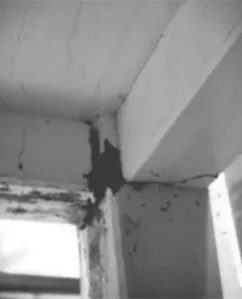
ANSWER :
Type: Damage
Cause: Beam column connection/joint failure
Explanation: - May be due to short column weak beam. Here the beam formed plastic hinges at undesirable locations and developed more flexural strength beyond the required/desired strength which lead to this.
- Can be repaired temporarily and a high chance of changing from damage to failure.
- In above picture we see that the crackes are developed at the joints of column beam
- the crakes in beam are developed through its entire width .
- also slab is developed the more crackes
- This is the plastic hinged type of failure
- the major damage is occer only in joints zone
- the joints can be repairable
2 ) What is the mode of failure or damage of the beams in the figure above? Are the damages repairable? Elaborate ?
2 (A)
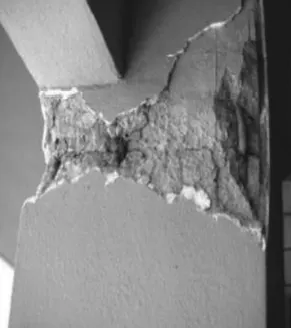
ANSWER :
Type: Failure
Cause: Failure of column due compression
Explanation: Due to high compressive load acting on the column, the column will fail without undergoing any lateral deformation. The concrete gets crushed and the steel will yield and then column failure occurs.
- Main objective here will be to keep the newly generated stress under the permissible limit
- In above picture we see that concrete damage around the column faces
- the above beam is safe .
- in the picture the this is the column is at ground floor or basement of the building no walls are provided around the wall
- this failure is occer due to soft story failure or due to plastic hinged formation .
- during lateral movement the absence of infill walls the plastic hinged is formed at the top of the column .
- it can be either repariable or non repairable .
2 (B)
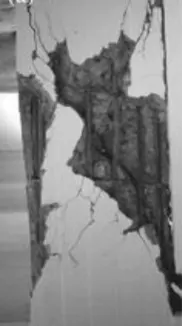
ANSWER :
Type: Failure
Cause: Shear failure
Explanation: In the absence of shear walls in a structure/ building the lateral loads will be completely carried by the columns. Lateral loads can be in the form of wind, earthquake loads etc.
- This is actually a design failure and was supposed to be provided provisions at the time of designing itself, like shear links or sections to carry the shear forces.
- In above picture the concrete developed complete brakages diagonally
- the spacing of shear reinforcement is too wider and less amount of shear rebar is provided .
- it is the pure shear failure
- inadiquate shear reinforcement compels concrete takes all the shere stresses
- it is non repariable
2 (C)
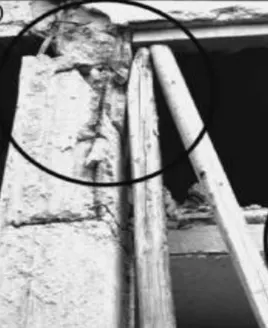
ANSWER :
Type: Failure
Cause: Short column failure
Explanation: The short column is subjected to compressive stresses and thus it fails due to crushing. Should have designed by considering design factors.
Failure can be rectified by retrofit techniques.
- In above picture we see that column is completely failled
- there are two slabes are connected to the one column .
- It is short column failure
- the failure is occur due to slab are provided at mid height it is not accoding to codel provision .
- this type of failure is not repairable .