Identification of Cracks
1) What is the mode of failure or damage of the beams in the figure above? Would you characterize the case as damage or as a failure? Are the damages repairable? Elaborate.
a)
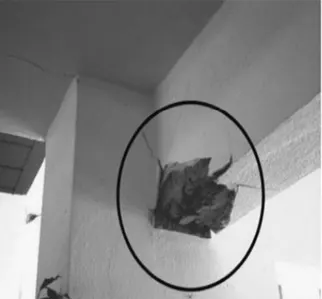
The inability of the beam to resist flexure will result in the formation of this fracture. The flexural strength, also known as the modulus of rupture, bend strength, or fracture strength, is a material parameter that may be described as the stress in a material shortly before it yields in a flexure test. Other names for this property include modulus of rupture, bend strength, or fracture strength. The flexural strength of a material indicates the stress that is felt across the material at its most extreme point just before it breaks. The level of stress is used to determine it. In order to prevent this kind of failure, major steel is installed at the very bottom and very top of the beam. It is possible to make repairs to the harm.Find a local welder or metal shop and ask them to cut and drill a piece of angle iron to the length of the beam that needs to be fixed. This will allow you to repair broken beams.It is necessary to remove any pipes, cables, or other objects that are presently passing through the beam. Be careful to switch off the water, the electricity, and everything else relevant before beginning.To detach the joist hanger from the beam, use a pry bar.Install the angle iron such that it is supported by both the jack and the temporary post. Put the angle iron in position, and then use the jack to gradually lift the beam until the angle iron is pressed up against it.After screwing the angle iron into the beam, remove the makeshift post from its position.Turn on the water and the electricity after sliding any pipes or wires that were removed earlier back through the beam.
b)
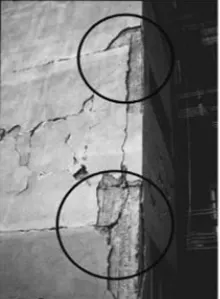
The errors that were made during construction, along with honeycombing in the concrete, led to the formation of these fissures.Avoid using concrete with a high slump if you want to keep your concrete from cracking. Cracking in concrete tends to be less severe when the droop is modest (less than 5 inches). A high slump concrete can only be utilised if it is regulated by concrete admixtures or built in such a way that the segregation and bleeding of the concrete can be controlled. Concrete admixtures like water reducers and super plasticizers may be used to enhance slump while simultaneously lowering the amount of water that is added to the mixture. It is also possible to generate air entertained concrete in order to enhance slump. This is particularly useful when the concrete is going to be exposed to freezing and thawing cycles. Honeycombing is a result of the fine mortar not falling and filling the gaps caused by the coarse aggregate in a complete and thorough manner. As was indicated before, insufficient concrete consolidation is often the leading cause of honeycombing, along with insufficient vibration, an inappropriate ratio of fine to coarse aggregate, dry concrete, and building circumstances that are not up to standard. Honeycombing may also be caused by improper vibration.
C)

The breakdown of the beam-column junction resulted in the formation of these fissures. Within the framework of the strong column-weak beam design, it is anticipated that the beams would acquire flexural overstrength in excess of the design strength and form plastic hinges at their respective ends. The plastic hinges' high internal pressures generate critical bond conditions in the longitudinal reinforcing bars that pass through the joint, and they also impose a significant shear demand on the joint's core.The degree to which the shear-resistant mechanism is affected by the bond performance of the bars when they are anchored in a joint is considerable.
QUESTION-2
a)
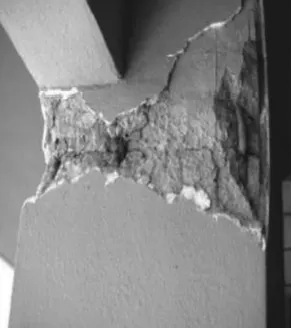
The column in question will fail owing to flexure, which will result in the formation of this fracture. In comparison to the other structural parts of a structure, columns play the most significant function. According to the fundamental idea of civil engineering, the collapse of the columns should only take place after the beams and the other components have been damaged. When compared with columns and column-beam joints, the performance of existing structures in earthquakes suggests that beams are less susceptible to damage during earthquakes and that any damage they sustain seems to have less of an impact on the building's ability to withstand future earthquakes.
b)
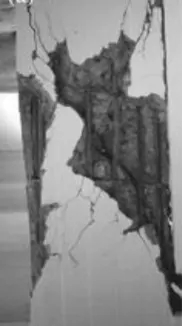
The shear failure of a column will eventually result in the formation of this fracture. Vertical parts in a construction, including columns and shear walls, are responsible for bearing lateral loads in the structure. When there are no shear walls present, the lateral loads are carried by the columns. Winds, earthquake loads, retaining structures, and other factors may all contribute to the generation of lateral loads. According to the shear forces that are exerted on the columns, shear linkages are added to the columns. In addition, the size of the columns is raised in the direction of shear so that the shear capacity may be increased.
C)
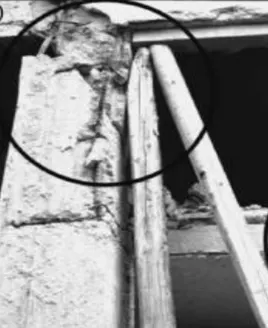
The breakdown of the short column led to the formation of these fissures. CRUSHING is the term that we use to describe the phenomena that occurs when short columns collapse because of yielding.Slenderness Ratio is the ratio of the effective length (length between point of zero moments) to the least lateral dimension of the column, and it is used to classify short columns. Effective length is defined as the distance between two points of zero moments.Failure of the column may often be attributed to any one of the following stresses that have formed inside the column. When a short column fails, it will only do so as a result of the development of direct compressive stress inside the column. Alternatively, we might say that a short column will often fail as a result of direct compression or crushing.