Identification of Cracks
What is the mode of failure or damage of the beams in the figure above? Are the damages repairable? Elaborate
1.a)
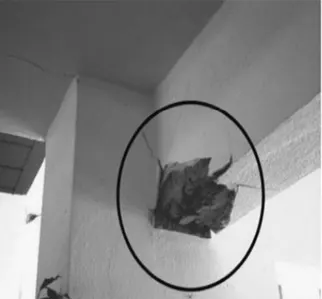
Observations:-
Concrete crushed at the bottom corner edge of beam and column and the reinforcements are exposed.
Beam top portion looks safe because of the monolithic construction of beam and slab as a flange beam.
Concrete is spalled beyond the level of reinfocement which is a sign of rupture.
Cracks shown to developed from bottom to top gives a sign that reinforcement starts yielding at bottom.
Modes of failure:-
Failure occurs due the stress reversal in the beam section.
During the stress reversal the beam top must have experiences the compression while the bottom have experiences the tension.
In that regard compression occured at top is managed by monolithic slab portion while tension at bottom do not sustained and the failure at some levels occured.
Is it repairable:-
The exposed portions can be plasterd or grout filling can be done,but from structural point of view as the reinfcement bars got yielded it cannot be revert back to its original form and the new one also can't be introduced at that site.
1.b)
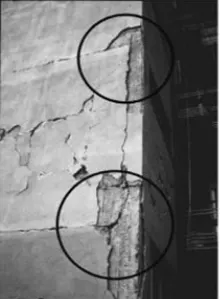
Observations:-
It looks like that the structure observed medium intensity eartquake for a longer duration.
The cracks occured at the edge of the joints, the cracked lines can be easily identified.
It looks like that the beam has slightly shifted outwards with respect to the position of column.
Modes of failure:-
Its a kind of connection failure occured at the joints of beam and column.
This may have occured due to insufficient development length provided at the joints which is a violation of codal provisions also.
The insufficient length causes to loose the connection between column and beam and hence due to shaking one part got seperated from other.
Is it repairable:-
As the connection is lost between the stuctural elements,introduction of new development length bars at the site is not possible so this failure can't be repairable.
1.C)
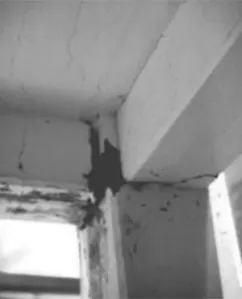
Observations:-
Cracks appeared exactly along the beam-column joint corner.
Crack in the beam appeared from one end to other end while slab also formed cracks along the direction of width of the beam.
Modes of failure:-
Its a plastic hinge failure as the plastic hinge failure occurs at the joints only but the damage occured due to cyclic lateral loading and stress reversal at the joints.
Slab has participated in controlling the damage but not sustained and the cracks appeared on its surface also.
Is it repairable:-
The joint can be strengthened so it is repairable.
2.a)
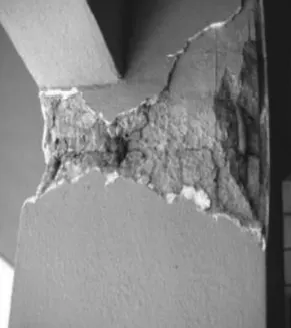
Observations:-
The concrete detached or crushed at top of the column and all around the face.
The beams have got no issue and it looks safe.
No adjoint walls can be seen on either side of the column,so it resembles that it is located at the ground floor in the parking area or for movement access.
Modes of failure:-
Its a soft storey failure,due to the absence of wall between the columns the upper portion of the column becomes a location of plastic hinge.
When lateral loads occured crushing of concrete happened at the upper portion of the gtound floor column.
Is it repairable:-
As only some part of the concrete gets detached and the reinforcement also not exposed and there is no sign of yielding hence, it can be repaired.
2.b)
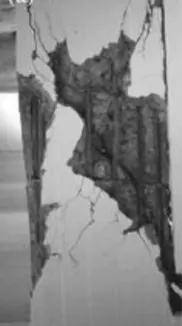
Observations:-
Complete detatchment of concrete can be seen on the face.
That is the concrete on either side of the column is completely crushed and the reinforcements are visible.
Longitudinal reinforcements seems to be at there positions indicating it is not a compression failure.
Diagonal cracks have developed on the face of the column.
Modes of failure:-
Its a case of pure shear failure.
Spacing between the shear reinforcements are not maintained as per codal provisions led to diagonal failure.
Is it repairable:-
No,can't be repaired as the concrete is completely crushed and the reinforcements got displaced from there positions.
2.C)
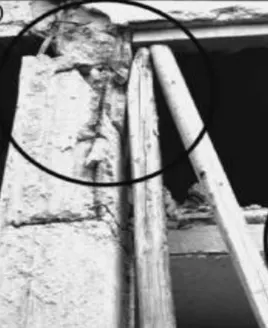
Observations:-
Its a complete failure and the failure occurs at the top of column.
Column get seperated from the slab.
An intermediate slab may be for mechanical purposes can also be seen at the mid height of the column.
Temporary wooden post or props supports can also be seen might have benn provided for the complete collapse of the structure.
Modes of failure:-
Its a short column failure.
Short column between the two slabs observes heavy shear forces cause short column failure.
It is generally occured because the intermediate slab is not accounted in the design but is introduced afterewards at the site leads to short column.
Is it repairable:-
Not at all repairable as it is completely detached from the structure.