Identification of Cracks
Question 1:
What is the mode of failure or damage of the beams in the figure above? Are the damages repairable? Elaborate
AIM: Identification of Cracks
a)
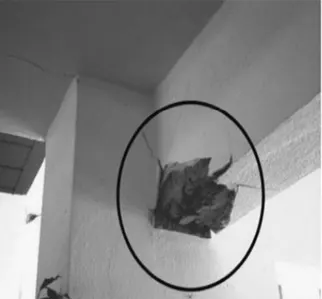
Observation:
- In this picture we observe that, concrete got damaged/broken and reinforcement are visible at bottom of the beam.
- The concrete spoiled beyond the reinforcement that is indicates the segregation
- The top portion of the beam is not exposed due to covered from the slab projection so, it's look safe and no major issue/severe issue on top of the beam.
- Cracks developed in bottom and gradually increasing towards the top. The pressure on beam is more than its yielding point on the bottom supports but the reinforcement is still active at the supports top so there is no crack on top of the beam.
Cause: Flexural cracks developed at bottom of beam
Conclusion:
- Its form of Flexural failure due to reversal of stress during earthquake.
- During stress reversal, Support top experiences Compression and Bottom experiences tension.
- Top compression is managed by Slab advantage otom tension was not Satisfied by ineorOvided reinforcement.
- The bottom reinforcement of the beam lost there elastic limit, so that its impossible to repair the bottom crack.
b)
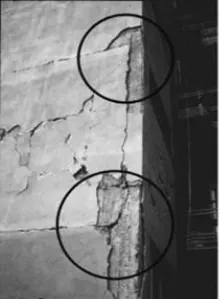
Observation:
- In above picture, we observed the cracks developed in column-beam corners
- It look like much wider crack that have developed through the column-beam joint
- In this picture, the beam has separeated from the column.
- the picture shows, the concrete has not crushed , thre is only crack developes.
Cause: failure due to insufficient development length of reinforcement in Joints
Conclusion:
- The reinforcement of the beam is not sufficient to anchor the vertical rebars of the column, that is insufficient development length of the rebar.
- Due to inadequate reinforcement, beam not bonded to the column that's why the horizontal members gets attatched from the vertical member during the earthquake.
- The lateral movement cannot be satisfied due to the insufficient anchorage length of beam rebar so it kepps on separeated frrom the column.
- It is very tough to provide the development length in the casted concrete between two members, so it is not repairable.
c)
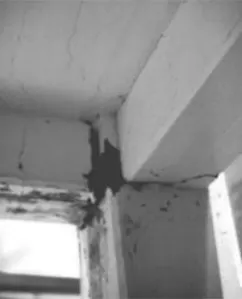
Observation:
- Cracks are exactly at the joint of Column- Beam.
- Cracks in Beam developed through its entire width.
- Slab also developed more cracks along the beam width direction.
Cause: Plastic hinge failure
Conclusion:
- It's a Plastic hinge failure
- The damage occurred only in the joint zone first of all.
- Cyclic lateral loading & stress reversal at the joints led to the damage.
- Even the slab participated to its best to handle the Tension (Slab is severely cracked means it has undergone tension with its flange condition), But unable to control the damage.
- The joint can be strengthened.
Question 2:
a)
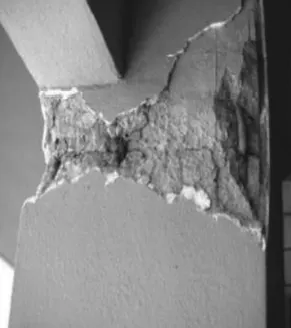
Observation:
- Concrete damaged at top of a Column.
- Concrete damaged all around the Column face.
- Beams are safe.
- The location of column looks at edge of the building.
- No walls are built along the column means it is probably at Ground floor, for Parking Car movement access.
Cause: Soft storey failure
Conclusion:
- From these observations its clear, this is a soft storey failure, technically plastic hinge formation at column.
- Due to the lateral movement in the building and obsence of walls, columns got affected because of the plastic hinge formed at the upper side of the ground floor.
- Based on spall out the concrete from column and the severity of column is to be decide either repairabe or non-repairable.
b)
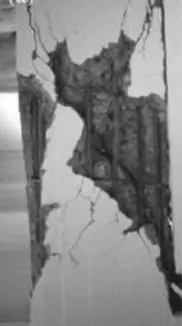
Observation:
- The breakage of concrete has diagonally developed in column. so this is not a crack it's a completely crushed and concrete detached from the column.
- Lateral and longitudinal reinforcements are visible. Rebar has not damaged and not separated.
- The clear vision of lateral reinforcement, i.e., shear links spacing is more than as per codel requirements which means that they have provided lesser shear reinforcemnt.
Cause: Shear failure
Conclusion:
- By observing the picture we can conclude this is a pure shear failure because the crack is in diagonal direction and the complete concrete had spoiled and get crushed.
- The shear reinforcements were not sufficent so it had detached and spolilled throughout the column, it had compelled concrete to breakdown into the pieces.
c)
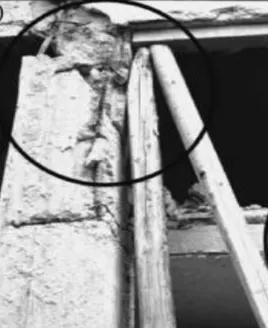
Observation:
- Column failed completely.
- Failure at top of column.
- There are two slabs connected to the column, Probably one at mid height of the column.
- The wooden piles might be a Post failure support after column failed, providing temporary prop to avoid collapse of the entire structure.
Cause: Short column failure
Conclusion:
- From the observation we can conclude that the failure is short column failure.
- The column is attached with intermediate slab and the height of column is not similar than the other columns, so there is the heavy shear load on the column.
- The intermediate slab load is unintentional and not accounted in the design so this leads to the failure.
- This failure is not repairable.