Identification of Cracks
Question 1: What is the mode of failure or damage of the beams in the figure above? Are the damages repairable? Elaborate
Ans:
a) 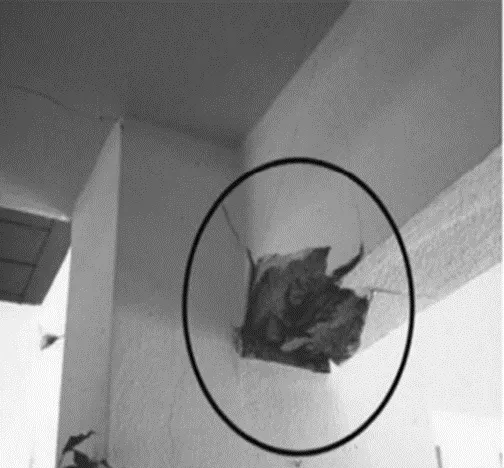
- In this picture we observe that, concrete get damage/ broken and reinforcement are visible at the bottom of beam.
- The concrete spalled beyond the reinforcement that is indicates the segregation.
- The top portion of beam is not exposed due to covered from the slab projection so it’s look safe and no major issue/ severe issue in the top of the beam.
- Crack developed in bottom and gradually increasing towards the top. The pressure on beam is more than its yielding point on the bottom support but the reinforcement is still active at the support top so there is no crack in top of beam.
- At the time of earthquake, the stress on the beam is reversal, so this is a kind of flexural failure.
- During the earthquake, beam gets in tension zone and the structure feels in compression due to the stress reversal support at top.
- Bottom reinforcement is not sufficient to resist the tension in beam and the top compression resist by the slab due to concrete
- The bottom reinforcement of the beam lost their elastic limit, so that it is impossible to repair the bottom crack.
b)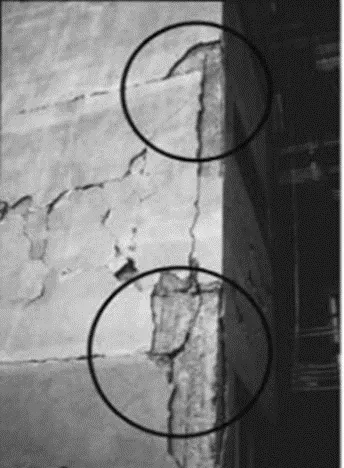
- This cracks are formed due to the mistakes done in the construction and honeycombing in concrete. To avoid cracks in concrete, avoid using high slump concrete. Concrete of moderate slump (less than 5 inches) results in less cracking. High slump concrete can only be used if it is controlled by concrete admixtures or designed such that segregation and bleeding of concrete is controlled. Concrete admixtures such as water reducers or super plasticizers can be used to increase slump while reducing addition of water content. Air entertained concrete can also be produced to increase slump especially when concrete is to be subjected to freeze and thaw cycles. The honeycombing occurs when the fine mortar fails to thoroughly fall and fill the gaps created by the coarse aggregate. As mentioned previously, poor concrete consolidation is usually the top cause of honeycombing, along with poor vibration, improper ratio of fine to coarse aggregate, dry concrete and construction conditions that are not up to standard.
c)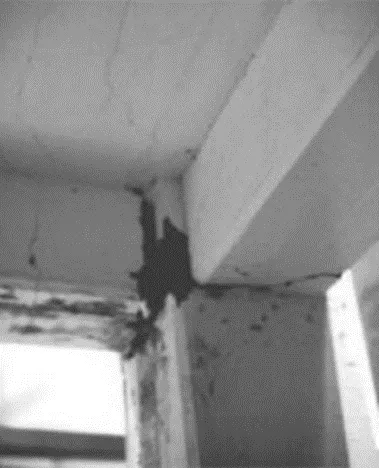
This cracks are formed due to the beam-column joint failure. In the strong column-weak beam design, beams are expected to form plastic hinges at their ends and develop flexural overstrength beyond the design strength. The high internal forces developed at plastic hinges cause critical bond conditions in the longitudinal reinforcing bars passing through the joint and also impose high shear demand in the joint core. The bond performance of the bars anchored in a joint affects the shear resisting mechanism to a significant extent.
Question-2: Question 1: What is the mode of failure or damage of the beams in the figure above? Are the damages repairable? Elaborate
Ans: a)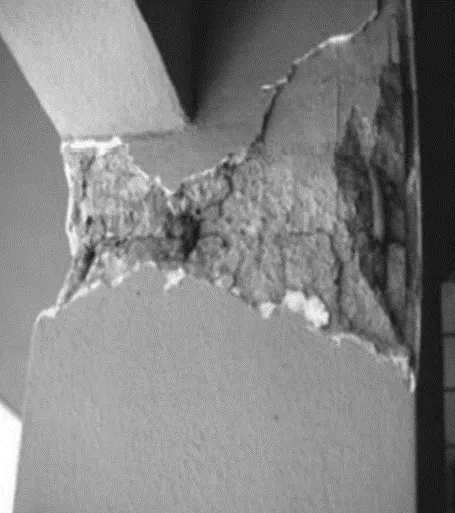
- In this picture we observe that, the column has damage from the top, bottom of column is safe.
- The damage is all around the face of column
- No damage found in beam
- No connected walls are along with column, so this could be ground floor, probably parking area
- It is a most outer or external column of the building
- In this picture we observe that, the column has damage from the top, bottom of column is safe.
- The damage is all around the face of column
- No damage found in beam
- No connected walls are along with column, so this could be ground floor, probably parking area
- It is a most outer or external column of the building
b)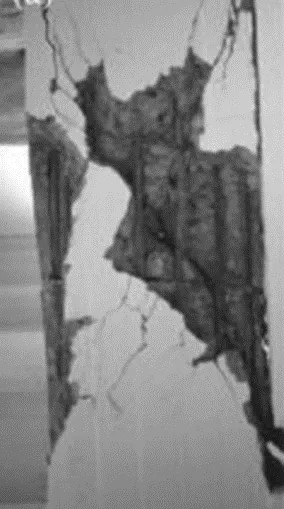
- The breakage of concrete has diagonally developed in column, so this is not a crack it’s a completely crushed and concrete detached from column
- Lateral and longitudinal reinforcements are visible. Rebar has not damaged and not separated
- The clear vision of lateral reinforcement, i.e., shear links spacing is more than as per codel requirement which means that they have provided lesser shear reinforcement
- By observing the picture, we can conclude this is a pure shear failure because the crack is in diagonal direction and the complete concrete had spalled and crushed
- The shear reinforcements were not sufficient so it had detached and spalled throughout the column. It had compelled concrete to breakdown into pieces.
c)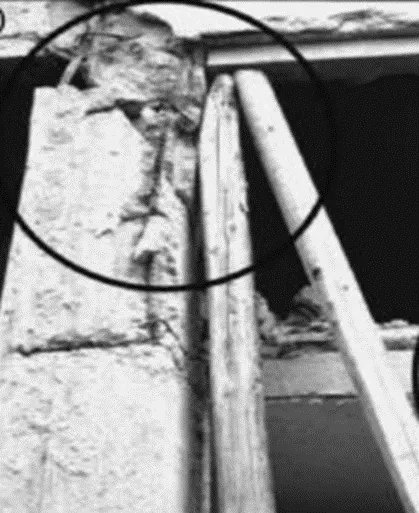
- From the given picture, we can observe that the column is completely fail
- Damage happen at top of column and bottom of column is safe
- As per picture, there are two slabs connected with the column and the space between both slab is not the floor hight so this is probably for mechanical equipment
- The beam has temporary supported with the wooden piles after the column failure to avoid the collapse of the structure From the observation we can conclude that the failure is short column failure.
- The column is attached with intermediate slab and the height of column is not similar then the other columns, so there is the heavy shear load on the column.
- The intermediate slab load is unintentional and not accounted in the design so this leads to the failure
- This failure is not repairable.