Identification of Cracks
QUESTION:-1
What is the mode of failure or damage of the beams in the figure above? Would you characterize the case as damage or as a failure? Are the damages repairable? Elaborate.
a)
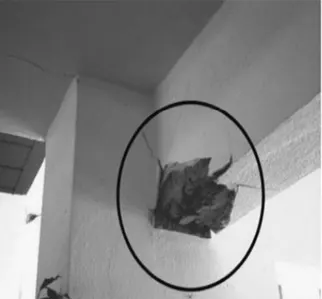
OBSERVATIONS:
- Reinforcement at the bottom portion of the beam is exposed due to the crushing of concrete.
- The beam top is intact and the cracks have developed from the bottom towards the top which indicates that the yielding has occurred only for the bottom portion of the beam.
- The damage is visible mainly at the beam-column joint indicating improper reinforcement detailing at the joint portion.
- A significant amount of concrete has been damaged which means the issue needs immediate attention to avoid further yielding and protect the structure from failure.
MODE OF FAILURE:
- It is a flexural failure due to the reversal of stress in the beam section.
- Stress reversal is a phenomenon in which the beam experiences the same amounts of compressive as well as tensile stresses at the same time.
- So, the insufficient and improper reinforcement detailing at the beam bottom has led to the crushing of concrete and yielding of the rebars.
IS IT REPAIRABLE?
- NO! Since the reinforcement bars have exceeded the point of yielding and have entered the inelastic behavior, it cannot be brought back to normal.
b)
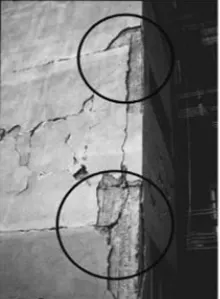
OBSERVATIONS:
- Cracks have developed along the edges of the beam-column joints.
- Cracks are very wide as can be seen in the picture indicating the severity of the condition.
- The beam-column connection is affected and the beam looks detached from the column.
MODE OF FAILURE:
- It is a form of beam-columns connection failure.
- This occurs due to the insufficient development length provided while designing the structure.
- So, the deficient development length leads to loosening the beam-column joint due to which cracks occur and the beam is pulled out of the column ultimately.
IS IT REPAIRABLE?
- NO! Since it is a completed structure, it is very difficult to provide anchorage at the beam-column joints. Hence, this failure cannot be repaired.
c)
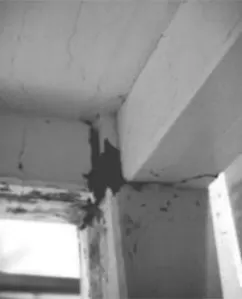
OBSERVATIONS:
- Severe cracks at the beam-column connection joint.
- More cracks on the beam than on the columns indicating the plastic behavior of the beam.
- Sizeable random cracks on the slab surface can also be seen that seem to be along with the beamwidth.
MODE OF FAILURE:
- It is a plastic hinge failure as only the beam is effected by cracks and not columns.
- Plastic hinge first appears in the beams before columns making it a strong column weak beam mechanism.
- Cyclic lateral loading and stress reversal can lead to this plastic hinge damage as seen in the picture.
IS IT REPAIRABLE?
- YES! The beam-column joint can be strengthened and the structure can be brought back to normal.
QUESTION 2:-
a)
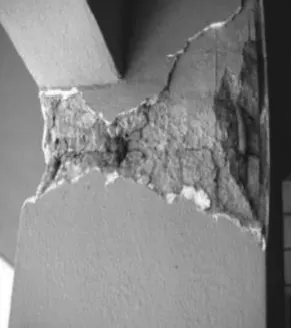
OBSERVATIONS:
- Column top portion is damaged excessively.
- The crushing has taken place on all four sides of the column.
- Beams are totally safe indicating stronger beams and weaker columns.
- No walls are attached to the column indicating it is a ground floor level used for parking etc.
MODE OF FAILURE:
- The mode of failure, in this case, is the soft storey mechanism.
- We can see in the picture that the beams are completely fine which projects the strong beam weak column connection.
- So, in the soft storey mechanism, the plastic hinge instead of being evenly distributed across the structural geometry is limited to a single story. Due to this, columns of that particular story are subjected to excessive stresses leading to such a type of failure.
IS IT REPAIRABLE?
- Depends on the crushing of concrete. If large a portion of the concrete has been crushed in this failure, the repair is not possible.
- On the other hand, repairs can be done for the damage limited to a certain level of concrete crushing.
b)
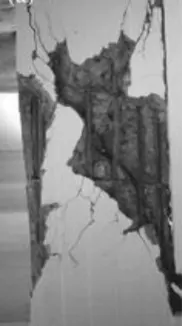
OBSERVATIONS:
- The concrete has been completely crushed and the entire reinforcement is visible.
- Large diagonal cracks are visible on the column surface.
- Longitudinal reinforcements are intact indicating it is not a compression failure.
MODE OF FAILURE:
- It is a complete shear failure.
- Inadequate shear reinforcement placing has led to this destruction.
- Stirrups spacing is more than recommended which is also one of the reasons for the damage caused.
IS IT REPAIRABLE?
- NO! Concrete has been crushed completely due to the excessive shear force. Therefore, it would be more economical to cast a new column rather than repair this one.
c)
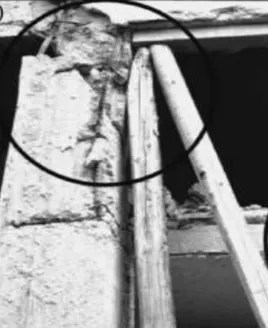
OBSERVATIONS:
- The column has completely detached from the beam and slab leading to an absolute column failure.
- The column is no longer in a position to support the beam resting on it.
- You can see an additional slab attached to the column at mid-height.
- As a result, temporary wooden props are installed to hold the beam still for some time.
MODE OF FAILURE:
- It is a classic example of short column failure.
- Due to connecting an additional slab at mid-height of the column, the lateral forces exceed the shear strength of the column.
- This leads to the complete column failure if special design considerations have not been made by the engineer for such scenarios.
IS IT REPAIRABLE?
- NO! The column has completely been detached from the structural geometry. Therefore, it can't be repaired anymore.