Identification of Cracks
Question 1:
What is the mode of failure or damage of the beams in the figure? Are the damages repairable? Elaborate
a)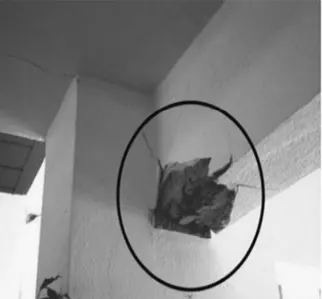
Observations:
- The initial observations which were found from the given image is that the concrete is crushed and spalled beyoond hence, the reinforcement is visible
- The cracks were observed only in the bottom of the beam and the top portion looks safe which refers to the flage adavntage of the slab i.e, the portion of the beam which is connected to the slab seems to be safe from cracking.
Answers:
- From the observations it is judged as the flexural failure in which the concrete is crushed due to the yielding of reinforcement which is because of the reversal of stress occuring in that part of the strcuture
- Reversal of strees is defined as the equal forces of compression and tension occuring in the strcuture which is inappropriate as the top portion of beam would act for tension and bottom for compression
- As a result, the compression at the bottom can not be managed by the reinforcement provided and hence the cracking of concrete occurs whereas, in the top the compression is handled by the adjoining slab concrete and so the cracking does not occur.
- These kind of problems are mostly not repairable.
b) 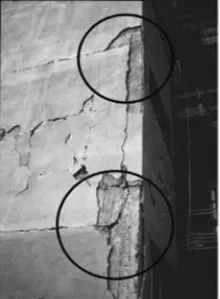
Observations:
- From the image it is observed that the cracks are developed at the edges of the beam-column and developed through the structure.
- The beam was observed to be seperated from the column at joints as per the cracks developed and less crushing of concrete is observed.
Answers:
- From the observations the failure is considered to be the lack of development lenght provided for reinforcement in joints of the beam-column and occurence of any earthquake makes this condition much worse.
- The detached beam from column can not be provided with anchorage length as it is not new concrete but a existing one hence, it is not repairable.
c) 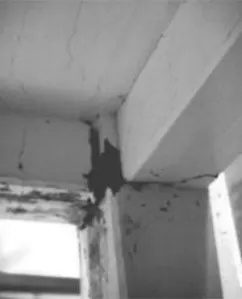
Observations:
- From the given image the cracks were observed to be at the joint of beam-column and extends through the width of the beam
- The cracks were also observed in the slab along the direction of the width of the beam
Answers:
- The failure observed from the cracks is plastic hinge failure as the damage occurs at joints in the first place
- The causes are considered to be cycling loading and stress reversal occuring at the joints and the slab is also participated in controlling the compression along the flange connection of the beam but failed to do so hence, the cracks are happen to occur in slab
- Strengthening of joints can be done as the repair for this problem.
Question 2:
a) 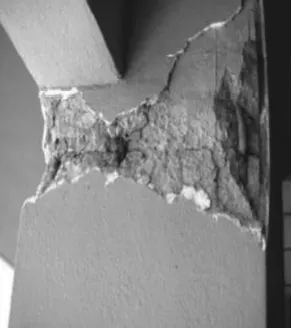
Observations:
- The observations from the image were found to be cracks and spalling of concrete has occured on top of the column and around the column face and the beam connected is found to be strong
- From the image the loaction of the column is considered to be in ground floor and at the edge of the building as no walls are found adjoining the column
Answers:
- From the observations it is found to be a plastic hinge formation at top of the column due to lateral movement and absence of walls at the ground floor'
- The solution of the probelem is based on the further development of cracks and deliberate study of the development hence, it can be or can not be repaired
b) 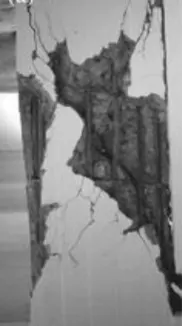
Observations:
- It can be clearly observed from the image that the cracks have been occured along the diagonal length of the column and spalling has occured paving the way to view reinforcement directly.
- Based on the observation it is found to be the lateral reinfrocemnt is seemed to be intact and the spacing of shear reinforcement are wider
Answers:
- It can be clearly classified as shear failure based on the observations of the inadequate shear reinforcement provided in the column
- The chances of repairing this kind of problem is slim.
c) 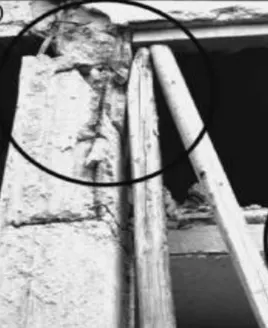
Observations:
- The major observation from the image the column has failed completely at the top and wooden piles are provided as temporary props to avoid failure of the structure
- It is also observed that a slab has been connected to the column at the mid height.
Answers:
- From the observations it can be clearly seen as the short column failure.
- The main cause is the connection of slab to the column at the mid height which reduces the length of the column and it is not repairable.