Identification of Cracks
1)a
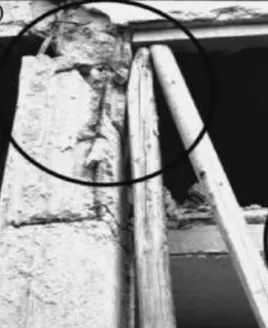
Flexural strength, also known as modulus of rupture, bend strength, or fracture strength, is a material property, defined as the stress in a material just before it yields in a flexure test.
The flexural strength represents the highest stress experienced within the material at its moment of rupture. It is measured in terms of stress. To overcome this type of failure, main steel is provided at the bottom/top of the beam. Flexural failure occurs at mid-span of beam.
It occurs when the beam is under-reinforced; the reinforcement ratio in the beam is low than balanced reinforced ratio . The signs of this type of failure are the development of cracks at the tension side of the beam which further extend to the compression side
Solution to avoid flexural failure:
Flexure failure could be avoided by designing under-reinforced sections, rather than over-reinforced. Introducing compression side steel reinforcement to increase compression strength of beam.
1)b
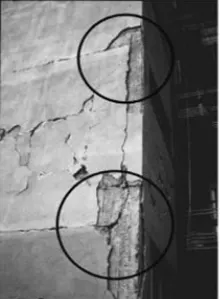
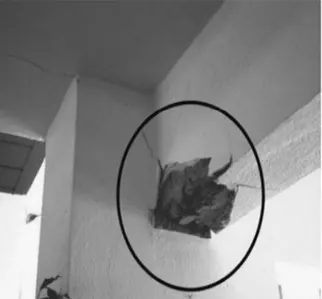
The most common causes of cracking are: Ground movement (beneath foundations) caused by clay shrinkage, land slip, vibration, subsidence, settlement, heave, sway, and so on. Foundation failure due to the decay of soft clay brick, concrete erosion due to chemical contaminants, and so on
A crack is a complete or incomplete separation of concrete into two or more parts produced by breaking or fracturing.
Cracks are one kind of universal problems of concrete construction as it affects the building artistic and it also destroys the wall’s integrity, affects the structure safety and even reduce the durability of structure
Carbon dioxide penetrates into the concrete through the cracks and speed up carbonation around the cracks, thus shortening the structure usage.
The cracks in the concrete wall would cause the leakage of the building; it reduces the stiffness, durability and seismic performance of buildings.
The principal causes of cracks in a building are as follows:
- Permeability of concrete
- Thermal movement
- Creep movement
- Corrosion of reinforcement
- Moisture movement
- Poor construction practices
- Improper structural design and specifications
- Poor maintenance
- Movement due to chemical reactions
- other factors
Remedial measures
Architects, Structural Consultants and Specifiers shall consider the following measure to avoid cracking and subsequent deterioration of structures:
- Proper specification for concrete materials and concrete.
- Proper specifications to take care of environmental as well as sub - soil conditions.
- Constructible and adequate structural design.
- Proper quality and thickness of concrete cover around the reinforcement steel.
- Planning proper reinforcement layout and detailing the same in slender structures to facilitate proper placing of concrete without segregation.
- Selection of proper agency to construct their designs.
1)c

Beam column joint failure:
In the analysis of reinforced concrete moment resisting frames the jpints are gennerally assumed as rigid
In indian practice ,the joint is usually neglected for specific design with attention being restricted to provision of sufficient anchorage for beam longitudnal reinforcement.
This may be acceptable when the frame is not subjected to earthquake loads .
unsafe design & detailing within the joint region jeopardizes the entire structure,even if other structural memebrs onform to the design requirements.
During earthquakes, the failure of beam-column joints is governed by bond and shear failure mechanisms which are usually brittle. Beam-column joints having deficient reinforcement details are expected to respond poorly, even when subjected to moderate seismic action
Remedies to avoid beam column joint failure:
Several techniques were applied to strengthen beam-column joints. These techniques include the use of concrete jackets, bolted steel plates and jacketing using corrugated steel sheets . Several beam-column joints strengthened using various steel-plate and angle rehabilitation systems were tested.
Cracks on the wall surface damage to the later rendering, will affect to the appearance.
2)a
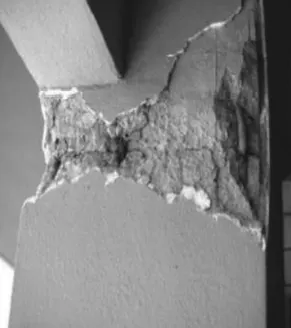
Column compressive failure:
Compression failure is the crushing or yielding of material itself and not the whole column. Shorter and wider column normally fails under compression failure when the axially loaded stress exceeds allowable stress. Compression failure occurs when then concrete starts to fail or bulge.
Remedies to avoid column compressive failure:
In this type of failure, the material fails itself, not the whole column. This type of failure mostly occurs in shorter and wider columns. To avoid this, the column should be made with sufficient cross-sectional area compared to the allowable stress.
2)b
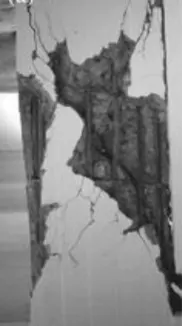
Shear failure:
1) Diagonal tension failure
This types of failure occur at the support of the beam where shear force has a high value and moment has a low value as compared to the shear. The crack formed due to this failure makes 35 degrees with the horizontal.
2) Diagonal compression failure
This type of failure occurs at the span between support and mid-span. At this span shear force and moment show approximately equal importance and values. This type of failure makes 45 degrees to 90 degrees with horizontal.
3) Flexural tension failure.