Hood design-Week 2
Title - Design and Development of Hood of a Car using Siemens NX CAD.
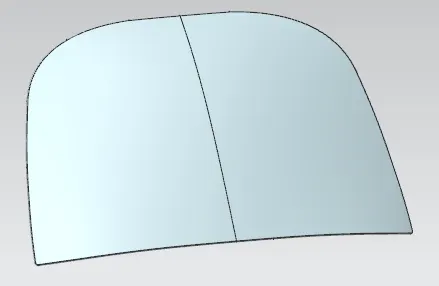
Objective - To design the Hood of a car in siemens NX CAD with the help of the skin given to us.
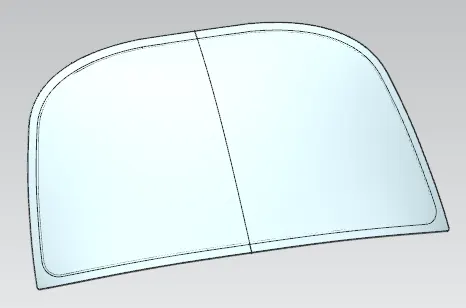
Introduction - The skin of hood, hinge assembly and stricker is given to us by which we have to make a solid geometry of the hood inner panel, outer panel and reinforcements.
Hood - A car hood, also referred to as a bonnet in some other countries, is the hinged cover that rests over the engine of a front-engine vehicle.
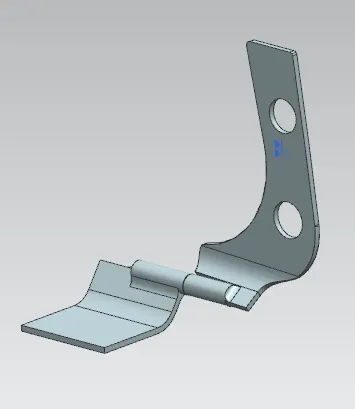
Hinge - A Hinge is the a part which connects the hood and the engine compartment of a car and allows the hood to shut and open in a circular trajectory.
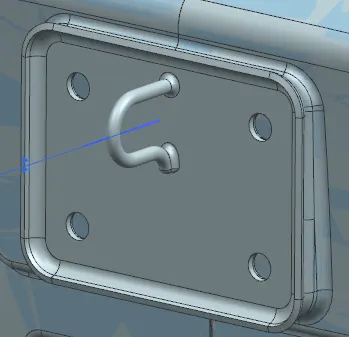
Stricker - A stricker is attached to the inner side of the hood which allows the hood to latch when shut.
Hood Balencer - It is a component which balances the hood when in open condition.
Reinforcements - Reinforcements are used to strengthen the respective parts locally.
Design Requirements for the hood - A hood is a critical component in a car because of frontal crash and pedestrian safety requirements. The hood desipates the crash energy or force outside the car body instead of inside the car body.
1.Opening Angle - According to the region for which you are designing a car the height of a person varies. So the opening angle of the hood should be according to the average height of people living in that region. The opening angle can be varied with the help of the hood balancer.
2.Hood balancer design requirements - The hood can be balanced in the open condition using the gas stay or support rod. In gas stay no man power is required to open the hood compared to the support rod. The support rod is cost effective compared to a gas stay. When iusing the support rod it can cause scars on the rod which in turn lead to rust. The support rod can be hot after using the car and cannot be touched with bear hands.We have to consider the location for mounting the gas stay or support rod either on the hood or the engine compartment. The length of the gas stay or the support rod has to be considered according to the opening angle. The support rod should not be straight, it should have a curve or a bend to avoid wobling and also curved or bent support rods withstand more load. The bends or curves on support rod should not be more than 35mm because due to the weight of hood the rod can bend. The support rod or gas stay should be in the opposite side of the battery because it shouldnt cause hinderence while working on the battery. An additional reinforcement or a bracket is used to improve the strength where the gas stay is mounted.
3.Mastic Sealants - Mastic sealants have the ability to improve the strength between the hood inner panel and outer pannel for 80mm diameter. The mastic data points should be placed in such a way that most of the area of the hood is covered.
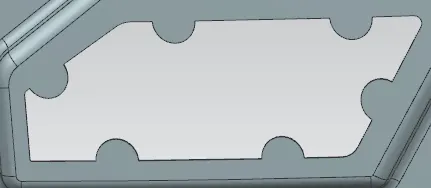
4.Emboss Definations - The ebosses should be created in such a way that if there is collision the force is directed outside of the vehicle. The emboss helps in reducing the force or energy reaching the cabin compartment ant dissipates it towards the hinges.
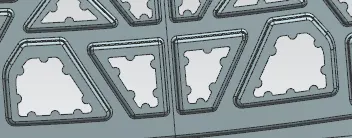
5.Latch Trajectory - A hinge axis is created by positioning the hinges and making it parallel with the respective axis and a circle is created in the middle of the axis with tangent line. The circle is the trajectory of the opening and closing of the hood and the tangent should be aligned with the stricker so that it is perpendicular and corelated with the hinge axis.
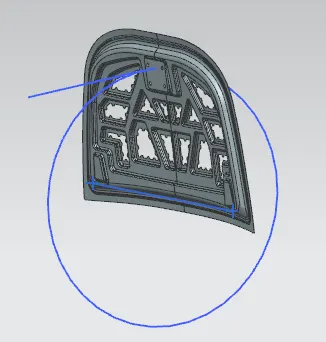
6.Inlaid Hood & Wrap Around Hood - When the end point of the car is on the fender then it is known as Inlaid hood. If the end point of the car lies on the hood then it is known as wrap around hood. The wrap around distance is taken in reference to the side referencnce line. The lesser the area of wrap around distance better is the pedestrian rating of the car.
Manufacturing Processes
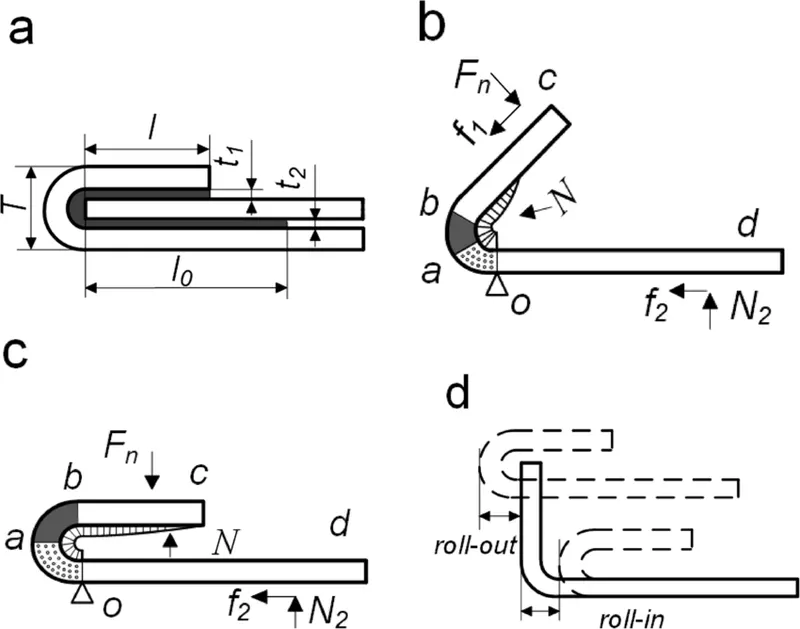
Hemming - Hemming is a sheet metal forming process in which sheets are joined by bending it usually to 180°. Automotive body panels and automotive parts such as deck-lids, trunk-lids, doors, hoods and tailgates are formed by hemming process. The distance between the hood inner panel and outer panel should be 0.2mm. The hemming flange of the inner panel should be 6mm to 8mm and of the outer panel should 12mm to 16mm. There should be reliefs given to the curved edges so that there is no deformity after the bending process is done.
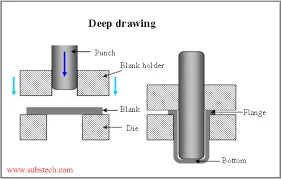
Deep Drawing - Deep drawing is a sheet metal forming process in which a sheet metal blank is radially drawn into a forming die by the mechanical action of a punch. It is thus a shape transformation process with material retention. The process is considered "deep" drawing when the depth of the drawn part exceeds its diameter.
Images of the Hood Design
Sticker
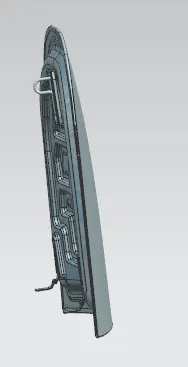
Hinge Assembly
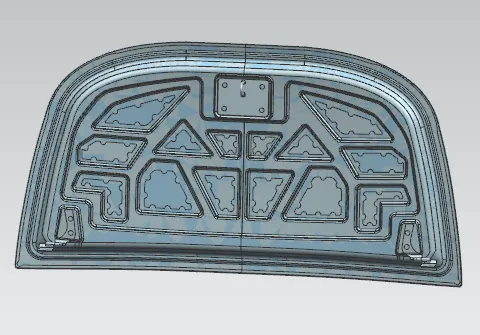
Hood inner Panel
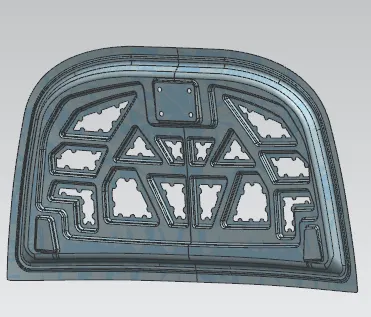
Hood Outer Panel
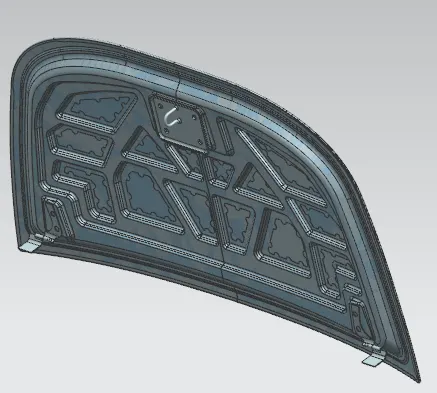
Assembled images