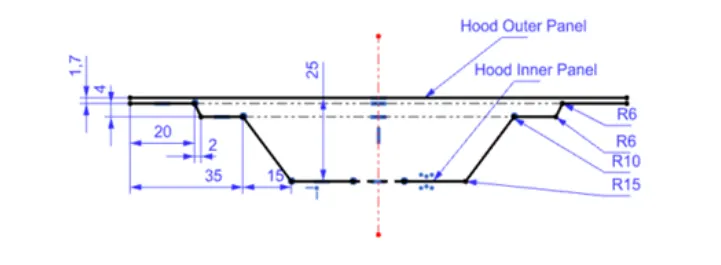
Embossing:


 The metal sheet embossing operation is commonly accomplished with a combination of heat and pressure on the sheet metal, depending on what type of embossing is required. Theoretically, with any of these procedures, the metal thickness is changed in its composition.

The metal embossing manufacturing process has these characteristics:

The ability to form ductile metals.
Use in medium to high production runs.
The ability to maintain the same metal thickness before and after embossing.
The ability to produce unlimited patterns, depending on the roll dies.
The ability to reproduce the product with no variation.
The following materials are suitable for embossing:


Aluminum (all alloys)
Brass
Card stock
Cold rolled steel
Copper
Galvanized steel
High strength, low alloy, steel
Hot rolled steel
Steel (all alloys)
Zinc


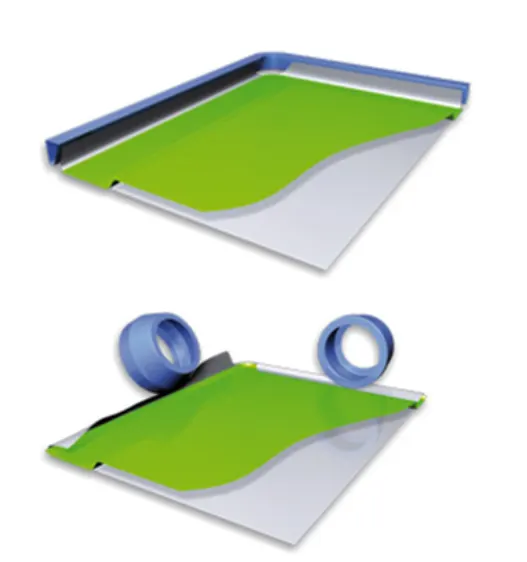
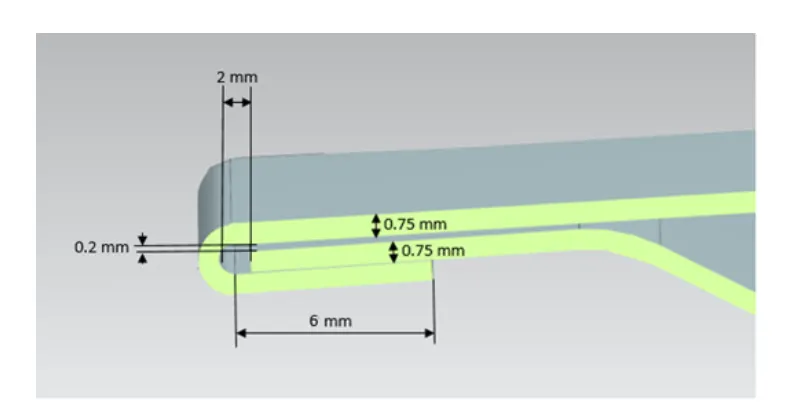
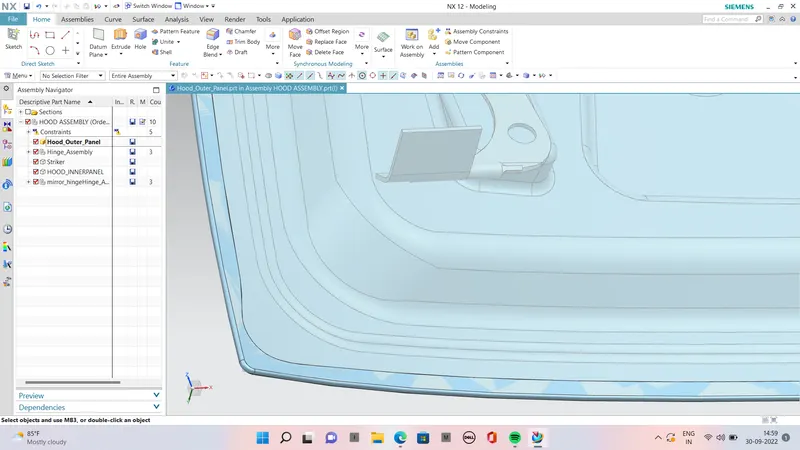
Hemming is a forming operation in which the edges of the sheet are folded or folded over another part in order to achieve a tight fit. Normally hemming operations are used to connect parts together, to improve the appearance of a part and to reinforce part edges.


In car part production, hemming is used in assembly as a secondary operation after deep drawing, trimming and flanging operations to join two sheet metal parts (outer and inner) together. Typical parts for this type of assembly are hoods, doors, trunk lids and fenders.


The accuracy of the hemming operation is very important since it affects the appearance of the surface and surface quality. Material deformations, which occur during the hemming process, can lead to dimensional variations and other defects in parts. Typical hemming defects are splits or wrinkles in the flange, material overlaps in the corner areas or material roll-in. Therefore it is important to use simulation tools in order to, on the one hand, better understand the hemming process and, on the other hand, significantly reduce the number of “trial and error” loops during tryout und production.


There are various types of hemming operations:

Conventional die hemming
Roll hemming


Latch Trajectory and Striker Mounting:


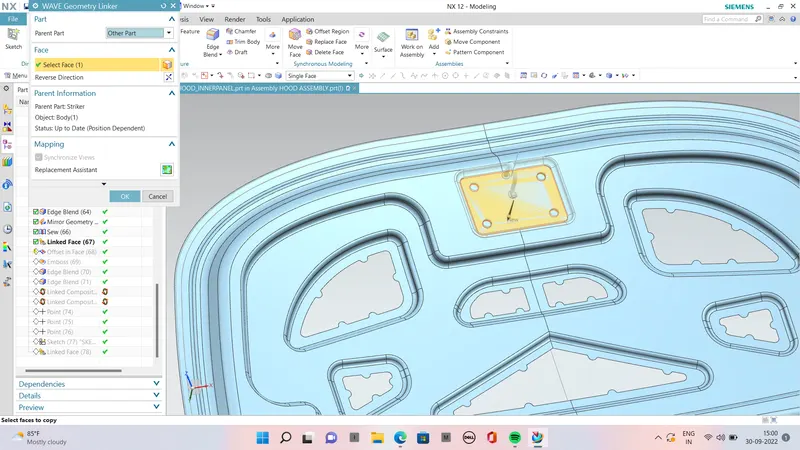
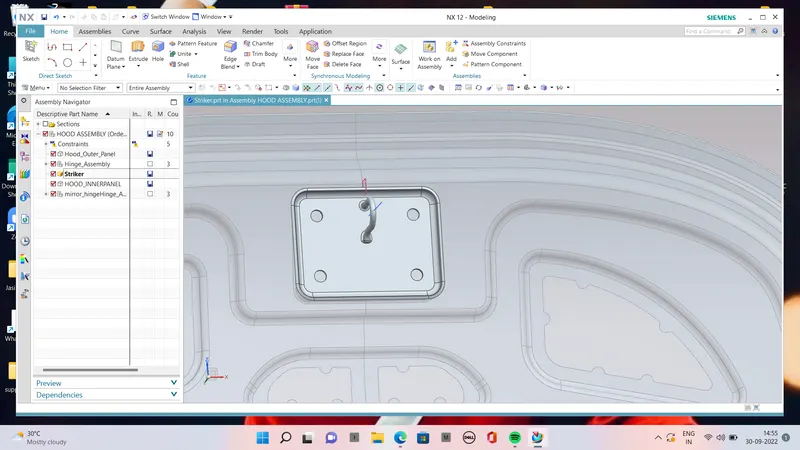
In opening and closing the hood of a vehicle, the striker should be placed in such a manner that is approximately same in all the vehicles. For that the striker should be mounted by measuring the inclination angle and with respect to the hinge axis.

In the designing process, we shall make a hinge axis and the find out the center of the axis and then draw a circle which is an approximate distance to fix the striker.

When the striker is in position, we will use the WAVE geometry linker to make the latch.

The Striker should be mounted in such a way that during the opening and closing of the hood, it should be in place and there shouldn’t be any kind of vibrations or loosening. The components of a latch are commonly formed from stamping. The stamped pieces are later assembled, and spot welded into complete latches, although the process differs slightly for each type of latch.


Deep-Drawing:


Deep drawing is a sheet metal forming process in which a sheet metal blank is radially drawn into a forming die by the mechanical action of a punch. It is thus a shape transformation process with material retention. The process is considered "deep" drawing when the depth of the drawn part exceeds its diameter. This is achieved by redrawing the part through a series of dies. The flange region (sheet metal in the die shoulder area) experiences a radial drawing stress and a tangential compressive stress due to the material retention property. These compressive stresses (hoop stresses) result in flange wrinkles (wrinkles of the first order). Wrinkles can be prevented by using a blank holder, the function of which is to facilitate controlled material flow into the die radius.

The total drawing load consists of the ideal forming load and an additional component to compensate for friction in the contacting areas of the flange region and bending forces as well as unbending forces at the die radius. The forming load is transferred from the punch radius through the drawn part wall into the deformation region (sheet metal flange). In the drawn part wall, which is in contact with the punch, the hoop strain is zero whereby the plane strain condition is reached. Mostly the strain condition is only approximately plane. Due to tensile forces acting in the part wall, wall thinning is prominent and results in an uneven part wall thickness, such that the part wall thickness is lowest at the point where the part wall loses contact with the punch, i.e., at the punch radius. The thinnest part thickness determines the maximum stress that can be transferred to the deformation zone. Due to material volume constancy, the flange thickens and results in blank holder contact at the outer boundary rather than on the entire surface. The maximum stress that can be safely transferred from the punch to the blank sets a limit on the maximum blank size (initial blank diameter in the case of rotationally symmetrical blanks). An indicator of material formability is the limiting drawing ratio (LDR), defined as the ratio of the maximum blank diameter that can be safely drawn into a cup without flange to the punch diameter. Determination of the LDR for complex components is difficult and hence the part is inspected for critical areas for which an approximation is possible. During severe deep drawing the material work hardens, and it may be necessary to anneal the parts in controlled atmosphere ovens to restore the original elasticity of the material.
DESIGNING THE HOOD

In order to design the hood for the vehicle we have been given the data as followed:

Hood Thickness Information:
Outer Panel Thickness = 0.75mm
Inner Panel Thickness = 0.75mm
Reinforcement Thickness = 1.5mm


SOFTWARE USED FOR DESIGN:

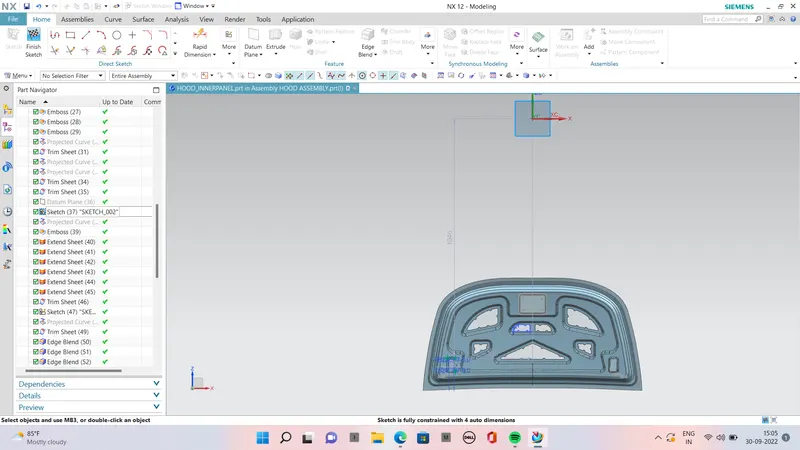
Siemens Nx 12 CAD


Commands Used in Design Process:

.Offset Surface: Creates a body by offsetting a set of faces.
.Offset Curve on surface: Offsets a curve along the face they lie.
.Trim sheet: Used to trim one or more bodies from a plane.
.Through curves: Allows you to create a body through multiple sections.
.Law extension: Creates a law-controlled extension from base sheet dynamically or based .on laws of distance and angle.
.Emboss: Modifies a body with faces made by projecting a section along a vector.
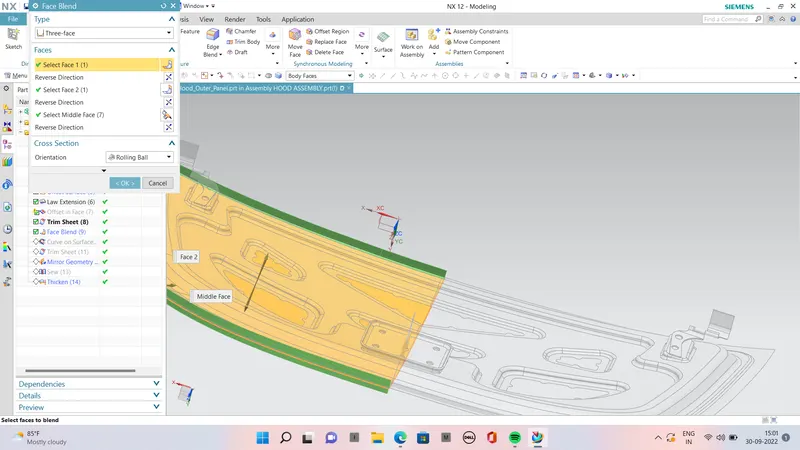
.Face blend: Adds tangent blend faces to selected set of adjacent faces. Blends can be .circular, conic or even law controlled.
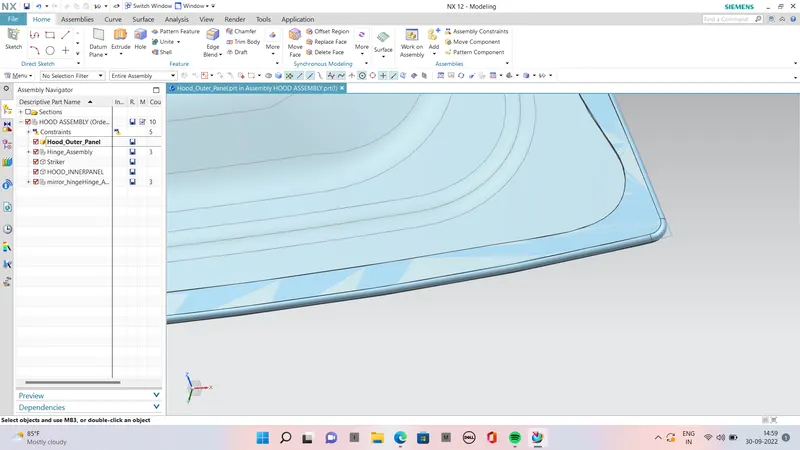
.Edge blend: Rounds sharp edges and blends them together. The radius of the blend can be .constant or variable.
.Extend sheet: This command will help to extend the sheet edge.
.Mirror geometry: As the name says, this command helps to mirror the shape of the body .along specified plane.
.Sew: Combines sheet bodies together by sewing the edges of the sheet metal to form a .single unit.
.Thicken: Helps in forming a sheet and thickens to a desired value.
.Important Processes and features in Design
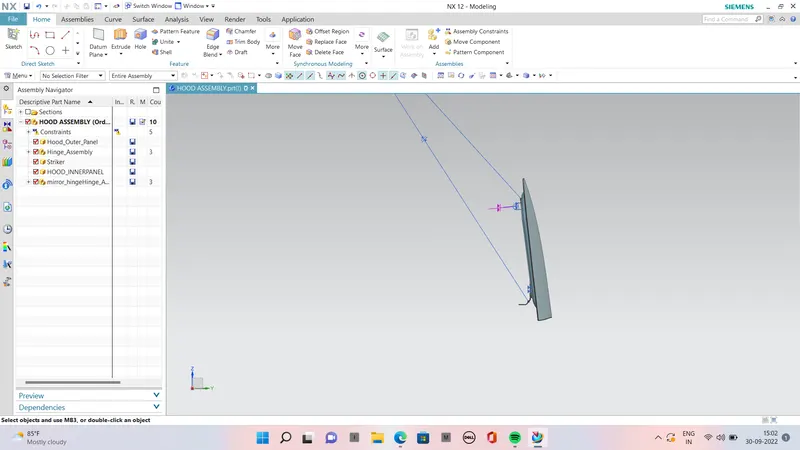
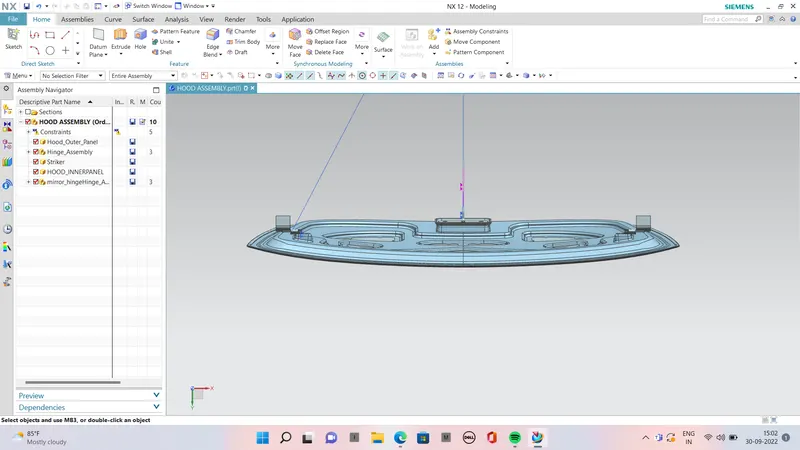
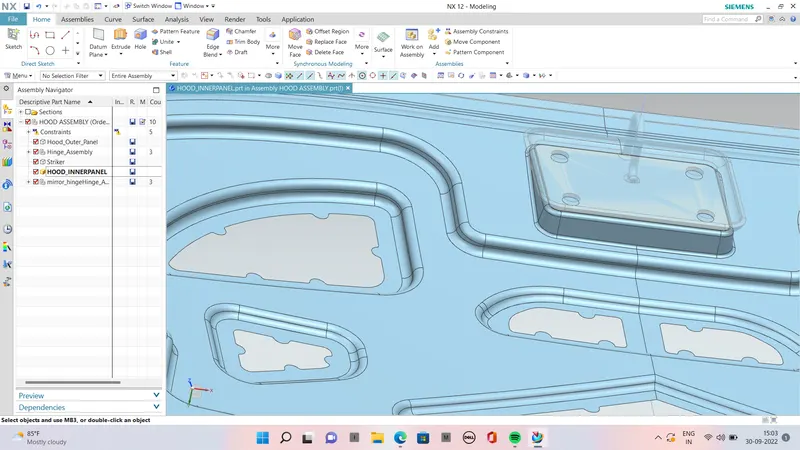
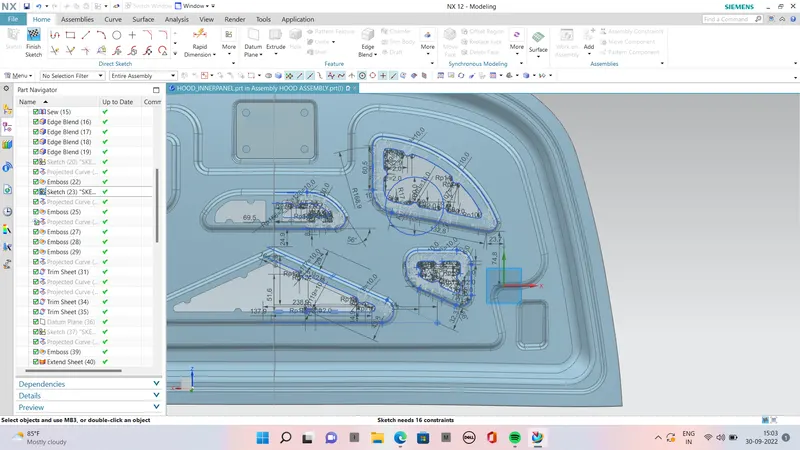
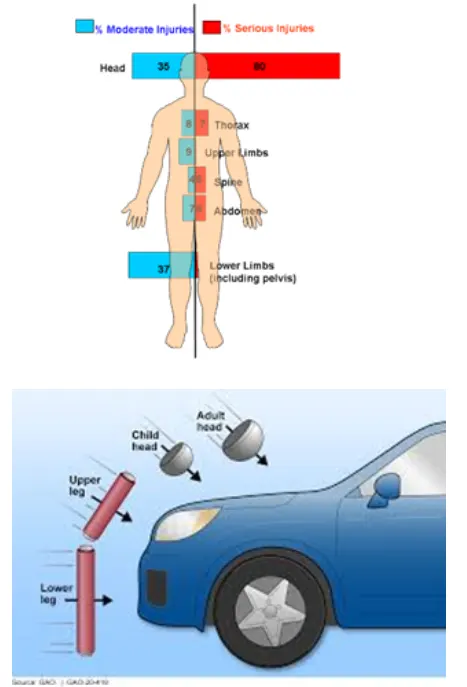
Force Distribution: This is one of the safety aspects when designing the hood. It is necessary for a designer while designing the hood that when the vehicle is hit to a rough area, the force exerted on to the vehicle should not be transferred directly to passengers, instead the force should be diverted to the hinges and not directly to the passengers.


Pedestrian Safety: When designing the hood, the main analysis of the designer in designing the hood must consider the safety of the pedestrians. These include children to adults. The hood should be designed in such a manner such that, whenever there will be a collision with the car to a pedestrian, it is likely to analyze that the head of the pedestrian will strike the hood first. So, the designer should make sure that the hood is divided into areas in the hood where the head should be most likely to hit and, in a way, create less damage.


Mastic Data: There should be ensuring that the hood must be hard enough to protect the main parts of a vehicle and must not be too hard too. Mastic Data enables the average hardness of the hood and ensures that there are no spaces between the inner panel nor the outer panel to reduce noise and vibrations from the vehicle.
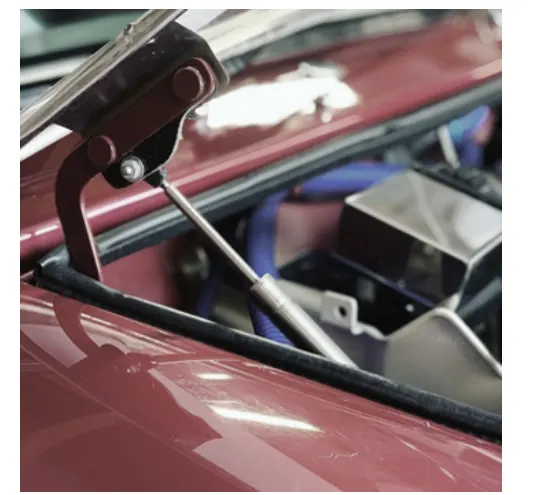
Hood stay: Hood stay is an important part in a vehicle and should be considered while designing a hood as when the hood is opened it needs to be restricted from closing until we need it to be closed. There are mainly two types of hood stays that is
Support Rod


Gas stay
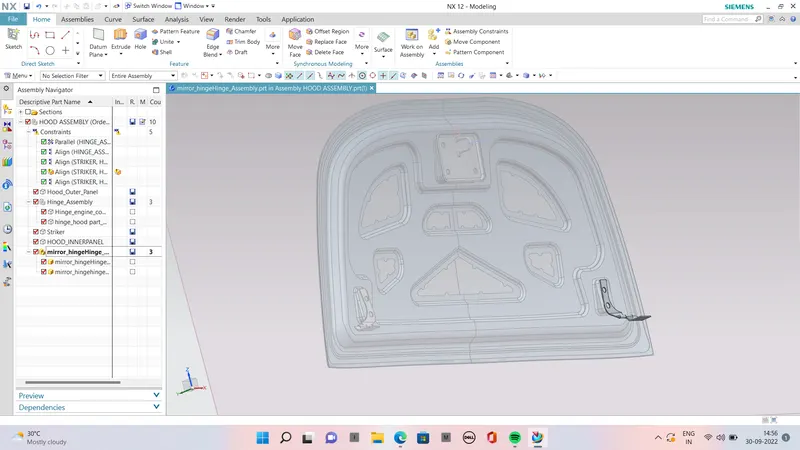
Types Of Design Considerations in Hood

There are certain aspects of study in designing a hood such a head collision, Force distribution, Hood stay, and mainly Pedestrian Safety.

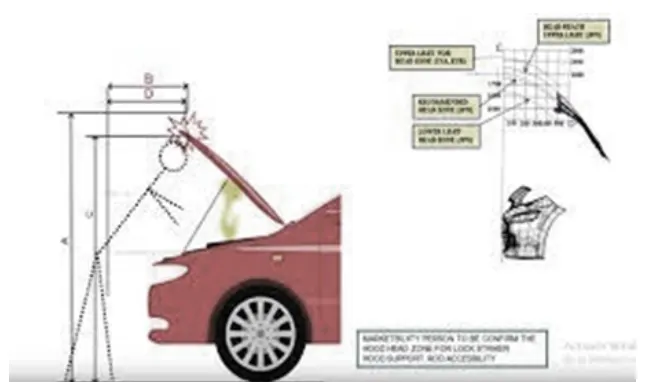
Hood Inclination Angle: During opening and closing of the hood, people must have a space to look around while cleaning or repairs. For that the hood inclination should be in a way that doesn’t restrict the people, or else the people will face collision of their head with the hood. For example, in India the average height of people is around 5ft, while in America, it’s around 5.5-6 ft. So, the angle should be calculated, and the hood should be designed in that manner.
Purpose of Hood:
Its purpose is to provide access to the engine for repair and maintenance.

Components In Hood

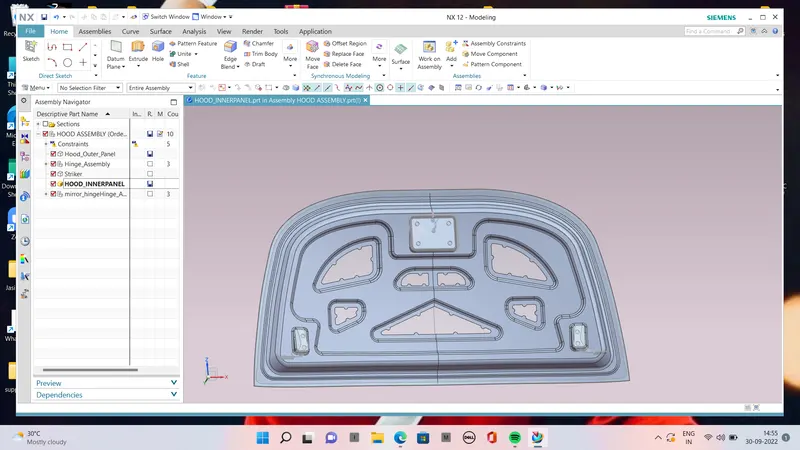
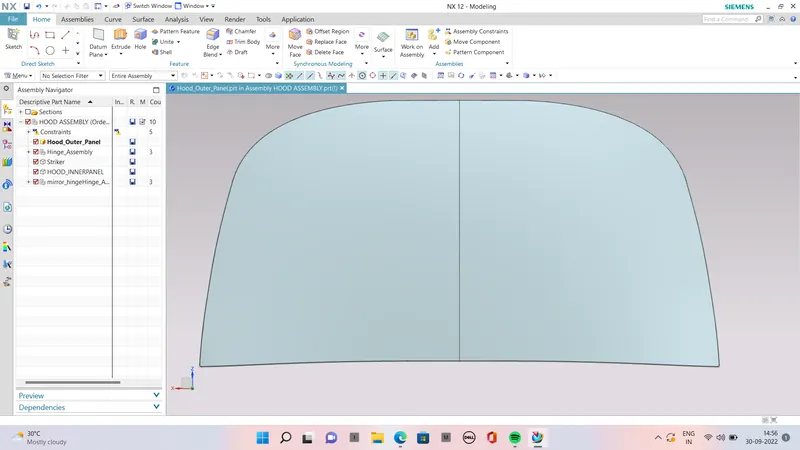
Hood outer pane
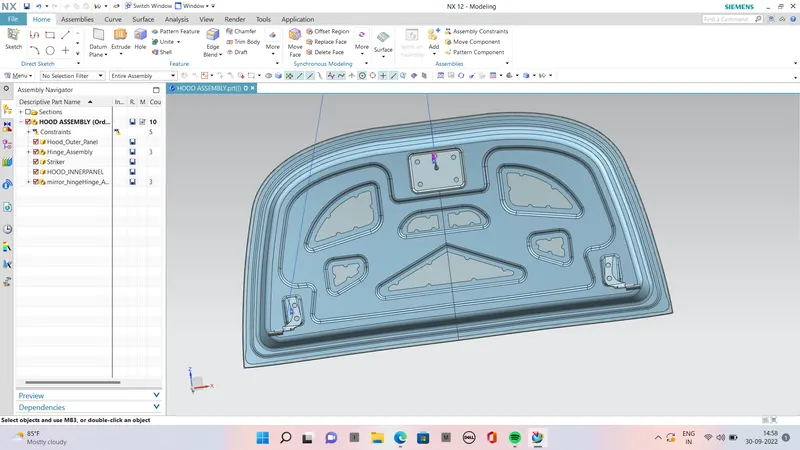
Hood design


Aim

A detailed report about the Hood Design which includes a detailed explanation about hood and its components, Latch Trajectory, Mastic Data, Emboss Definitions, Manufacturing process like Deep-Drawing and Hemming, and all the parameters followed in the design and To Submit an ASSEMBLY of Hood Inner Panel, Outer Panel, Latch, Hinge and the Reinforcements.


Styles and materials

On front-engine cars, the hood may be hinged at either the front or the rear edge, or in earlier models (e.g., the Ford Model T) it may be split into two sections, one each side, each hinged along the Centre line. A further variant combines the bonnet and wheel arches into one section and allows the entire front bodywork to tilt forwards around a pivot near the front of the vehicle.

Hoods are typically made from the same material as the rest of the body work. This may include steel, aluminum, fiberglass or carbon fiber. However, some aftermarket companies produce replacements for steel hoods in fiberglass or carbon fiber to make the vehicle lighter.


Hood Design

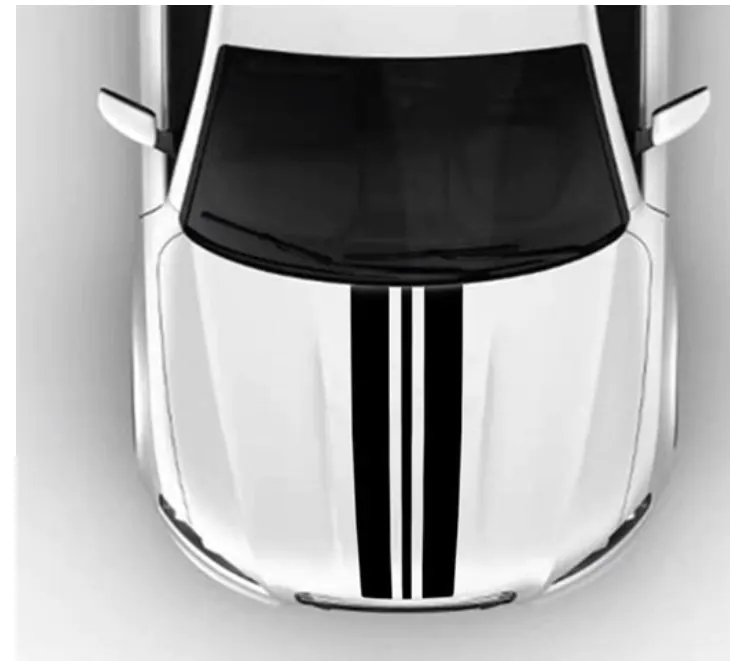
A hood, also referred to as a bonnet in some other countries, is the hinged cover that rests over the engine of a front-engine vehicle.