Hood design-Week 2
HOOD
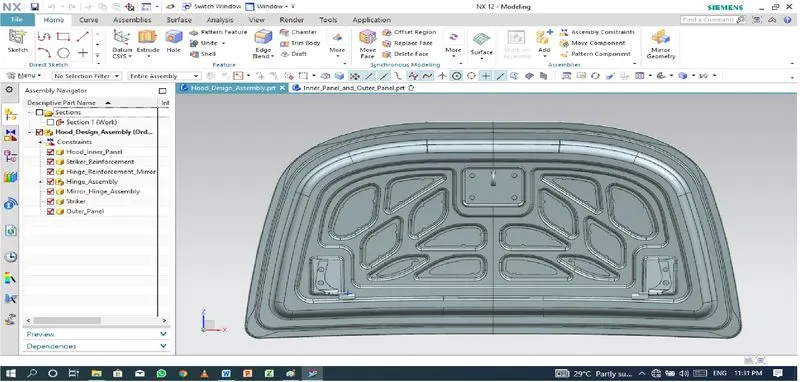
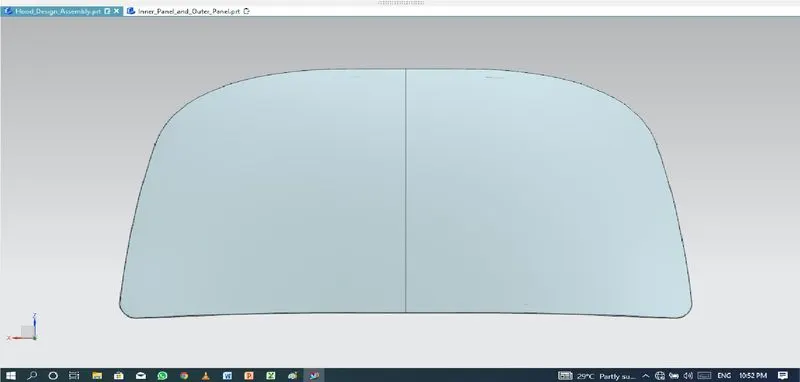
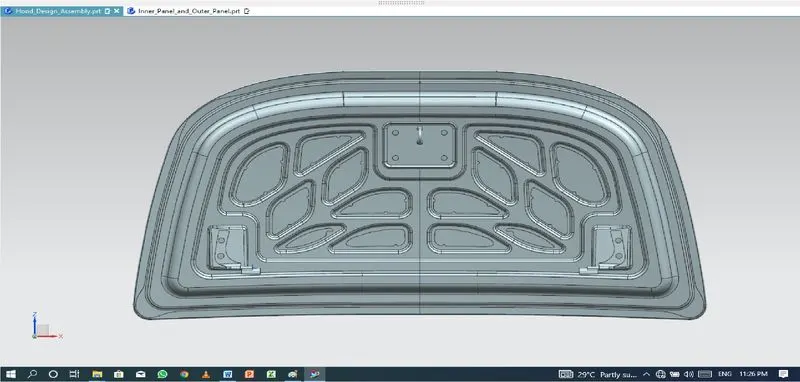
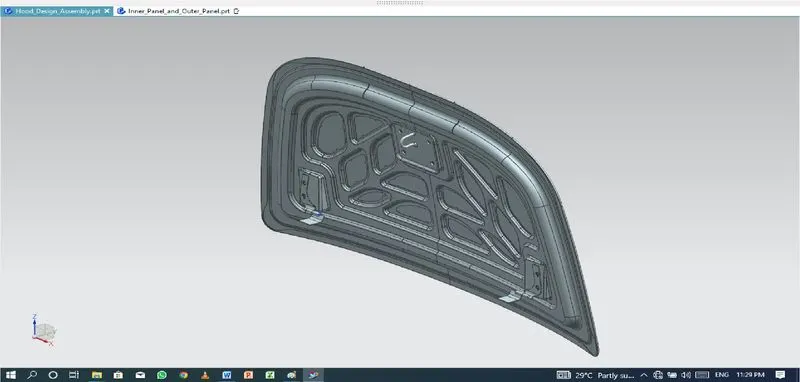
The hood or bonnet is the hinged cover over the engine of motor vehicles. Hoods can open to allow access to the engine compartment or trunk on rear-engine and some mid-engine vehicles for maintenance and repair. It generally covers the engine and other essential accessories like battery, Radiator, electrical components, etc. of the car which are exposed outside. The Hood consists of an outer panel and an inner panel. The inner panel provides strength and support, where the outer panel is a metal cover that has styling factors.
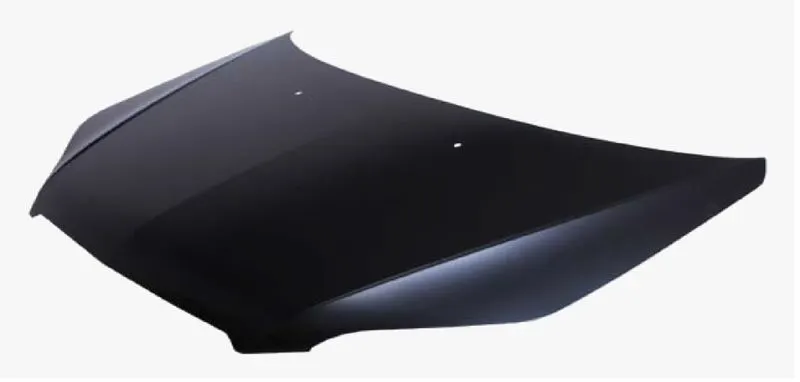
SAFETY CONSIDERATION WHILE DESIGN HOOD
While designing the hood, a design engineer needs to make sure that the following design requirements are followed.
-
Pedestrian safety
Vehicle designers usually focus on understanding the car-pedestrian interaction, which is characterized by the following sequence of events: the vehicle bumper first contacts the lower limbs of the pedestrian, the leading edge of the hood hits the upper thigh or pelvis, and the head and upper torso are struck by the top surface of the hood and/or windshield. Most pedestrian deaths occur due to the traumatic brain injury resulting from the hard impact of the head against the stiff hood or windshield. In addition, although usually non-fatal, injuries to the lower limb (usually to the knee joint and long bones) are the most common cause of disabilities. The hood of most vehicles is usually fabricated from sheet metal, which is a compliant energy-absorbing structure that poses a comparatively small threat. Most serious head injuries occur when there is insufficient clearance between the hood and the stiff underlying engine components. A gap of approximately 10 cm is usually enough to allow the pedestrian’s head to have a controlled deceleration and a significantly reduced risk of death. Most limb injuries occur due to a direct blow from the bumper and the leading edge of the hood. Wrap Around Distance (WAD) is the distance from the ground level to the end of the hood as shown in the image.
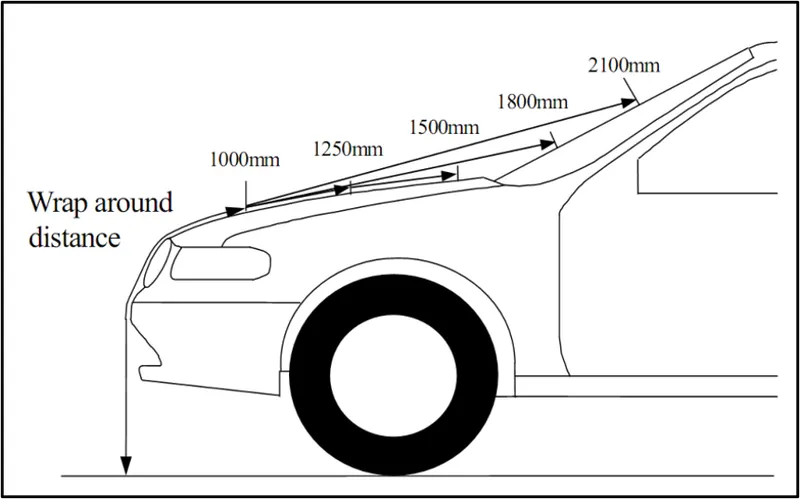
There are two main zones that are considered while the designing stage; the Child head impact zone (1000mm to 1700mm WAD) and the Adult head impact zone. (1700mm to 2100mm WAD). If the side reference line is on the fender, the WAD will be more and the impact zone will be less and vice versa.
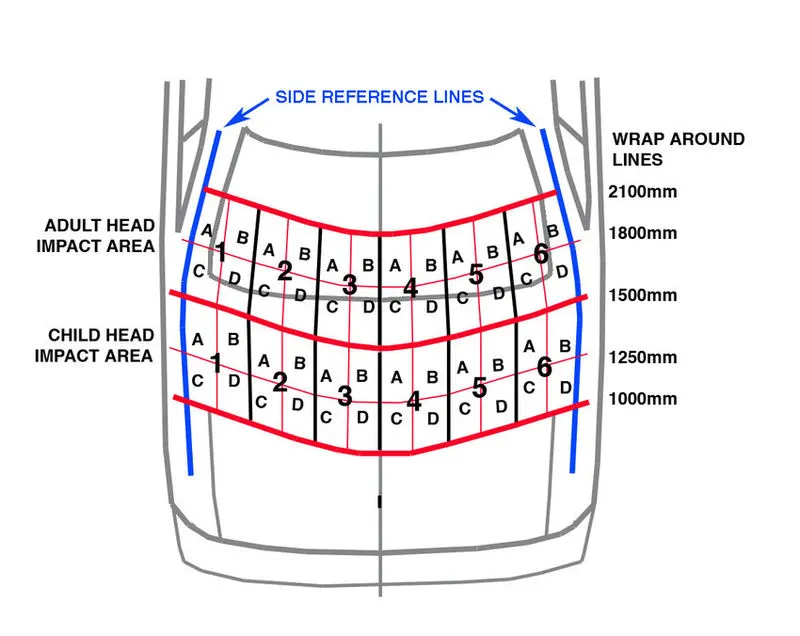
The hood panel should be designed in such a way that it diverges the impact forces during a collision away from the occupants inside the cabin. The forces should be damped properly to avoid or reduce the risk of injuries and death.
- Angle of hood
This criterion average height of the humans in the region of consideration. For example, the average height of a human being in India is 5.8 feet whereas in European countries the average height of a human being is 6 feet. Hence the opening angle of the hood greatly depends on the height of the human which can be controlled by the support rod or gas stay.
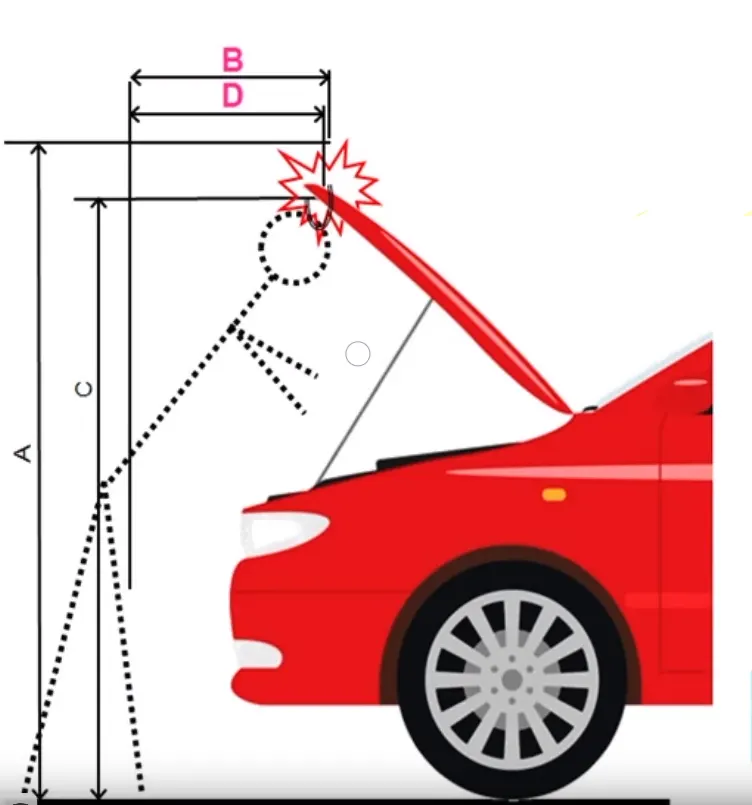
The opening angle is considered important criteria because when the opening angle is less there is a chance of head injury to the human. By varying the length of the support rod the opening angle can be varied.
There are two types of rod:
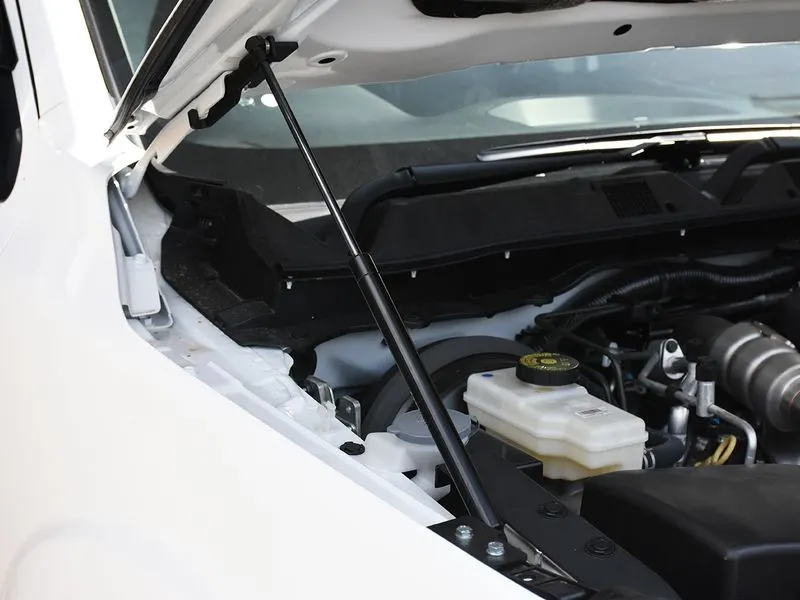
1. Gas stay
Gas Stay is a mini version of the bicycle pump in which the compressed nitrogen is stored in the pump with oil and tightly sealed so that the gas can't escape. The gas allows to store energy which produced by the force acting on the piston and oil damps the movement of the piston and also lubricates it. When force is acted upon the piston, it compresses the gas, and energy is stored and when force is stopped acting on the piston, the stored energy is released moving the piston to its free state position. Gas stay aids in easily lifting the heavy hood and holding the hood in the open position. Hence there is no human effort needed. Since gas stay supports the weight of the hood reinforcements should be given at the mounting points of the gas stay and grommets are used to attach the gas stay to the hood inner panel. It rotates with a pivoting point at grommets.
2. Support rod
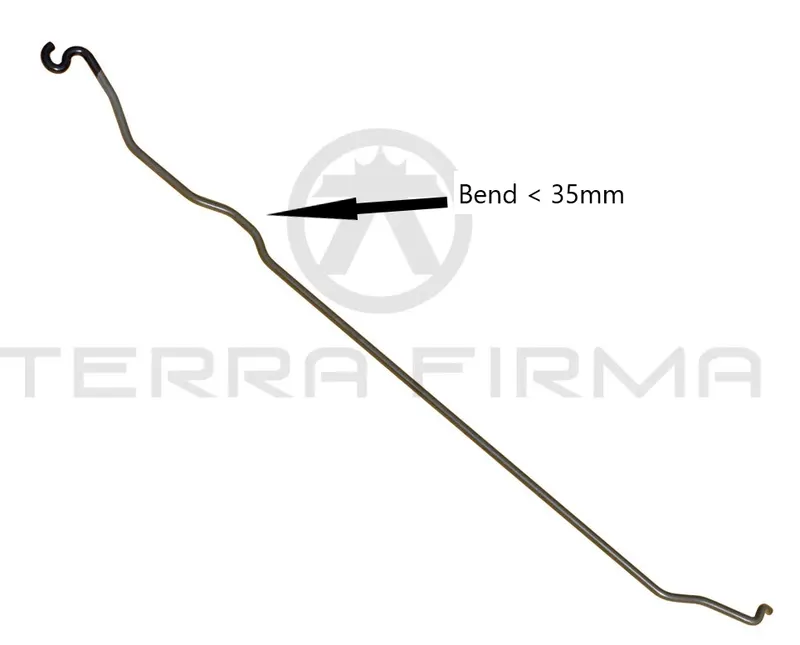
Support rods serve the same function as the gas stay but in this case, the hood has to lift with all the loads and it is held in position using the support rods. Support rods length is decided based on the opening angle of the hood. In the support rod maximum bend of 35mm is given in order to strengthen the support rod to bear all the load of the hood. There is the human effort needed. Support rods can either mounted on the hood or on the body of the car. The mounting of the support rod is always on the opposite side of the engine compartment.
MANUFACTURING PROCESS
The manufacturing process involves turning raw materials into finished products which are used for some purpose. The economics of the manufacturing operation is a very important consideration. To be viable in the modern environment, a product has to be competitively priced besides having functional and aesthetic appeal. There are different processes available for manufacture. These are classified as Casting Process, Forming Process, Fabrication Process, Material Removal Process.
1. Deep drawing process
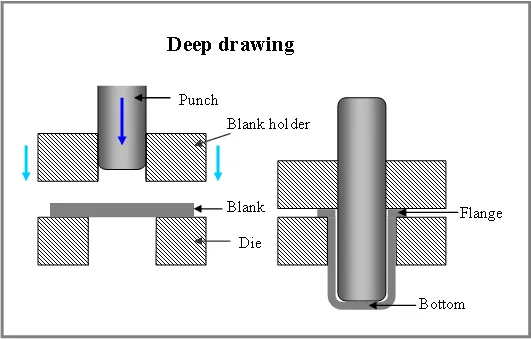
Deep drawing is a sheet metal forming process in which a sheet metal blank is radially drawn into a forming die by the mechanical action of a punch. It is thus a shape transformation process with material retention. The process is considered "deep" drawing when the depth of the drawn part exceeds its diameter.
2. Hemming
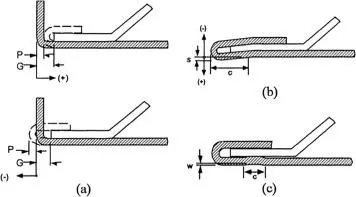
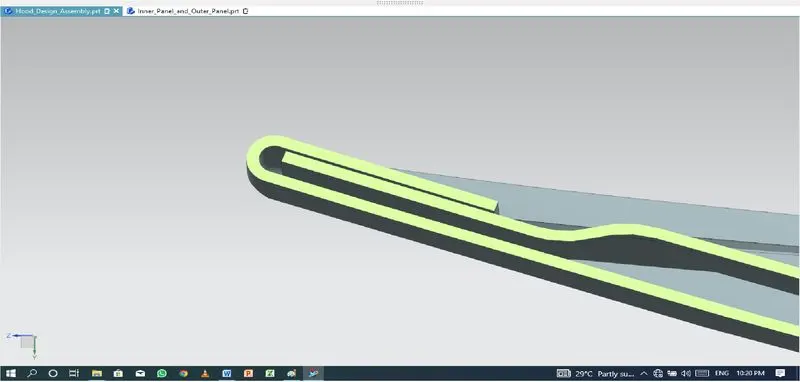
Hemming is a sheet metal forming process in which sheets are joined by bending it usually to 180 degrees. Automotive body panels and automotive parts such as deck lids, trunk lids, doors, hoods, and tailgates are forming by the hemming process.
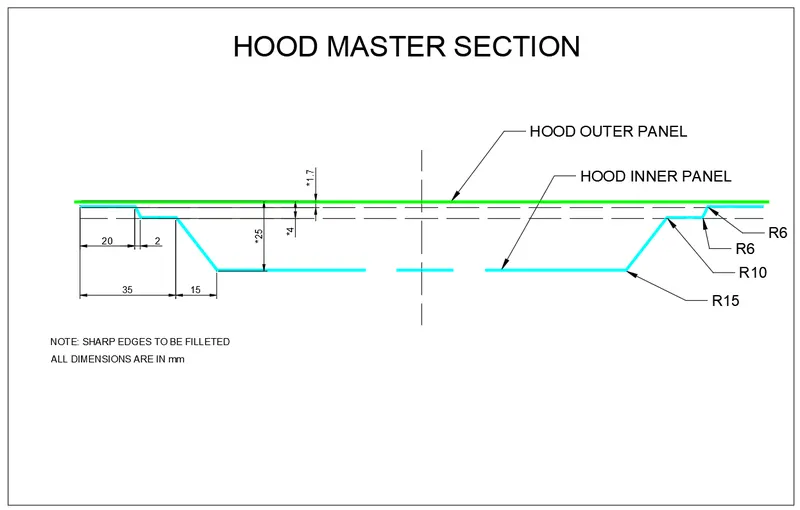
MASTER SECTION
DESIGN INPUTS
- Outer panel thickness = 0.75mm
- Inner panel thickness = 0.75mm
- Reinforcement thickness = 1.5mm
COMPONENTS OF HOOD
- Outer Panel
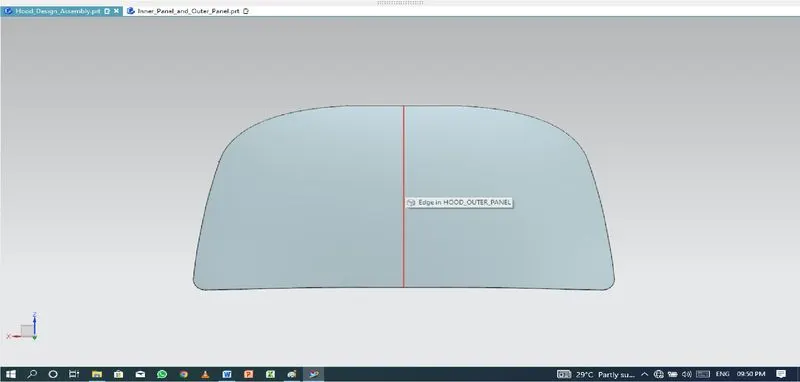
The outer panel is nothing but the outer skin of the inner panel. Otherwise called as a cover of the inner panel. It is the part, which gives luxurious look to the hood or bonnet. The outer panel and inner panel cannot join by any welding process like spot welding or rivet, which spoil the outer look of a car.
- Inner Panel
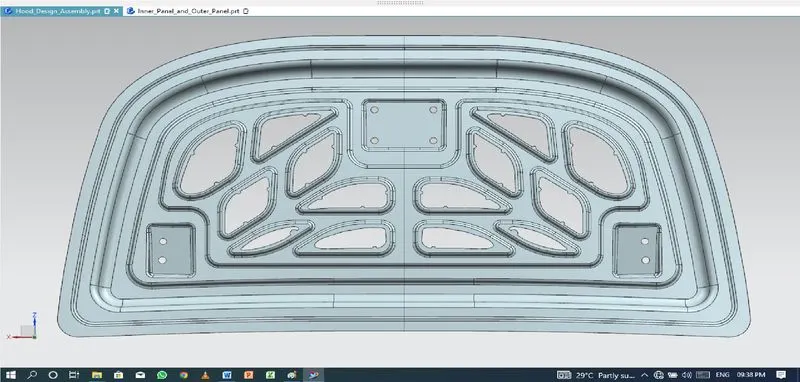
The inner panel master section was designed based on the master sketch. The inner panel is the critical part of the hood which acts as a force redirecting medium during frontal crash. Hence, it becomes very important to ensure that the inner panel is designed in such a way that the damage caused to the passenger as well as the pedestrian is minimum.
- Hinge
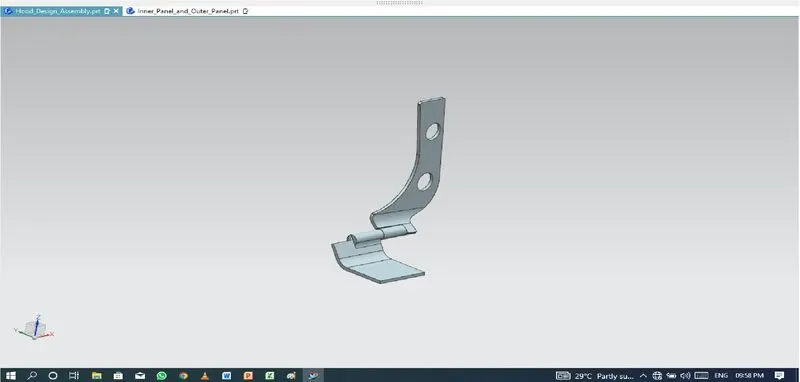
A hinge is a piece of metal, wood, or plastic that is used to join a door to its frame or to join two things together so that one of them can swing freely.
- Reinforcement
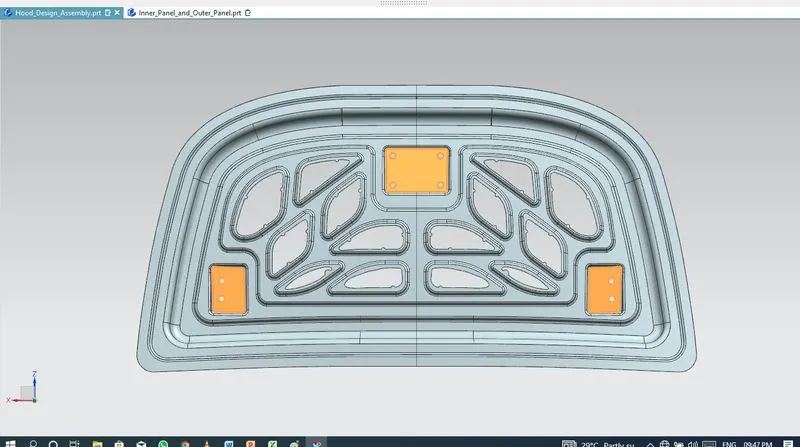
The purpose of reinforcement is to provide additional strength for the hood where it is needed. When the latch and striker attached to the panel, the strength will be reduced in that area. To improve the strength in that area the reinforcement is added.
- Mastic points
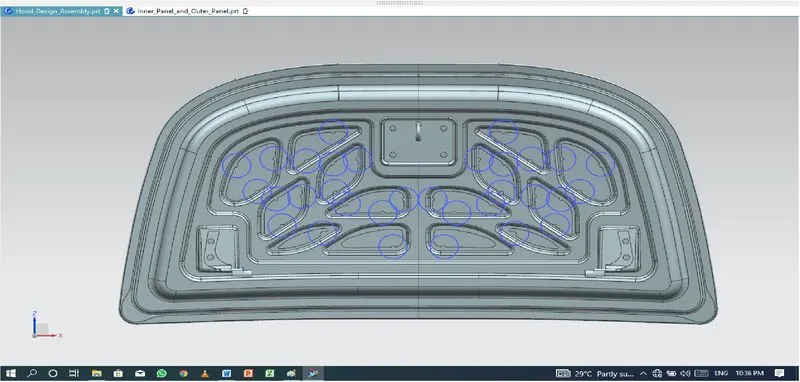
The Mastic sealant or the Mastic point is an elastic compound that behaves like a rubber. The mastic points are defined on the hood inner panel where the hood can easily deform. They help the hood outer panel to come back to its original shape after it gets deformed. The mastic has an influence area of 80mm. They also play a major role in reducing NVH (Noise, Vibration, Hardness) of the car.
The circles indicate the mastic positions.
- Embosses
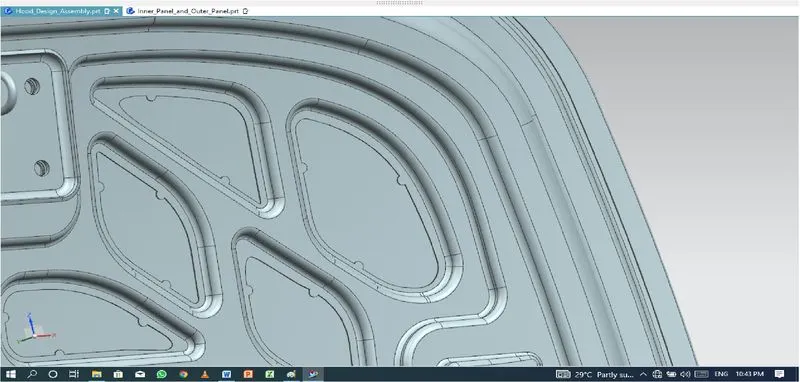
The embosses are projected sections from the inner panel surface that are created in order to redirect or dissipate the forces away from the centre of the hood, towards the hinge to avoid passenger damage. The embosses with varying depths (5mm, 7mm, 9mm, 13mm) are provided on the hood for reinforcement & to add strength to the inner panel.
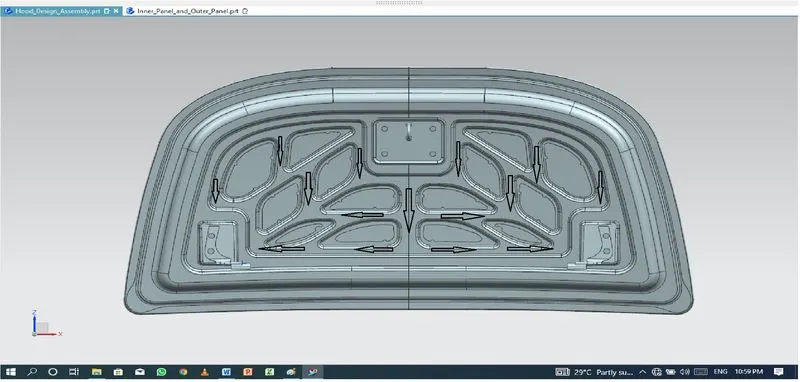
The following image shows the path of the force exerted due to collision in such a way the damage to the passengers is minimized. The arrows denote the impact force during collision and the line of action of force travelling away from the center of the center and towards hinge.
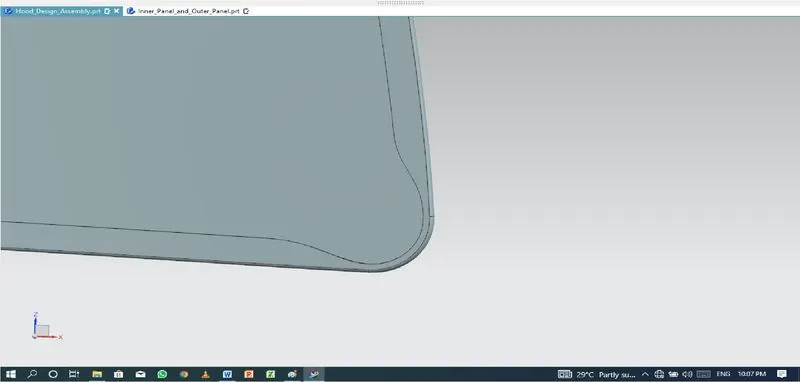
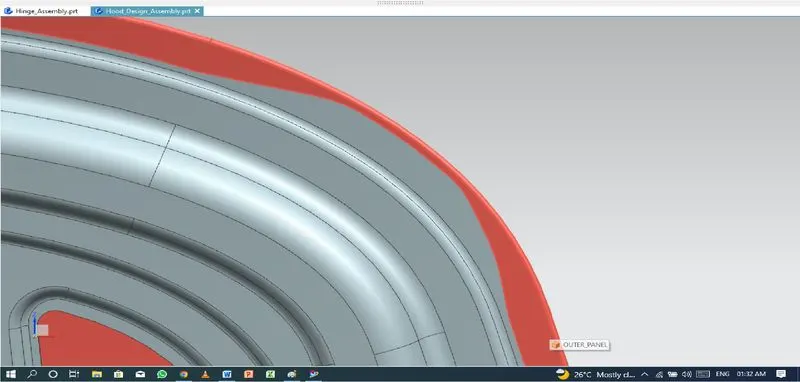
- Front relief
- Latch & striker and hinge assembly
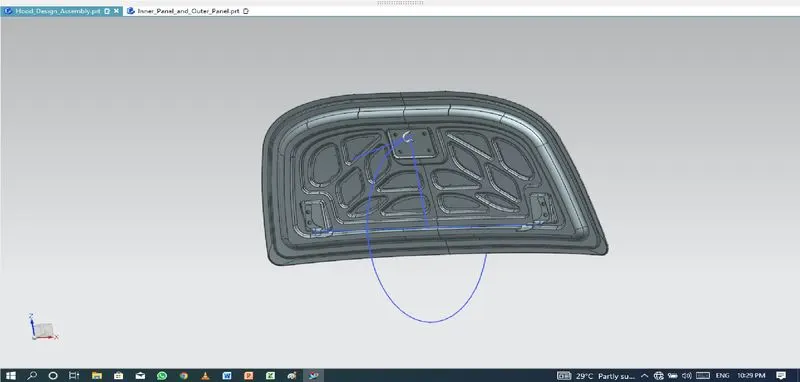
This is a critical stage in Hood Design as it plays an important role in the opening & closing of the Hood. The positioning is done as shown below concerning the Hinge axis so that the circle is passing through the center of the striker with the Hinge axis as its center.Also, The Striker must be perpendicular to the trajectory to achieve the correct position and thus enables it to close with the latch.
- Hemming
Hemming is the process of joining both the outer and inner panel together. The hemming process roles and wraps the hood outer panel around the inner panel and holds it tightly together. The following image shows the result post hemming process.
Conclusion
The hood for a car was designed that satisfies the industrial manufacturing requirements and functional requirements using Siemens NX CAD.