Hood design-Week 2
HOOD DESIGN
- OBJECTIVE:-
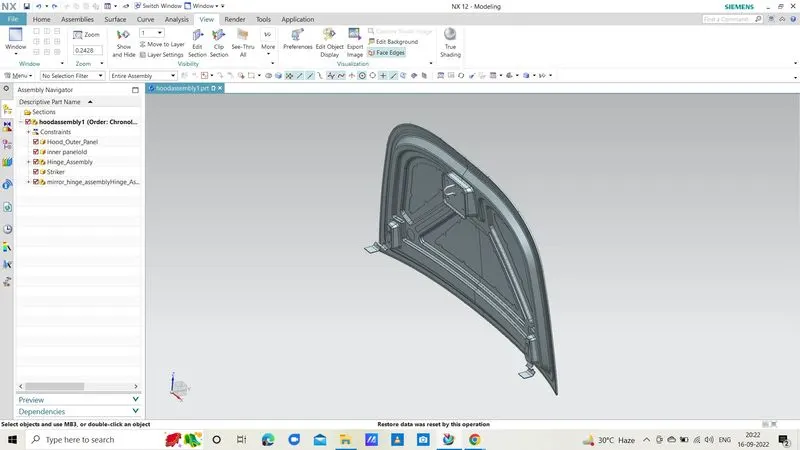
The main pourpose of this project is to design a hood of a car with the given master section and BY following neccessary safety precaution. The Body in White (BIW)inner panel and outer panel of the hood must be designed and assembled with hinge assembly and striker.
- AIM:-
The main AIM was to improve the pedestrian safety rating by reducing the risk of injuries.
- INTRODUCTION:-
A car hood also referred to as a bonnet in some other countries, is the hinged cover that rests over the engine of a front engine vehicle. its purpose is to provide access to the engine for repair and maintenance.
A concealed latch is typically used to hold down the hood.car hood are typically constructed from steel and sometimes from aluminum .Aftermarket car hoods may be constructed from various other materials, including carbon fiber, fiberglass or dry carbon.
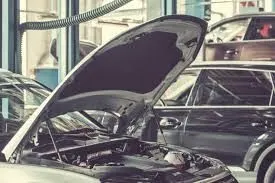
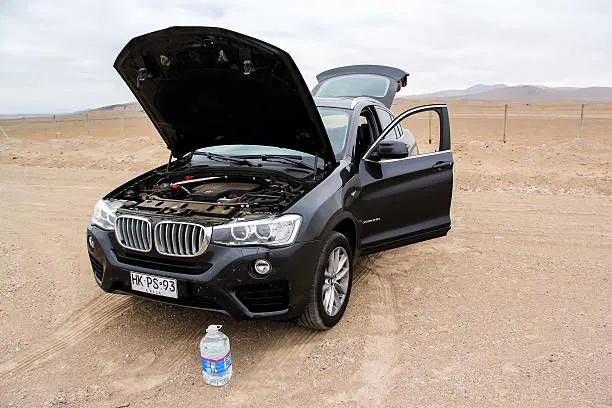
Concerns regarding the severity of a potential pedestrian head injury during a collision with a motor vehicle have led to advanced hood designs on many models. such designs may include a multi-cone inner hood panel design .an active structure that is capable of pushing the surface of the hood away from the vehicle's hard motor components in the event of a pedestrian crash is also in use.
(BIW) Body In White is the stage in automobiles manufacturing in which a car bodys frame has been joined together , that is before painting and before the motor , chassis sub assemblies , or trim have been integrated into the structure .assembly involves different techniques such as welding (spot,MIG),riveting ,clinching ,bonding and laser brazing.
The term derives from manufacturing practices before steel unibody monocoques when automobile bodies were made by outside firms on a separate chassis with an engine , suspension, fender attached. The manufacturers built or purchased wooden bodies (with thin ,non-structural metal sheets on the outside )to bolt onto the frame. the bodies were painted white prior to the final color.
- WHY DO WE NEED A HOOD?
The main function of the car hood is to protect the components underneath it for example,the engine.Without this protection ,small stones kicked up by other cars could puncture a fluid container or damage the engine. in addition, most engines are not supposed to be exposed to excess water. it makes your car more beautiful
- THE FOLLOWING ARE SOME OF THE IMPORTANT PURPOSES OF THE HOOD
- safety of the passenger .
- covers all engine, radiator and other neccessary components .
- reduce air effect due to its aerodynamic shape design .
- Reduce engine noise which helps for a quieter drive .
- Provide access to engine maintenance.
- Absorbed most of the impact forces when a frontal crash occurs.
- PEDESTRAIN SAFETY :-
pedestrians are the most vulnerable road users who are the high risk of vehicle collisions in traffic,almost 1.2 million pedestrian are killd annually in road traffic accidents worldwide.the major injuries occure in lower, upper leg and head injury resulting from the hard impact of the head against the stiff hood or to the ground . in recent years, enginners are working on the vehicle front end design which includes bumper and hood to reduce the injuries to the pedestrians in the event of pedestrian vehicle collision.
EURO NCAP is a voluntary vehicle safety rating system created bt the swedish road administration the international consumer research &testing ,backed by members and motoring &consumer organisations in several EU cuntries .they provide consumers with information regarding the safety of passenger vehicles .in 1998,operations moved from london to brussels.

many pedestrian crashes involve a forward moving car .in such a crash, a standing or walking pedestrian is struck and accelerated to the speed of the car and then continues forward as the car brakes to a half . the pedestrian is impacted twice, first by the car and then by the ground, but most of the fatal injuries occur due to interaction with the car.vehicle designers usually focus on understanding the car pedestrian interaction ,which is characterized by the following sequence of event the vehicle bumper first contacts the lower limps of the pedestrian ,the leading edge of the hood hits the upper thinh or pelvis and the head and upper torso are struck by the top surface of the hood
- Pedestrian Head Imapct Zone
- Wrap Around Distance :-
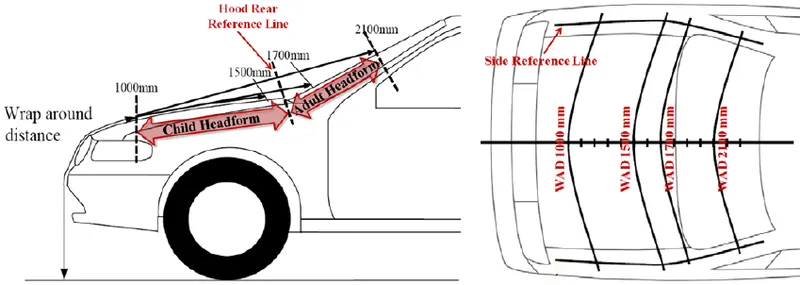
when a car crashes on the pedestrian the whole human body wrap around the front shape of the car and the head impacts on the bonnet or the windscreen . The distance on which the head impacts on the car from the ground is called as the wrap Around Distance (WAD).
To be specific the Wrap Around Distance is a measurement of distance from the ground to the head impact zone over the outer surface of the car .The wrap around distance is measured longitudinally in the centre of the vehicle from the ground .
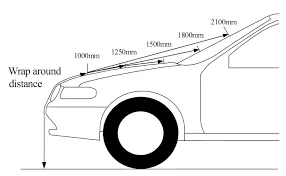
THE severity of the injury caused by the frontal crash depend on the type and shape of the vehicle ,speed of the vehicle and the movemebt of the pedestrian relative to the vehicle .in addition to these parameters , the wrap around distance plays a major role in the safety measurment of a pedestrian .
During the crash analysis ,based on the wrap around distaance ,two test areas will be created namely child head impact zone and the adult head impact zone .the child head impact zone is between 1000 to 1700 mm WADand the adult head impact zone ranges between 1700to 2100 mm WAD.
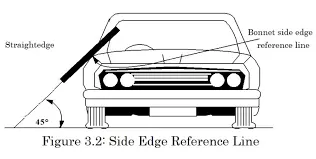
2. BONNET SIDE EDGE REFERENCE LINE :-
The bonnet side Reference line is defined as the geometric trance of the highest points of contact between a straight edge 700 mm long and the side of a bonnet as defined in section 3.31and A-pillar,when the straight edge,held parallel to the lateral vertical plane of the car and inclined inwards by 45deg is traversed down the side of the bonnet top and A-piller,while remaning in contacts occure the most outboard ontact shall form the bonnet side reference line.
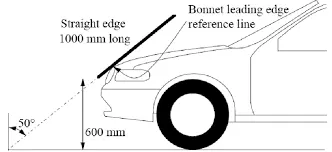
3. BONNET LEADING EDGE REFERENCE LINE:-
the bonnet leading Edge Reference LIne is defined as the geometric trace of the points of contact between a straight edge 1000mm long and the front surface of the bonnet ,when the straight edge ,held parallel to the vertical longitudinal plane of the car and inclined rearwards by 50 degree and with the lower end 600mm above the ground is traversed across and in contact with the bonnet leading edge.for vehicles having the bonnet top surface inclined at essentially 50deg ,so that the straight edge makes a continuous contact or multiple contacts rather than a point contact determine the reference line with the straight edge inclined rearwards at an angle of 40deg. for vehicles of such shape that the bottom end of the straight edge makes first contact then that contact is taken to be the bonnet leading edge reference line, at that lateral position.for vehicles of such shape that the top end of the straight edge makes first contact then the geometric trace of 1000mm wrap around distance will be used as the bonnet leading Edge reference line at that lateral position. The top edge of the bumper shall also be regarded as the bonnet leading edge, if it is contacted by the straight edge during this procedure .
- Child Impact Zone:1000-1500mm
- Adult Impact zone:1500-2100mm
- COMPONENTS OF THE HOOD:-
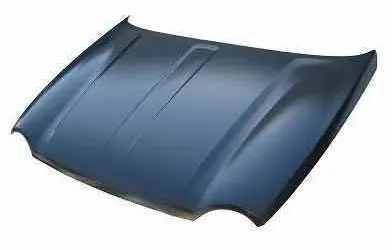
1. Outer Panel-
the outer panel is called the skin of the vehicle which is designed by the styling team to get a good look for a vehicle by covering the inner panel and engine parts of the car. this part should not be welded to the inner panel but using the sealent and mastic points makes contact between the inner and outer panel which acts as a bond between both and makes the hood stiff
2.inner panel-
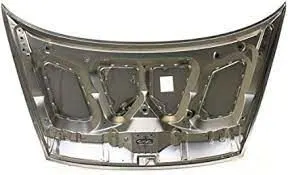
the main part of the hood which given support to the outer panel of the car and embossing shapes dissipates the forces in different direction when the vehicle takes crashes to not to injure the men in the car.
3. latch & striker-
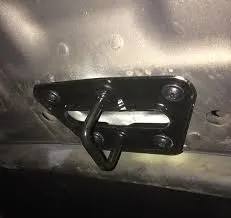
it is a part that helps in locking the hood with the striker which is mounted on the engine block when it is not in use.it plays a major role in opening and closing hood for maintenance of car engine and gives a tight locking position not to create undisturbed noise when the vehicle is running.
4. Hinges-
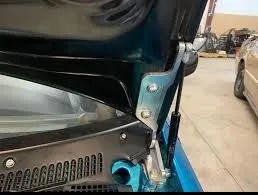
The hinge consists of two parts hinge at the inner panel and hinge at the engine compartment . this coupling allows the hood to open and close ,as well as makes contact between the engine block to the hood. it also controls the lifting of the bonnet.
DESIGNING THE HOOD
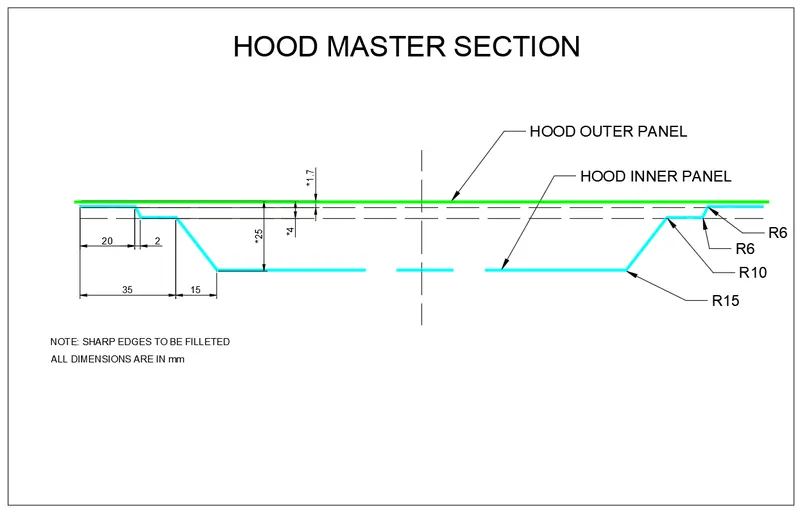
- For designing the hood or bonnet, master section , hamming data front relief and rear relief has been given for the reference.
MASTER SECTION- Master Section are the guides for design requirement which decide the component packaging after technical surface.
HAMMING DADA-
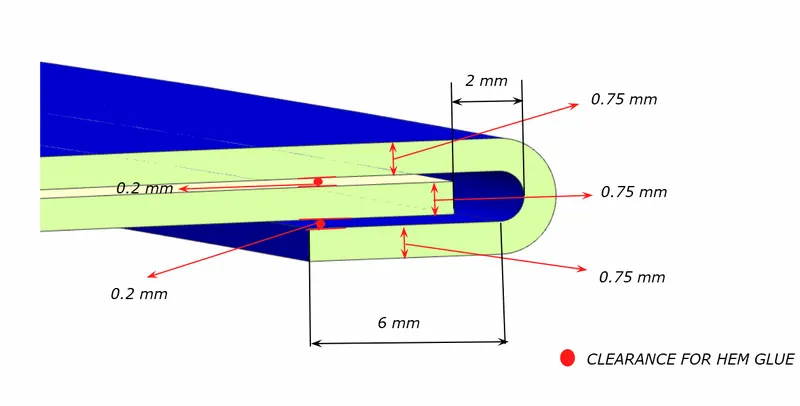
SOFTWARE USED- Siemens NX 12.0
Manufacturing Requirements-
minimum fillet radiu = 3mm+thikness
no sharp corners inside the component
provide approprite corner relief on area or curvature
provied exact mastic points to reduce the NVH(Noise Vibration harness)
embosses height of 18.5
Hood Thickness information -
Outer panel Thickness= 0.75
inner panel thickness=0.75
- DESIGN PROCESS-
- Creating assembly for the hood a top down process
- Outer panel
- Inner panel
- hinge assembly
- striker
- DESIGN CONSIDERATION FOR DESIGNING THE HOOD
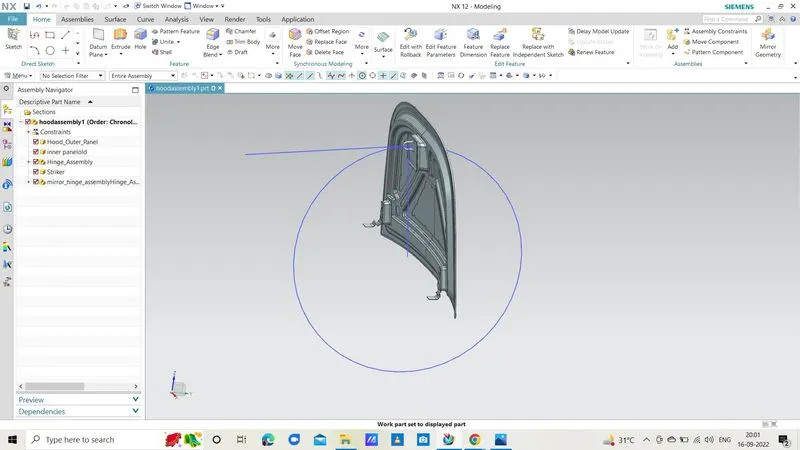
1. Latch Trajectory -
The latch trajectory shows the path of the striker when the hood is opened and closed on a vehicle. the radius of the circular trajectory is determined by the set standard based on the average height of a person. the radius is measured from the hinge axis up to the latch.
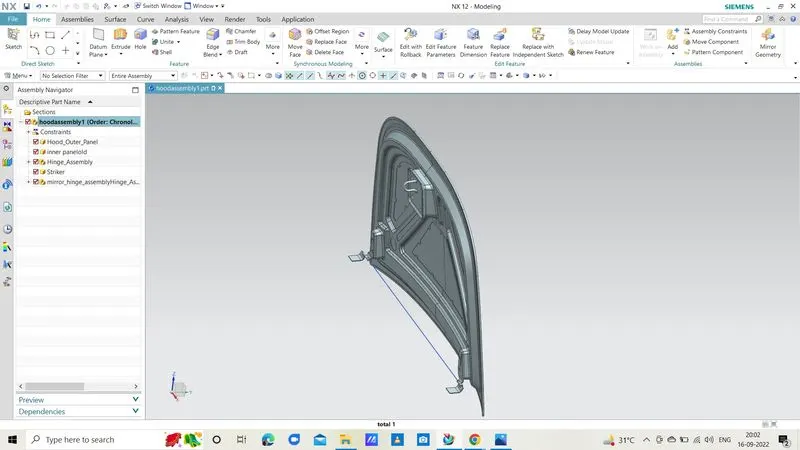
2. Fixing the hinge Axis-
the hinge axis is positioned in such a way that the axis lines in the same line so that it is parallel to the x-axis plane .this is done in order to position the latch and striker trajectory motions exactly perpendicular to the hinge axis.
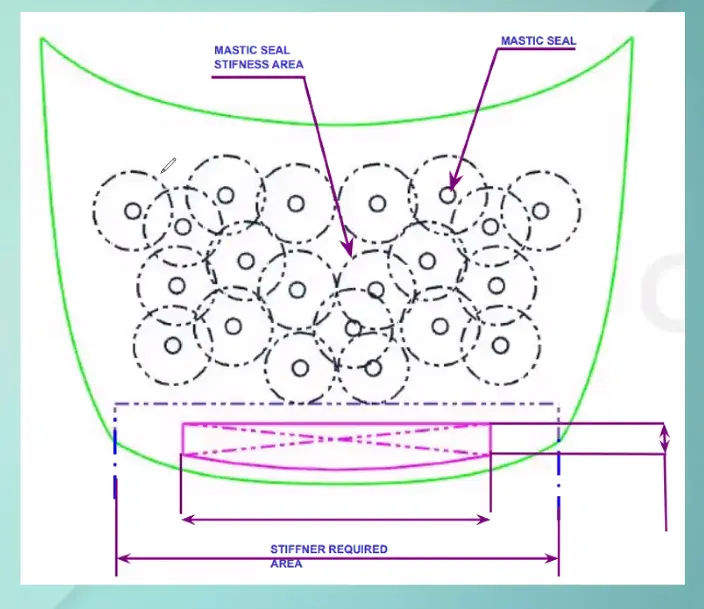
3.Mastic Points-
The mastic points are areas where the mastic is placed to attach the outer pannel to the inner panel ,+. we cannot use spot welding as it would give a less aesthetically pleasing result.hence mastic are used to join the panels together as it does not melt the metal itselfit .
is an organic glue made form a sticky resin. it is available in the form of thin liquid, thick glue or sticky paste.
each mastic can improve the strength locally and sprad 60-80mm surrounding area.
it will also provide better NVH
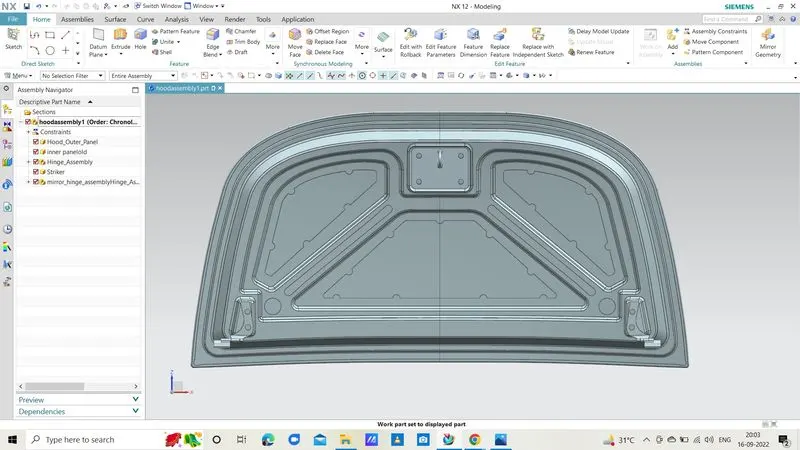
4.Emboss definitions -
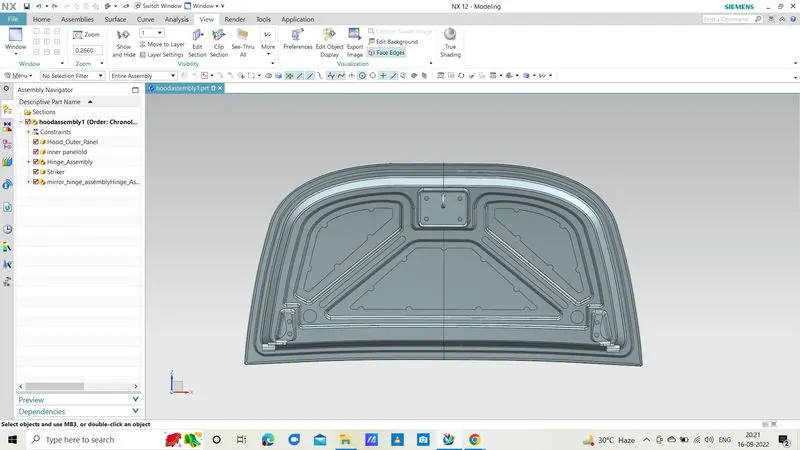
The inner panel consists of varies embosses which help dissipate the force during impact .
5. Relief on the Corners -
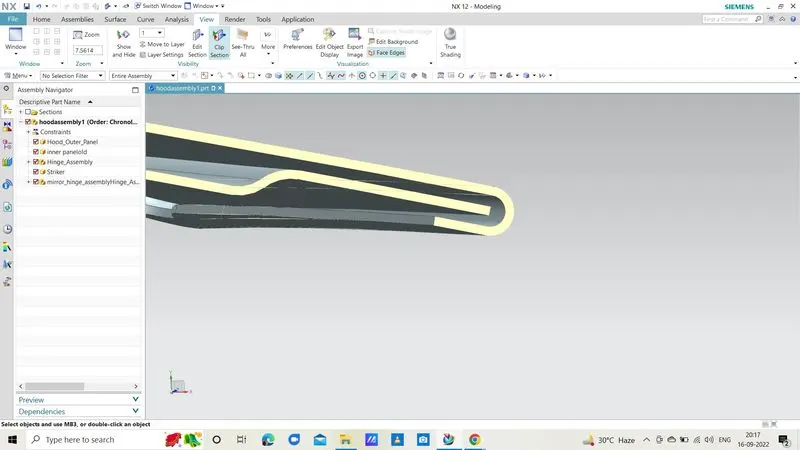
A relief on the corners is provided for the hemming process in order to avoid spring back issues .when the roller are movieng on the panels the force that is used to bend the sheet metal has to be maintained within the limit to avoid spring back issue . Due to which a relief is given on the corners to avoid the red zone on the hood
- Manufacturing Processes Involved In Hood Design
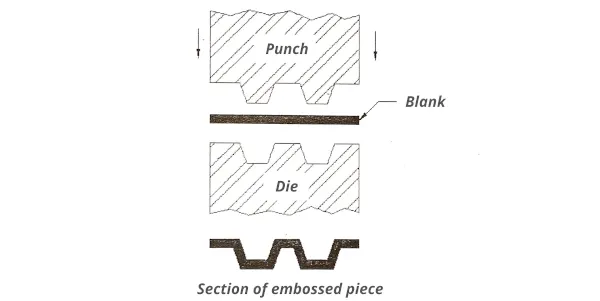
1.Embossing (manufacturing )-
sheet metal embossing is a stamping process . this process create in press shop .this process cann made by punch and die. or pressing on sheet or a strip of metal between rolls of the desired pattern
2.Deep Drawing -
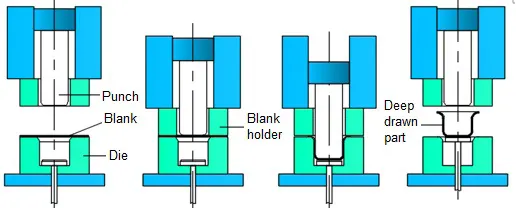
Deep drawing is a sheet metal forming process in which a sheet metal blank is radially drawn into forming die by the mechanical action of a punch . it id thus a shap transformation process with material retention. the process is considered deep drawing when the depth of the drwan part exceeds its diameter. this is achived by redrawing the part through a series of dies. the flange region (sheet metal in the die shoulder area)
experience a radial drawing stress and a tangential compressive stress due to material retention property. these compressive stress(hoop stresses) result in flange wrinkles (wrinkles of the first order). wrinkles can be prevented by using a blank holder , the function of which is to facilitate controlled.
3. Hamming process-
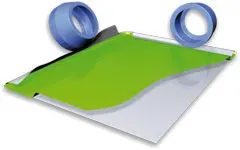
in this process sheets rolled by roller in such of one by one different angles. this process use in outer and inner panel to join
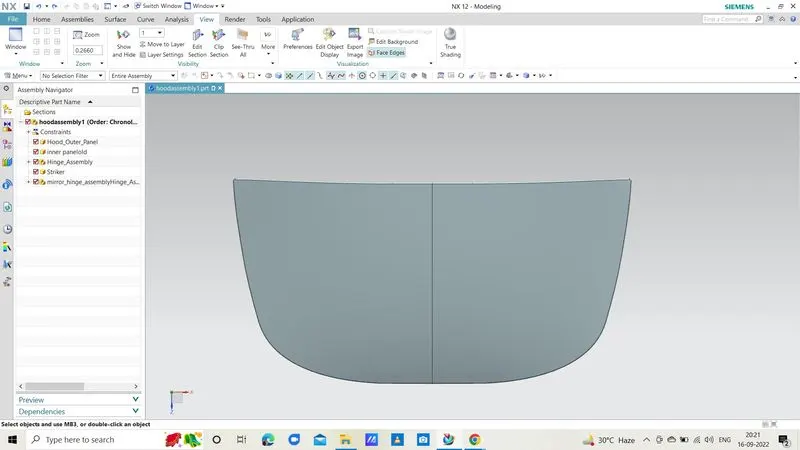
- DIFFERENT VIEWS OF HOOD DESIGNED
- FRONT VIEW-
- TOP VIEW-
- SIDE VIEW-
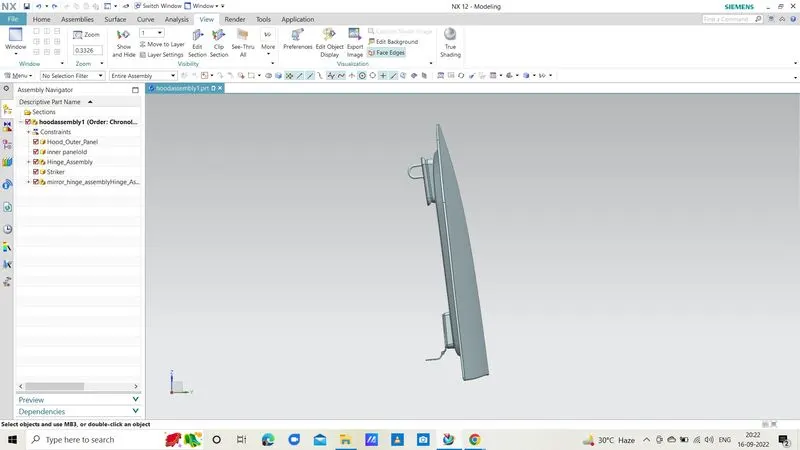
- ISOMETRIC VIEW-