Hood design-Week 2
#3 HOOD DESIGN
OBJECTIVE :
This project is to create a hood assembly from the given hood outer panel which is provided as
input surface to us according to the master section sketch and assemble the Hinge and Striker component
inthe inner panel.
Software used: Siemens NX 12.01
Following report contains
1. Hood explanation
2. Hood Design
3. Mastic Data
4. Hood parameters
*Emboss Definition's
*Hemming process
*Latch Trajectory
*panel relief
5. Assemble part
6. Conclusion
HOOD EXPLANATION:
A car hood is the metal part that covers the engine of an automobile. The term hood is a North American
term, used primarily in America and Canada. is the hinged cover that rests over the engine of a front-engine
vehicle. Its purpose is to provide access to the engine for repair and maintenance.
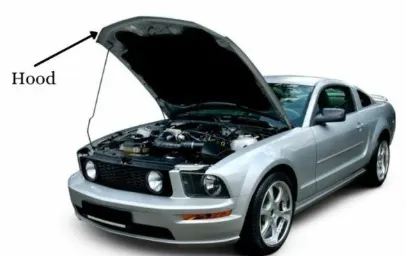
A concealed latch is typically used to hold down the hood.Hoods are usually made from the
same material as the rest of the body. This can be steel , aluminum, fiberglass, or carbon fiber. However,
some aftermarket companies produce fiberglass or carbon fiber steel hood replacements to make the vehicle
lighter.
HOOD DESIGN:
The hood designed has the inner pannel, outer panel and reinforcement (it will provide the strength) and
emboss.Latch and striker mechanism is used to open and close the hood whenever is needed. Latch and hinge
is needed some reinforcement for strength. the hood openning distance is very importent to access the inner
engine components,This criterion average height of the humans in the region of consideration. For example,
the average height of a human being in India is 5.8 feet whereas in European countries the average height of
a human being is 6 feet.
There are two types of support is there,
- Gas stay
- Support rod
Hence the opening angle of the hood greatly depends on the height of the human. which can be controlled by
the support rod or gas stay.To design the car hood and understand the mechanism behind the design of hood,
then development & its safety features as per the design consideration.
The following task is performed:
- To make a Inner Panel
- Develop all the Necessary Reinforcements
- Mirror and position the Hinge & Striker
- Provide Mastic Data
- Provide the required Emboss definition
- Develop a detailed Report for the Mastic position and Embosses you have placed.
- To assemble the Inner panel and Outer Panel with the Hemming process
To make a inner panel by following data to be given
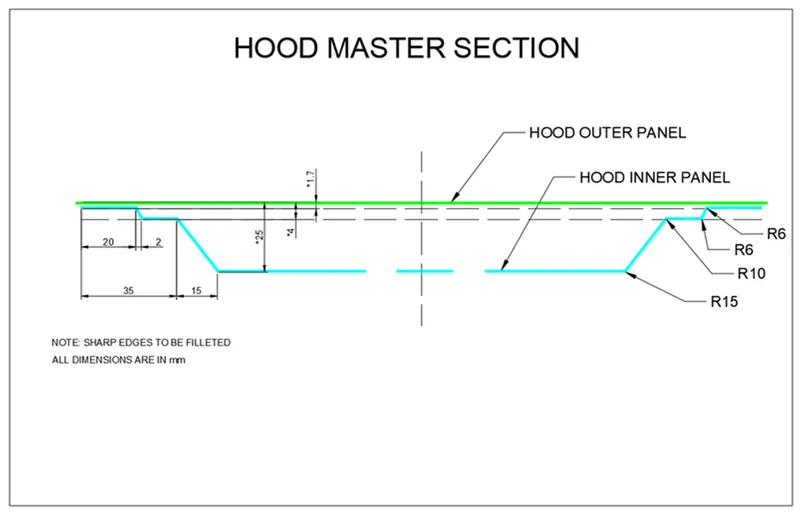
Hood Thickness Information
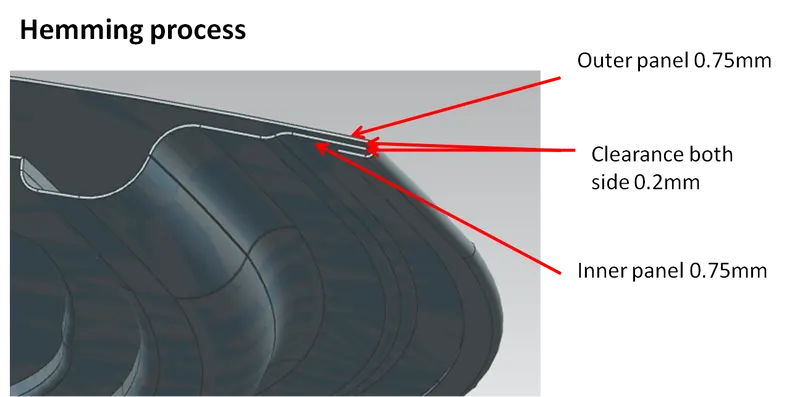
- Outer Panel Thickness = 0.75mm
- Inner Panel Thickness = 0.75mm
- Reinforcement Thickness = 1.5mm
MASTIC DATA
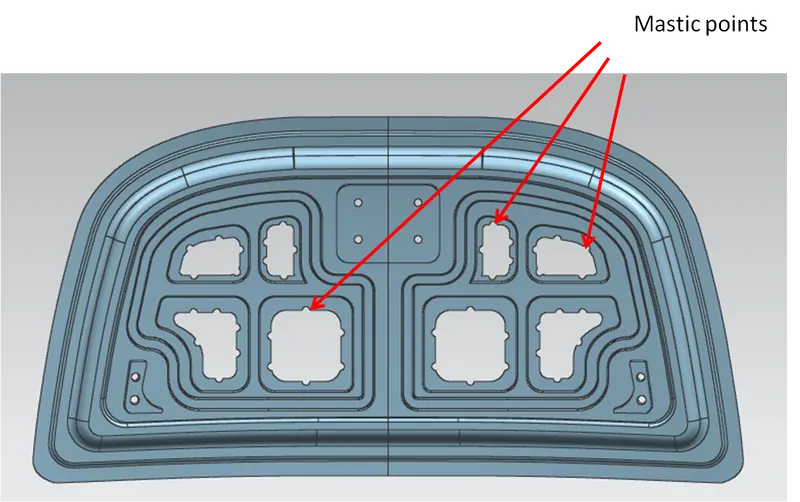
The Mastic sealant or the Mastic point is an elastic compound that behaves like a rubber. The mastic
points are defined on the hood inner panel where the hood can easily deform. They help the hood outer panel
to come back to its original shape after it gets deformed. The mastic has an influence area of 80mm.
A mastic sealant data is used to fix or combine the hood outer panel and hood inner panel.
- They can provide thermal and acoustical insulation, and may serve as fire barriers. They may have electrical properties, as well Sealants can also be used for simple smoothing or filling. They are often called upon to perform several of these functions at once.
- A sealant has three basic functions: It fills a gap between two or more substrates; it forms a barrier through the physical properties of the sealant itself and by adhesion to the substrate and it maintains sealing properties for the expected lifetime, service conditions, and environments. The sealant performs these functions by way of correct formulation to achieve specific application and performance properties.
HOOD PARAMETER'S
* EMBOSS DEFINITION'S
The Emboss is the process to deform the sheet metal body by using in pressing process that angle is
maintain at 10 deg by relifing. geometry is created based on the master section that was designed above.
After performing the initial stages of design, we will provide local embosses to strengthen the component. The
component will be strengthened based on the master section.
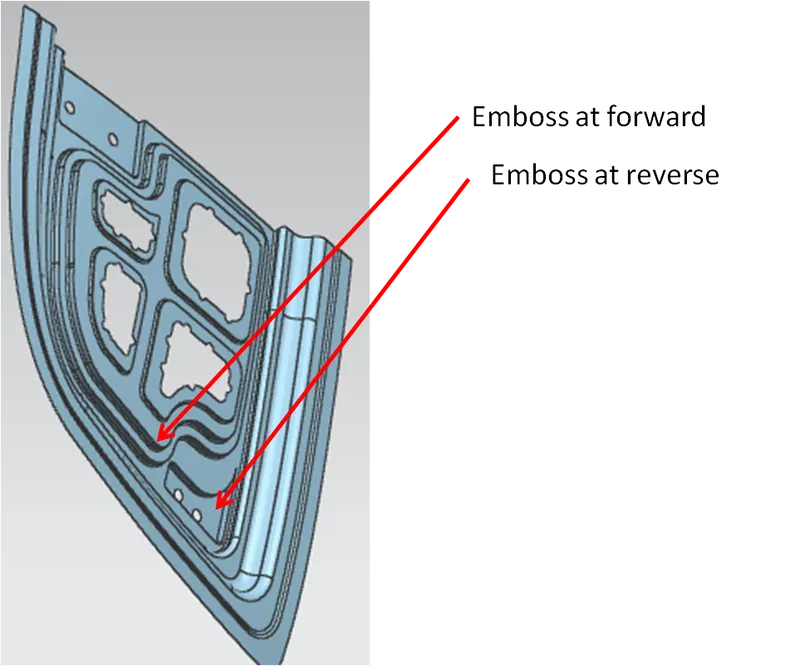
When a force impacts the hood from the front, it travels in an upward direction. The component is
designed to divert the force away from the passengers into the hinges, as shown in the image below The
embosses in the inner panel are made according to the diversion of the load path. The emboss depth is kept
at a maximum of 5mm to be on the safer side so that the part is manufacturable.
*HEMMING PROCESS
Hemming is a technology used to join inner and outer panels together.. It is the process of
bending/folding the flange of the outer panel over the inner one. The accuracy of the operation significantly
affects the appearance of the car’s outer surfaces and is, therefore, a critical factor in the final quality of a
finished vehicle.
The following data to be given and do that same dimension by the Hemming process
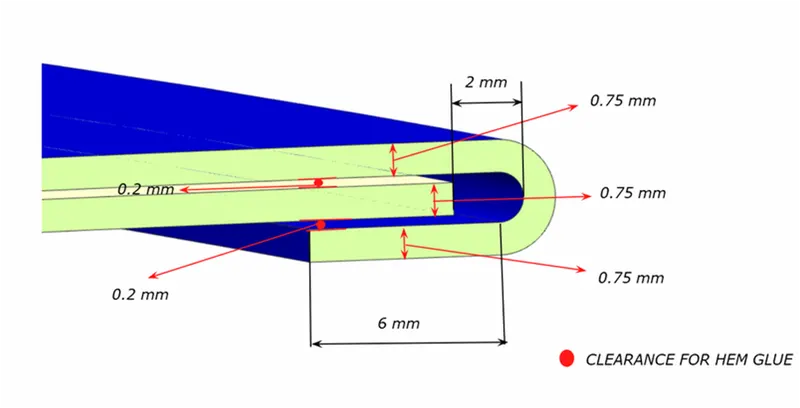
The hemming process roles and wraps the hood outer panel around the inner panel and holds it tightly
together.
The following are the dimensions followed for hemming my self
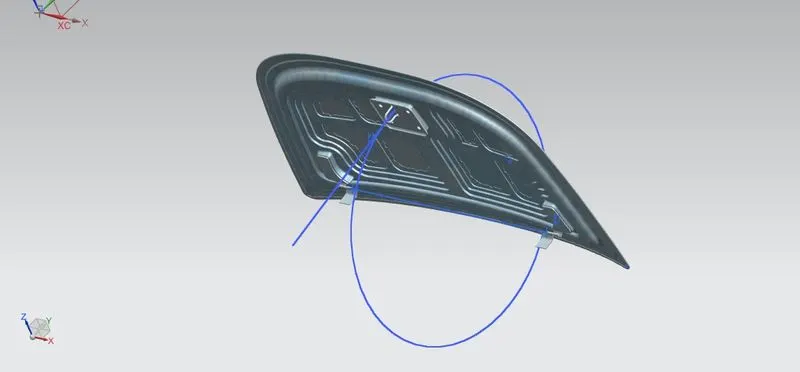
*LATCH TRAJECTORY
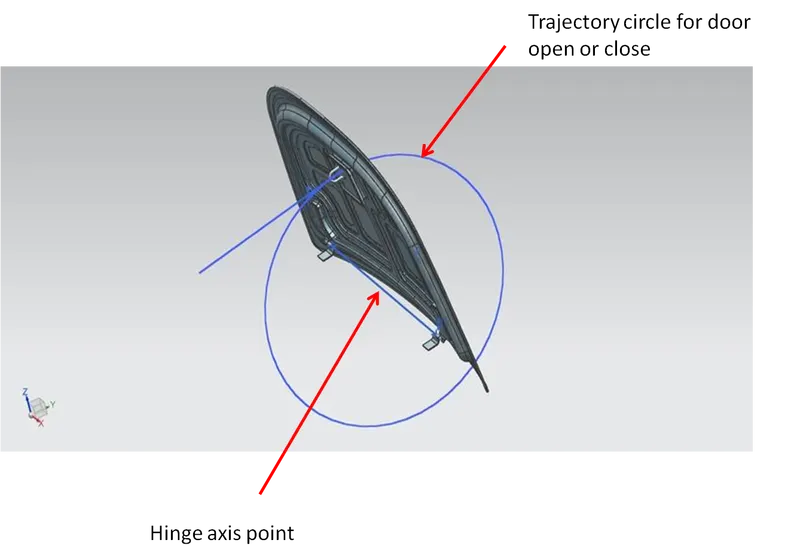
Trajectory line for the proper opening and closing of the hood, the striker should be perpendicular to
the trajectory of the hood.For this, hinge is assembled at its position. Once it is placed, hinge axis is drawn.
Using the hinge axis as the center we draw a big circle to the position the latch in such a way that it is
perpendicular to the hood trajectory.
*PANEL RELIEF
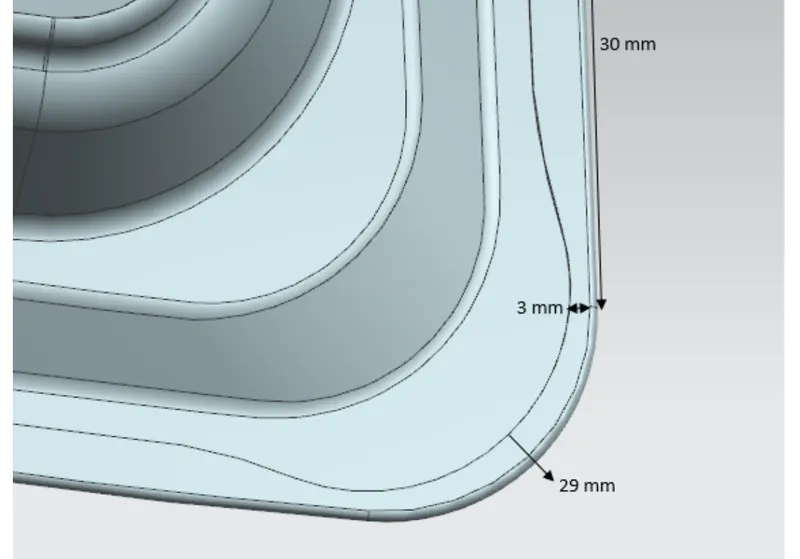
Relief is provided onto the part or component in order to remove any stresses developed in a particular area
sharp corners that takes place during the hemming process is carried out. Thus corners are rounded or
chamfered.
ASSEMBLE PART (Final hood assembly)
After that we assemble all the componet in same referance point
CONCLUSION:
To make the hood design succesfully completed as per the given inputs and design standards and also done
the draft analysis on the parts to check feausability. Also the design was executed under the EuroNCAP safety
standards and hence satisfies hood safety both for occupants and the pedestrians. Thank you!