Hood design-Week 2
DESIGN A HOOD USING NX CAD:
- AIM:
- To design a hood for the car with the given parameters considering various factors like safety, manufacturing, and functional requirements with respect to the EURO N-CAP standards.
- INTRODUCTION:
-
The Hood is an opening body panel that covers the engine in a front-engine vehicle in some cases like rear engine vehicles it acts as the cover of the boot space.
-
The inner panel provides strength while the outer panel functions as the metal cover for aesthetics.
- Hoods are designed in such a way that the outer hood doesn't have any joints or weldings to make it aesthetically pleasing.
-
Hoods also play a major role in the aerodynamics of the car, thereby reducing the drag and increasing the downforce of the car.
-
Hood also helps to direct impact of the any head-on collisions away from the passenger cabin there-by reducing the damages to the passengers.
-
These Hoods are designed in such a way that less damages are caused to the pedestrians during accident.
-
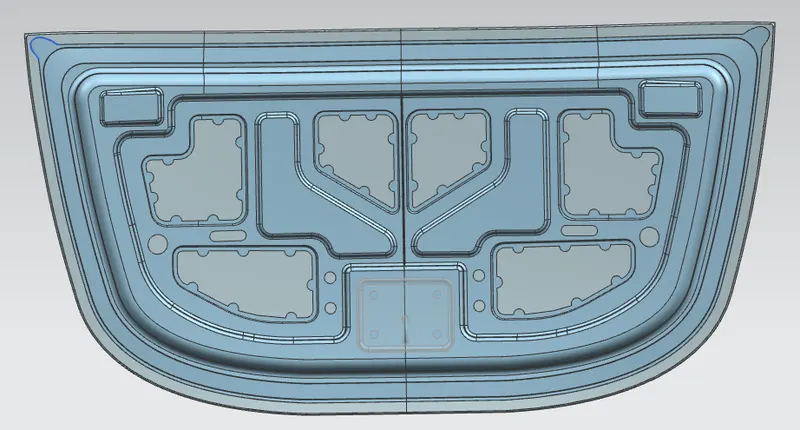
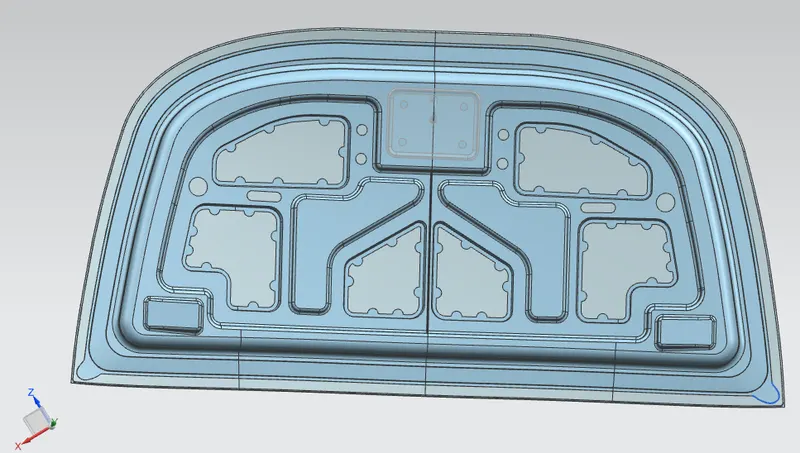
DESIGNING:- There is a Master Sketch for every region which can be adopted from a parent car on different situations which gives us the rough dimensions of the part to be designed. The inner panel including all its embosses are designed by offsetting the outer panel. The maximum gap between the inner and outer panel in the master sketch is 25mm, under which the Engine compartment is situated. This specification is given taking into consideration pedestrian safety. Process of Deep Drawing is used in manufacturing the inner panel and the design considerations are kept in mind for the same.
- The 4 components af a hood are: Outer hood, Inner hood, Striker and Hinges
-
Firstlt, we start with deciding the open angle which is based on average height of a human being in a country. Based on this data with decide the length of the support. There are two types of support - 1) Rod support and 2) Gas support. The Gas support is expensive and usually used for heavy car hoods. Rod support are usually given a curve of max 35mm for efficiency and strength.
- We have two latches to open the hood, One is the primary one which opens under the driver seat and second is between the hood and engine body which has 2.5mm gap for fingers. The second latch should be in the center or on the circumference of a circle whose diameter is the distance between the 2 hinges attached
- We have the primary latch on the front hood and hinges on the sides. These cut down the metal portion in that area, thus reducing the strength of the hood at that portion. To compensate that, we use reinforcement in form of emboss or mastic data.
- Mastic points were the gluing points where the paste is applied between the inner and outer panel to join the panels. Each mastic point will stiffness up to 80mm surrounding. So mastics to be added in such a way that it covers entire surface of the hood. If the gap is less than 5mm between the outer and the inner panel without mastic points it will cause vibration resulting in NVH problem. Below image shows the mastic points where the paste is applied, and it will get hardened in further processes resulting in a rigid joint.
-
The embosses are projected sections from the inner panel surface that are created in order to redirect or dissipate the forces away from the centre of the hood, towards the hinge to avoid passenger damage.The embosses with varying depths (5mm, 7mm, 9mm, 13mm) are provided on the hood for reinforcement & to add strength to the inner panel.
- Hemming: It is the process of joining both the outer and inner panel together. The hemming process roles and wraps the hood outer panel around the inner panel and holds it tightly together. The wrapping the flange of the outer panel to the flange of the inner panel so that they are fitting rigidly. After hemming process, the sealants were applied along the edge of the flange of outer panel so that water tightness is achieved.
- Usually, the reliefs were provided at the corners of the hemming flange to avoid the Hemming relief to avoid stress developed while hemming. stress developed during the hemming process.
- Manufacturing Feasibility:
-
When creating a component, a design engineer must ensure that it can be manufactured using any method with the least amount of resources (time, materials, personnel, and electricity). so that we can lower the cost of the car as a whole.
-
When the hood is taken into account, it is typically made by deep sketching. A single sheet of metal is placed over a die that has the necessary shape for the final product and is pressed against it using a tool in the process known as deep drawing. Typically, throughout the modelling process, a pressing relief of 5° to 9° will be offered to allow the tool to exit the portion.
-
In NX draft analysis, we can understand whether the product is manufactured by pressing or not. One side of the surface is highlighted by green and other side by Red colour means that the model can be manufactured.
-
Data to be used:
Hood Thickness Information
- Outer Panel Thickness = 0.75mm
- Inner Panel Thickness = 0.75mm
- Reinforcement Thickness = 1.5mm
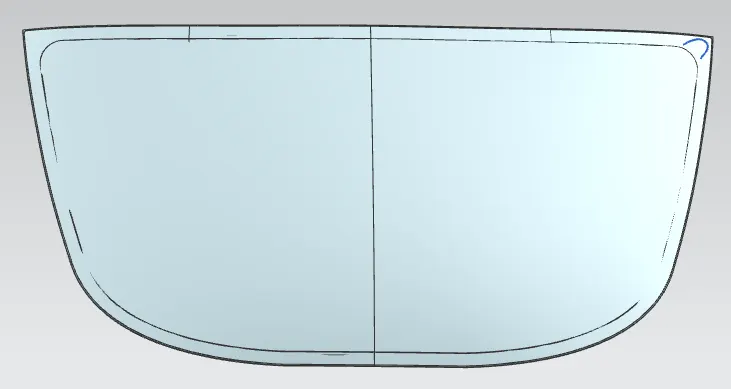
- Images of the HOOD
-
RESULT:
Thus the hood for a car was designed that satisfies the industrial manufacturing requirements and functional requirements using NX CAD.