Hood design-Week 2
Hood Design:
Introduction:
The hood is a design element and is the part of the body that borders to
the front fenders, front lights, bumper and the plenum cover. The complete
hood consists of an inner and an outer plate joined together by hemming
around the edges of the hood. Rubber based glue is used in the flange joint
as glue between outer and inner hood and on points as well in the inner plate
pattern as anti-flutter. Today a certain pattern is used in order to fulfill
the requirements for pedestrian safety and total stiffness in the hood. Front
reinforcement (=lock striker reinforcement) and hinge reinforcements (steel)
are clinched to the inner plate. Spot welding is used in part assembly of front
reinforcement.
Purpose of Hood Design:
- Save and safety of purposes inside the car.
- Cover all engine parts and radiators.
- Reduce the Air effect due to design aerodynamic shape.
- provide access to the engine for repair and maintenance.
- reduces engine noise, providing you with a quieter drive.
- In Japan and Europe, regulations have come into effect that place a limit on the severity of pedestrian head injury when struck by a motor vehicle. This is leading to more advanced hood designs, as evidenced by multicone hood inner panel designs as found on the Mazda RX-8 and other vehicles. Other changes are being made to use the hood as an active structure and push its surface several centimeters away from the hard motor components during a pedestrian crash. This may be achieved by mechanical (spring force) or pyrotechnic devices.
Hood & Fender Design Requirements for Head Impact:
- The 1st and most important safety requirement to be considered while designing the Bonnet is the Pedestrian Safety from a frontal collision.
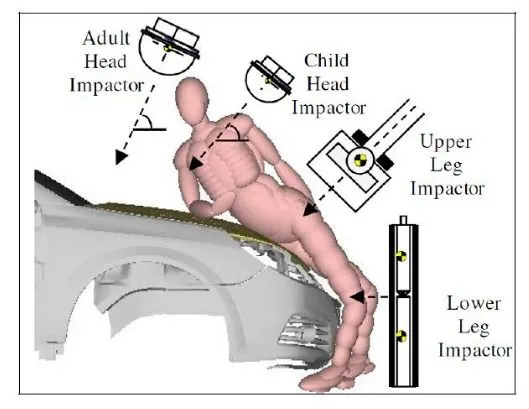
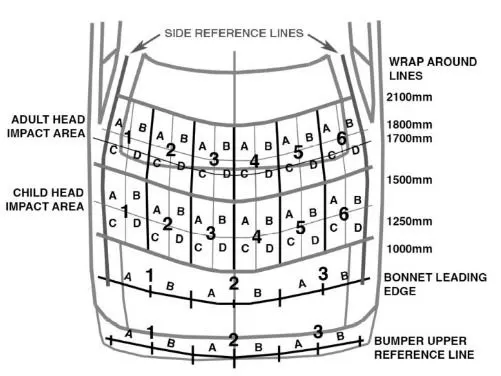
- The European New Car Assessment Program (Euro NCAP) is a European car safety performance assessment program which has developed test specifications and rating systems for assessing pedestrian injuries during impacts with the front of vehicles Such tests include a series of tests using impactors designed to mimic a collision at a speed of 40 km/h. They describe a situation in which a pedestrian is situated laterally and a car first hits one of his legs. Tests are conducted on the leg, upper leg, and most importantly, the head, as head trauma is most commonly responsible for casualties.
- Thus to avoid severe injuries to the head, the high impact area for adults and children is subjected to less thickness. Also, no reinforcement should be provided in that area as, during the head collision, the hood will absorb the head impact energy leading to the collapse of the hood and thus protecting the severe head injury.
- Another important criterion for the hood design is the protection of the occupants inside the car during the front collision. The design of the hood should be in such a way that during the collision, the force should travel in the upward direction through the embosses and directed towards the body of the car. Thus protecting the occupants inside.
Mastic Data Design:
The main purpose of the outer panel is for the aesthetic looks. Thus we cannot use bolts or welding. This has to be done with the help of the hemming and mastic sealants. Mastic sealants are elastic compound that behaves like the rubber. It is placed between the outer and inner panels. Initially is it in paste form, but after the hot furnace bath, it gets hardened thus joining the outer and inner panel. Mastic sealant has the tendency to increase the strength of the panel and has the influence of 80mm diameter.
Hemming in outer hood panel:
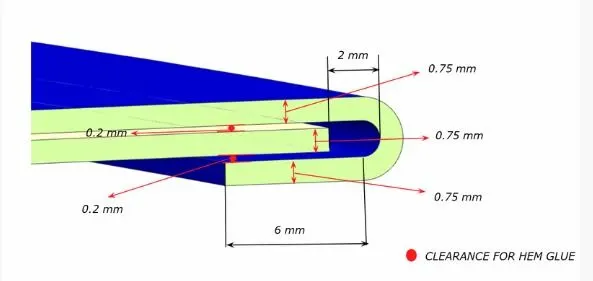
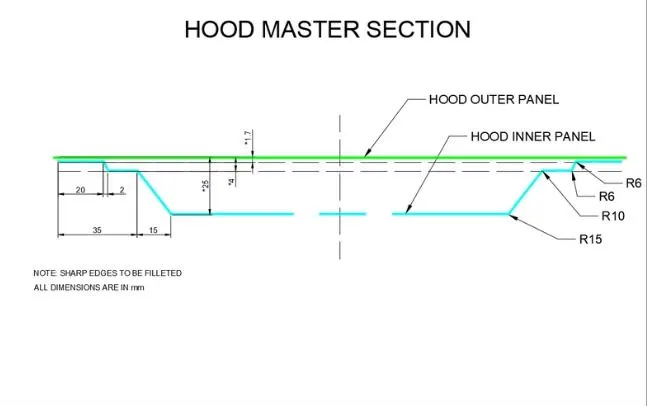
Hemming is the process in which the edge is rolled flush to itself, while a seam joins the edges of two materials. Normally hemming operations are used to connect parts together, to improve the appearance of a part, and to reinforce part edges. In hood design, hemming is used in assembly as a secondary operation after deep drawing, trimming and flanging operations to join two sheet metal parts (outer and inner) together. Dimensions of hemming are given below.
Embossing Operation:
- Embossing is done by pressing a sheet of paper (or another substrate) into a female die, that has a design engraved or etched into it. This is usually done with a male counterpart underneath the paper so that the paper is sandwiched between the two and the design is transferred to the paper.
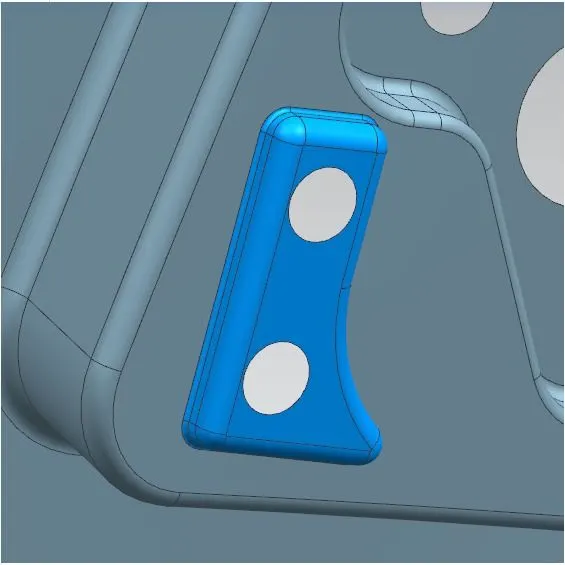
- Purpose: Emboss Surface provides flat surfaces between inner panel and hinge assembly and striker hence help in reducing NVH.
Hood Design Steps:
1.Master Section
The Master section is already provided by the marketing team and the manufacturing requirements.
2.Hood Inner Panel Design
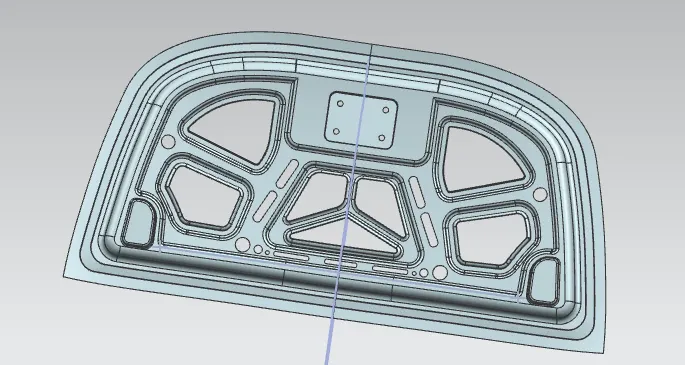
The initial design was created from the master section that was already provided. Embossing is a metal forming process for producing raised or sunken designs or relief in sheet material by means of matched male and female roller dies, theoretically with no change in metal thickness. Embosses are created to provide additional strength and to direct the forces from the front collision towards the hinge and body of the car.
To furthermore reduce the impact to the occupants inside the car, additional latch and hinge reinforcement to the hood. When latch and striker are placed, there is a drop in strength at that position thus reinforcement is required. Also, stiffness pads are placed to reduce NVH. Hinge and latch reinforcement thickness is kept at 1.2 mm but it may vary.
3.Hinge and Striker
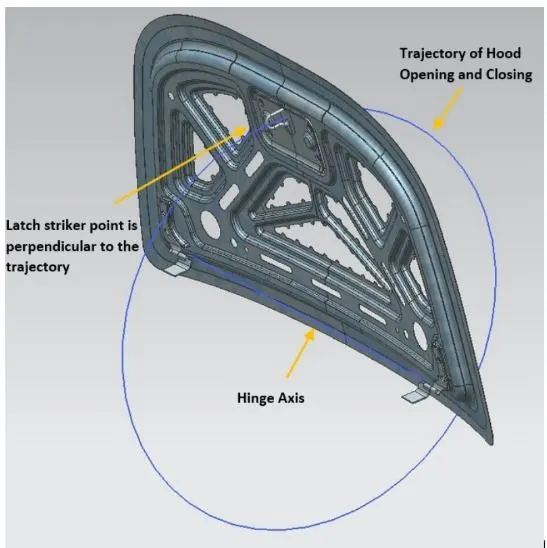
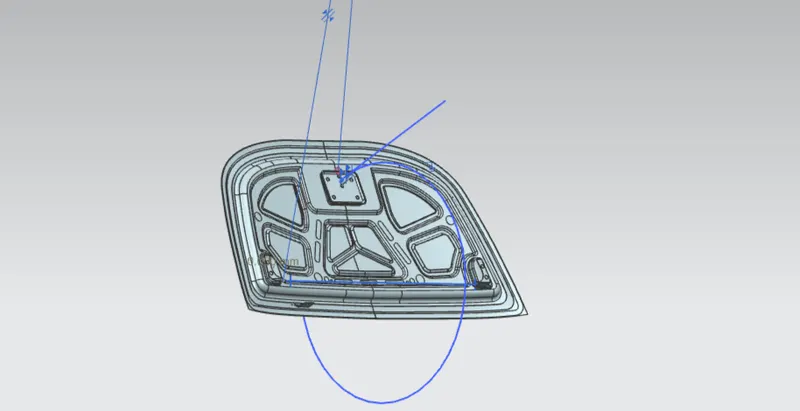
For the proper opening and closing of the hood, the striker should be perpendicular to the trajectory of the hood. For this, the hinge is assembled at its position. Once it is placed, the hinge axis is drawn. Using the hinge axis as the center we draw a big circle to the position the latch in such a way that it is perpendicular to the hood trajectory.
Hood Assembly:
NX CAD commands used:
Sketch.
Extrude.
Offset.
Law of Extension.
Time Sheet.
Face Blend.
Edge Blend.
Mirror geometry.
Extract Body
Extended Sheet.
Sweep.
Deep Drawing Operations:
Operation in which the thickness of the shell wall is reduced and it's surface smooth. When materials get compress between the punch and die, which reduce the thickness and increase the height of the cup.