Hood design-Week 2
HOOD:
The hood (American English) or bonnet (Commonwealth English) is the hinged cover over the engine of motor vehicles. Hoods can open to allow access to the engine compartment, or trunk on rear-engine and some mid-engine vehicles) for maintenance and repair. The hood release system is common on most vehicles and usually consists of an interior hood latch handle, hood release cable and hood latch assembly. The hood latch handle is usually located below the steering wheel, beside the driver's seat or set into the door frame. On race cars or cars with aftermarket hoods (that do not use the factory latch system) the hood may be held down by hood pins. Some aftermarket hoods that have a latch system are still equipped with hood pins to hold the hood buttoned down if the latch fails.
Design parameters to be used:
- Outer Panel Thickness = 0.75mm
- Inner Panel Thickness = 0.75mm
- Reinforcement Thickness = 1.5mm
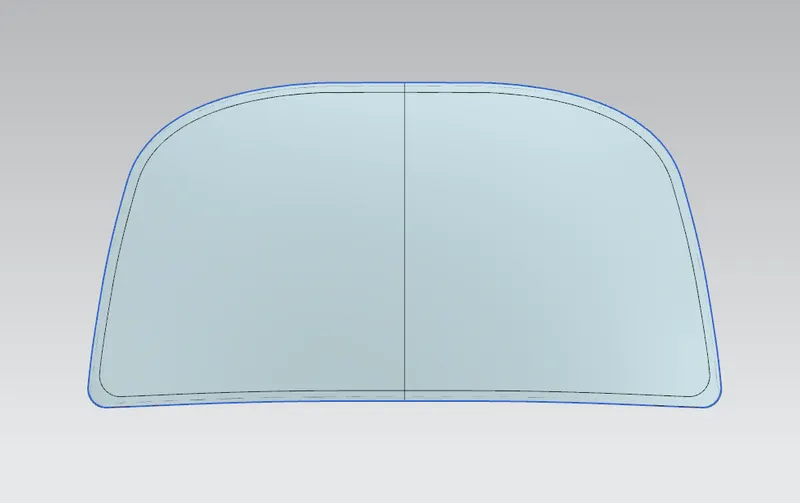
Hood Outer Panel:
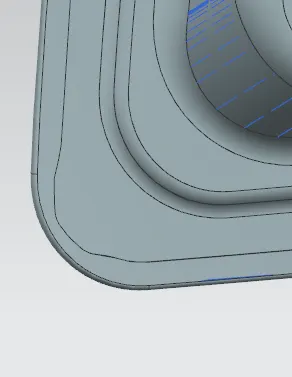
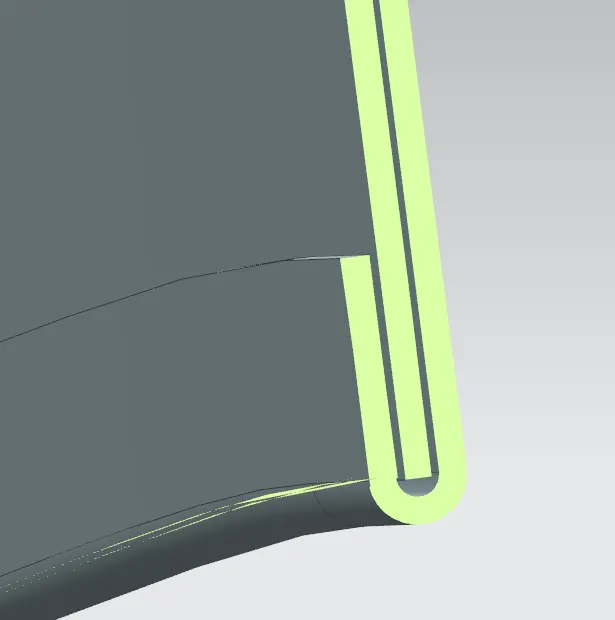
Hood Outer Panel is the Aesthetic Surface of the car. The outer panel is attached to the inner panel by hemming. So, it is necessary to provide required hemming flange and reliefs for the hemming operation. We also provide mastic sealants between outer panel and inner panel to reduce vibration.
Hood Inner Panel:
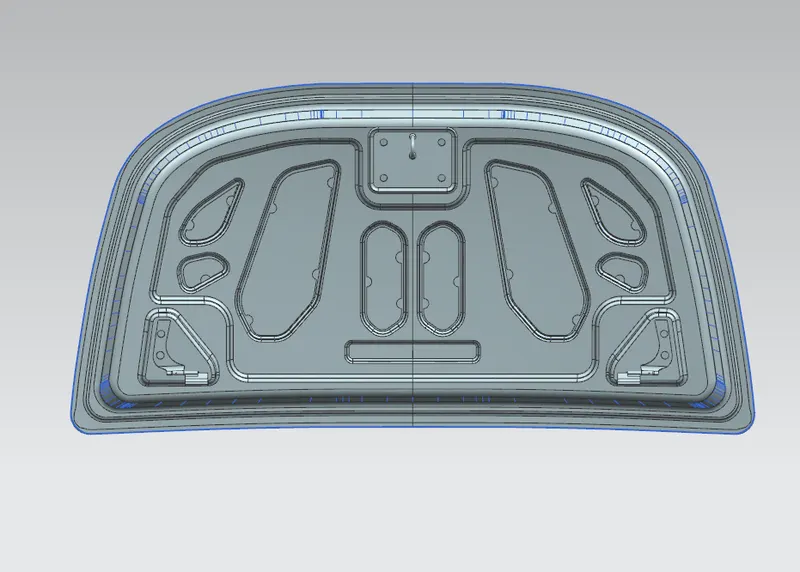
Hood Inner Panel is strengthening part for the outer panel and also holds the latches and Stringer with it.
Trajectory :
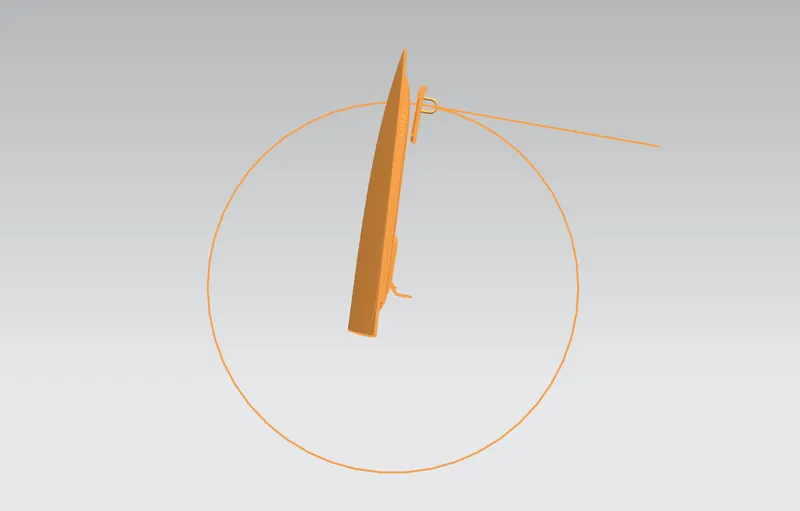
Trajectory is the path that the latch follows which is along the axis of the hinge attached. The latch tip should be tangency to the patch.
Mastic Points:
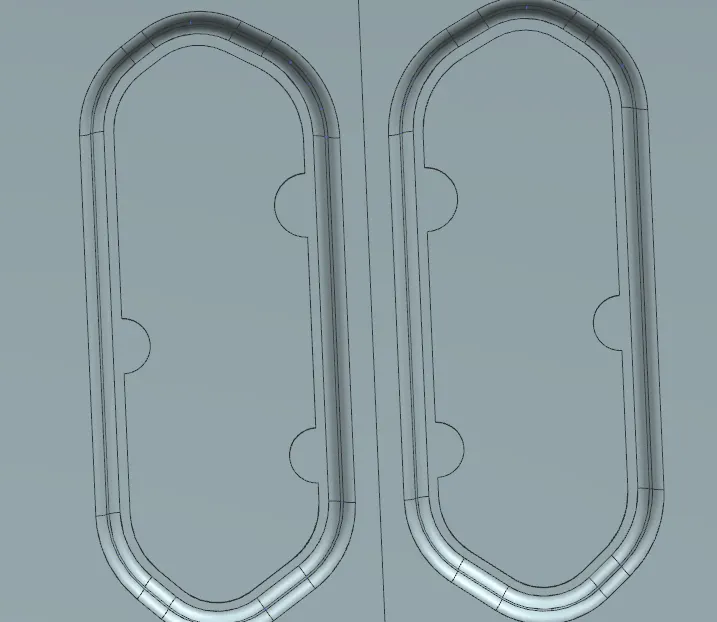
A selection of high-quality vehicle-specific mastic joint sealants & adhesives from professional vehicle assembly sealant and adhesive manufacturers such as Sika, Geocel and Otto Chemie for a wide variety of commercial and industrial sealing & bonding applications around all types of vehicles. There's specialist Sikaflex vehicle assemble sealants and vehicle adhesives for windscreen assembly, maintenance and repairs, vehicle sealant & adhesives suited to vibration dampening etc. and polyurethane vehicle mastic sealants for waterproofing and bonding which adhere perfectly to a variety of substrates and are suitable for a wide range of timber, metal and glass.
Hemming:
Hemming is a sheet metal forming process in which sheets are joined by bending it to 180°. Automotive body panels and automotive parts such as deck-lids, trunk-lids, doors, hoods and tailgates are formed by hemming process. In this process, usually a sheet is bent with the help of inner sheet in three different stages.
Saftey prespective of Hood:
The latest data released by the World Health Organization (WHO) showed that India ranks first
country with the highest number of deaths caused by traffic accidents, while Indonesia was reported to
have an increase in the number of traffic accidents by more than 80 percents, where the death toll from
traffic accidents reached 120 people per day. However, the mechanism of injury is complex. The Head Injury Criterion (HIC) indicates a measure of head injury arising from an impact, which is evaluated by the impactor in terms of the
simulation of child head. HIC includes the effects of head acceleration and the duration of the
acceleration.
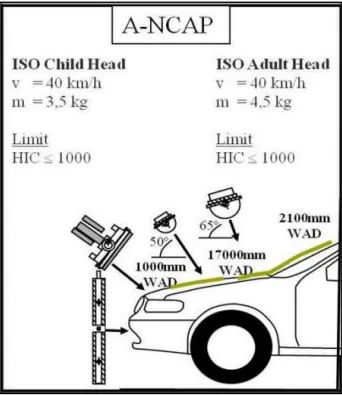
ANCAP (Figure) provides measures for the assessment of pedestrian protection performance of a
passenger car experimentally by firing subsystem impactors representing a child head, adult head,
upper leg and lower leg at a specified angle and speed to the front end of a stationary vehicle. The
resulting injury measures from these physical tests are assessed against the bounds specified by the
protocols shown in Figure . This study focuses only on child pedestrian head impact to the outer hood
panel and do not include inner hood, upper or lower leg impacts defined in these protocols.
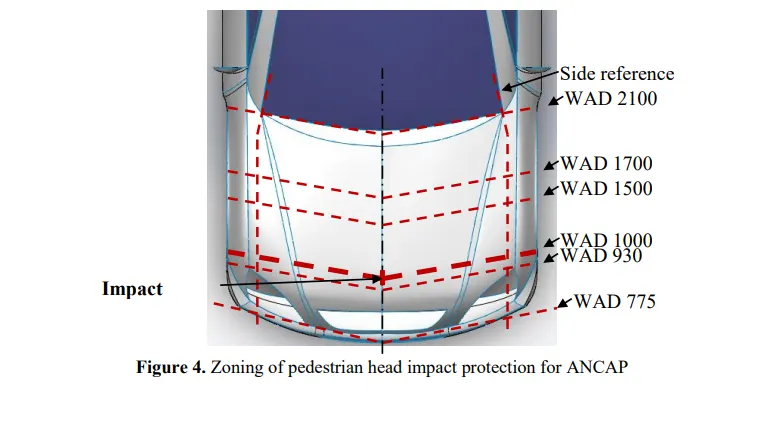
According to the requirements of the Australian New Car Assessment Program (ANCAP) for
pedestrian protection, it needs to define zones of car hood for analysis, as shown in Figure 4. It can be
noted that when the collision projection point locates between (Wrap Around Distance) WAD 1000
and WAD 1500, the head type will use the children head type. The adult head type will be used while
the collision projection point locates between WAD 1700 and WAD 2100. In the current study, the
collision projection point located at WAD 1000 when the children head type will be used.
Results :
- Zip File is attched
- Drive link :
- Assemble and parts are attched