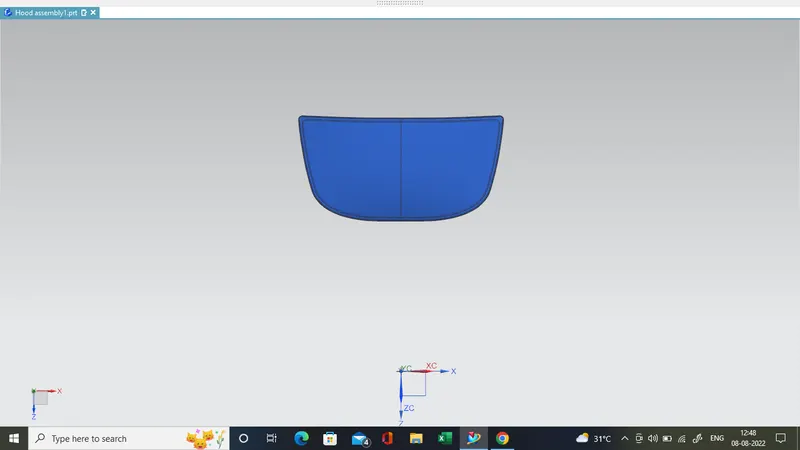
Hood design-Week 2
INTRODUCTION:
HOOD
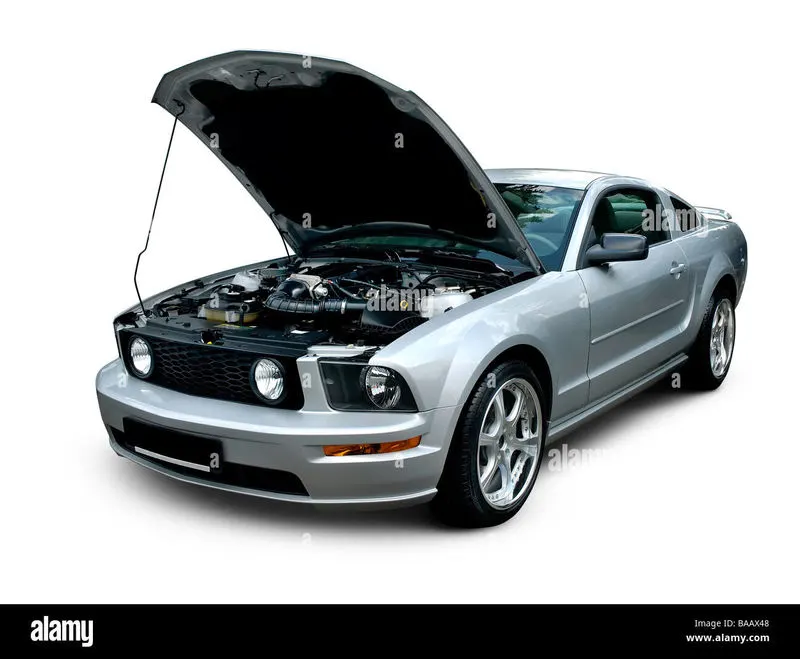
The HOOD or BONNET is the hinged cover the engine of motor vechicle. Hoods can open to allow access to the engine compartment, or trunk on rear engine and some mid engine for maintenance and repair
In British terminology, hood refers to a fabric cover over the passenger compartment of the car (known as the 'roof' or 'top' in the US). In many motor vehicles built in the 1930s and 1940s, the resemblance to an actual hood or bonnet is clear when open and viewed head-on; in modern vehicles it continues to serve the same purpose but no longer resembles a head covering.
On front-engined cars, the hood may be hinged at either the front or the rear edge, or in earlier models (e.g. the Ford Model T) it may be split into two sections, one on each side, each hinged along the centerline. A further variant combines the bonnet and wheel arches into one section and allows the entire front bodywork to tilt forwards around a pivot near the front of the vehicle.Hoods are usually made from the same material as the rest of the body. This can be steel, aluminum, fiberglass, or carbon fiber. However, some aftermarket companies produce fiberglass or carbon fiber steel hood replacements to make the vehicle lighter. The hood release system is common on most vehicles and typically consists of an inner hood latch/lock handle, a hood release cable, and a hood lock assembly. The hood lock handle is usually located under the steering wheel, next to the driver’s seat, or in the door frame.For racing cars or vehicles with aftermarket hoods (that do not use the factory latch system) the hood can be held down by hood pins. Some aftermarket hoods that have a latch system still have hood pins to keep the hood buttoned down if the latch fails.
A hood may contain a hood ornament, hood scoop, power bulge, and/or wiper jets
.
PEDESTRAIN SAFTEY NCAP STANDARDS:
Gloally, various NCAP's are present that carry on the pedestrain saftey tests on new vehicles and rate them accordingly
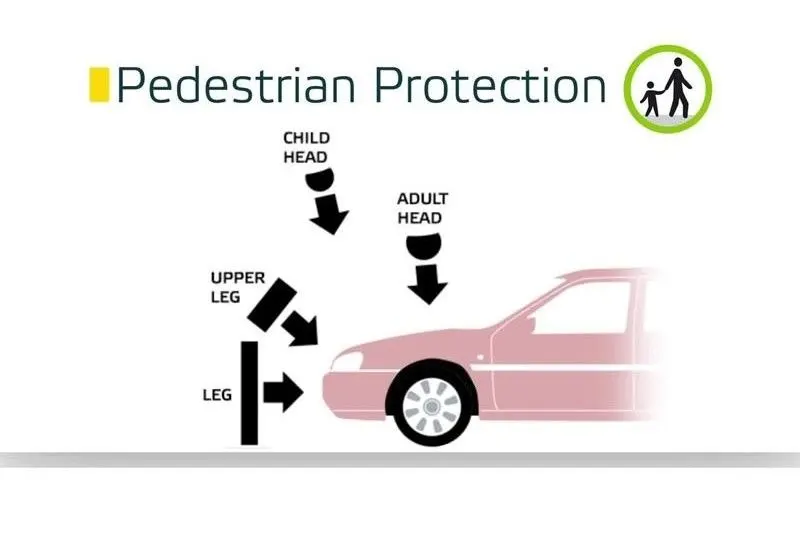
1.Head impact
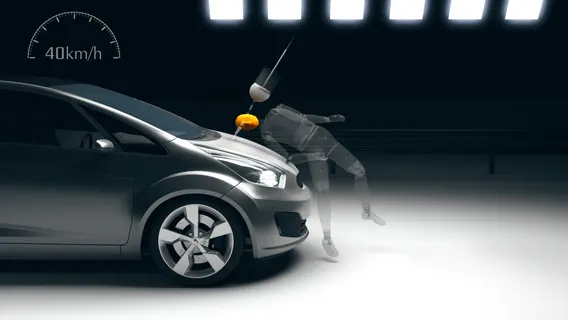
This test is carried out to have an estimate of the potential head injury in the fateful event of a vehicle striking a person a head from impactor is used in a series of test and the impact sites are then assessed this test will give some essential information which we have to consider while designing a hood
2.Upper Leg Impact
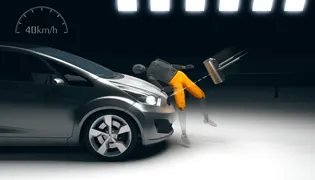
An adult upper leg form impactor is used in a series of impact test and the impact sites are assesed and then the protection is rated. The test procedure allows to check the energy absorbing capacity of the structure of the vechicle
3.Lower Leg Impact
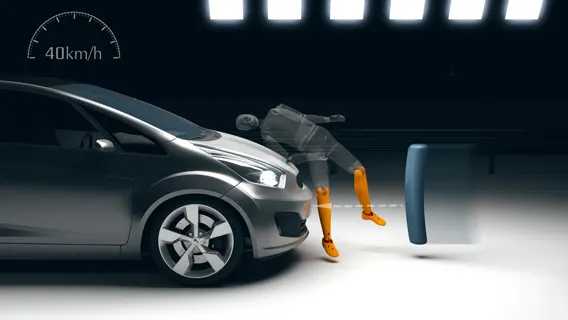
It uses an adult leg impactor and a series of tests are carried out. Impact sites are then assessed and then the projetion rating are offered
4.AEB Pedestrain
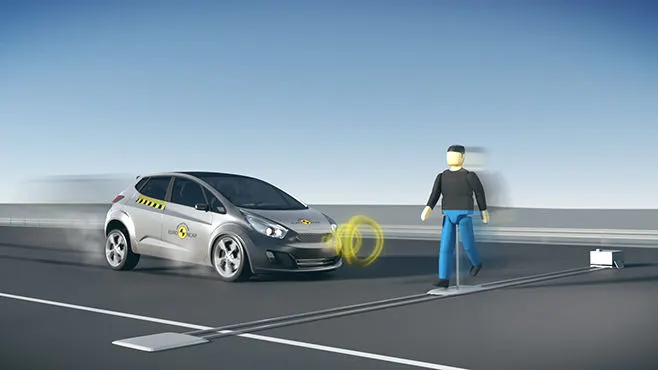
In this test the NCAP uses a specially designed pedestrain form which has articulated limbs to replicate walking motion of a human. ars are assessed o the basis of how forgiving the front end design is in case of impact. AEB pedestrain tech may not be able to completely avoid the collision in some cases. The test are done in both in day as well as night to ensure vulnerable road users are protected all the time.
5.AEB Cyclist
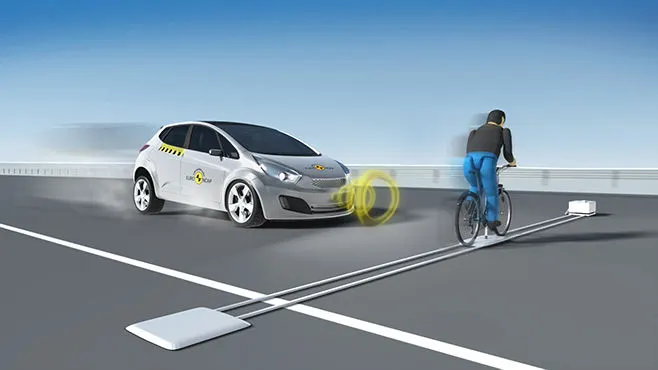
In this test Euro NCAP uses a specially designed cyclist form which will replicate the actual cyclist on the road
DESIGNING A HOOD
The most important criteria for designing the hood is to set an opening angle till which the hood panel can be opened. This opening angle is different for different countries which largely depends on the average height of a person in that particular country.
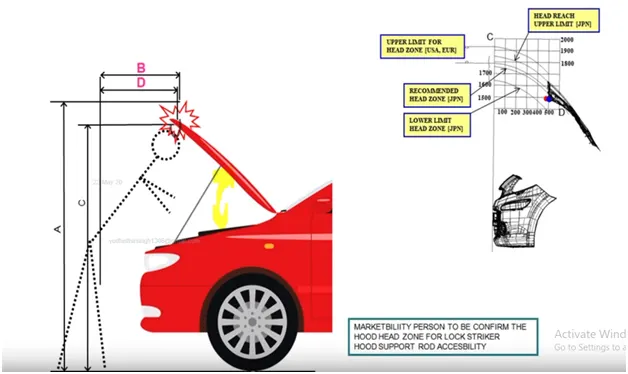
The Hood is made up of four major components
- outer panel
- inner panel
- latch & striker
- hinges
HOOD THICKNESS INFORMATION
- Outer Panel Thickness = 0.75mm
- Inner panel Thickness = 0.75mm
- Reinforcement Thickness = 1.5mm
MASTER SKETCH
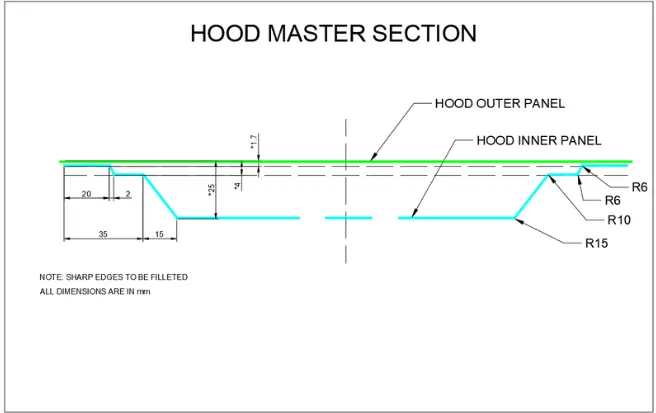
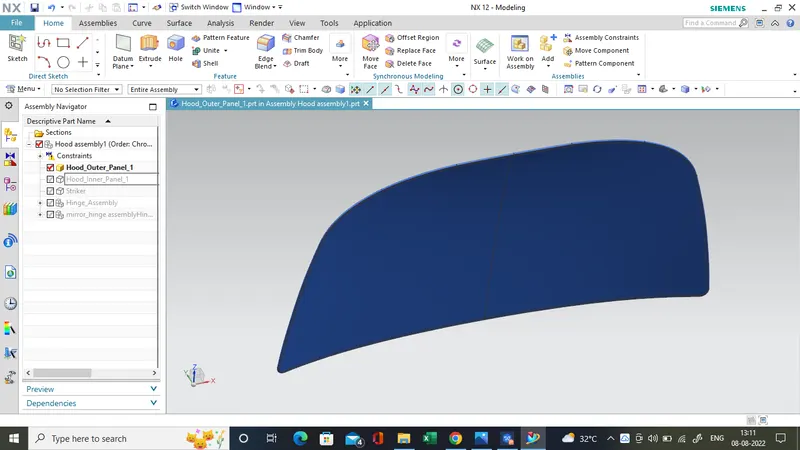
OUTER PANEL
For designing the outer Hood panel the class A surface was proiveded as input and then outer edge were extended to form a flang which was designed in a manner which represent the hemming being done to hold the inner panel with the outer panel from the outside
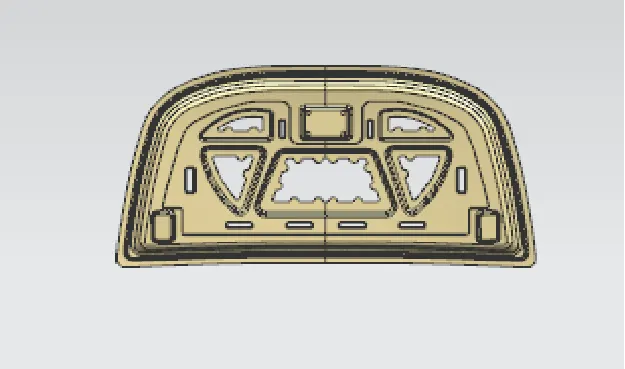
INNER PANEL
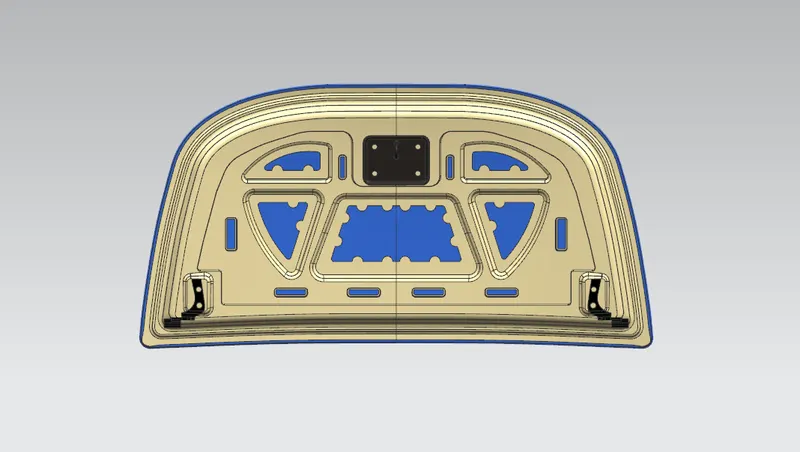
The inner panel of the Hood act as a reinforcement for hood outer panel. The thickness of hood inner panel is 0.75mm. The hood inner panel is designed by offseting the outerpanel. It contain too much of offset according to the master section and they are then combained using law extension or by using through curves. The most importan thing is that there will be no intersection and extended sheet material. Then all the edges are blended according to the master section radius.
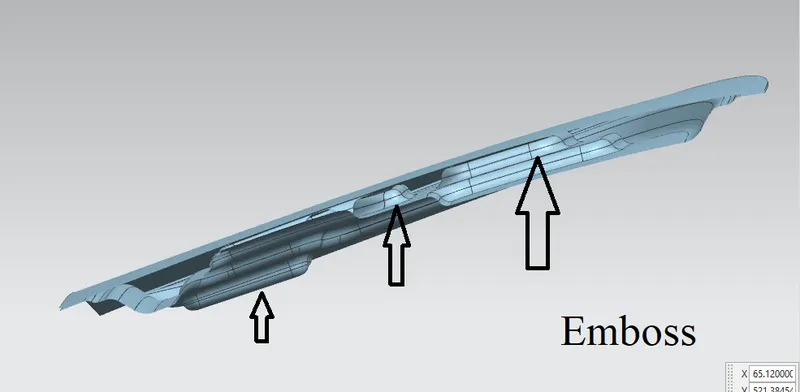
EMBOSS
Sheet metal embossing is a stamping process for producing raised and sunken designs are relief. In sheet metal embossing, the deformation of the metal takes place because of stretching of the metal (or tensile force acting on the metal), due to which the sheet metal is subjected to excessive thinning and fracturing. Thus the depth to which the material is depressed depends upon the thickness of the sheet as well as stretchability of the material.
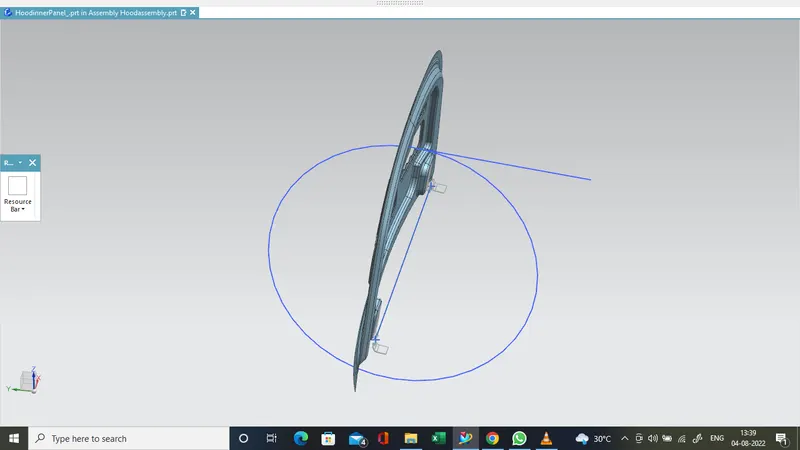
TRAJACTORY CIRCLE
To place a striker at the correct position a trajactory circle was made by taking a reference from the hinge axis the hinges have to be placed parallel for smooth opening and closing of the a hood
MANUFACTURING PROCESS INVOLVED IN MAKEING DIFFERENT FEATURES OF SHEETMETAL
Deep Drawing
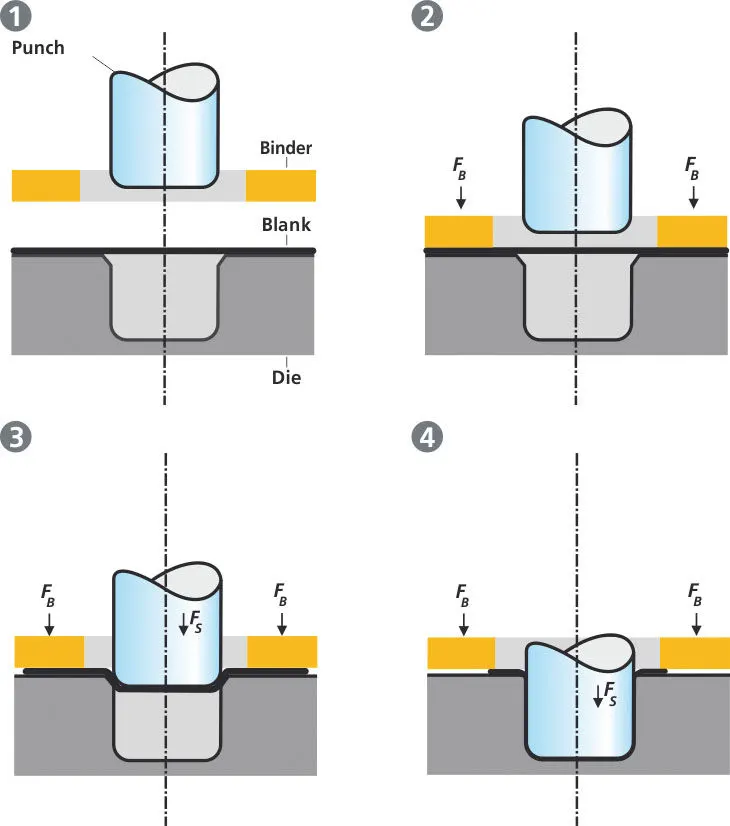
Deep drawing is one of the most widely used processes in sheet metal forming. Apart from its use in many other sectors, it is applied in the automotive industry for the manufacturing of car body parts. The deep drawing process is a forming process which occurs under a combination of tensile and compressive conditions.
Sheet metal blank is radially drawn into a forming die by the mechanical action of a punch. It is thus a shape transformation process with material retention. The process is considered "deep" drawing when the depth of the drawn part exceeds its diameter. This is achieved by redrawing the part through a series of dies. The flange region (sheet metal in the die shoulder area) experiences a radial drawing stress and a tangential compressive stress due to the material retention property. These compressive stresses (hoop stresses) result in flange wrinkles. Wrinkles can be prevented by using a blank holder, the function of which is to facilitate controlled material flow into the die radius.
Hemming
Hemming is a forming operation in which the edges of the sheet are folded or folded over another part in order to achieve a tight fit. Normally hemming operations are used to connect parts together, to improve the appearance of a part and to reinforce part edges.
In car part production, hemming is used in assembly as a secondary operation after deep drawing, trimming and flanging operations to join two sheet metal parts (outer and inner) together. Typical parts for this type of assembly are hoods, doors, trunk lids and fenders.
The accuracy of the hemming operation is very important since it affects the appearance of the surface and surface quality. Material deformations, which occur during the hemming process, can lead to dimensional variations and other defects in parts. Typical hemming defects are splits or wrinkles in the flange, material overlaps in the corner areas or material roll-in. This is why it is important to provide required reliefs at the corners.
There are two types of hemming operations
1.Conventional die hemming
In conventional die hemming, the flange is folded over the entire length with a hemming tool.
2.Roll hemming
It is the roll hemming process that is used for automotive sheet metals. Roll hemming is carried out incrementally with a hemming roller. An industrial robot guides the hemming roller and forms the flange. Roll hemming operation can also be divided into several pre-hemming and final hemming process steps. Roll hemming is very flexible to use and tool costs are significantly lower as compared to those of conventional die hemming. However, the cycle times are much higher since the hemming is realized using a hemming roller which follows a defined path.
Back view
Front view
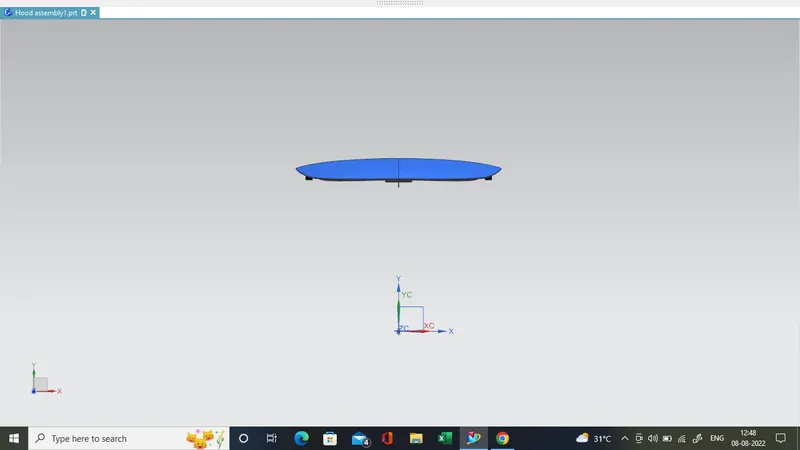
Top view