Hood design-Week 2
HOOD DESIGN
INTRODUCTION
The hood or bonnet is the hinged cover over the engine of motor vehicles that allows access to the engine compartment for maintenance and repair. Hoods are typically made out of the same material as the rest of the bodywork. This may include steel, aluminum, fiberglass, or carbon fiber. However, some aftermarket companies produce replacements for steel hoods in fiberglass or carbon fiber to make the vehicle lighter. Hood generally consists of an inner panel, outer panel, hinge reinforcement, latch reinforcement, etc. The outer panel acts as a protective cover for the inner panel. The hood is attached to the car body using hinges. The hood release system is common on most vehicles and usually consists of an interior hood latch handle, hood release cable, and hood latch assembly. The hood latch handle is usually located below the steering wheel, beside the driver's seat, or set into the door frame. Hood has an inner panel and an outer panel. The outer panel acts as the cover for the inner panel and the inner panel consists of the embosses and mastic points that give the strength. The hood is attached to the car body using hinges and to support it in the open position either a support rod or a gas stay is used. The hood release system is common on most vehicles and usually consists of an interior hood latch handle, hood release cable, and hood latch assembly. The hood latch handle is usually located below the steering wheel, beside the driver's seat, or set into the door frame. On race cars or cars with aftermarket hoods, the hood may be held down by hood pins. Some aftermarket hoods that have a latch system are still equipped with hood pins to hold the hood buttoned down if the latch fails. The Hood should be designed with aerodynamic consideration in order to minimize the air resistance and have to give good aesthetic looks. Therefore, the hood design may vary from one make and model to another. It is a critical component of design and model because it has to be strong and hard enough for frontal crash requirements, and at the same time, it should deliver a good pedestrian safety requirement.
OBJECTIVE
1. To design the outer and inner panel of the hood of a car according to the design considerations.
2. To know about the tools, operations, and design methodology involved in creating the hood of a car.
MAIN CONSIDERATION FOR DESIGNING THE HOOD
HOOD OPENING ANGLE:
It is one of the major criteria in designing the hood of a car. The opening angle of the hood is varying from place to place and from country to country. It is designed based on the average height of the people in the country.
SUPPORT REQUIREMENTS:
The support is to be designed based on the height and weight of the hood. Some of the design considerations for the hood such as curvature of the rod and it is to be mounted opposite to the battery mountings.
DISTRIBUTION OF FORCE DURING COLLISION:
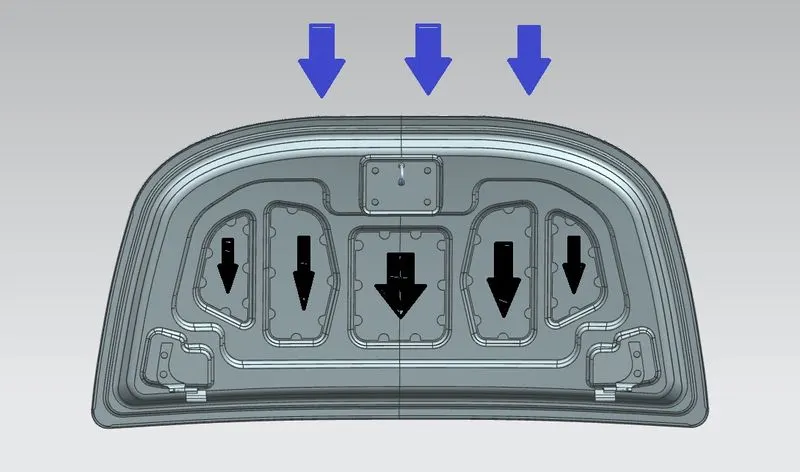
The inner panel is designed in such a way that the force produced during the collision is delivered in the outward direction so that the damage to the passenger and the driver is to be reduced.
TRAJECTORY OF LATCH AND STRIKER:
The striker must follow a circular patch whose center is present on the axis joining both the hinges and also striker must be always perpendicular to the line joining the striker and the axis joining the hinges
PEDESTRIAN SAFETY:
Pedestrian safety is one of the important criteria which must be taken into consideration during designing a hood. Based on the wrap-around distance and pedestrian head impact zone, the hood is designed so that during a collision impact on the person must be reduced. Around the impact zone, the hood is made softer by removing material. There are two main zones in the hood that are considered while designing it. The Child head impact zone (1000mm to 1500mm) and the Adult head impact zone (1500mm to 2100mm) as shown above. The wrap-around distance is the distance from the ground level to the end of the hood. The side reference line and the wrap-around distance are related to each other. If the side reference line is on the fender, the wrap-around distance will be more and the impact zone will be less and vice versa. Pedestrian safety is to avoid severe injuries to the head, the high-impact area for adults and children are subjected to less thickness. In addition, no reinforcement should be provided in that area as, during the head collision, the hood will absorb the head impact energy leading to the collapse of the hood and thus protecting the severe head injury. To protect the occupants inside the car during the front collision, the design of the hood should be in such a way that the force should travel in the upward direction through the embosses and be directed towards the body of the car during the collision. Thus, protecting the occupants inside the car. Mastic sealants and embosses help to meet pedestrian safety standards. The adult and child impact zone is taken into consideration, and the deformation zone is considered with respect to the engine compartment and outer panel thereby determining the interference. This generated deformation is considered critical and needs to be relocated or tuned to fill. Relocating or tuning leads to reducing the force exerted on pedestrians especially in heat during collision Generally, inner and outer panels are made of 0.65 to 0.75 mm thick and reinforcements are made of 1.5mm thick. Adding more reinforcement improves the strength but it also increases the cost and weight of the car.
NVH-NOISE, VIBRATION, AND HARSHNESS:
Noise, vibration, and harshness (NVH) is the study and modification of the noise and vibration characteristics of vehicles, particularly cars and trucks. While noise and vibration can be readily measured, harshness is a subjective quality. Many problems are generated as either vibration or noise, transmitted via a variety of paths, and then radiated acoustically into the cabin.[1] These are classified as "structure-borne" noises. Others are generated acoustically and propagated by airborne paths. Structure-borne noise is attenuated by isolation, while airborne noise is reduced by absorption or through the use of barrier materials. Vibrations are sensed at the steering wheel, the seat, armrests, or the floor and pedals. Some problems are sensed visually - such as the vibration of the rear-view mirror or header rail on open-topped cars.
The car hood consists of the following parts:
1. Outer Panel
2. Inner panel
3. Hinge
4. Latch and Striker
OUTER PANEL
TOOLS USED:
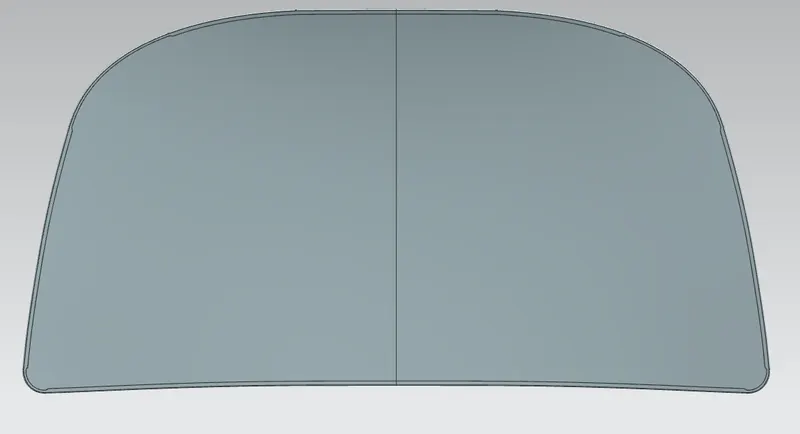
• Sketch
• Offset Surface
• Offset in Face
• Law Extension
• Trim Sheet
• Face Blend
. Projected curve
• Mirror Geometry
• Sew Thicken
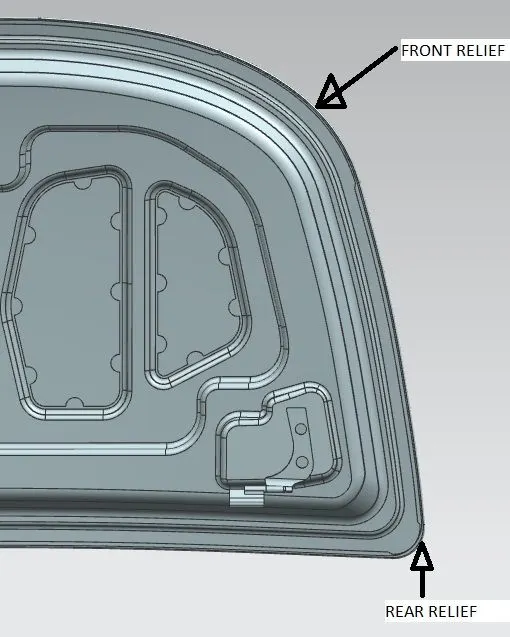
FRONT AND REAL RELIEF
Assembly of hinge:
STRIKER
INNER PANEL
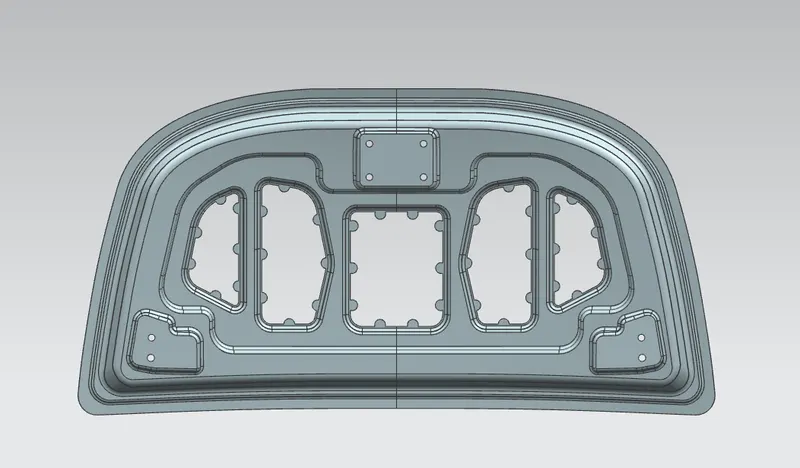
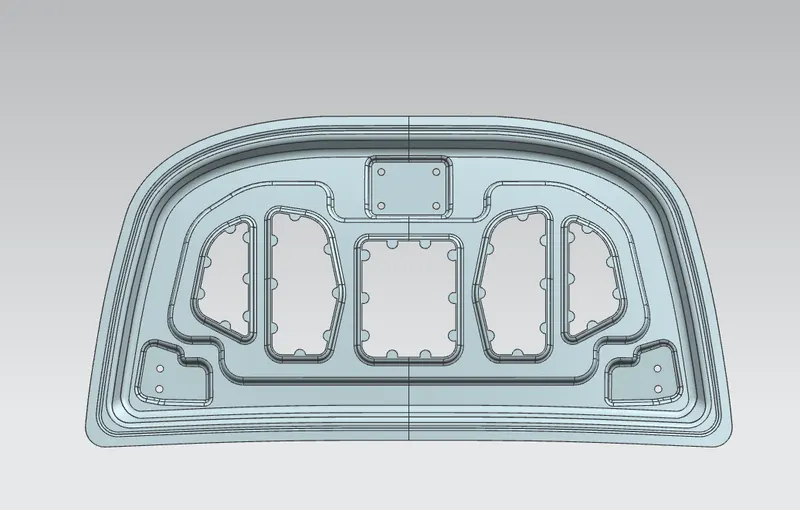
The inner panel is designed according to the mastic data
TOOLS USED:
- Sketch
- Offset Surface
- Offset in Face
- Law Extension
- Trim Sheet
- Face Blend
- Edge Blend
- Emboss
- Through Curves
- Trim and Extend
- Projected curve
- Mirror Geometry
- Sew Thicken
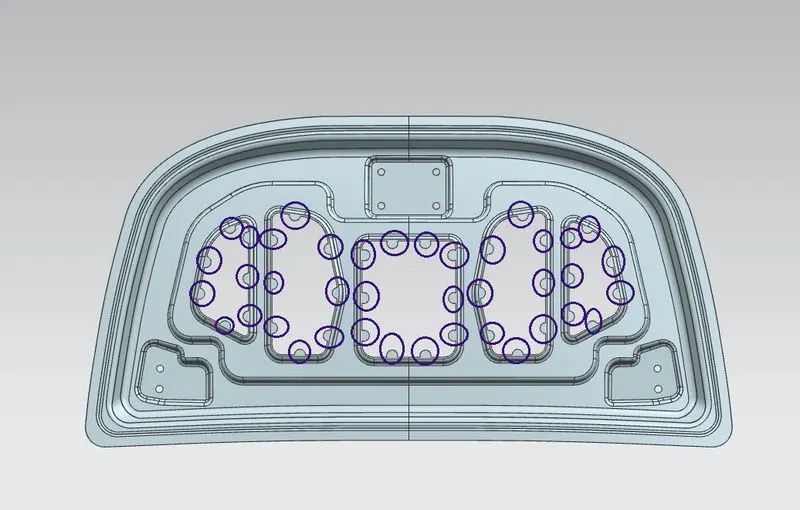
Mastic Points:
The Mastic sealant or the Mastic point is an elastic compound that behaves like rubber. The mastic points are defined on the hood inner panel where the hood can easily deform. They help the hood outer panel to come back to its original shape after it gets deformed. The mastic has an influence area of 80mm.
Embosses:
Embosses are used for the purpose of increasing the strength of the hood. By providing embosses in the hood the force during a collision can be diverted outside so that it can reduce the damage to the person who is sitting in the car.
Hemming:
Hemming is the metalworking process in which a Sheetmetal edge is rolled over onto itself. Hemming is the process in which the edge is rolled flush to itself, while a seam joins the edges of two materials. Hems are commonly used to reinforce an edge, hide burrs and rough edges, and improve appearance. Maintained 2 mm gap
DEEP DRAWING
Deep drawing is a sheet metal forming process in which a sheet metal blank is radially drawn into a forming die by the mechanical action of a punch. It is thus a shape transformation process with material retention. The process is considered "deep" drawing when the depth of the drawn part exceeds its diameter.
ASSEMBLY
Initially, the outer panel is a mage in the assembly workbench and it is made fixed. Then the outer panel is assembled accordingly. Then the placement of the latch and the hinge is made by giving concentric conditions to the holes on the respective parts. The assembly of the parts is as follows:
Import the inner panel into the NX assembly workbench
Place the hinge on hinge emboss with help of a touch constrained and parallel constrained.
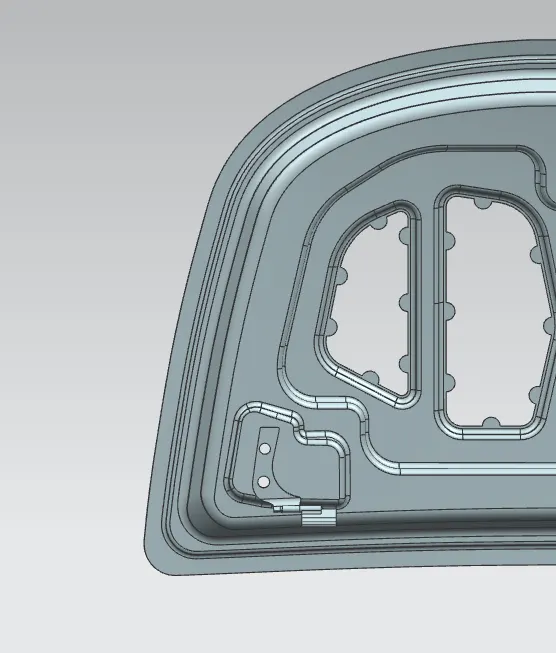
Mirror the hinge with help of the mirror command through the plane to place the second emboss.
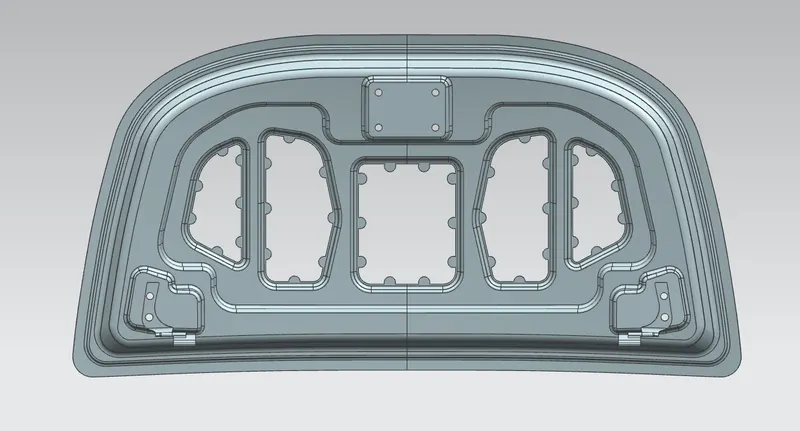
Make A 3D curve in between hinges and place a Datum plane in one curve center, make a line for striker placement.
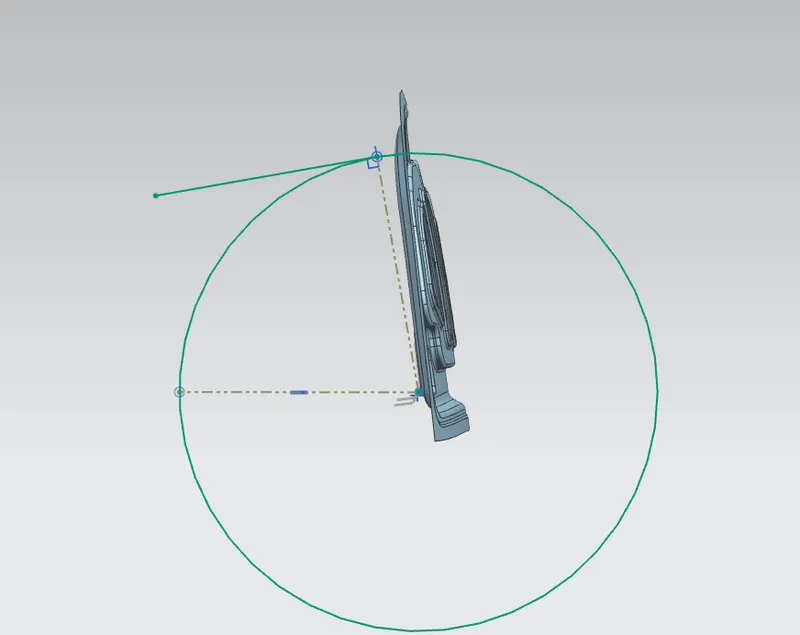
imported striker base face for emboss creation.
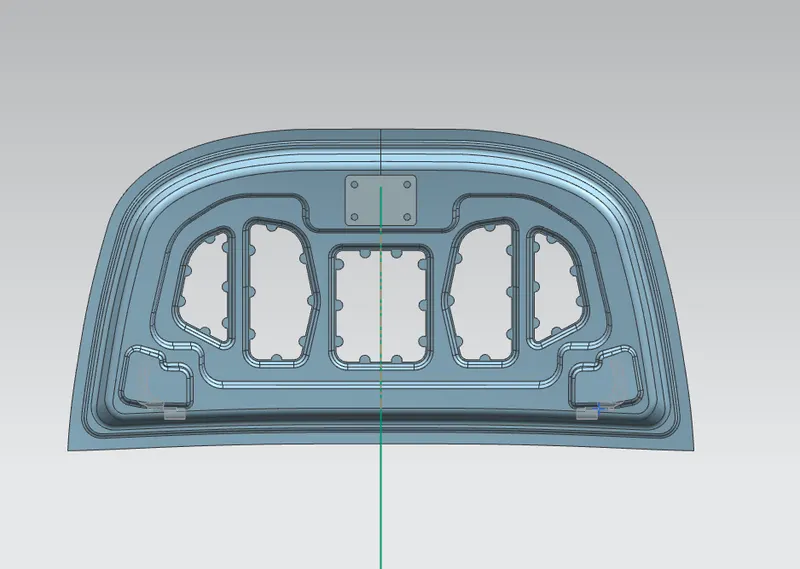
with help of law extension and trim and extend command created emboss.
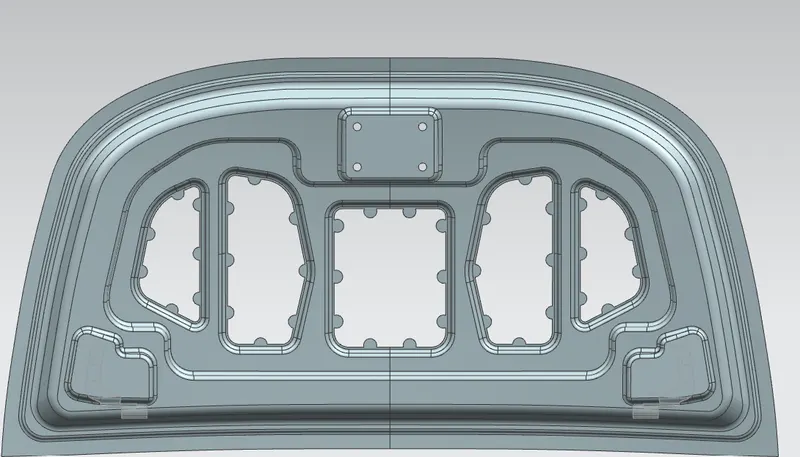
placed the striker and completed assembly.
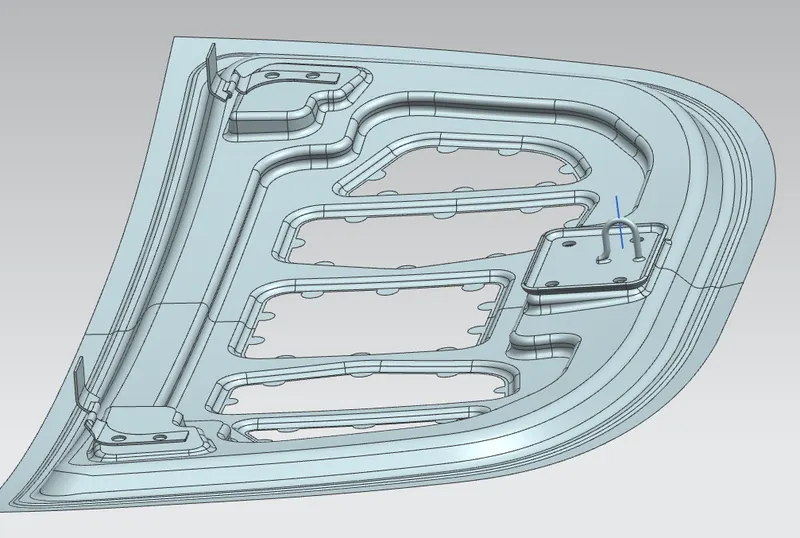
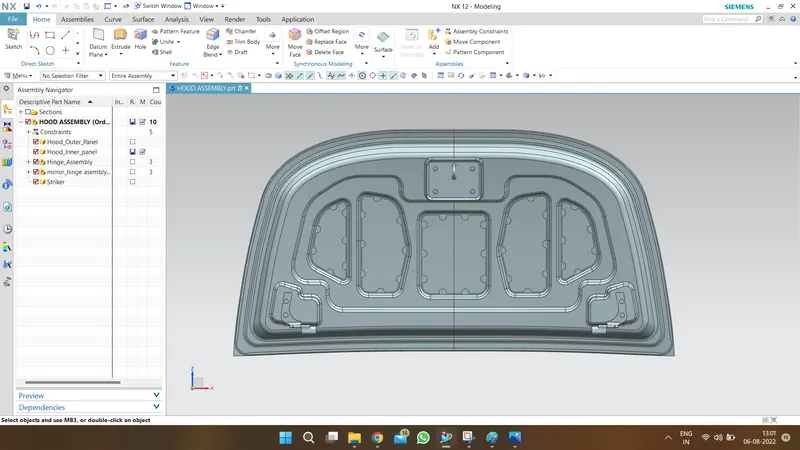
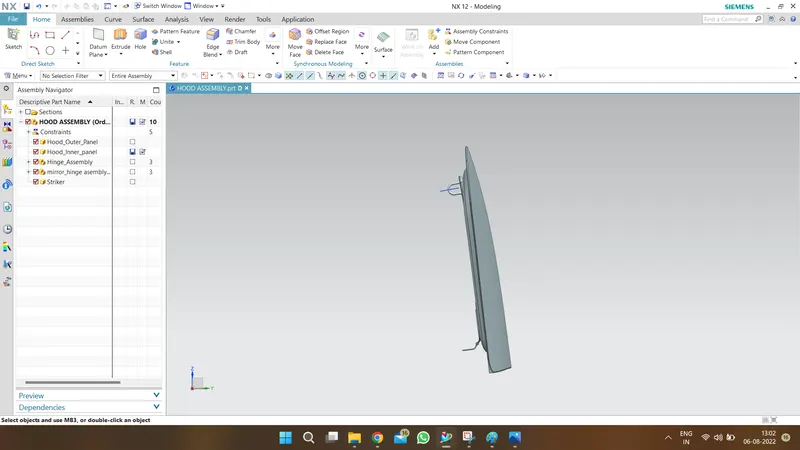
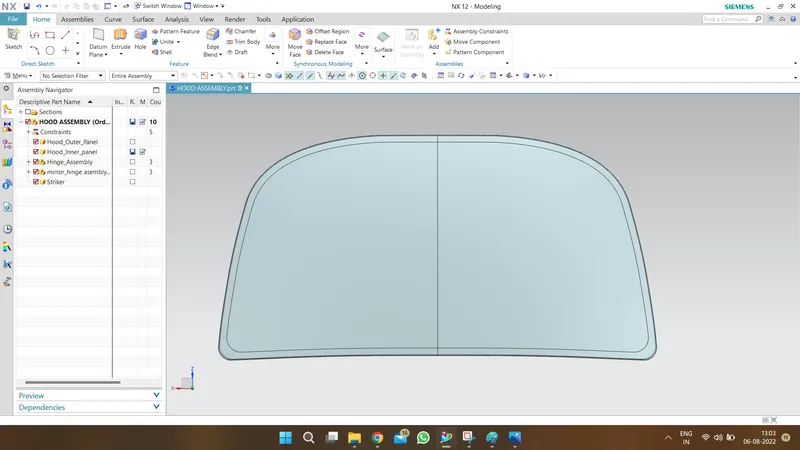
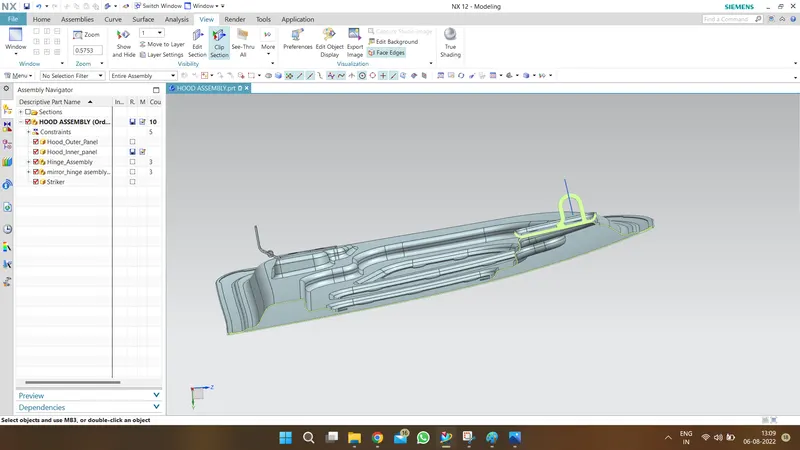
Views
CONCLUSION:
In this challenge, the design consideration and operations involved in creating the hood of the car are studied.