Hood design-Week 2
OBJECTIVE:
* Design hood outer paneal ,inner paneal and reinforcement with the given outer hood skin ,master section and design parameters.
INTRODUCTION:
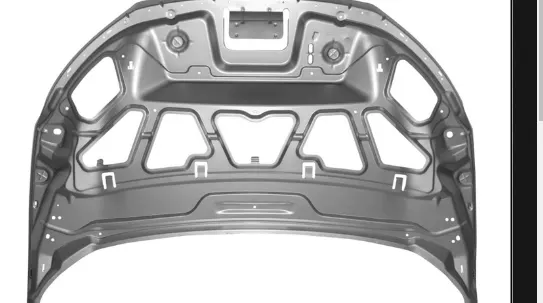
* The hood or bonnet is the hinged cover over the engine motor vehicles .hoods can open to allow access to the engine compartment of maintenance and repair .
* In design perspective hood shoot meet some specific conditions like pedestrain safety hood head zone for the lock striker ,force distrbution when subjected to frontal collision manufacturability.
* A typical hood assemply consist of hood outer panel,latch and striker ,hinge hood stay .hood stay is an appartus for supporting the engine hood of a motor vehicle in its open position the purpose of opening the the engine hood is for inpecting engine room replanishing cooling water and engine oil changing part repair etc.
* Deep drawing ,hemming ,blanking and piercing are the common sheet metal operations that are used in manufacturing hoods in automotive industries.
DESIGN PARAMETERS:
hood thickness information
outer panel thickness = 0.75 mm
inner panel thickness = 0.75 mm
reinforcement thickness = 1.5 mm
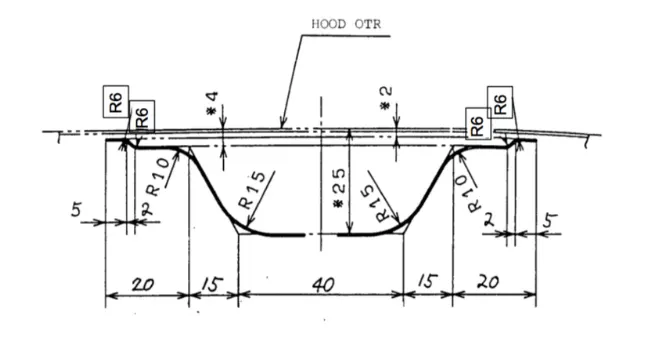
DIAGRAM :
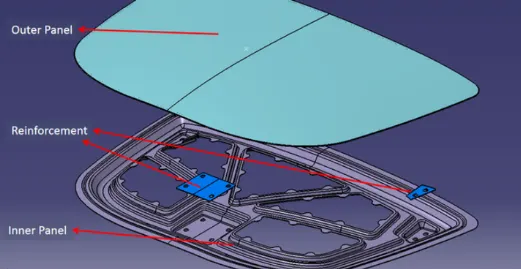
COMPONENTS:
* Hood outer panel
* Hood inner panel
* Reinforcement
Hood outer panel :
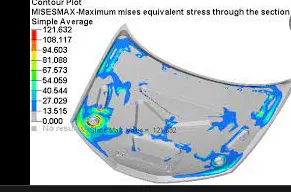
* Outer panel are the aestthetic elements of a car .it is styling team who provides the skin for the outer panel .the shape position and size of the hood should satsify the safety norms so while designing the hood we should given more importance to pedestrain safety.the outer panel is attached to the inner panel by hemming so its necessary to provide required hemming flange and reliefs for the hemming operation .
Hood inner panel :
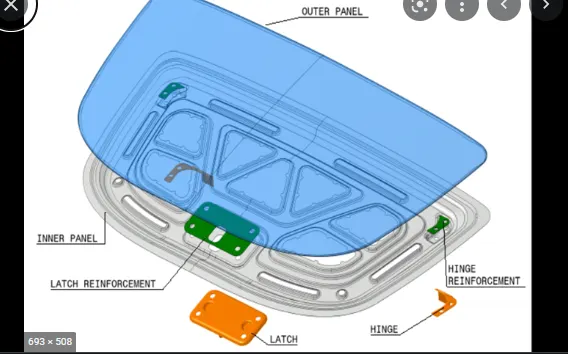
* Inner panel is the part that gives strength and rigidity to the outer panel .the master section represent the initial emboss shape and size .then we provide the emboss for the latch and hinge elements after fixing the location .
Reinforcment:
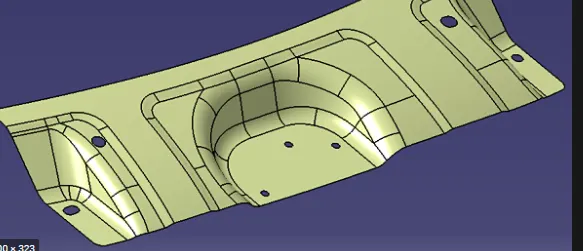
* Reinforcements are provided according to the design requirements .mainely it is provided at the hinge and latch regions to improve the strength locally .usually thickness of reinforcement will be higher than that of the inner panels and the value varies according to cost and requirement here it is given 1.5 mm thickness to both hinge and latch reinforcements .
Latch Trajectory:
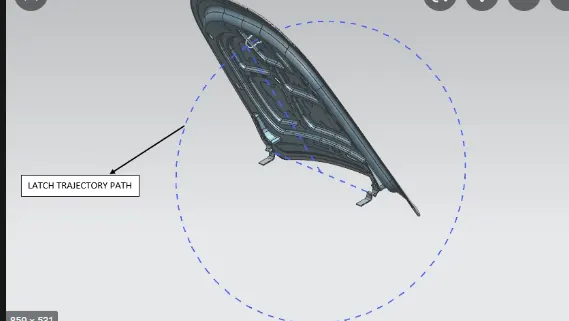
* Latch trajectory is given by the circle drawen from the hinge axis point.hinge axis point is the centre point of the hinge axis .first we can fix the latch or the hinge .if we have fixed the hinge position then we should plot the trajectory circle for the latch for proper mating condition the striker axis through the tip of the striker should be tangentional to the latch trajectory.
Emboss definations:
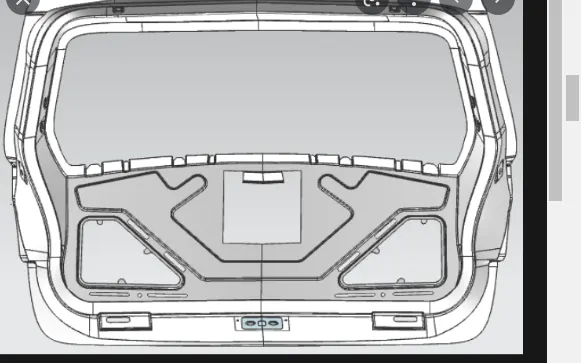
* Througout the inner panel we provide different emboss .we can increase the stiffness of the inner panel through these emboss .the shape and size of the embossalso determines the direction of the force distribution resulted from frontel collision.
Mastic data:
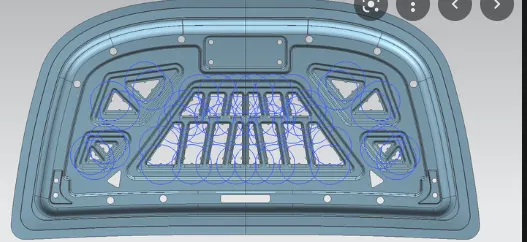
*Hood commonly process large surface area and hemming can only be provided through its boundary .we cannot use other joining techniques like welding ,riveting etc.because they leave marks on the outer panel which spoil its aesthetic appearance .so mastic sealant are used to stick the inner surface of outer panel and inner panel.
Design Methodology:
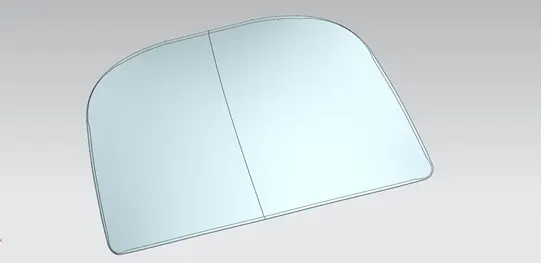
* First the inner panel is designed from the given master section using the various commands and features .we create the embossing using the offset surface from the original master section .
* Then the outer panel is designed from the same master section .here we are supposed to provied the hemming to outer panel .the parameters of hemming are taken as per given values .
Imporant Features used in designing:
Trim body: it is used to trim one or more bodies using a face or plane .you can also specify the bodies to retain and the bodies to discard.
Offset surface: it allows you to offset one or more existing surfaces.
Offset in Face: this commandwill allow you to offset particular edges or curve on selected faces.
Trim sheet: it is used to trim off a portion of a sheet body using curves ,face ,edges,or planes.
Through curves: it will allow you to create a body through multiple sections,where its shape changes to pass through the each sections .
Law Extension : this command extends a curve or edge to create a sheet body at desired angle length by changing the rules under angles law and length angle.
Trim and Extend : it helps you to trim and extend intersecting surfaces and makes corner at the intersection .
Face Blend: it creates fillets between faces
Edge Blend: it creates fillets on edges .
HEMMING:
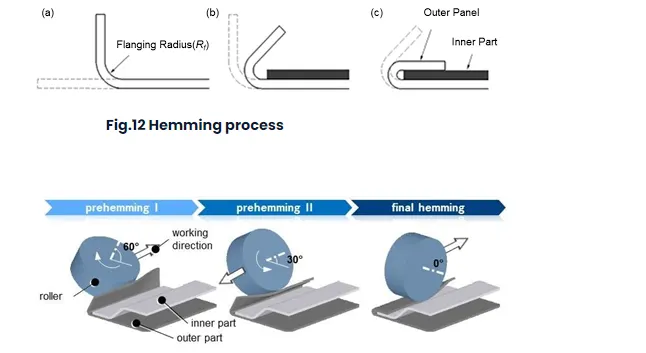
* Hemming is a forming operation in which the edges of sheet are folded over other part or simply folded in oreder to achieve a tight fit.in a car part production ,hemming is used in assembly as a secondary operation after deepdrawing.
Piercing:
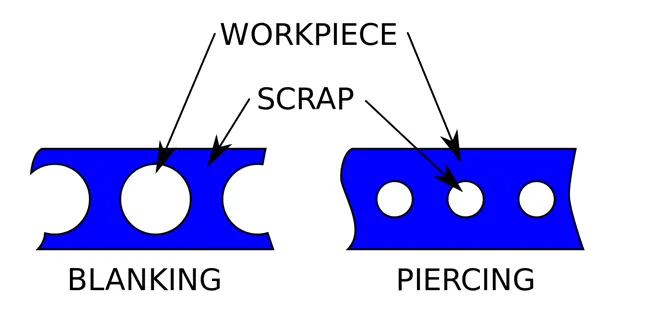
* it is a shearing process in which raw sheet metal is pierced with a machining tool,resulting in the creation in particular shape hole in sheet .
CONCLUSION:
* I designed the car hood with its components and assembled the same NX CAD.