Hood design-Week 2
Objective
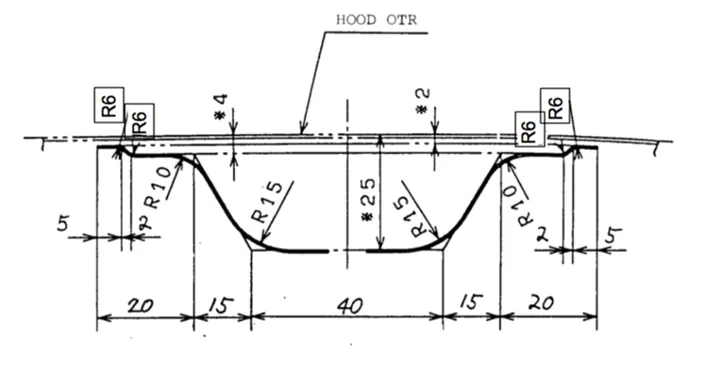
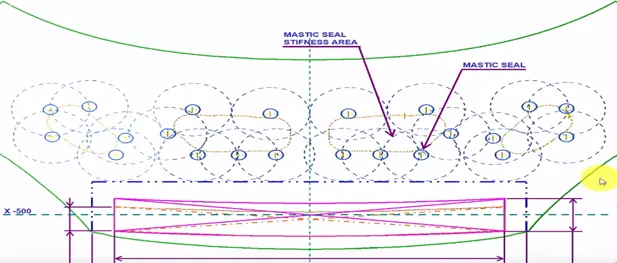
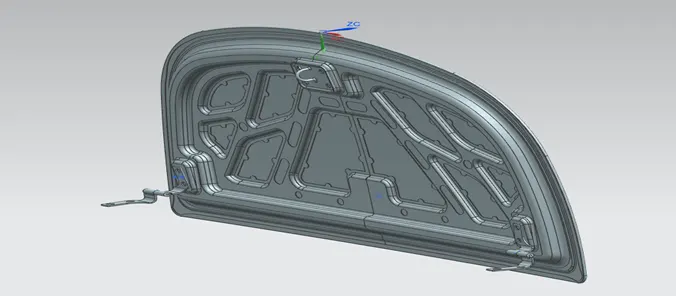
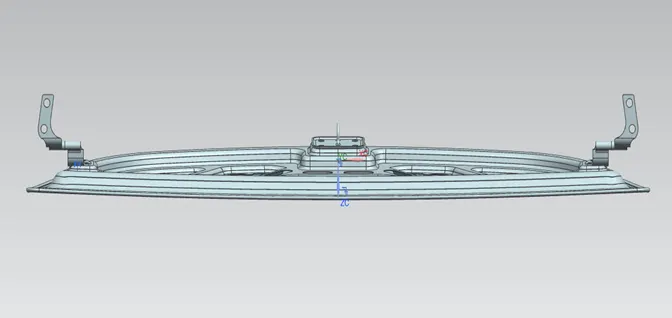
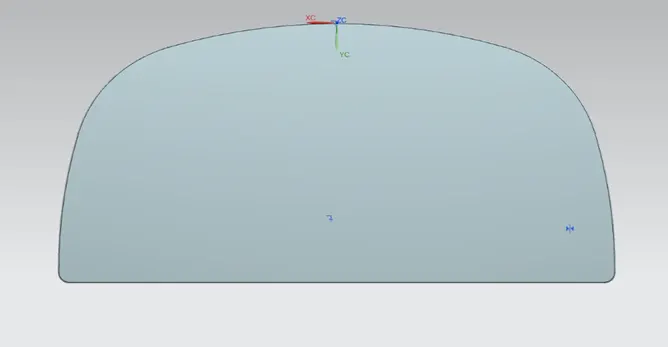
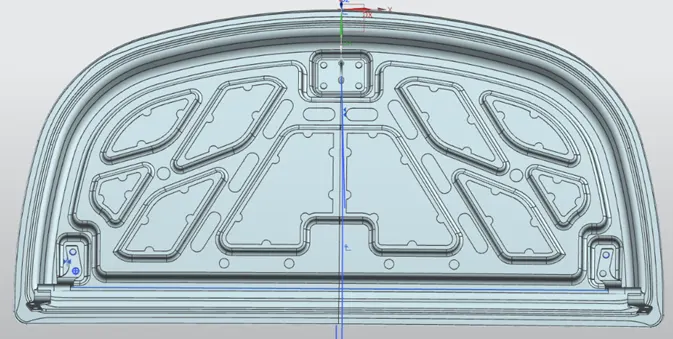
- Design hood outer panel, inner panel and reinforcements with the given outer hood skin, master section and design parameters. Design outer panel with the hem, develop the Inner Panel, develop all the necessary Reinforcements, Mirror and position the Hinge & Striker, provide Mastic Data, and provide the required Emboss definition.
Design Parameters
Hood Thickness Information
-
Outer Panel Thickness = 0.75mm
-
Inner Panel Thickness = 0.75mm
-
Reinforcement Thickness = 1.5mm
Master Section
About Hood
-
A car hood, also referred to as a bonnet in some other countries, is the hinged cover that rests over the engine of a front-engine vehicle. Its purpose is to provide access to the engine for repair and maintenance. A concealed latch is typically used to hold down the hood.
-
A hood is meant to protect the vehicle’s performance parts like the engine or battery. They also provide easy access for car maintenance and repair. Vehicle owners should be aware that hoods are vulnerable to damage.
-
Hood is an important component of the front portion of the car which is used for many purposes. It is made aerodynamic in shape to reduce air drag. Generally, it is used to cover car engines, radiators, and many other components, the design must meet pedestrian's requirements and design should be satisfying serviceability and also design should be made in a way that when an accident occurs the energy absorption should no reach to passengers.
Adding Latchs And Stiffener Pad
-
Latches are mechanical components that allow the temporary joining of moving parts relative to each other. They are actuated to release the coupling and allow the two parts to separate. They are mostly seen on doors and enclosures. They are used in devices such as seat belts, clamps, straps, and objects with retractable parts. Different designs feature different methods of actuation, holding style, and mounting.
-
Latches are added where and all the weight is added. On the inner panel we have Hinges and striker, which are attached to the inner panel so due to this attachment the strength of the inner panel is going weak. In order to strengthen the inner panel Latches will play a very important role. Stiffener pad is the sponge-like material place b/w Inner and outer panel to reduce vibrations.
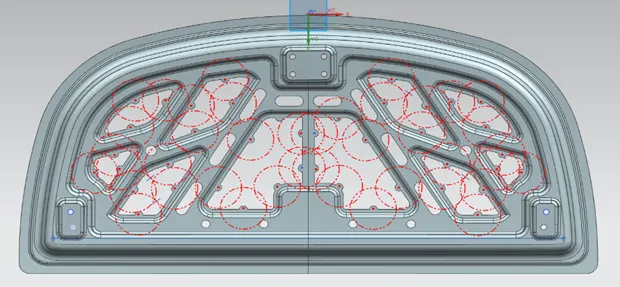
Corrosionpedia Explains Mastic
The term mastic generally includes
- Thin metallic coverings
- Organic coverings such as polymeric material and paint
- Optical film coverings
- Etched or printed surface coverings
Surface protective mastic coatings are widely used for waterproofing underground metallic surfaces. In particular, a combination of coal tar and vinyl resin is used on equipment or surfaces that process crude oil and other petroleum products. Such a combination is mastic in nature and provides desirable resistance.
Emboss definition
-
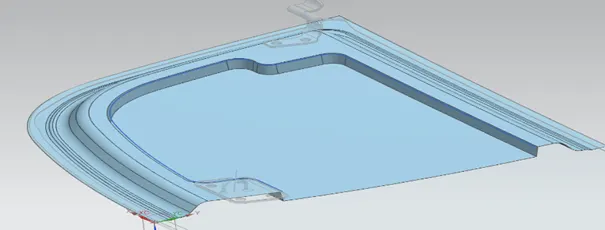
Embossing is a forming process in which a high pressure is applied to a workpiece to change its surface. Depending on the shape, a distinction is made between hollow embossing and solid embossing.
-
Emboss are provided in the inner panel of the hood assembly. This helps in weight reduction of the hood and also to dissipate the force during collision.
-
Sheet metal embossing is a stamping process for producing raised or sunken designs or relief in sheet metal. This process can be made by means of matched male and female roller dies, or by passing sheet or a strip of metal between rolls of the desired pattern. It is often combined with foil stamping to create a shiny, 3D effect.
Deep Drawing
-
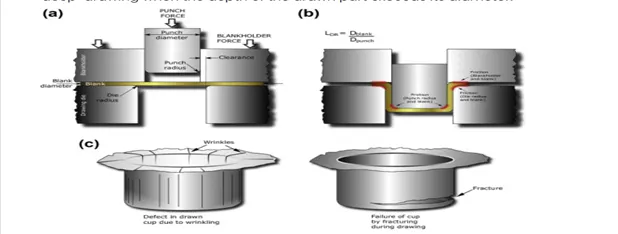
Deep drawing is a manufacturing process that is used extensively in the forming of sheet metal into a cup or box-like structures. Pots and pans for cooking, containers, sinks, automobile parts, such as panels and gas tanks, are among a few of the items manufactured by sheet metal deep drawing.
- A deep drawing of sheet metal is performed with a punch and die. The punch is the desired shape of the base of the part, once drawn. The die cavity matches the punch and is a little wider to allow for its passage, as well as clearance. For many calculations, the sheet metal thickness is assumed to remain constant. However, there are changes in thickness in certain areas, due to the forces involved.
- Deep drawing is a sheet metal forming process in which a sheet metal blank is radially drawn into a forming die by the mechanical action of a punch. It is thus a shape transformation process with material retention. The process is considered "deep" drawing when the depth of the drawn part exceeds its diameter.
Hemming
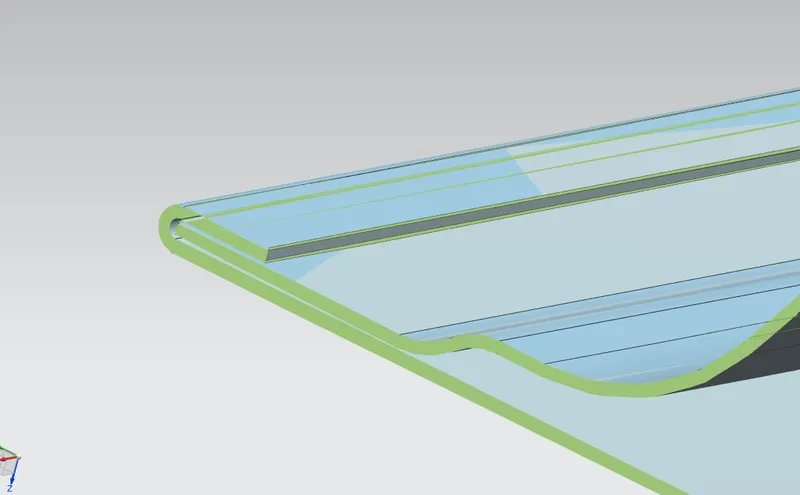
- Hemming is a forming operation in which the edges of the sheet are folded or folded over another part in order to achieve a tight fit. Normally hemming operations are used to connect parts together, to improve the appearance of a part and to reinforce part edges.
- In car part production, hemming is used in assembly as a secondary operation after deep drawing, trimming and flanging operations to join two sheet metal parts (outer and inner) together. Typical parts for this type of assembly are hoods, doors, trunk lids
-
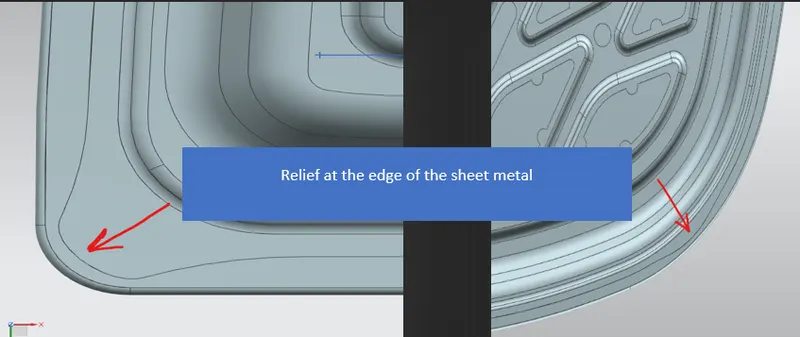
The accuracy of the hemming operation is very important since it affects the appearance of the surface and surface quality. Material deformations, which occur during the hemming process, can lead to dimensional variations and other defects in parts. Typical hemming defects are splits or wrinkles in the flange, material overlaps in the corner areas or material roll-in. This is why it is important to use simulation tools in order to, on the one hand, better understand the hemming process and, on the other hand, significantly reduce the number of “trial and error” loops during try out und production.
There are various types of hemming operations
1. Conventional die hemming
-
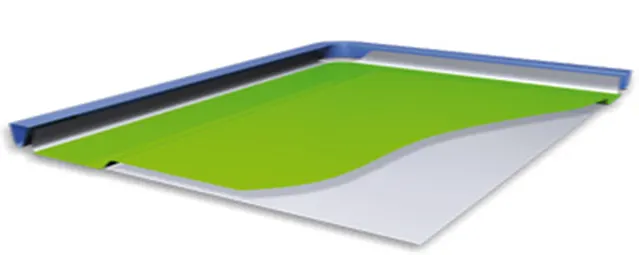
In conventional die hemming, the flange is folded over the entire length with a hemming tool.
-
Conventional die hemming is suitable for mass production. In die hemming, the flange is folded over the entire length with a hemming tool. Normally the actual hemming is a result of a forming operation in which the flange is formed with a hemming tool after the drawing and trimming operations have been completed. The formed flange is then hemmed in several process steps. These steps include, for example, the pre-hemming and final hemming depending on the respective opening angle of the flange. Production plants for conventional die hemming are very expensive, but the cycle times are very low.
2. Roll Hemming

-
In roll hemming, the hemming roller is guided by an industrial robot to form the flange.
-
Roll hemming is carried out incrementally with a hemming roller. An industrial robot guides the hemming roller and forms the flange. Roll hemming operation can also be divided into several pre-hemming and final hemming process steps. Roll hemming is very flexible to use and tool costs are significantly lower as compared to those of conventional die hemming. However, the cycle times are much higher since the hemming is realized using a hemming roller which follows a defined path.
Hood components
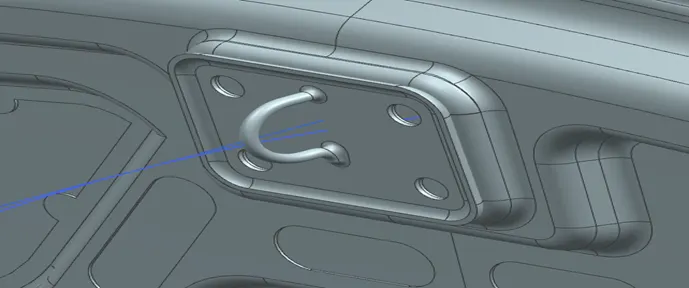
Latch
-
A hood latch is a very simple component. It's basically the fastener that keeps your hood closed shut. This latch ensures that your hood is securely connected to your vehicle and that it doesn't pop open unexpectedly
-
When tension is applied to the cable from the hood release handle, it pivots the secondary latch, which pulls away from a retaining seat located under the hood. By design, the secondary latch then releases the hood a few inches before a safety latch takes over.
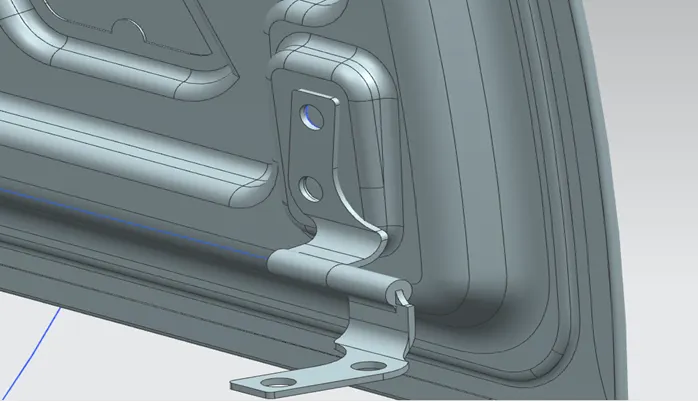
Hinge
-
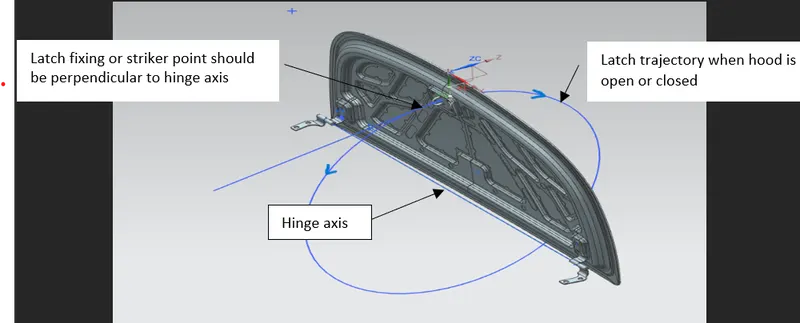
Hinge is a component that fixes the hood to the fenders of the car. The latch must be fixed perpendicular to the hinge axis so that the hood opens or closes properly.
Reinforcements

- Reinforcements are provided according to the design requirements. Mainly it is provided at the hinge and latch regions to improve the strength locally.
- Usually thickness of reinforcements will be higher than that of the inner panels and the value varies according to cost and requirement.
- According to the design requirement here it is given 1.5mm thickness to both hinge and latch reinforcements.
Latch trajectory motion
-
Latch trajectory is given by the circle drawn from the hinge axis point. Hinge axis point is the centre point of the hinge axis. First, we can fix either the latch or the hinge. If we have fixed the hinge position then we should plot the Trajectory circle for the latch. For proper mating condition the striker axis through the tip of the striker should be tangential to the latch trajectory.
-
while opening or closing the hood, the latch must be perfectly aligned to the fixing or striker point. For that, the latches trajectory must be perpendicular to the hinge axis.
Impact force distribution in hood design
-
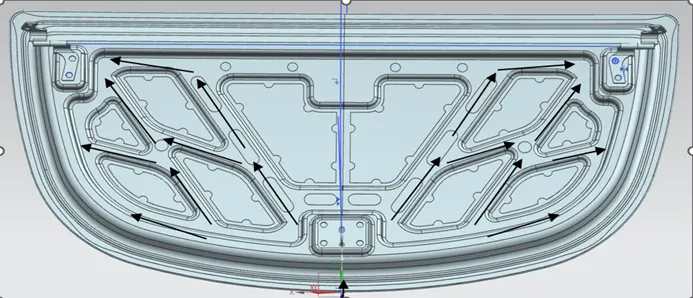
A hood design must be made in such way that when a force is impacted in the front of the hood, all the force must be directed out wards from the vehicle. And distribution of the force must be controlled along with hood.
Hood design
Conclusion
-
Thus we have designed the hood of the car that satisfies the industry’s manufacturing requirements, functional requirements and as well as Euro NCAP standards using NX CAD.