Hood design-Week 2

hood desgin
At the beginning of the 21st Century, laboratory design practices have emerged that
place new demands on laboratory ventilation systems and more specifically, on fume
hood design. Evolving laboratory chemistries and technologies (such as nanoscale
work, genetic engineering, and 3-D printers), open plan laboratories, automated
ventilation control technologies, and concerns about facility energy costs have all
impacted fume hood design and operation. These changes mean that institutions that
host laboratories are reevaluating their expectations for design, performance, testing
and usability criteria for their fume hoods. These expectations are often expressed as
institutional design standards. The goal of these standards are to assure that
a prudent balance of 1) protecting worker safety and health and 2) providing and
operating a flexible and sustainable facility is achieved in new and
renovated laboratories.
To support institutions in identifying elements that should be included in these design
standards, a one-day workshop was held on October 29, 2014 to discuss emerging
fume hood design. The focus of the workshop was to describe key questions that an
institution should consider in developing fume hood design standard and performance
testing requirements as well as to identify potential answers to these questions. The
information collected from the discussions is intended to help a design team identify
what issues need to be addressed in programming, planning, designing and
commissioning a lab project that includes fume hoods.
what is a hood ?
A car hood, also referred to as a bonnet in some other countries, is the hinged cover that rests over the engine of a front-engine vehicle. Its purpose is to provide access to the engine for repair and maintenance. A concealed latch is typically used to hold down the hood. On vehicles with an aftermarket hood and on racecars, hood pins may be used to hold down the car hood. Hoods sometimes also contain a hood scoop, wiper jets, power bulge, and/or hood ornament. Car hoods are typically constructed from steel and sometimes from aluminum.
conponents used in hood are .
hinge.
hood inner panel
hood outer panel
striker
Latch Trajectory
Mastic
definitions of
latch ;The LATCH system consists of built-in straps and hooks on the safety seat and anchor hardware in the vehicle. When using LATCH, the LATCH anchors and attachments take the place of seat belts. Tuck the seat belts out of the way to avoid interfering with the lower anchoring system.
mastic data ; means adhesive, glue, or protective coating used to fasten a material to another surface.
Emboss ; to raise the surface of into bosses
especially : to ornament with raised work
details on Manufacturing process like Deep-drawing and Hemming
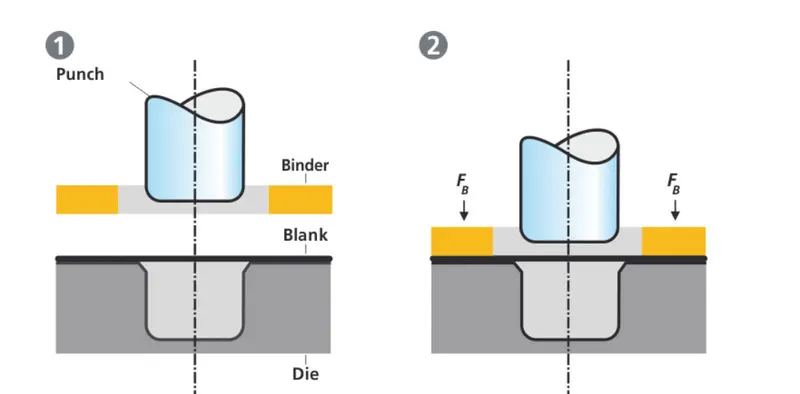
The deep drawing process is a forming process which occurs under a combination of tensile and compressive conditions. A flat sheet metal blank is formed into a hollow body open on one side or a hollow body is formed into a hollow body with a smaller cross-section.
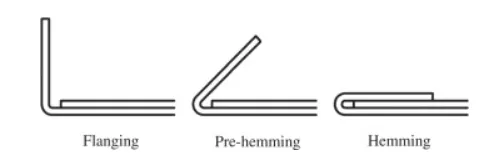
The length hemming operation is performed subsequent to length cutting operation. One split of the towel is hemmed on both of the longer sides using a chain stitch. The chain is formed on the face side of the towel, or the back side of the towel, depending on the stitching head installed on the hemming machine.
BASIC parameters followed in the design