Hood design-Week 2
Answer of Design Of Hood inner panel
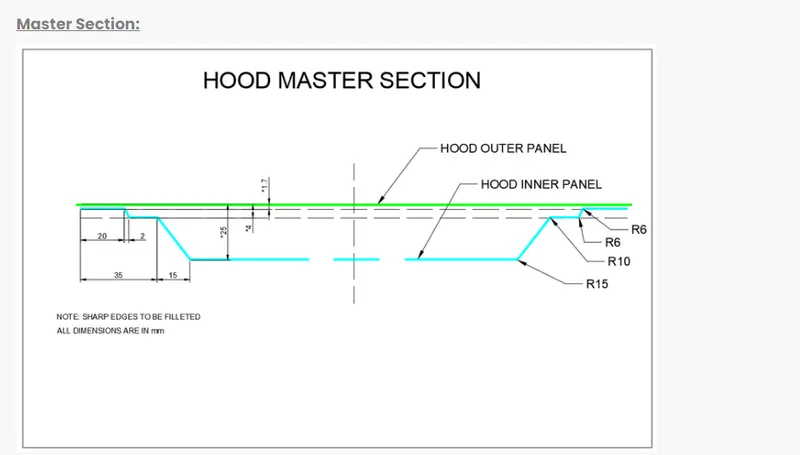
Design Hood Outer Panel, Inner Panel and the necessary reinforcements by following the Master Section mentioned with the Design parameters explained in ASSEMBLY of Hood Inner Panel, Outer Panel, Latch, Hinge and the Reinforcements.
A detailed report about the Hood Design which includes a detailed explanation about hood and its components, Latch Trajectory, Mastic Data, Emboss Definitions, Manufacturing process like Deep-Drawing and Hemming, and all the parameters followed in the design
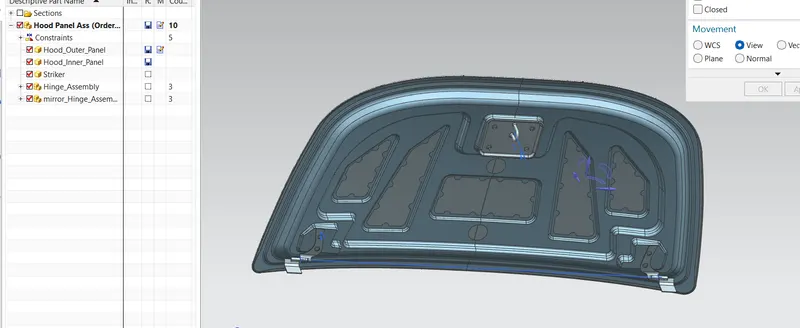
In this design make sure all parrts is open in assembly and there are 5 parts used in assembly of hood panel design.
Hrere Prats are uesd in assembly as follow.
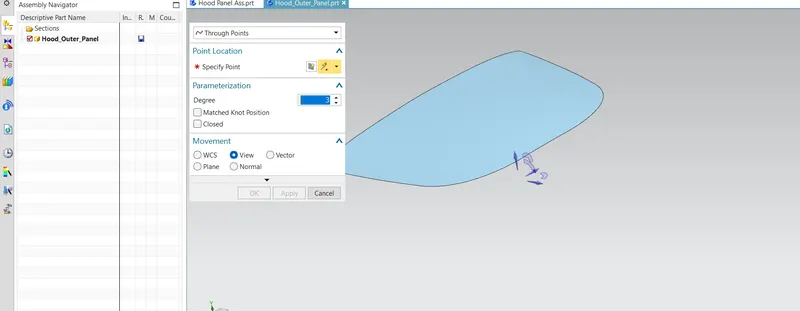
- Hood Outer Panel:- The outer panel works as a metal cover and its responsible for aesthetics of the vehicle
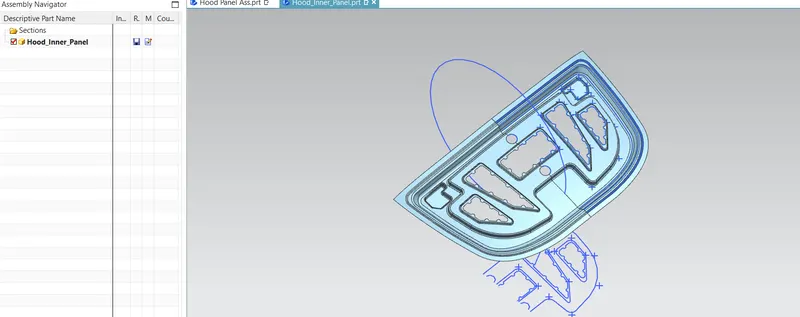
- Inner panel:- The inner panel provides strength and supports the outer panel. It is where hood balancer and hinges are attached.
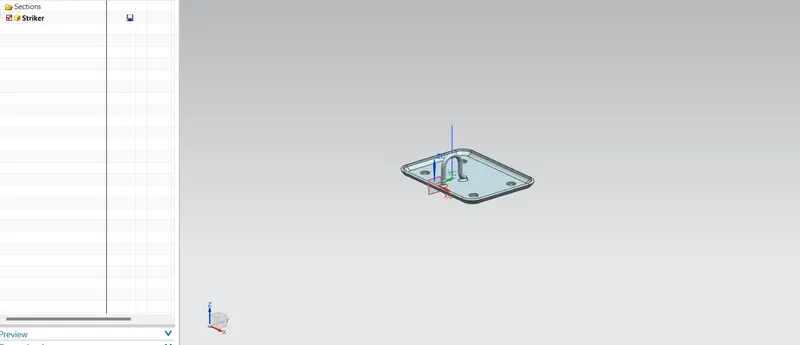
- Latch and striker:- Latch and striker mechanism is provided to lock the hood ,in order to prevent accidental opening of hood during driving.The Latch is present on the engine compartment while striker is attached to inner part of hood.
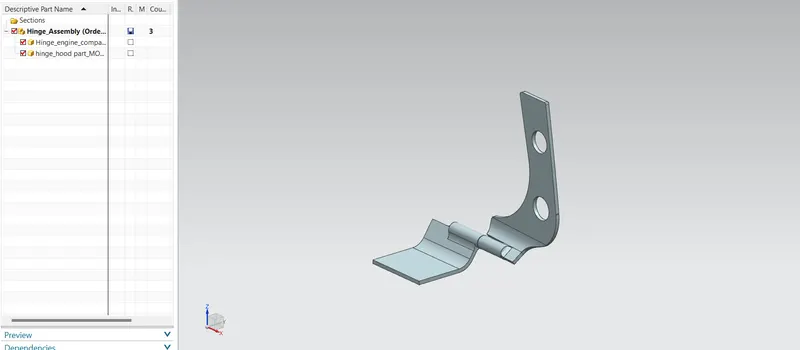
- Hinge assembly:- Hinges allowas the hood to rotate around a fixed axis for opening and closing movement.One part of the hinge is fixed with the engine compartment,while part is connected to hood.
All parts file given in the challange and to make inner panel of hood to follow help section videosto make better understanding
and follow design rules as per master section provided in challange data.
- Reinforcements:- The reinforcements are provided to add material to inner panel to provide extra strength to hood to compensate for loss of strength near component installation region.
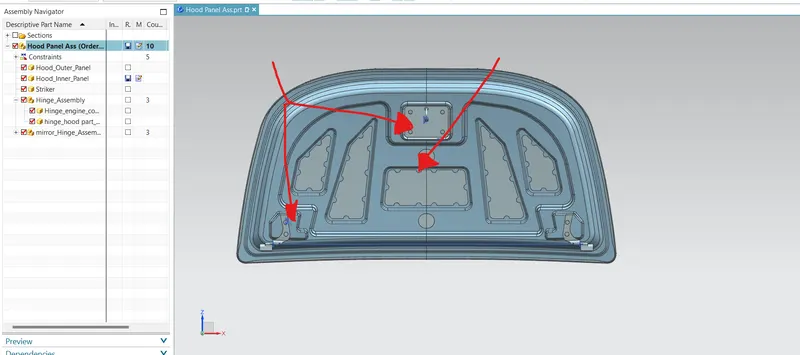
- Latch Trajectory: It is the path along which the hood rotates during opening and closing movement.The striker in the hood follows a perticular path while opening or closing the hood.which is along circumference of a circle with center at hinge axis.this path is nothing but the latch trajectory.It is a very important aspectrs in hood design ,in order to decide hinge,latch and striker installation points.
- Mastic sealant:- Mastic sealant helps to loaclly improve strength of the hood.It is generally a hard rubber part,which is intriduced as a paste between inner and outer panel of the hood , which will get hardened insuide furnace.Every mastic point will have tendency to improve the local strength in around 80mm diameter. considering this , the mastic points are positioned such that most of hood region is coverd.
- Design Methodology:-
- First the inner panel is designed from given master section using the various commands and features.we creates the embossinbg using the offset surface from the original master section . similarly we create the cuts on the the emboss by sketching and using trim surface option.
- Then the outer panel is designed from same master section. here we are supposed to provide the hemming the outer panel. The parametersog the hemming take as per given values.
- Now on the inner panel, the embossing for hinge and striker are produced by considering their respective dimensions and assembly positions.First the emboss for hing is created and then by fixing the hinge into position. we draw an axis passing through both axis to commen axis and then position of striker such that it will move along circumference of a circle and whose center is nat a midpoint to commen axis.Thus,position of striker is decied and we canb create emboss for same.
- Data provided
outer panel thickness-0.75mm
inner panel thickness- 0.75 mm
reinforcements thickness - 1.5 mm
Sheetmetal Operations in car Hood Manufacturing Process:
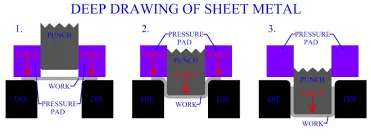
- Deep Drawing:-
It is sheet metal forming process in which a sheet metal blank is radially drawn into a forming die by mechanical action of punch .The process is considered deep drawing when the depth of the drawn part exceeds its diameter.
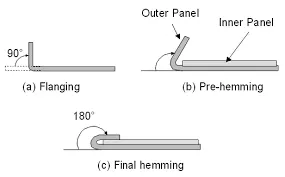
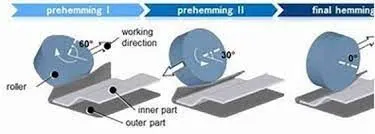
- Hemming:-
Hemming is a forming operation in which the edges of the sheet are folded over other part or simply folded in order to achive a tight fit .In car part production,hemming is used in assembly as a secondary operation after deep drawing,trimming and flanging operations to join two sheet metal parts(inner and outer ) together.
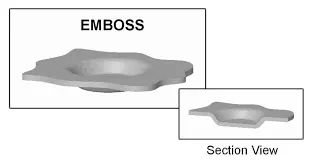
- Embossing:-
Sheet metal embossing is generally used to create logos, lettering, small depressions, etc. It is also used to create desired non-slip surfaces as well as other geometric features on the sheet metal.In sheet metal embossing, the deformation of the metal takes place because of stretching of the metal (or tensile force acting on the metal), due to which the sheet metal is subjected to excessive thinning and fracturing.Thus the depth to which the material is depressed depends upon the thickness of the sheet as well as stretchability of the material.Embossing is generally used to make dimples on sheet metal to increase their rigidity as well as it is also used for decorative purposes on panels in houses or other places.
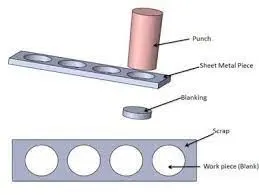
- piercing:-
Piercing is the process of cutting small, cylindrical holes in the sheet metal whilst removing very little quantity of material. This is done by using a bullet shaped punch during the punch and die operation.
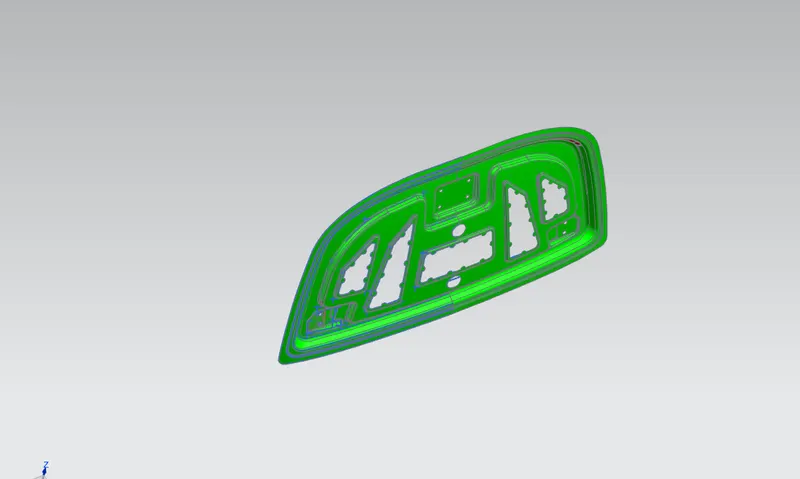
Here some photos of all operations do in this challages.
- Relief:
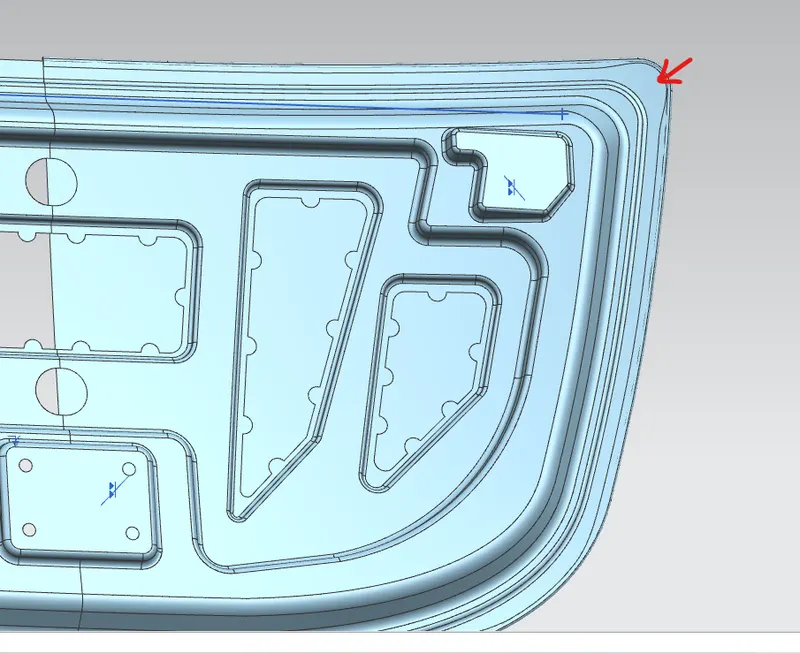
- Drafting analysis:
- Conclusion:- Designed the car hood along with its components and assembled the same, using NX CAD,under given parameters.
All parts attach together as a zip file.