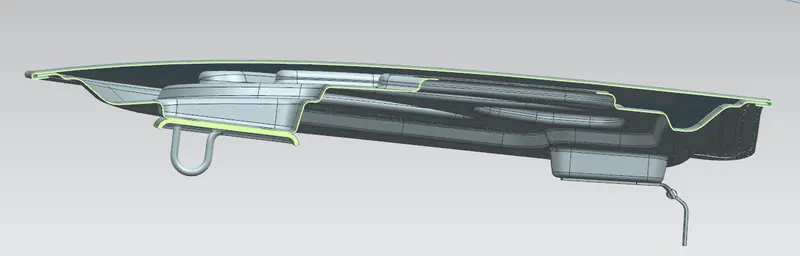
Hood design-Week 2
Hood design
Introduction
A car hood also referred to as a bonnet in some other countries is the hinged cover that rests over the engine of a front-engine vehicle. Its purpose is to provide access to the engine for repair and maintenance. Car hoods are typically constructed from steel and sometimes from aluminium.
The process involved in designing hood as a sheet metal operation
- Blanking
- hemming
- Punch cutting or piercing
- Deep drawing
- Embossing
Deep Drawing
- Deep drawing is a manufacturing process that is used extensively in the forming of sheet metal into a cup or box-like structures. Pots and pans for cooking, containers, sinks, automobile parts, such as panels and gas tanks, are among a few of the items manufactured by sheet metal deep drawing.
- A deep drawing of sheet metal is performed with a punch and die. The punch is the desired shape of the base of the part, once drawn. The die cavity matches the punch and is a little wider to allow for its passage, as well as clearance. For many calculations, the sheet metal thickness is assumed to remain constant. However, there are changes in thickness in certain areas, due to the forces involved.
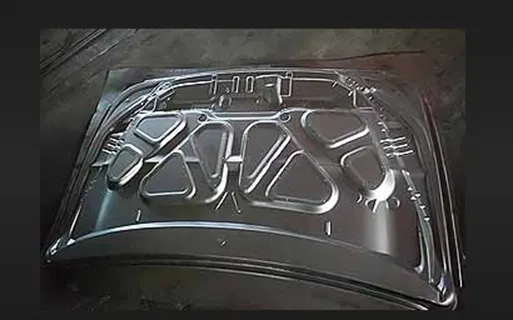
Hemming
Hemming is a forming operation in which the edges of the sheet are folded or folded over another part in order to achieve a tight fit. Normally hemming operations are used to connect parts together, to improve the appearance of a part and to reinforce part edges.
In car part production, hemming is used in assembly as a secondary operation after deep drawing, trimming and flanging operations to join two sheet metal parts (outer and inner) together. Typical parts for this type of assembly are hoods, doors, trunk lids and fenders.
Rules and regulation standards for designing the hood.
- A perfect hood design means it should have a great impact distribution angled outside the car.
- In Japan and Europe, regulations have come into effect that places a limit on the severity of pedestrian head injury when struck by a motor vehicle. This is leading to more advanced hood designs, as evidenced by multicore hood inner panel designs.
- European Enhanced Vehicle-Safety Committee (EEVC), European New Car Assessment Program (euro NCAP)
Pedestrian -Vehicle Collision
- India is a ranks 1 in the number of road accident deaths across the 199 countries reported in the World Road Statistics, 2018 followed by China and the US. As per the WHO Global Report on Road Safety 2018, India accounts for almost 11% of the accident-related deaths in the World.
- Road transport remains the most favoured mode of transport for both freight and passenger movement in India. The fast-growing population, exceptional rate of motorization coupled with the ever-growing urbanization has made people vulnerable to frequent road accidents resulting in fatalities, injuries/disabilities.
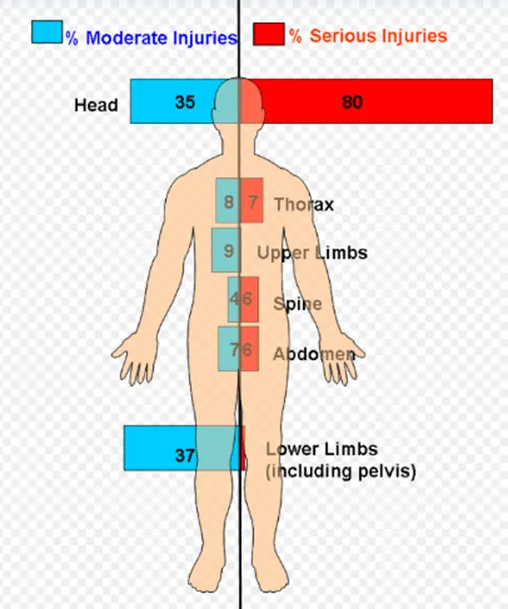
- The sequence of injuries and events in a pedestrian collision images are mentioned below.
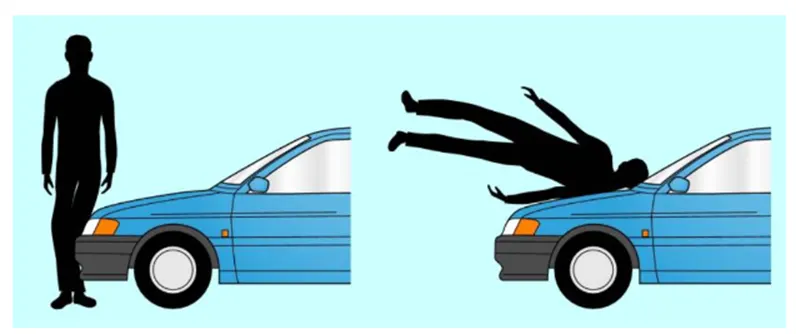
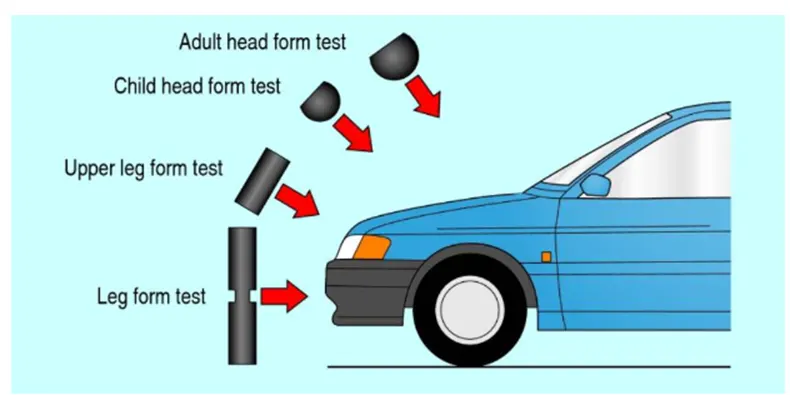
Design specifications for the automotive hood component
Inputs:-
Master Section of Outer & Inner Panel Assembly
Hood Thickness Information
- Outer Panel Thickness = 0.75mm
- Inner Panel Thickness = 0.75mm
- Reinforcement Thickness = 1.5mm
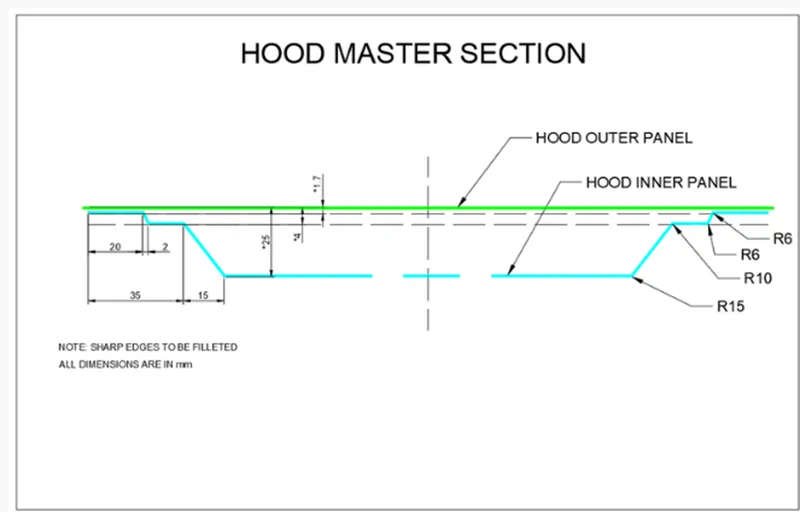
Design of hood
Inner panel design
- The hood inner panel is required to have a high initial reaction force against the impact exerted on the hood to enhance the energy absorption capacity. The hood is further required to minimize a reduction of a reaction force by deformation in a collision.
- It is an object of the present invention to provide a hood inner panel capable of reduction of a reaction force of the hood inner panel even if a level of deformation of a hood of a vehicle increases, and ensuring a sufficient energy absorption capacity.
- In the inner panel only we can research and implement the safety of pedestrians and as well as the driver.in this panel only we can attach the reinforcement, embossed, mastic points, etc.
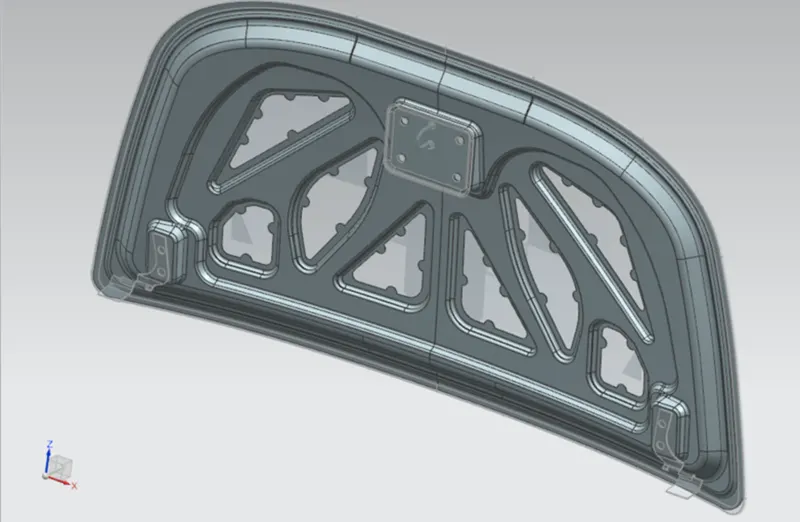
Embossing in sheet metals
- The metal sheet embossing operation is commonly accomplished with a combination of heat and pressure on the sheet metal, depending on what type of embossing is required. Theoretically, with any of these procedures, the metal thickness is changed in its composition.
- A metal sheet is drawn through the male and female roller dies, producing a pattern or design on the metal sheet. Depending on the roller dies used, different patterns can be produced on the metal sheet. The pressure and a combination of heat actually "irons" while raising the level of the image higher than the substrate to make it smooth. The term "impressing" refers to an image lowered into the surface of a material, in distinction to an image raised out of the surface of a material.
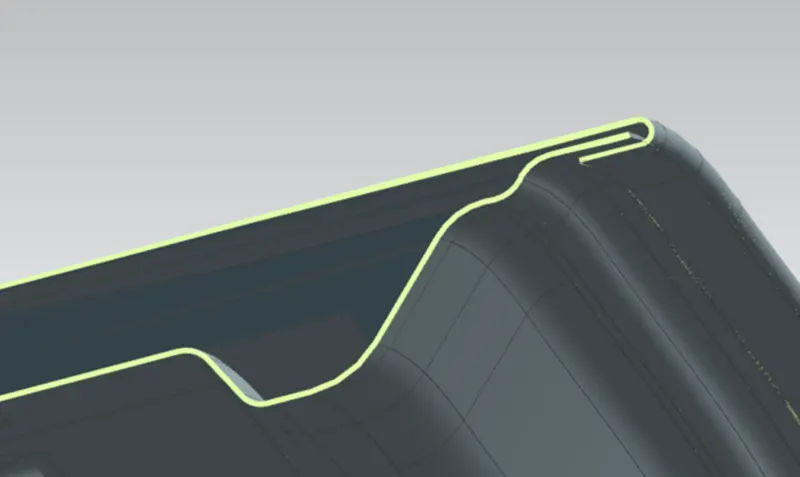
Hemming of hood
- Hemming is a sheet metal forming process in which sheets are joined by bending it usually to 180°. Automotive body panels and automotive parts such as deck-lids, trunk-lids, doors, hoods, and tailgates are formed by hemming processes.
- Conventional die hemming is suitable for mass production. In die hemming, the flange is folded over the entire length with a hemming tool. Normally the actual hemming is a result of a forming operation in which the flange is formed with a hemming tool after the drawing and trimming operations have been completed
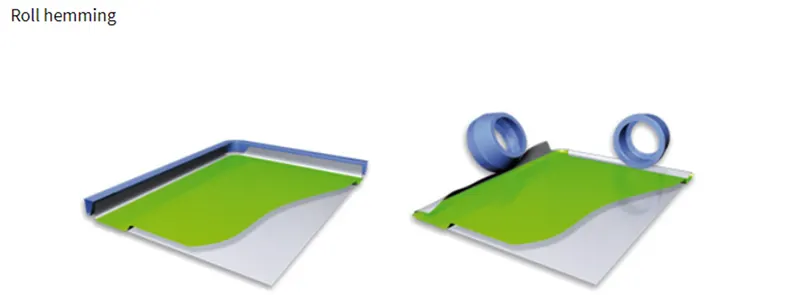
- Roll hemming is carried out incrementally with a hemming roller. An industrial robot guides the hemming roller and forms the flange. Roll hemming operation can also be divided into several pre-hemming and final hemming process steps.
If weld or bolts were used to join the hood panels then the design and the aerodynamic features would get damaged so hemming is more significant to use.
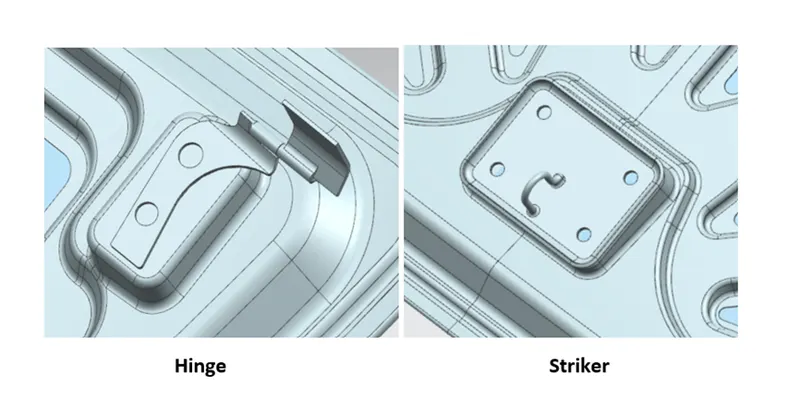
Reinforcement.
- Which is adding an extra material to increase the strength of the material (or) to compensate the strength of the material on the particular region.
- The area that I'm going to attach my hinge assembly and striker those will lose their strength to compensate I'm going to attach a reinforcement of 1.5 mm thickness
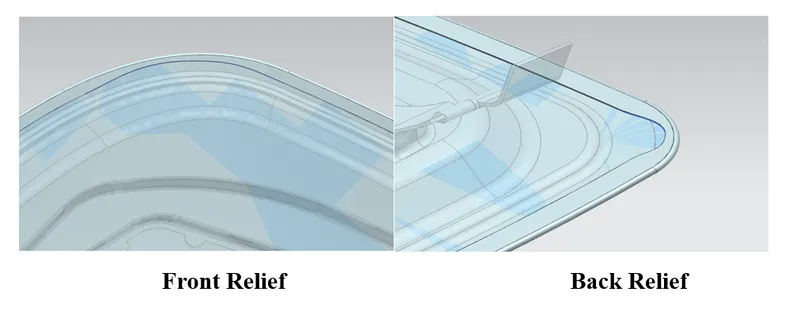
Relief section
In sheet metal, a bend relief is an incision cut along the sides of a planned bend. Though bend relief lengths and widths vary between projects, they all share a common goal: preventing tearing and part deformation during the bending process
Mastic data
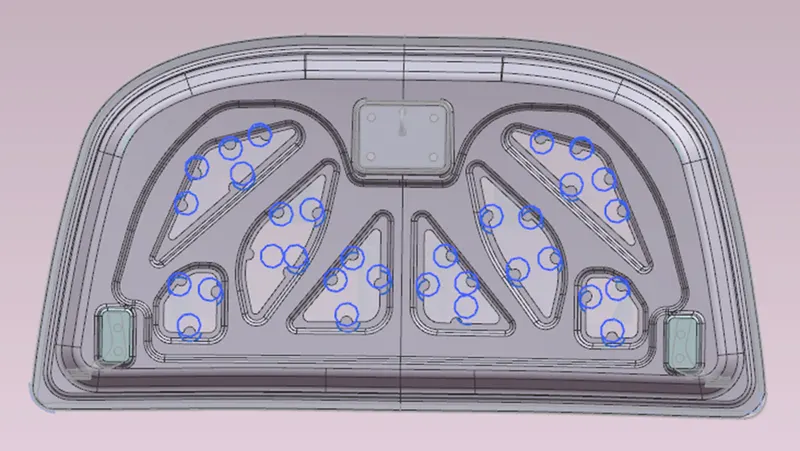
A mastic sealant data is used to fix or combine the hood outer panel and hood inner panel.
- They can provide thermal and acoustical insulation, and may serve as fire barriers. They may have electrical properties, as well. Sealants can also be used for simple smoothing or filling. They are often called upon to perform several of these functions at once.
- A sealant has three basic functions: It fills a gap between two or more substrates; it forms a barrier through the physical properties of the sealant itself and by adhesion to the substrate; and, it maintains sealing properties for the expected lifetime, service conditions, and environments. The sealant performs these functions by way of correct formulation to achieve specific application and performance properties.
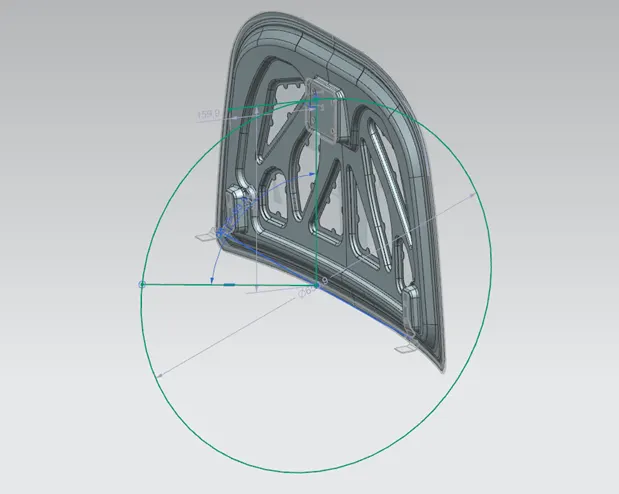
Latch trajectory motion
While opening or closing the hood, the latch must be perfectly aligned to the fixing or striker point. For that, the latches trajectory must be perpendicular to the hinge axis.
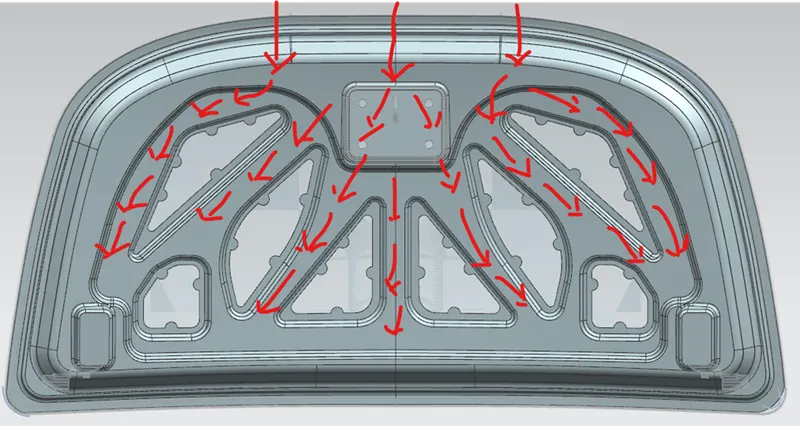
Impact Force Distribution in Hood design
A hood design must be made in such a way that when a force is impacted in the front of the hood, all the force must be directed outwards from the vehicle. And the distribution of the force must be controlled along with the hood.
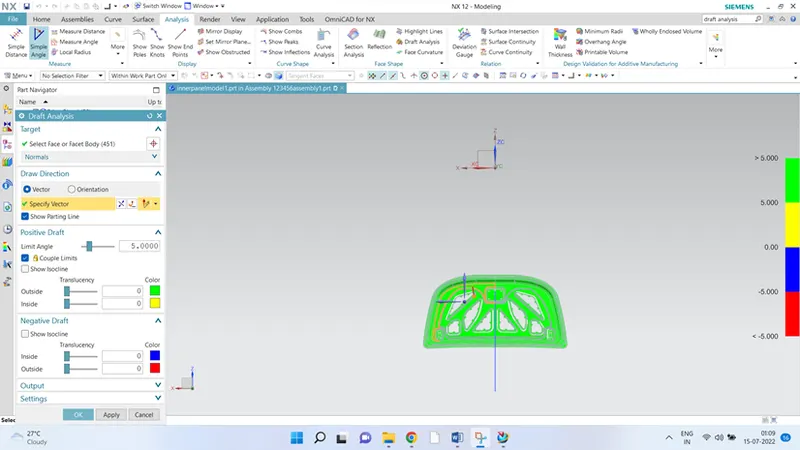
Draft Analysis
- 5 degrees of draft analysis is made to the inner panel to find any negative draft. This process is done because we need to develop and submit a positive design to the manufacturers.
we can see that there are no negative drafts by the inner panel, hence the design is positive and ready to manufactured
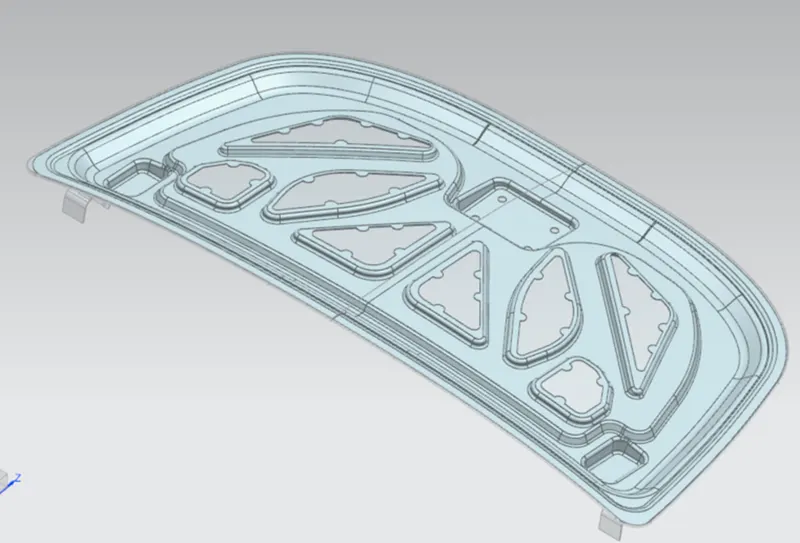
View of Hood
ISOMETRIC VIEW OF HOOD
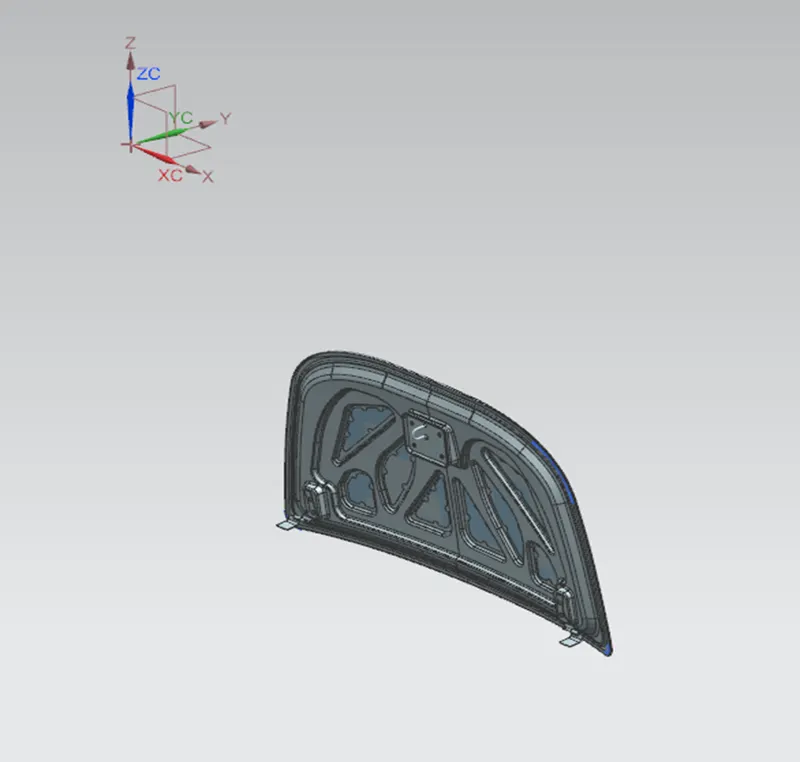
FRONT VIEW OF HOOD (Inner Pannel of Hood)
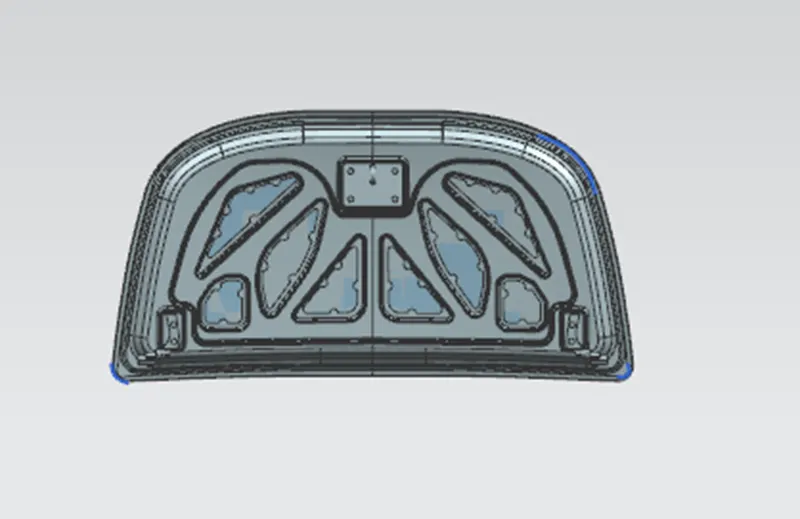
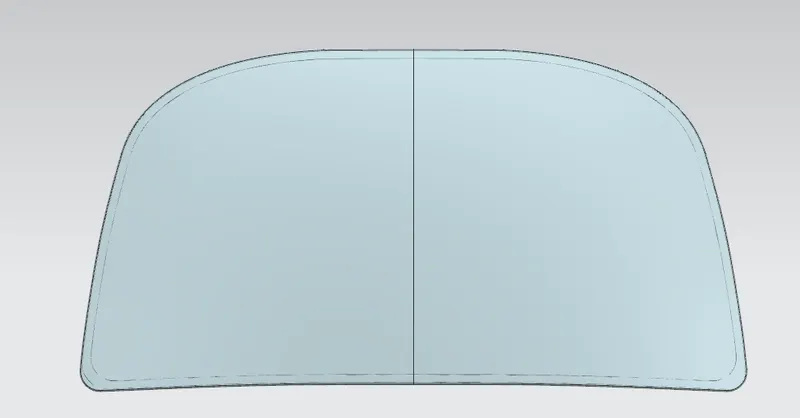
TOP VIEW OF HOOD
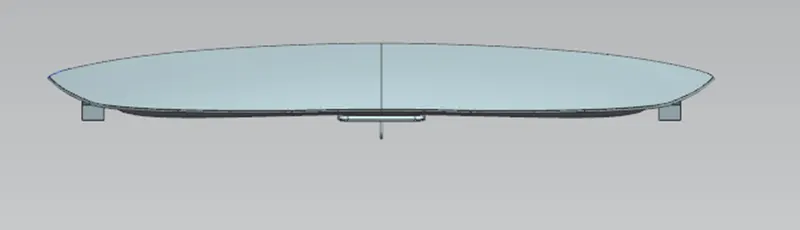
BOTTAM VIEW OF HOOD
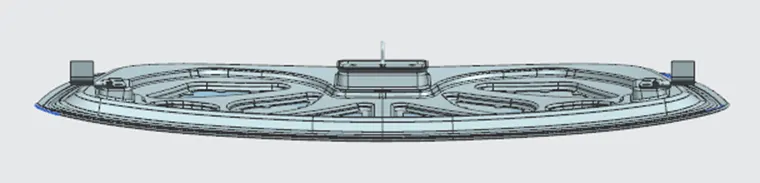
BACK VIEW OF HOOD (Outer Pannel of hood)
MASTER SECTION