Hood design-Week 2
HOOD DESIGN
- Introduction
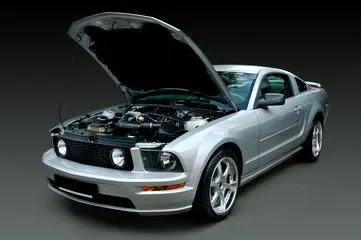
- Hood is hinged thin sheet which covers and protects the main parts of car like engine. Hood is a critical part of a car because of the frontal crash and pedestrian safety requirements. Also, when a front collision happened, the hood is the component which divert the direction of force acting on the car to both sides rather than sending it to the centre of the car which can results in more damage to the passengers sitting inside the car.
- Its main function is to direct access to the engine, battery and other crucial parts of the cars for repair and maintenance and to protect these parts from direct sunlight and dust. It is fundamentally a reinforced skin panel with many safety and quality requirements.
- A concealed latch is typically used to hold down the hood. On vehicles with an aftermarket hood and on race cars, hood pins may be used to hold down the car hood. Hoods sometimes also contain a hood scoop, wiper jets, power bulge, and/or hood ornament.
- Car hoods are typically constructed from steel and sometimes from aluminium. Aftermarket car hoods may be constructed from various other materials, including carbon fibre, fiberglass, or dry carbon.
2. Components of Hood
- Outer panel
- Inner panel
- Hinge assembly
- Stricker
3.While access for repair and maintenance Hood can be fixed by two methods. They are
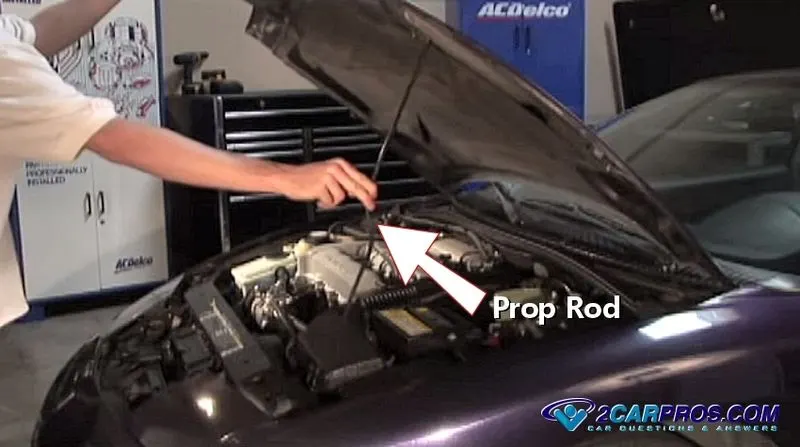
- Support Rod
Support rod is basically long cylindrical rod. It safely keeps an engine hood in an open state even if external forces are abruptly generated due to vibration & wind.
- Gas Stay
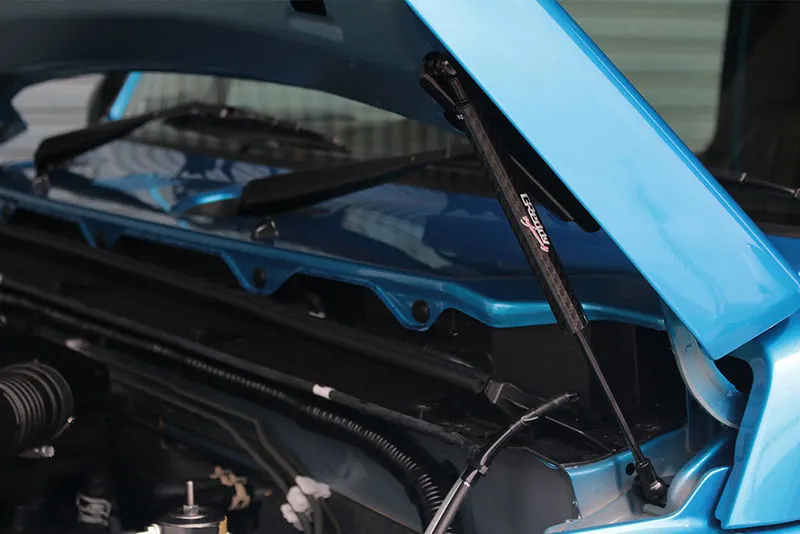
Gas struts work by compressing the gas within a cylinder. The compressed air causes pressure to build on one side of the piston and decrease on the other, creating movement in an arc-like motion. It helps smooth opening and closing of the hood.
4. Design Boundary Conditions for Hood
The boundary conditions for commencing a new design process using aluminium can be identified and analysed by grouping together requirements using affinity matrix methods.
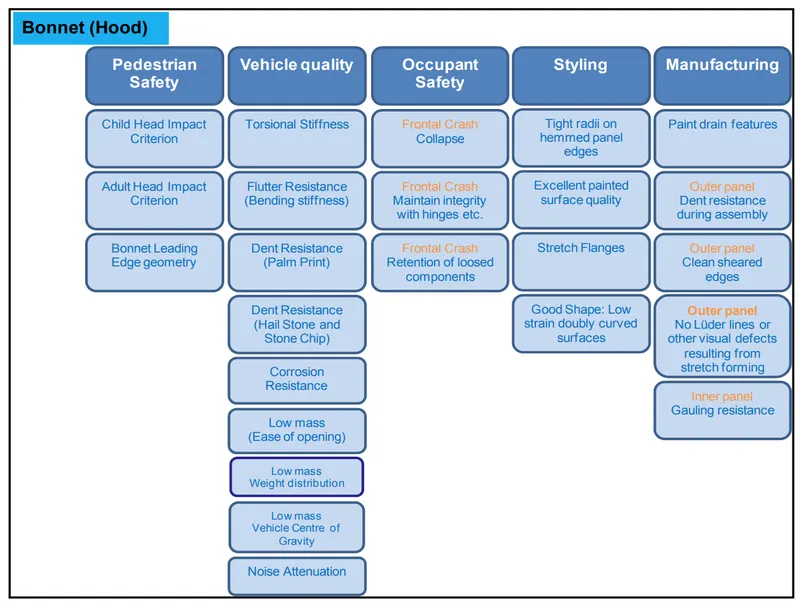
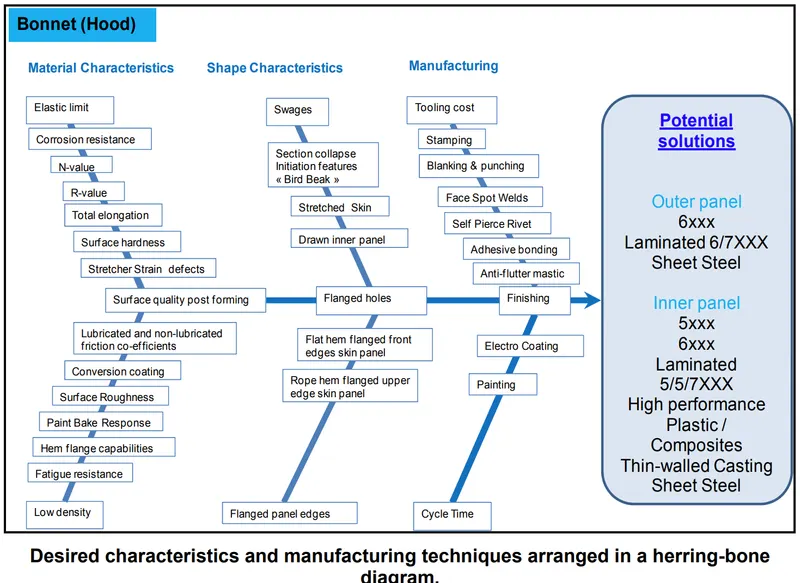
- Herring-bone diagrams are a good way to start to develop a Design Failure Modes and Effects Analysis (DFMEA). They are also a good starting point for identification of the key design requirements, wishes and constraints in order to assist the selection of candidate materials, product forms and assembly methods, etc.
- Hood head zone for Stricker Locking
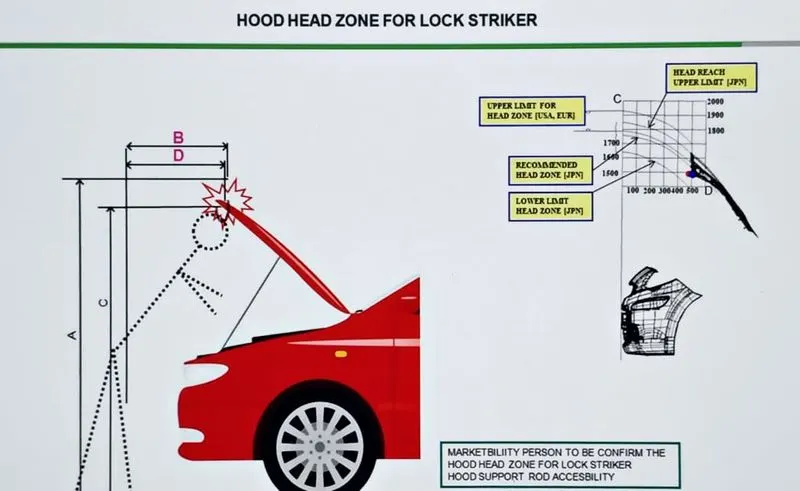
While designing the hood, hood head zone should be taken into consideration because when a person access to the engine compartment for performing operations like maintenance and cleaning, his head should not collide with the hood in the open condition. So, there should provide a minimum height for the hood when it’s in open condition to avoid collision of head with the hood. The height of hood in the open conditions should be more than that t of the average height of person in a particular region or country.
Pedestrian Safety
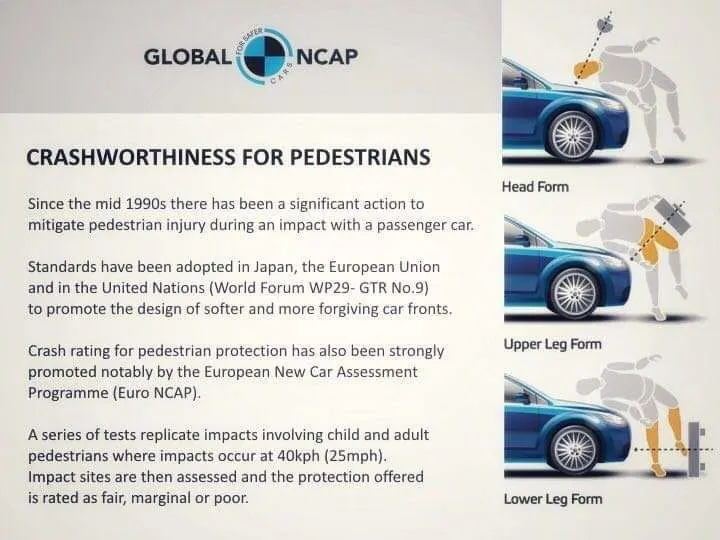
Vehicle safety factors should simultaneously consider occupant and pedestrian safety, given that pedestrians are the third largest category of traffic fatalities. Most pedestrian deaths occur due to traumatic brain injury, resulting from the hard impact of the human head against the vehicle's stiff hood or windshield. Therefore, how to design a pedestrian-friendly vehicle and propose a new hood structure is a matter of urgency for minimising pedestrian head injuries.
Concerns regarding the severity of a potential pedestrian head injury during a collision with a motor vehicle have led to advanced hood designs on many models. Such designs may include a multi-cone inner hood panel design. An active structure that is capable of pushing the surface of the hood away from the vehicle's hard motor components in the event of a pedestrian crash is also in use. Pyrotechnic or spring force designs are often used in active-hood design.
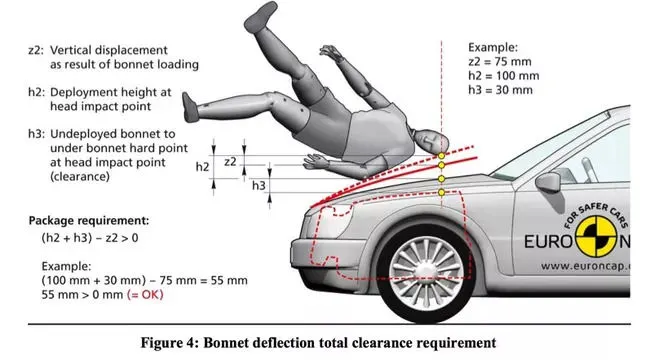
Evaluation of pedestrian safety for a bonnet must be carried out in the context of its surrounding elements:
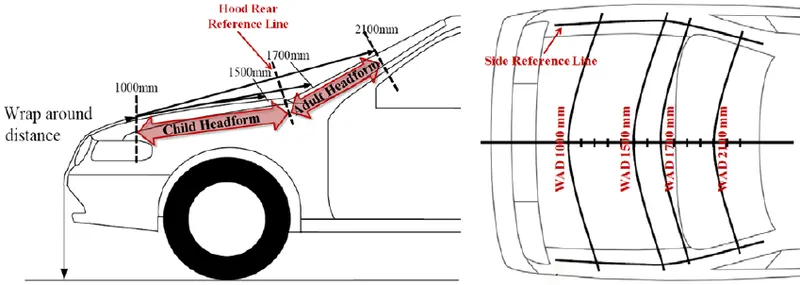
- Vehicle styling, size (wrap around distance “WAD”) and under bonnet clearance to other elements (considered as hard points).
- Local bonnet stiffness is influenced by mounting point stiffness such as hinges, bump stops and latches.
- This is better understood by superimposing the kinematics of a dummy onto the test conditions.
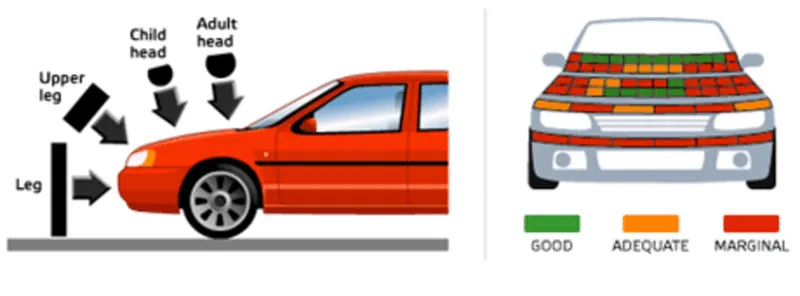
Based on pedestrian injury data, the head and lower extremities are the most commonly injured body regions in vehicle-to-pedestrian crashes. As a result, Euro NCAP (and all the other pedestrian impact-test procedures) focuses only
on these two body regions. As shown in below figure, Euro NCAP pedestrian tests include legform to bumper tests, upper legform to hood leading-edge tests, and child/adult headform to hood/windshield tests. Multiple tests are conducted at different test zones at the bumper, hood leading edge, and headform contact areas. The headform test area is defined based on the pedestrian wrap-around distance (WAD) as shown in Figure, in which child and adult headform test zones are separated. The test zones cover almost the full width of the vehicle, so that the overall pedestrian protection can be evaluated throughout the vehicle front-end structures. Once the tests are conducted, the impact responses are then assessed by points and rated in colour.
Head injury criteria (HIC)
The equation that used for the measurements of the head injury of the whole model for the pedestrian head impact was head injury criteria (HIC).
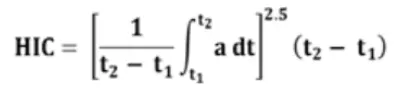
Where (a): the resultant acceleration (as a multiple of 10 ms-2 or about 1 g). t1, t2: two-time instants (in seconds), which define the start and end of the recording when HIC is at maximum. Values of HIC at the time interval t1-t2 is greater than 15 ms are ignored to calculate the maximum value.
Euro NCAP Active Bonnet
Active safety designs were not considered much until the last few years. Recent rapid development of sensing systems for detecting an imminent collision enabled active safety features to be used for occupant protection, and similar technology can also be used for pedestrian protection. The goal of all active safety designs for pedestrian protection is to avoid a pedestrian crash or reduce the impact speed. Given the strong correlation between the impact speed and pedestrian injury risk, such technology, if reliable, would significantly reduce all pedestrian injuries regardless of the specific body region
5. Design of Car Hood Using Siemens NX CAD
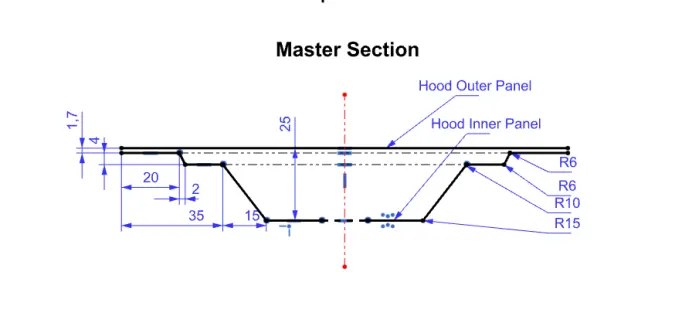
I am here by designing the hood inner panel using the A class surface and master section provided.
5.1 Data to be used:
Hood Thickness Information
- Outer Panel Thickness = 0.75mm
- Inner Panel Thickness = 0.75mm
- Reinforcement Thickness = 1.5mm
5.2 Mainly used features and commands in NX CAD while designing the Hood are as follows
- Offset curve in face
- Offset curve
- Offset Surface
- Through Curves
- Law extension
- Trim Sheet and trim body
- Face Blend and Edge Blend
- Emboss
- Mirror Geometry
- Sew
- Thicken
5.3 Sheet Metal operations in DFM involves the following process
- Shearing Operation
- Blanking & Fine Blanking Operation
- Punching Operation
- Piercing Operation
- Perforating Operation
- Slotting Operation
- Notching Operation
- Bending Operation
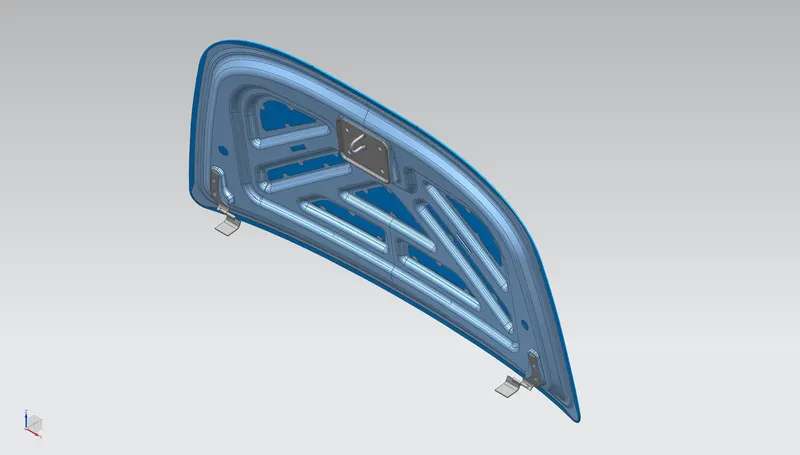
5.4 Hood Inner panel
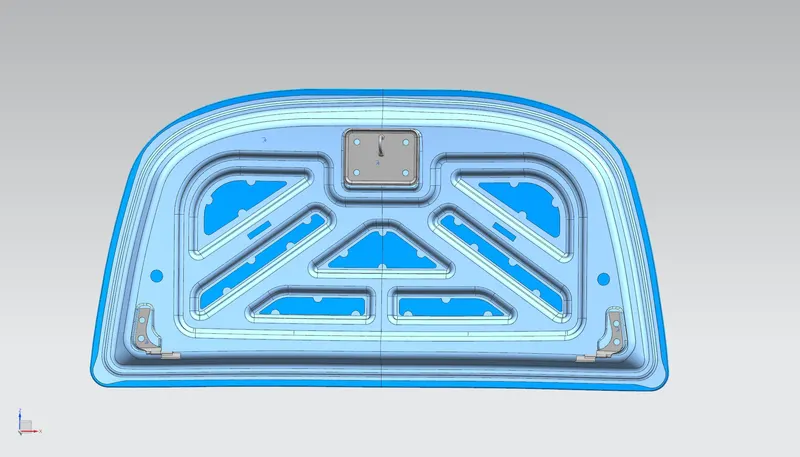
The design of inner panel is based on the data given in the master section. Inner panel is the part oh Hood when so many embossed structures are created. Basically, the inner panel provide strength to the hood outer panel as well as the reinforcement attached to it.
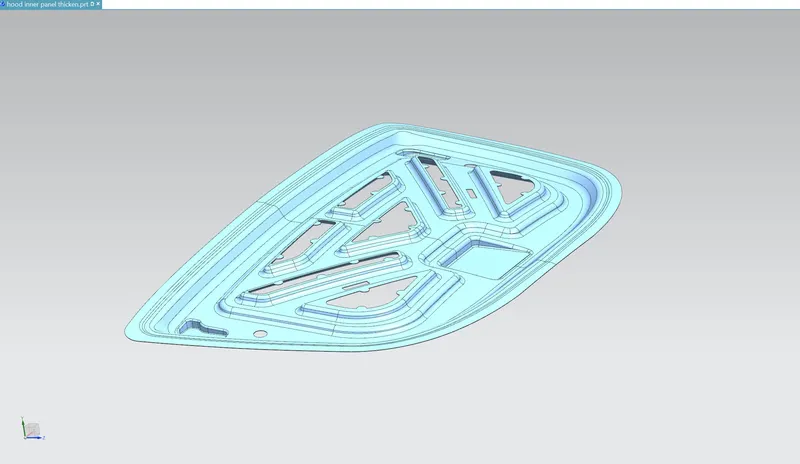
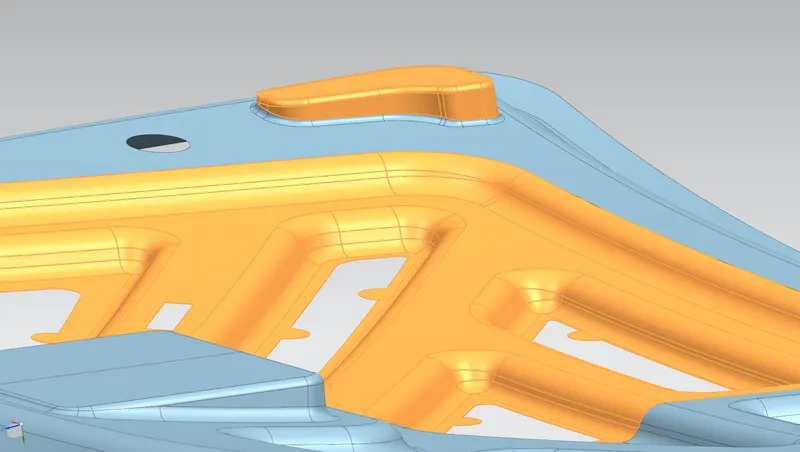
- Emboss Operation
Sheet metal embossing is a stamping process for producing raised or sunken designs or relief in sheet metal. This process can be made by means of matched male and female roller dies, or by-passing sheet or a strip of metal between rolls of the desired pattern. It is often combined with Foil Stamping to create a shiny, 3D effect.
There are three types of metals that are used for embossing dies. Depending on the shape of the image, the texture to be created and the length of the run you can select the metal.
- Magnesium dies are used for easy embossing projects that have short runs. The designs are large and uncomplicated. Magnesium also allows for special hand tooling.
- Brass dies are the most popular embossing dies. They are very flexible and give the embosser leeway to create fine lines, sculptured images, combo foil stamping and embossing. They are also very good for images requiring extensive hand tooling
- Copper dies are used as an in between to magnesium and brass. However, copper dies do not permit hand tooling.
Embossing operation also enables to highlight important elements of printed products, such as letters (company names), Logo designs etc.
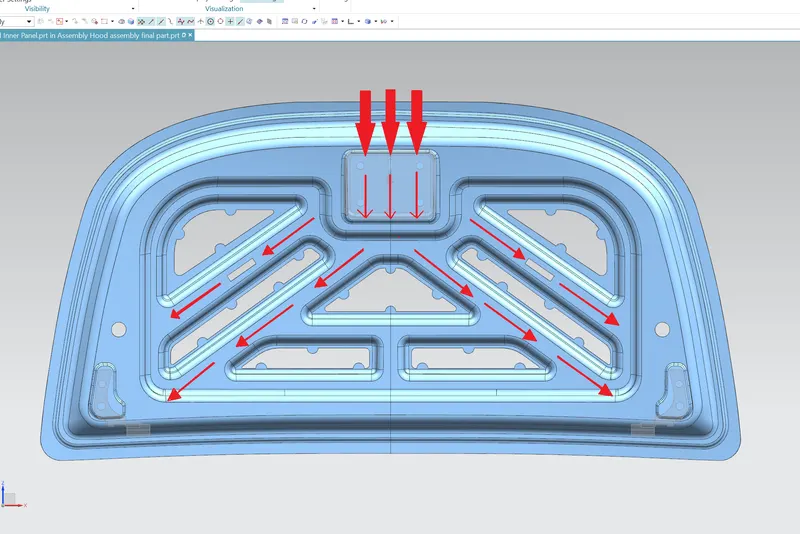
Force acting on the Hood
If a front collision occurs, the hood is the part by which the direction force acting on the front centre part is diverted or spread the direction towards the side of the body. When we design the inner panel of the hood. To attain this direction change, emboss structure on the inner panel is designed and implemented. is introduced Which results in drastic reduction of impact directly to the passengers sitting inside the car.
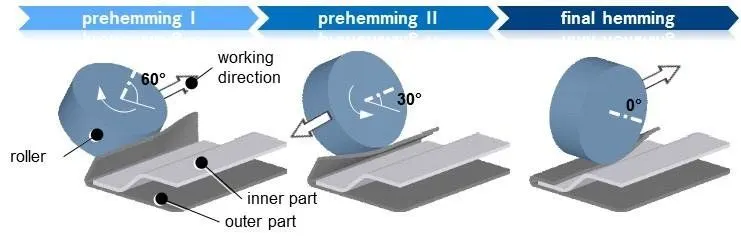
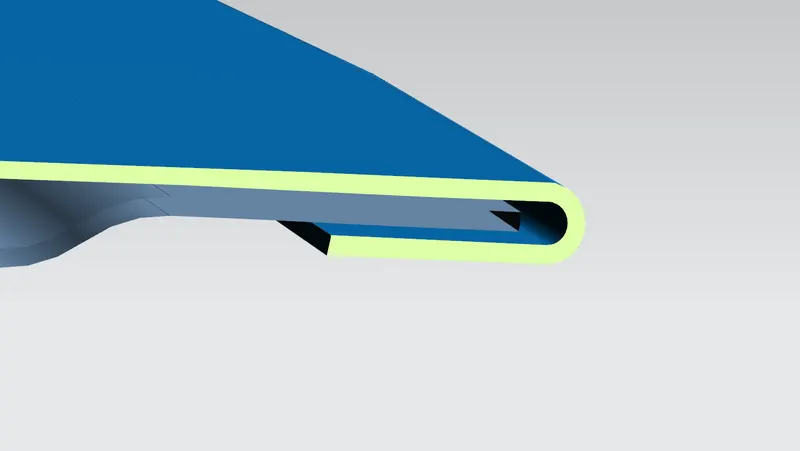
5.5 Hemming Process
Hems are commonly used to re-enforce, hide imperfections and provide a generally safer edge to handle. When a design calls for a safe, even edge the added cost of material and processing of a hem is often preferable to other edge treating processes. Doubling a hem can create an edge perfectly safe to be handled without almost regard for the initial edge quality. Adding a hem in the ‘middle’ of a bend profile can open the doors to a variety of profiles not possible without fasteners or welding. Even without sophisticated seaming machines a combination of two hems can create strong, tight joints with little or minimal fastening. Hems can even be used to strategically double the thickness of metal in areas of a part which may require extra support.
In roller hemming process, a robot guides a small roller across the flange to fold a sheet onto itself or onto another sheet. The process is oriented to low volume automotive applications, providing a distinct advantage in manufacturing closures and subassemblies with developed flanges.
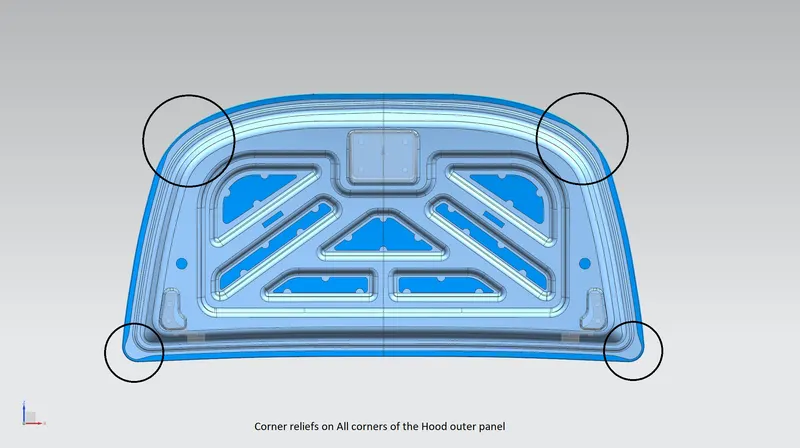
- Corner Relief
When you add relief, sheet metal sections are removed from the model. You can apply corner relief automatically to all corners or manually to individual sets of corners. Relief helps to control sheet metal material behaviour and to prevent unwanted deformation during unbend operations.
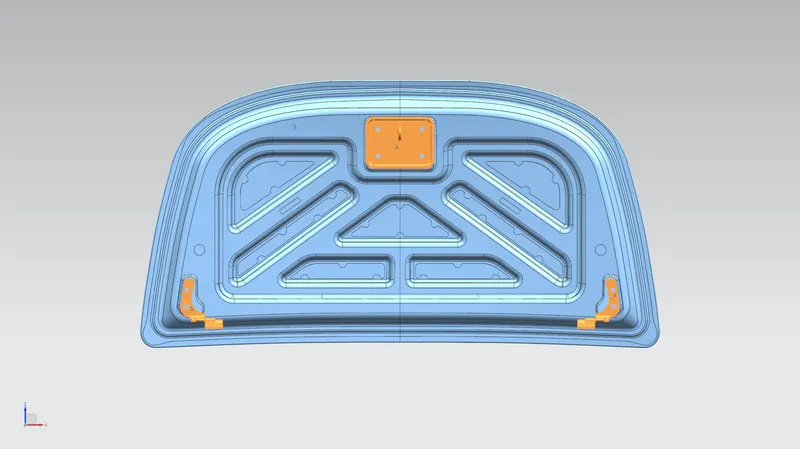
5.6 Reinforcement of Hinge and Stricker Latch parts
Whenever we add weight to a material, it loses the strength of that panel locally. So, in order to keep the component strong, we add some thickness of reinforcement to it. In other words, reinforcements are materials which are given additionally to compensate the loss of strength on the body part locally.
Hinge is a mechanical bearing that connects two solid objects typically allowing only a limited angle of rotation between them. it has One Degree of freedom. So, the hinges provide rotation motion to the hood about its own axis.
Latch Stricker is provided on the front side of the bonnet to fulfil the lock mechanism of hood. It is also provided with reinforcement plate to provide extra strength on that attachment region.
For the proper opening and closing of hood, the Stricker is placed perpendicular to the trajectory of the hood with respect to the hinge axis provided. In order to achieve this, the hinge is assembled at a position and then a hinge axis is drawn and using this hinge axis as a centre we draw a circle which is the trajectory for the hood opening and closing and also the Stricker will be perpendicular to the trajectory drawn.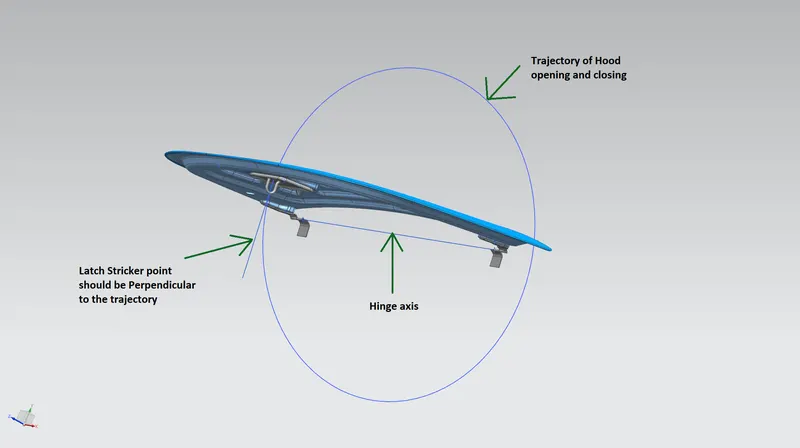
5.7 Mastic Seal Points
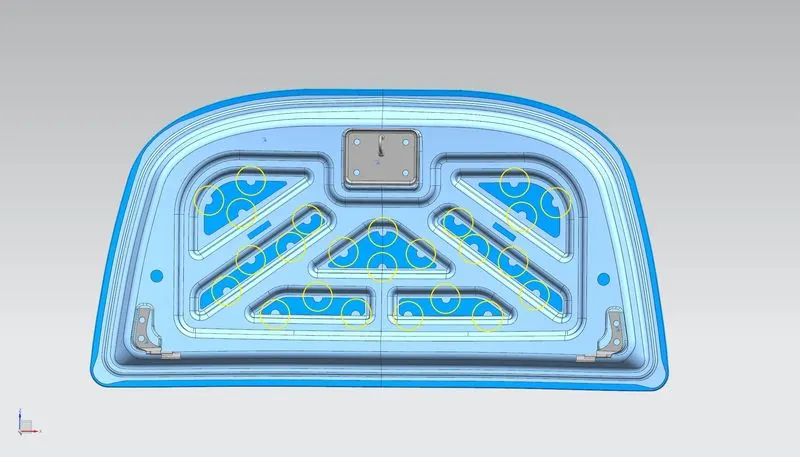
- To fill or apply the mastic adhesive in between the inner and outer panels, we provide mastic points on the inner panel of the hood. So that we apply the mastic sealants, which have a tendency to improve the strength locally by around 80mm diameter.
- Mastic sealants are nothing but a hard rubber or introduced as a paste in between the inner and outer panels.
- The gap in between the inner and outer panel should be around 4.5mm and they will be filled with the mastic sealant.
- The skin panels or outer panels are always strict to not apply any welds, rivets etc which causes the aesthetic appearance. so, in order to ignore these conditions, Mastic sealants are introduced to strength in that region.
5.8 Hood Outer Panel
Hood outer panels are the aesthetic element of a Car. It is the styling team who provides the skin for the outer panel.
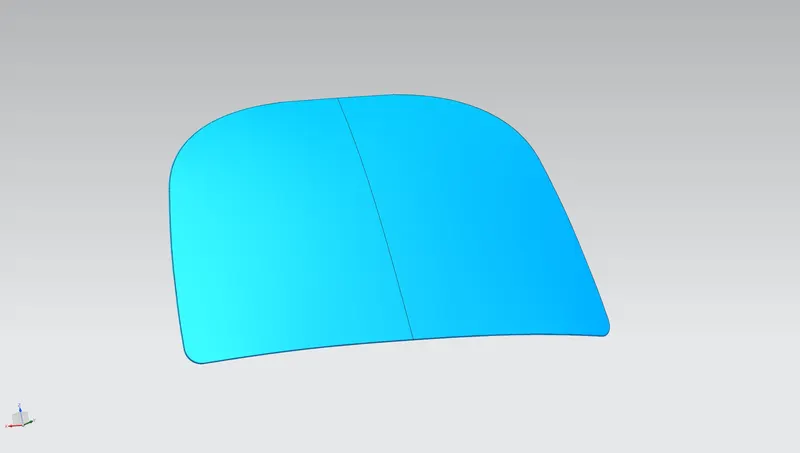
Front View
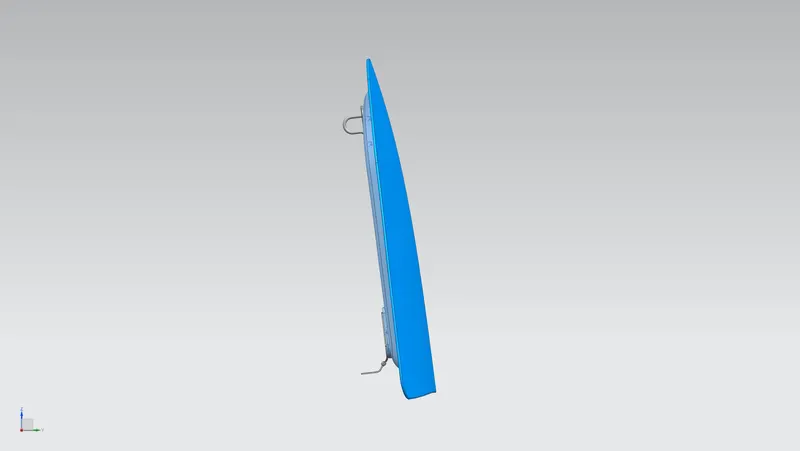
Side view
Isometric View
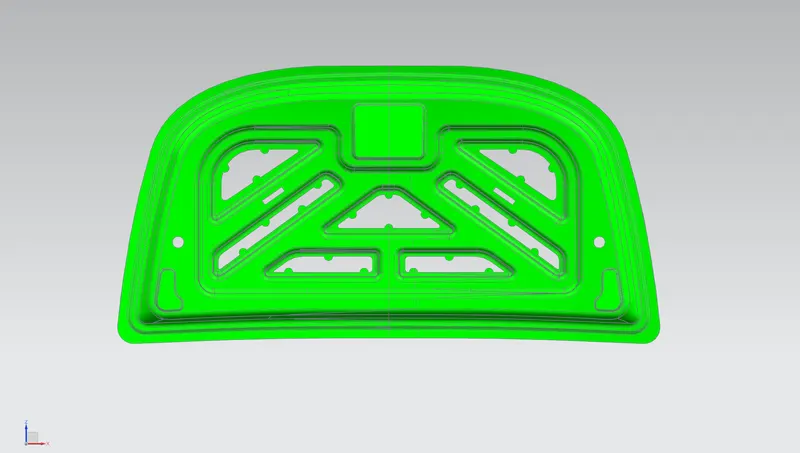
5.9 Draft analysis
Draft analysis is carried out to find out the panel can be drawn or not. It is used to find out if any negative drafts are present with in the design which may cause difficulties during the manufacturing process
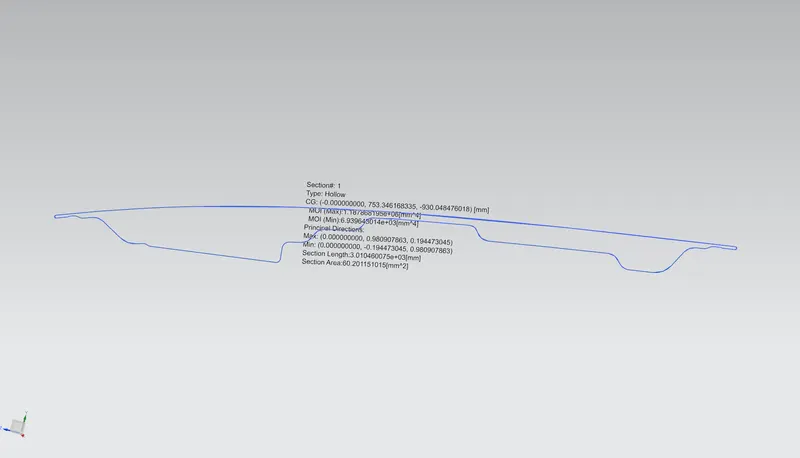
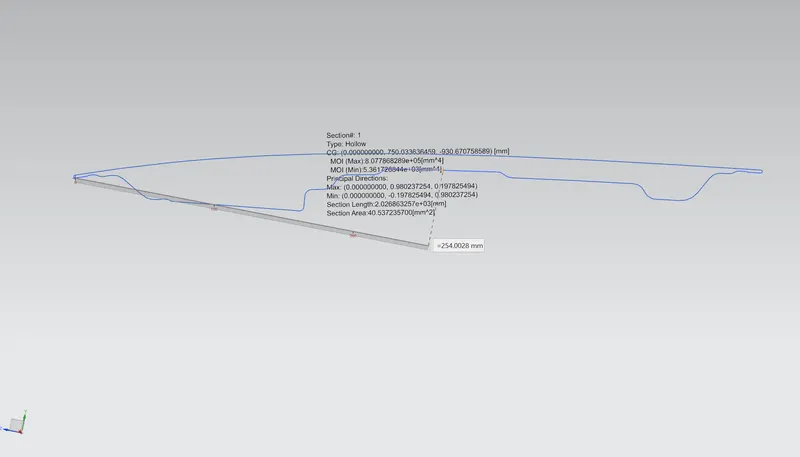
6. Section Modulus and section Inertia analysis
Section modulus is a geometric property for a given cross-section used in the design of beams or flexural members. Equation to find ut the section modulus of an object or substance is given below
S=I/y
Here,
S-Section Modulus
I-The moment of inertia
y-the distance between the neutral axis and the end of the object
Section moment of inertia also known as second area moment or 2nd moment of area is a property of a two-dimensional plane shape where it shows how its points are dispersed in an arbitrary axis in the cross-sectional plane.
When the area of section increases, the moment of inertia also increases. In other words, we can say,
the section modulus is directly proportional to the moment of inertia
Conclusion
Thus, I have completed designing of the Car hood which satisfies the industry’s manufacturing requirements, functional requirements and as well as the Euro NCAP standards using siemens NX CAD Plm software.