Hood design-Week 2
DESIGN OF HOOD
OBJECTIVE:
The main objective is to design the hood inner panel from a styling input of a car with fulfilling various requirements.
CONTENTS:
- Introduction
- Functional requirements
- Safety requirements
- Design requirements
1.INTRODUCTION
HOOD
The hood is a closure component that covers the engine compartment area in the vehicle. The hood also gives good aesthetic to a vehicle and also gives good aerodynamic properties. This hood contains two components they are inner panel and outer panel. The inner panel of the hood gives reinforcements and the outer panel will act as a metal cover.
There are four major components of a hood, they are hood outer panel, inner panel, hinge, latch and striker. Each and every part of the hood is having some functions for example the outer panel provides aesthetic and aerodynamics functions, and the inner panel provides reinforcements, hinge is used to close and open the hood, and striker is used to lock the hood while car is moving.
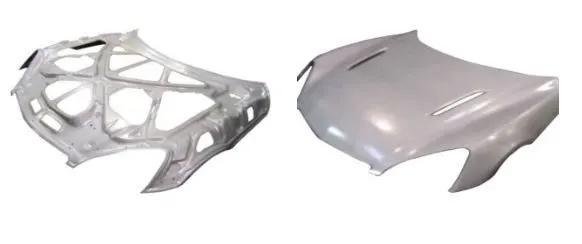
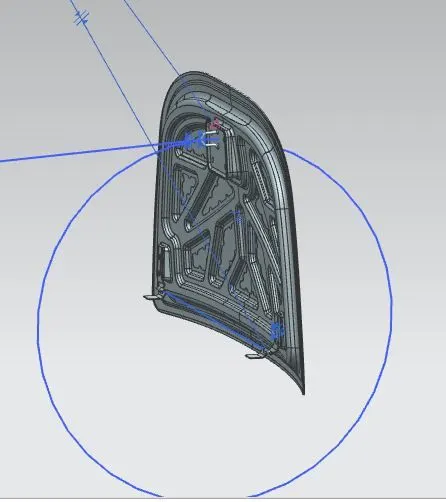
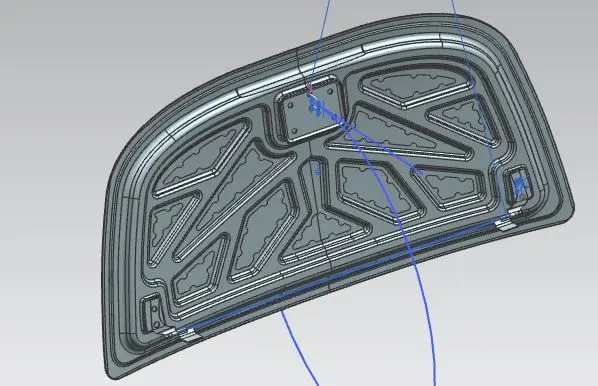
left side image shows the inner panel and the right side image shows the outer panel of the hood.
2.FUNCTIONAL REQUIREMENTS
Hood opening angle
Hood of a car have some functional requirements, the hood should be opened and closed in a proper way and held at opened condition without any difficulties.
The opening angle of the hood varies according to the region of the world. The below image shows the opening angle of the hood and the height of the latch and striker.
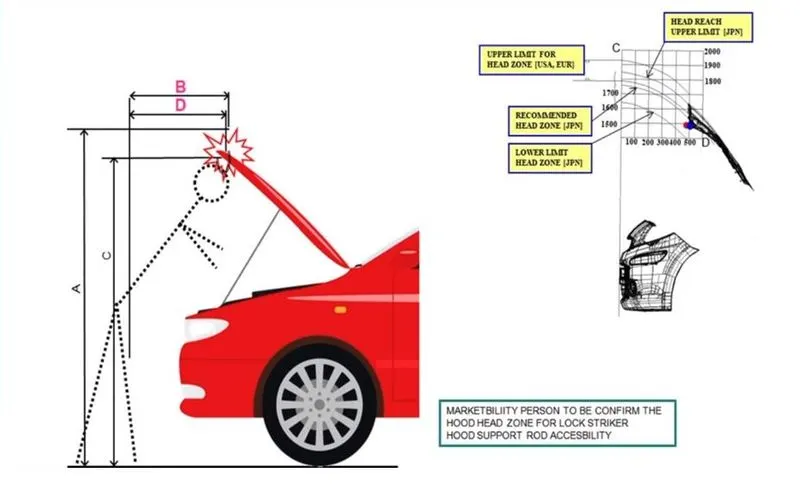
The average height of the people varies according to the region for that we have to ensure the latch height should be according to the data shown above.
Support rod and Gas stay
The another functional requirement of the hood is it should have a support mechanism to hold the hood in open position when it is required, that can be a support rod or the gas stay. The support rod and gas stay images are shown below.
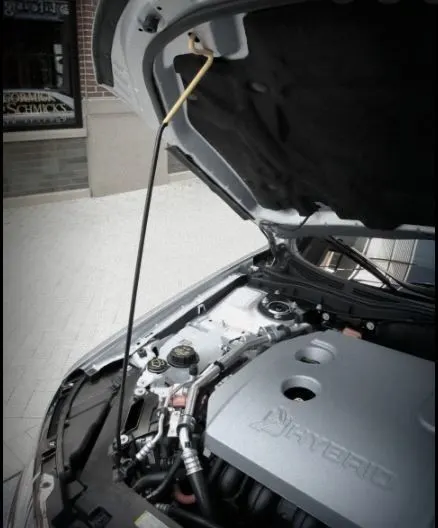
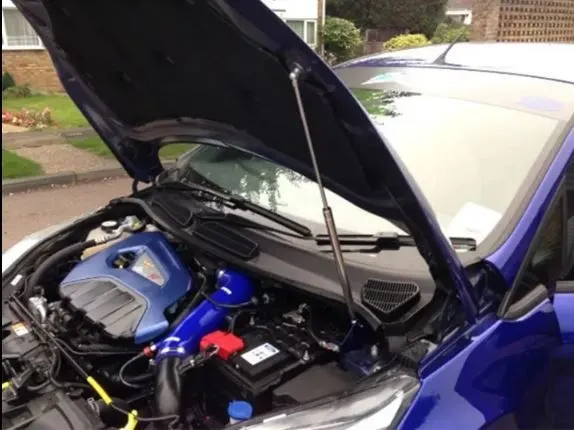
The above image in the left side shows the support rod mechanism, and in the left side gas stay mechanism is shown. The support rod mechanism should have adequate strength to hold the hood, so it is required to have some bends as a reinforcement in the support rods otherwise it will tend to bend while supporting the hood, and the support rod should always be placed opposite to the battery side to ensure the easy installation of the battery. The support rod should not have a bend above 35mm.
The gas stay is another mechanism used to hold the hood in open position, this gas stay also does the same function of the support rod but here we don’t need bear the entire weight of the hood, because the gas stay itself will opens the hood with the small initial force given by us.
3.SAFETY REQUIREMENTS
When it comes to safety the hood has major contribution, due to the frontal crash. Here apart from the passenger safety the pedestrian safety also should be ensured. In a pedestrian crash the most critical thing is head injuries, to prevent serious head injuries we have to make the hood which can absorb the impact energy from pedestrian head and deform. This deformation of the car hood will reflect less energy back to the head of the pedestrian. So the hood outer panel should perform better in pedestrian crash and the inner panel should provide strength while frontal crash.
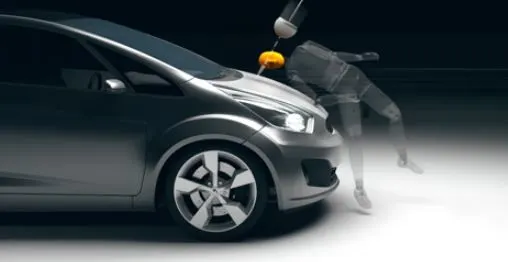
The above image shows that how a crash will affect pedestrian’s head during a pedestrian crash.
Also there are various regulations are provided for pedestrian safety, Euro NCAP provides the star ratings for pedestrian safety of a car, this pedestrian crash has impact on the head according to the type of pedestrian that is child or adult and here the wrap around distance of the pedestrian head impact zone also provides some major contribution to the head impact analysis. Wrap around distance is shown below.
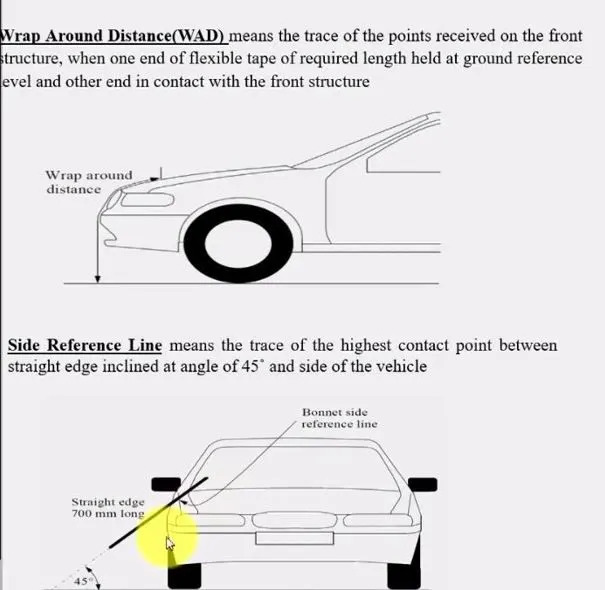
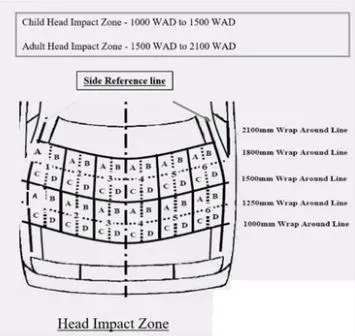
There are two types of hood according to the pedestrian head impact criteria they are
- Inlaid hood
- Wrap around hood
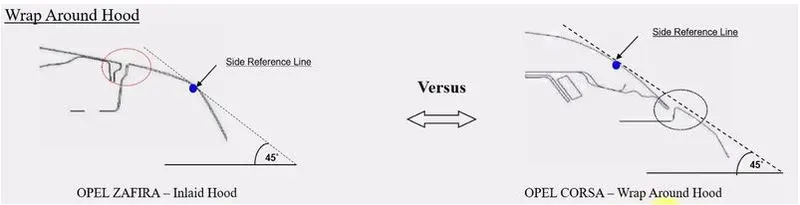
The above section image shows the wrap around hood and inlaid hood.
- Inlaid hood
- This inlaid hood is having the hood area which is inside the fender area, and this hood does not cross the fender area so the above shown side reference line will lie on the fender area so the pedestrian will have more impact when compared to wrap around hood.
- Here hence the wrap around area is less so the head impact zone is more.
- Wrap around hood
- Here the hood area is such extending out from the fender area so when we draw a 45 degree from the base to the car side the line will touch the hood area so here the head of the pedestrian will hit on the hood area only, where the head impact absorption makes the injury less.
- Here the wrap around area of the hood is more so the head impact zone is less.
UNDER BONNET CLEARANCE
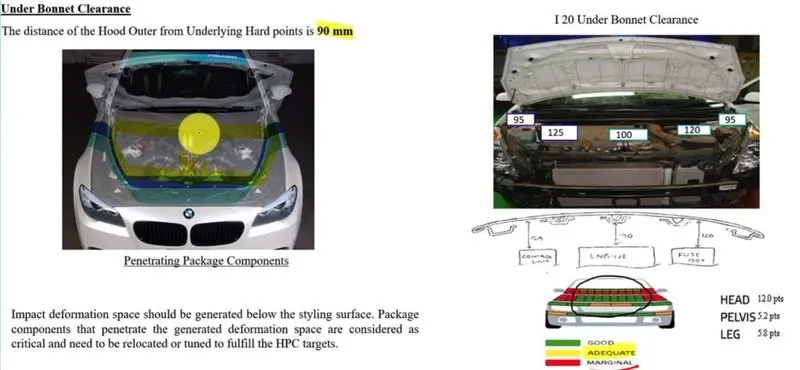
The another important safety criteria is the under bonnet clearance. while head of the pedestrian hits on the bonnet, the outer panel of the hood should allow some deformations to absorb the impact more and also to avoid the energy’s reflections, the minimum value of the hood’s deformation will be 90mm.
The below image shows that the colour coding shows about the penetration of the head impact, here that particular car has the 120mm under bonnet clearance, more the clearance is there will be more the green area.
4.DESIGN REQUIREMENTS
While designing the hood we have to follow some constraints, that constraints are according to the design point of view and also in the manufacturing and safety point of view. They major rules are listed below they are
- Master section
- Force dissipation and strength
- Manufacturing process
- Ejection of the part after deep drawing
Master section
This master section requirement falls under the design point of view, while we are designing the hood we have to follow the master sections always. The master section is shown below.
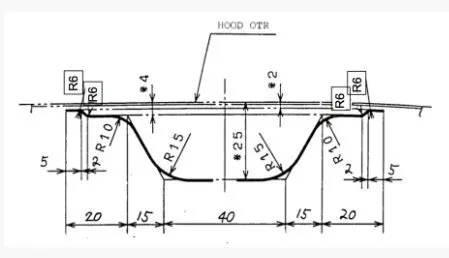
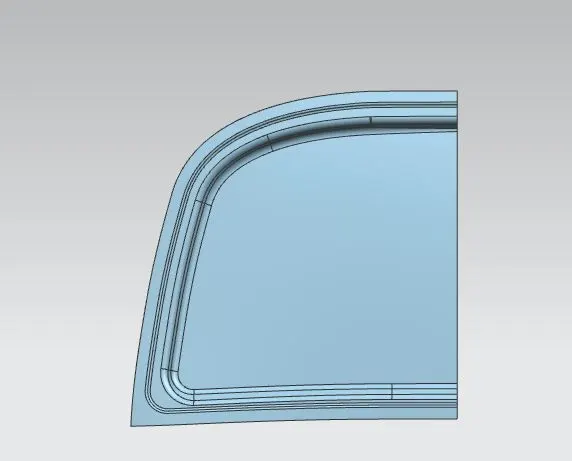
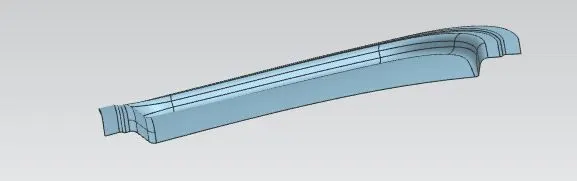
According to the master section we should follow the design process by offsetting the given styling skin.
Force dissipation and strength
Here we have to create the emboss in the hood inner panel for adding the strength to the inner panel to perform good in frontal crash. The emboss not only adds strength to the component but also it will dissipate the force from frontal crash towards the pillar and hinge area and avoiding it from going inwards the passenger compartment.
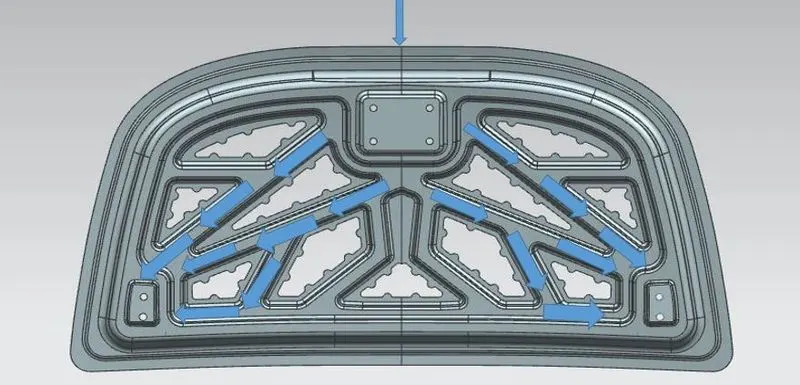
Then we have to provide some reinforcements for the hinge assembly area also to avoid the NVH criteria. This NVH criteria means Noise Vibration and Harshness, these NVH determines how smooth and quality the car is.
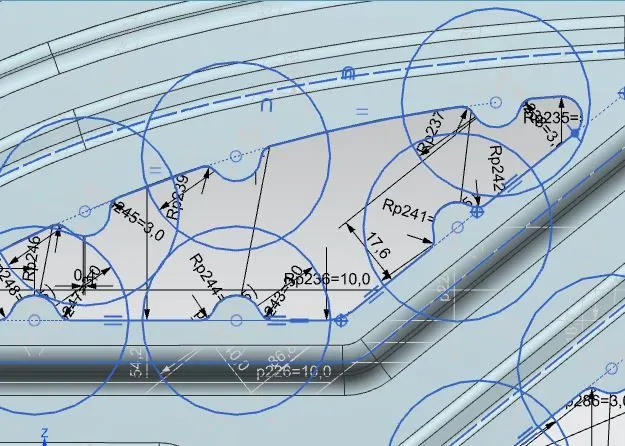
And also to fulfil the NVH criteria and for some aesthetic aspects the outer panel should be joined with inner panel by using the mastic points, these mastics are the adhesive material which is applied in liquid state and forms a strong bond when it is heated, and makes the both panel sticks together. These mastic points always have a circumferential influence of 80mm.The reinforcements and mastic points are shown below.
Manufacturing process
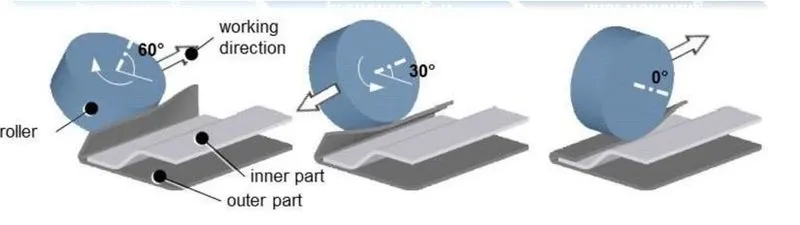
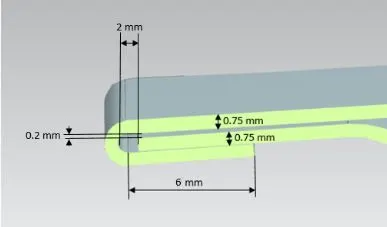
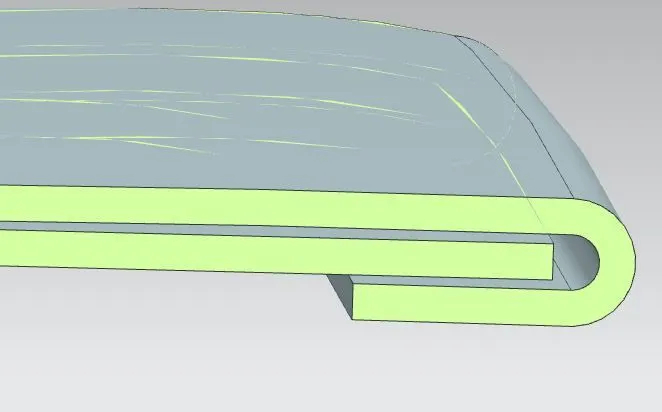
In the hood design all the sheet metal components are die drawn and assembled using various joining methods, but for joining the hood outer panel to the hood inner panel we should not follow any joining process that may leave the traces on the aesthetic side so we have to follow hemming operation. In the hemming operation two rollers are used these two rollers will make the inner and outer panel joining by pressing and rolling of the components. It is shown in the below image.
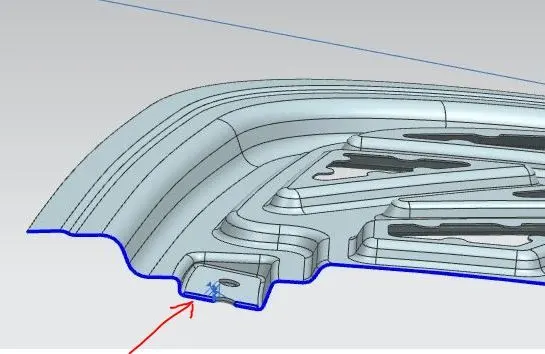
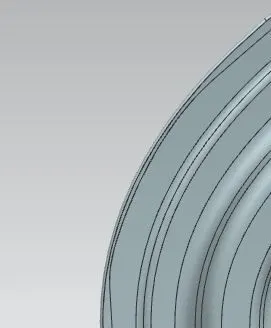
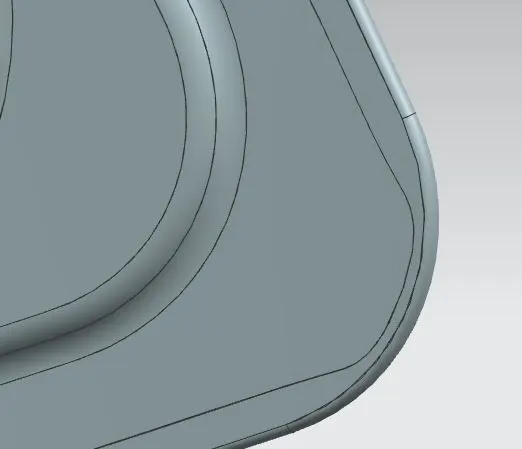
We should also provide some relief for the hemming in the corner area and also the hemming should have the following clearances with the inner panel as shown in the below image. And it also should have a correct tolerance value to ensure the proper hemming as shown in the below image.
The latch and striker and reinforcements are assembled to the hood panel, this latch and striker is assembled by using the hinge axis of the assembly, so the latch will work properly.
Ejection of the part after deep drawing
Here the sheet metal components are created using the deep drawing method, this method is shown in the below image.
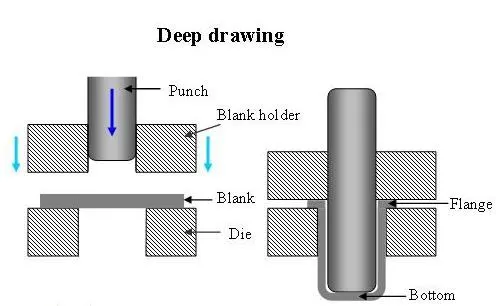
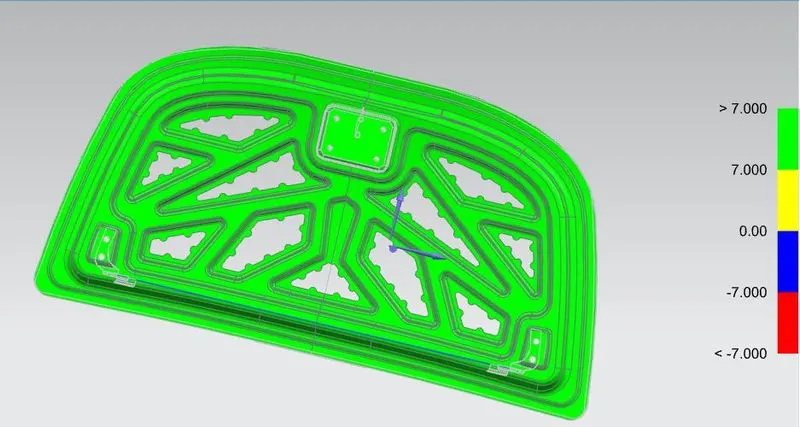
In deep drawing the die and the punch are made according to the final product’s shape and the blank is placed in between them and a high force is applied to form the final product, so here we need to provide some draft angles for the easy removal of the product, here for this hood the draft angle is provided and so it is clearing the draft analysis the green area shows that there is adequate draft above 7 degrees.
CONCLUSION
- Hood outer panel and inner panel is designed according to the master section and hemming flange is also created.
- Latch and striker, hinge assembly are assembled to hood assembly.
- The reinforcements are also created.
- Adequate draft angle is given to ensure the manufacturability of the component.