Hood design-Week 2
Introduction:
Bonnet is an important component of the front portion of the car which is used for many purposes. Bonnet is used decorate front portion of the car and to add luxurious look. It is made aerodynamic in shape to reduce air effect. Generally, it is used to cover car engine radiator and many other parts therefore bonnet must be designed. In such a way that all maintenance part should be easy of access, and it should give minimum impact of external disturbance on the engine when car come across any accident from the front portion. Most of the time bonnet system gut damage and absorbs some part of impact energy result from crash.
Design consideration:
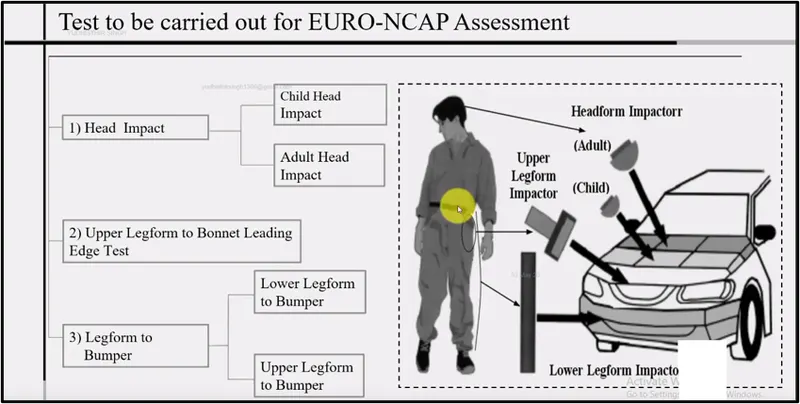
The first and most important safety requirement to be considered while designing the bonnet is the pedestrian safety from frontal collision. That European new car assessment program is a European car safety performance assessment program which has developed test specifications and rating systems for assessing pedestrian injuries during impact with the front of vehicles such tests include a series of tests using impactors designed to mimic a collision at a speed of 40 km/h. They describe a dictation in which a pedestrian is Situated latterly and yeah car first hits well now his leg test is conducted on the leg upper leg and most importantly their head ask head true trauma is most commonly responsible for casualties thus to avoid server injuries to the head the high impact area of for adults and children R subjected to less thickness. Also know reinforcement should be provided in the area as during the head collision the hood minute absorb deckhead impact the energy leading to collapse of the hood and thus protecting server head injury. Another important criterion for the hood design is the protection of the occupants inside that car during the front collision the design of the hood should be easy that you have way that the during the collision. The force should that travel upward direction through the embosses and directed towards the body of the car thus protecting the occupants inside.
Procedure:
Hood outer panels:
Outer panels are the aesthetic element of a car. it is the styling team who provides the skin for the outer panel. the shape, position and size of the hood should satisfy the safety norms. So, while designing the hood we should give more importance to pedestrian safety. the outer panel is attached to the inner panel by hemming. So, it is necessary to provide required hemming Flange and reliefs for the hemming operation. We also provide mastic sealants between outer panel and inner panel to reduce vibration.
Hood inner panels:
Inner panel is the part that gives strength and rigidity to the outer panel.That master section represents the initial emboss shape and size. Then we provide the emboss for the latch and hinge elements after fixing the location.
Reinforcement:
Reinforcements or provide according to the design requirements. Mainly it is provided at the hinge and latch regions to improve the strength locally. Usually thickness of reinforcement will be higher than that of inner panel and the value Various according to cost and Requirement. According to design requirements here it is giving 1.5mm I'm one other thickness to both hinge and latch reinforcement.
Emboss:
We provide different embosses throughout the inner panel. We can increase the stiffness of the inner panel through this embosses. the shape and size of the emphasis also determined the direction of the force distribution resulted from frontal collision. The force should be always disturbed away from the passengers. here in the figure the embosses are designed in such a way that the forces is directed to either side of the car.
Mastic sealant data:
Hood commonly processed large surface area and hemming can only be provided through its boundary. we cannot use other joining techniques like welding, riveting etc. Because they leave marks on the outer panel which spoil its aesthetic appearance. So, mastic sealants are used to strip the inner surface of outer panel and inner panel magic sealant are elastic component that behaved like rubber. it applied between the inner and outer panels at specified spot. Each spot of mastic sealant has its effect around a circle region of 80mm diameter. that's the mastic point are arranged in such a way that it covers The areas away from hemming which are more vulnerable to vibrate.
Hemming:
Hemming is a forming operation in which the edges of the sheet are folded or folded over another part in order to achieve a tight fit. normally hemming operations are used to connect part together, to improve the appearance of the of a part and to reinforce part edges. In a car productions hemming Used in assembly as a secondary operation after deep Drawing, trimming and flanging operations to join two sheet metal part together. Typical parts for this type of assembly are hoods, doors, truck lids and fenders. The accuracy of the hemming operation is very important since it affects the appearance of the surface and surface quality. material deformations, which occur during that hemming process, can lead to dimensional variations and other defects in parts. Typical hemming defects are splits are wrinkles in the flange, material overlap in the corner areas are material role in. It is important to provide required reliefs at a corner.
There are two types of hemming operations:
- Conventional die hemming
- Roll hemming
Conclusion:
In this challenge I learning to design the hood inner panel, outer panel with the help of master stretch and the styling surface and also learnt errant that assembly of could inner panel, outer panel and the reinforcement like latch and hinge assembly.