Hood design-Week 2
Aim: To Design Hood outer panel, inner panel by following the Master section mentioned with the design parameter.
Introduction: The hood or bonnet is the hinged cover over the engine of motor vehicles.Hood can open to allow access to the engine compartment, or trunk on rear-engine and some mid-engine vehicles for maintenance and repair.
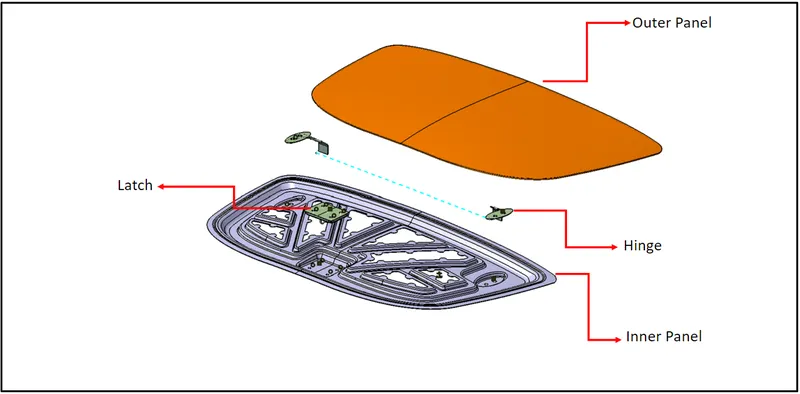
The Hood is an opening body panel the covers the engine in the front-engine vehicle. It is also considered as another type of door in a vehicle as it consists of outer panel and inner panel. The inner panel provides strength while the outer panel functions as the metal cover.
A car hood is typically made from steel and sometimes alluminium.
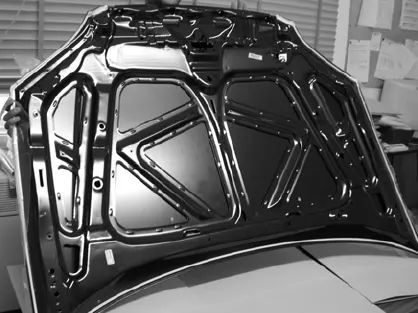
An Image of Inner Panel
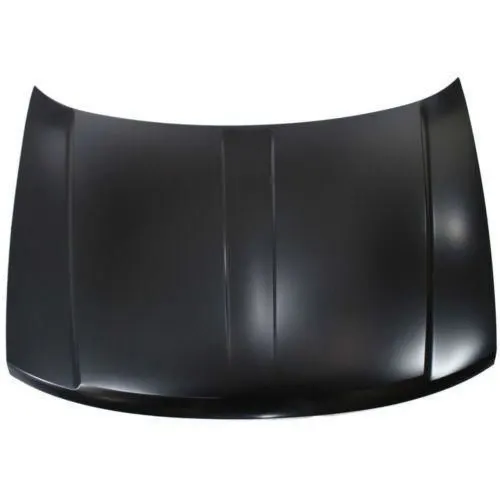
An image of outer panel
Hood Design:
There are certain parameters to be considered before the hood gets designing hands.
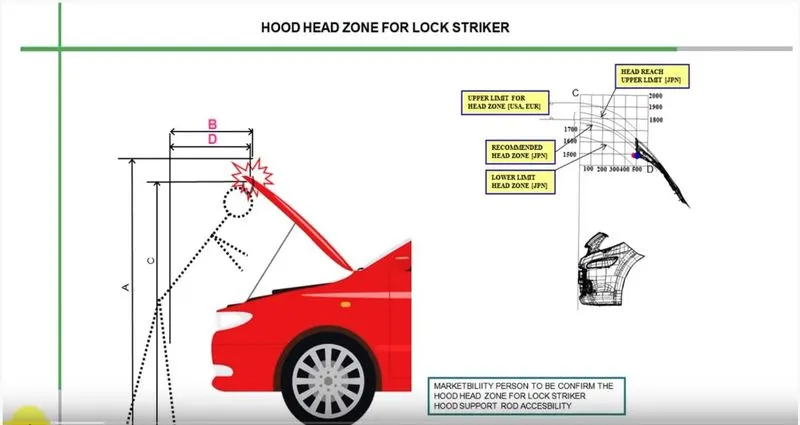
Opening angle: This angle is different for different region.
For example for india the average height is considered 5feet 6 inch so this parameter is considered for indian markets. Similarly below is the image for usa, europe region and japan region.This opening angle is controlled by the gas stay or supporting rod.
Here the important point is whenever we are opening the hood there should be enough clearance between the tip point of the hood and the striker(which attaches to the hood for locking purposes).
Hood and its components:
Input Given in the form of master section:
Hemming Data:
Relief rear section:
Front relief:
Following parts are used in the hood assembly in this report.
1) Hood outer panel.
2) Hood inner panel.
3)Hinge assembly.
4)Striker assembly.
Hood with hemming of outer panel:
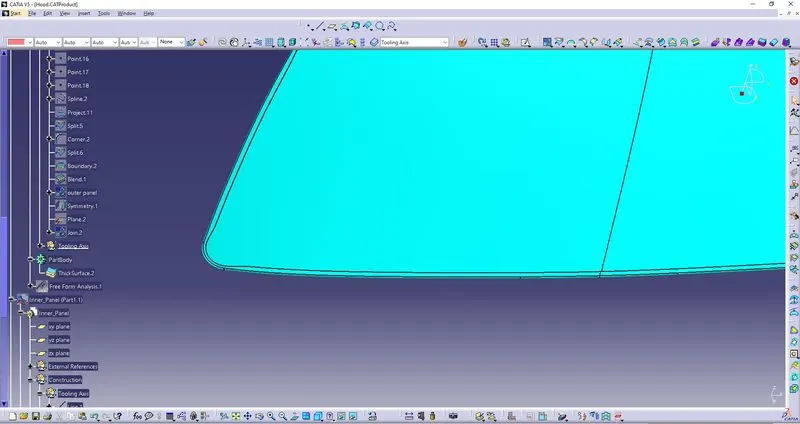
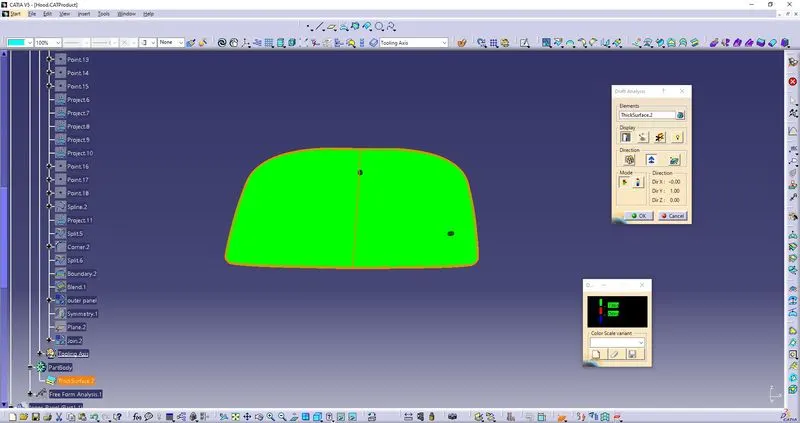
Hood inner panel.
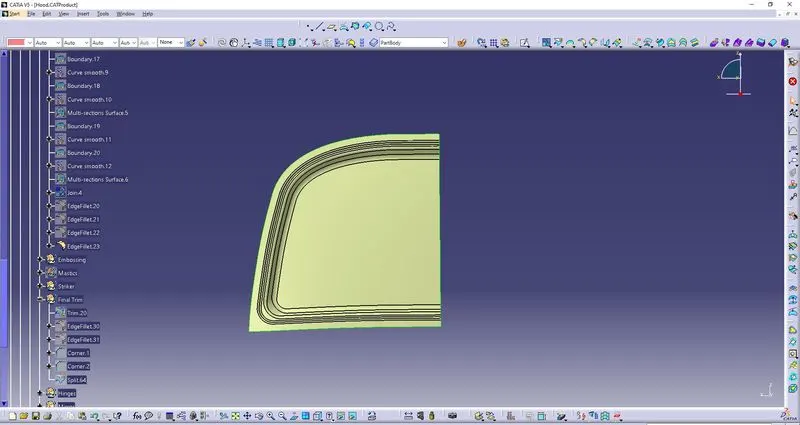
Inner matic with embossing:
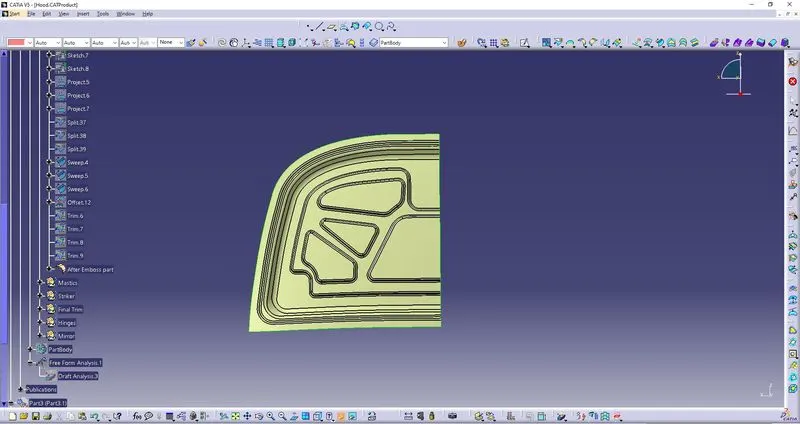
Inner panel with mastics:
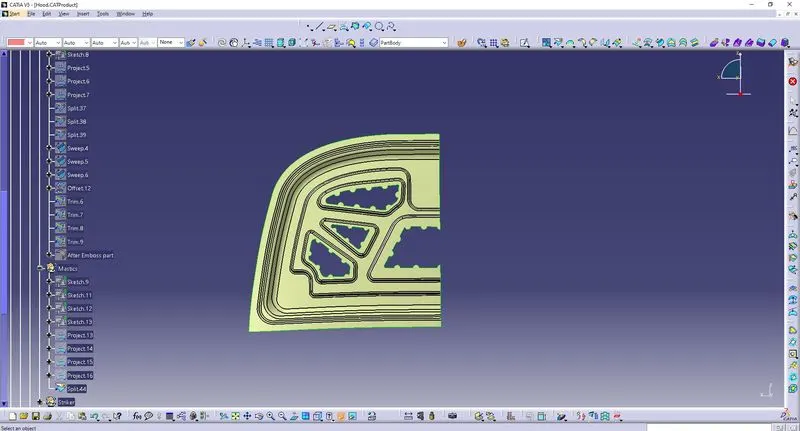
Final inner panel:
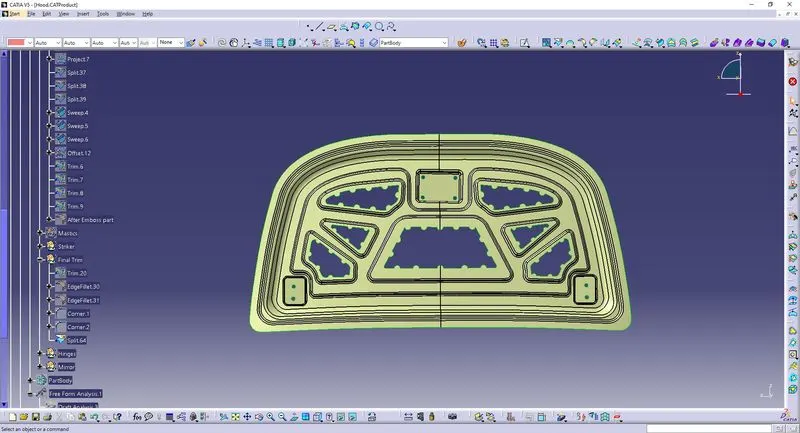
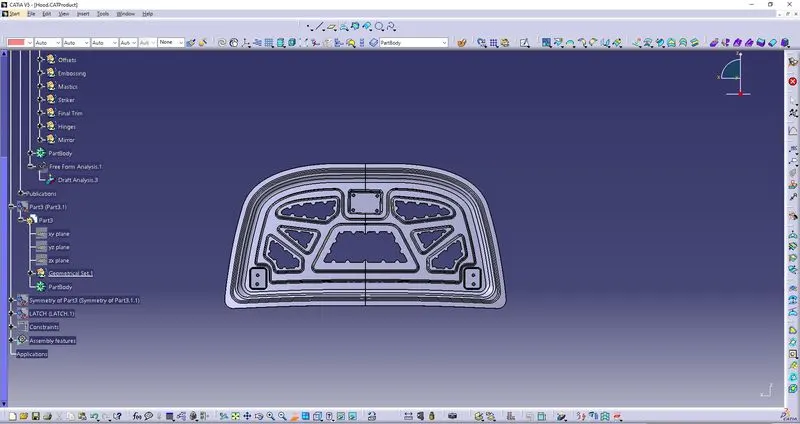
Assembly of hood:
Latch Trajectory:
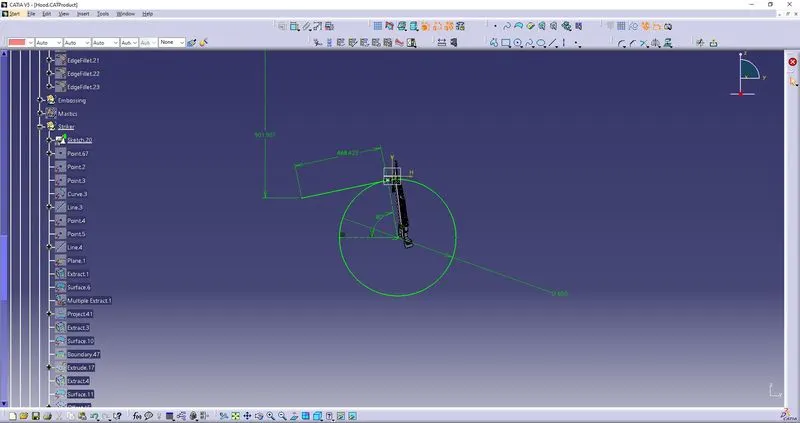
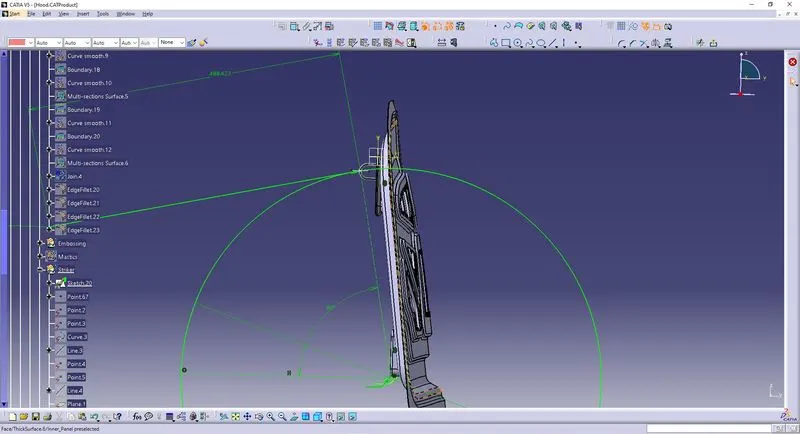
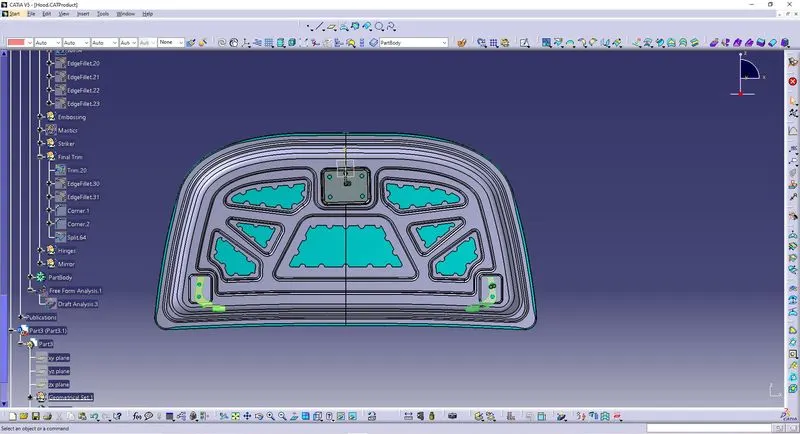
Operations:
Hemming:
Hemming operations are used to connect parts together, to improve the appearance of a part and to reinforce part edges.Hemming is a forming operation in which the edges of the sheet are folded over another part in order to achieve tight fit.
In car part production, hemming is used in assembly as a secondary operation after deep drawing, trimming and flanging operations to join two sheet metal parts (outer and inner) together.
The accuracy of the hemming operation is very important since it affects the appearance of the surface and surface quality. Material deformations, which occur during the hemming process, can lead to dimensional variations and other defects in parts. Typical hemming defects are splits or wrinkles in the flange, material overlaps in the corner areas or material roll-in. This is why it is important to use simulation tools in order to significantly reduce the number of "trial and error" loops during tryout and production.
There are various types of hemming operations:
- Conventional die hemming
- Roll hemming.
In roll hemming, the hemming roller is guided by an industrial robot to form the flange.
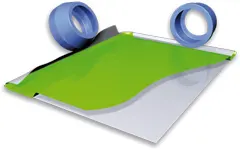
In conventional die hemming, the flange is folded over the entire length with a hemming tool.
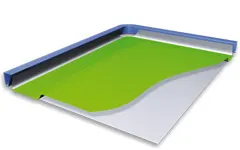
Deep Drawing:
It is also a forming process which occurs under a combination of tensile and compressive conditions. A flat sheet metal blank is formed into a hollow body open on one side or a hollow body is formed into a hollow body with a smaller cross-section.
Deep drawing processes are divided into three types:
- Deep drawing with tools
- Deep drawing with active means
- Deep drawing with active energy
In the automotive industry, deep drawing is usually carried out using rigid tools.
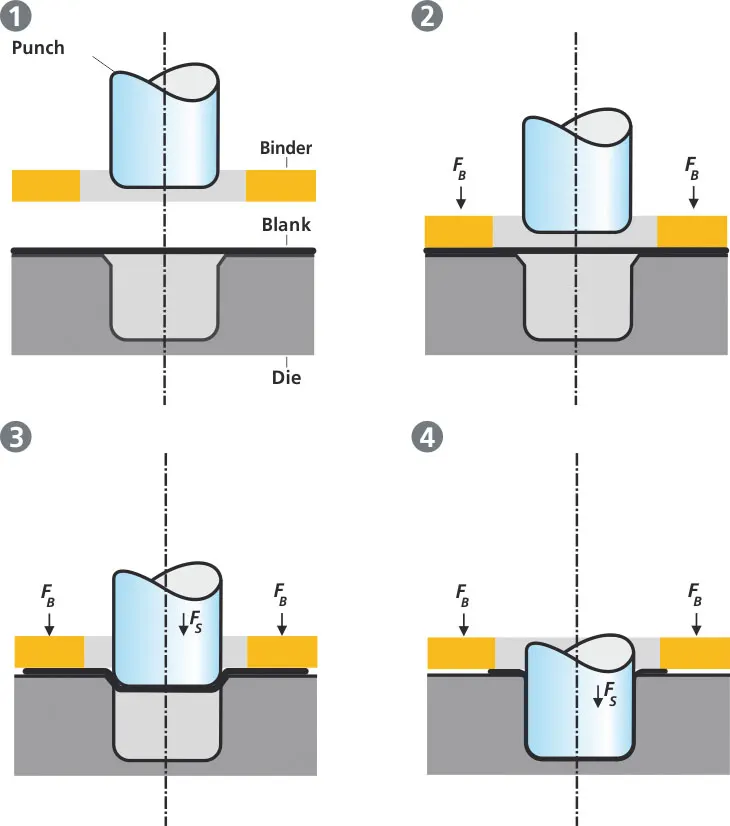
The figure illustrates the deep drawing process. The rigid tools consist of a punch, die and binder. In deep drawing, the plate holder closes after the metal sheet blank has been inserted.
Next the sheet is clamped between the die and the binder. This process slows down the flow of the sheet while it is being drawn and thereby prevents wrinkles from forming under the binder. The punch stretches the sheet over the die radius and forms it in the die. The amount of punch force necessary for forming is thereby continually increased up to the lower dead center of the punch.
Whereas in pure deep drawing there is no reduction of sheet metal thickness, forming is achieved in stretch forming purely as a result of a decrease in sheet metal thickness. Stretch forming is extensively used for the forming of only slightly curved parts with low depth of draw (e.g. roofs, doors).
When drawing complex car body parts in practice, there is usually a combination of stretch and deep drawing involved. It is necessary that the sheet metal is stretched as well as possible without reaching the material limits (e.g. splits, wrinkles).