Hood design-Week 2
Aim:
Design the Hood Outer panel, Inner panel and other necessary reinforcements by following the Master Structure and design Parameter.
Objective:
To understand the design approach and its consideration that follows the designing and developing an automobile hood to ensure the pedestrian for inner and around the vehicle.
Introduction about the Hood:
A car hood also referred to as a bonnet in some other countries is the hinged cover that rests over the engine of a front-engine vehicle. Its purpose is to provide access to the engine for repair and maintenance. Car hoods are typically constructed from steel and sometimes from aluminum.
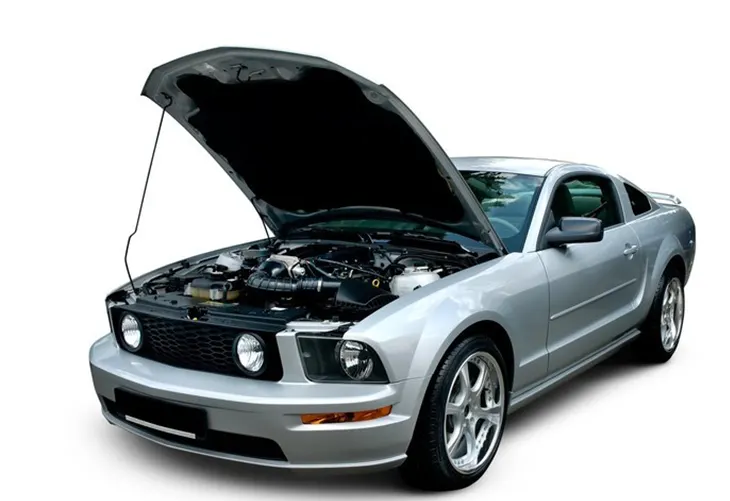
On front-engine cars, the hood may be hinged at either the front or the rear edge, or in earlier models (e.g. the Ford Model T) it may be split into two sections, one on each side, each hinged along the centerline. A further variant combines the bonnet and wheel arches into one section and allows the entire front bodywork to tilt forwards around a pivot near the front of the vehicle.
Hoods are usually made from the same material as the rest of the body. This can be steel, aluminum, fiberglass, or carbon fiber. However, some aftermarket companies produce fiberglass or carbon fiber steel hood replacements to make the vehicle lighter.
The hood release system is common on most vehicles and typically consists of an inner hood latch/lock handle, a hood release cable, and a hood lock assembly. The hood lock handle is usually located under the steering wheel, next to the driver’s seat, or in the door frame.
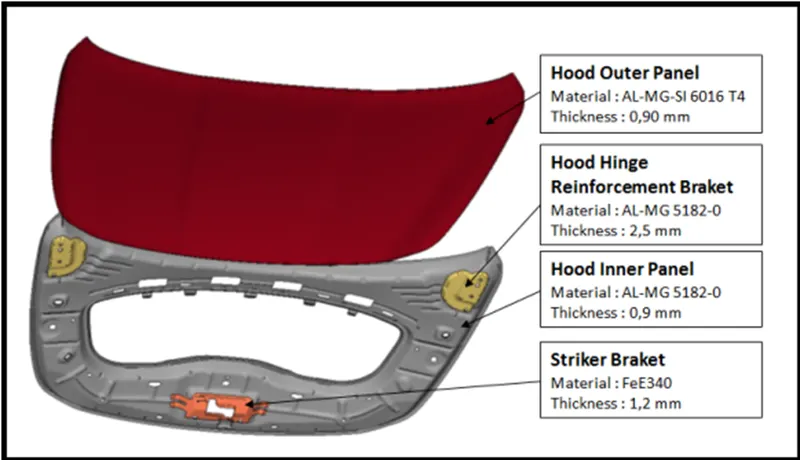
Design methodology of Hood outer and inner panel:
A hood inner panel includes an inner panel main body a) forming part of a hood of a vehicle, a front bead provided on the inner panel main body and extending along a vehicle width direction, and a rear bead provided on the inner panel main body located on the rear side of the front bead toward a back of the vehicle and extending along the vehicle width direction. The front bead is curved toward the front of the vehicle such that a center portion in the vehicle width direction is located in front of each end portion in the vehicle width direction, and the rear bead is curved toward the back of the vehicle such that a center portion in the vehicle width direction is located behind each end portion in the vehicle width direction.
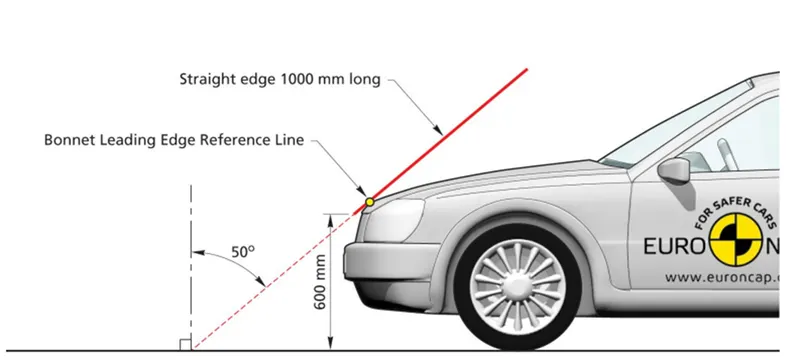
Euro NCAP the European car assessment program is European car safety performance program based in Leuven and founded in 1997.
They published safety reports on new cars and awards star ratings based on the performance of the vehicle in a variety of crash test including front side and pole impacts with pedestrian. The top rating is 5 star.
Hood clearance criteria:
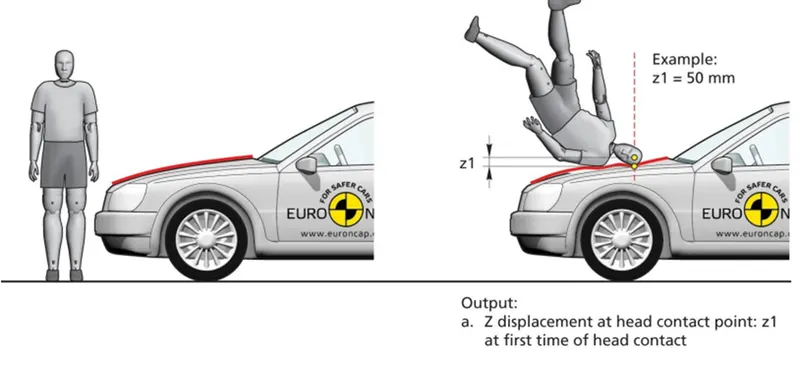
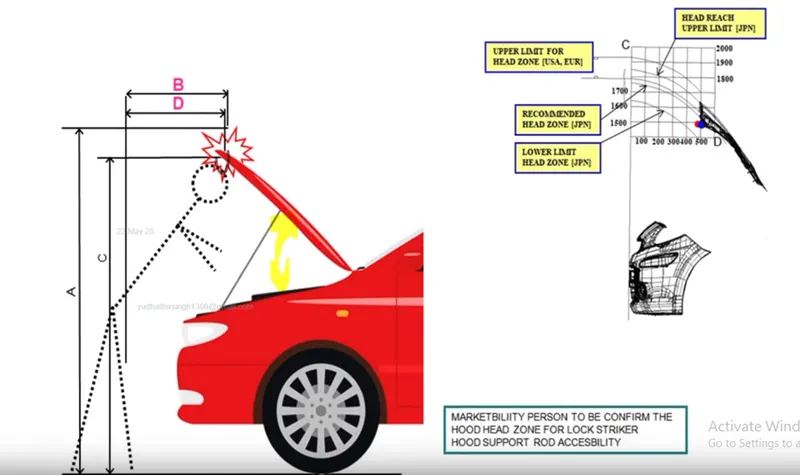
Hood clearance is decided upon the zone or country. So same car if it is made for a different country will have different openings angles depending on the country or region.
The distance C and D show in the images is represented as a graph in the upper right corner of the image. Choosing the right head zone position will decide upon the angle of the hood opening.
Product engineers will also get input from the marketing team for deciding the head zone.
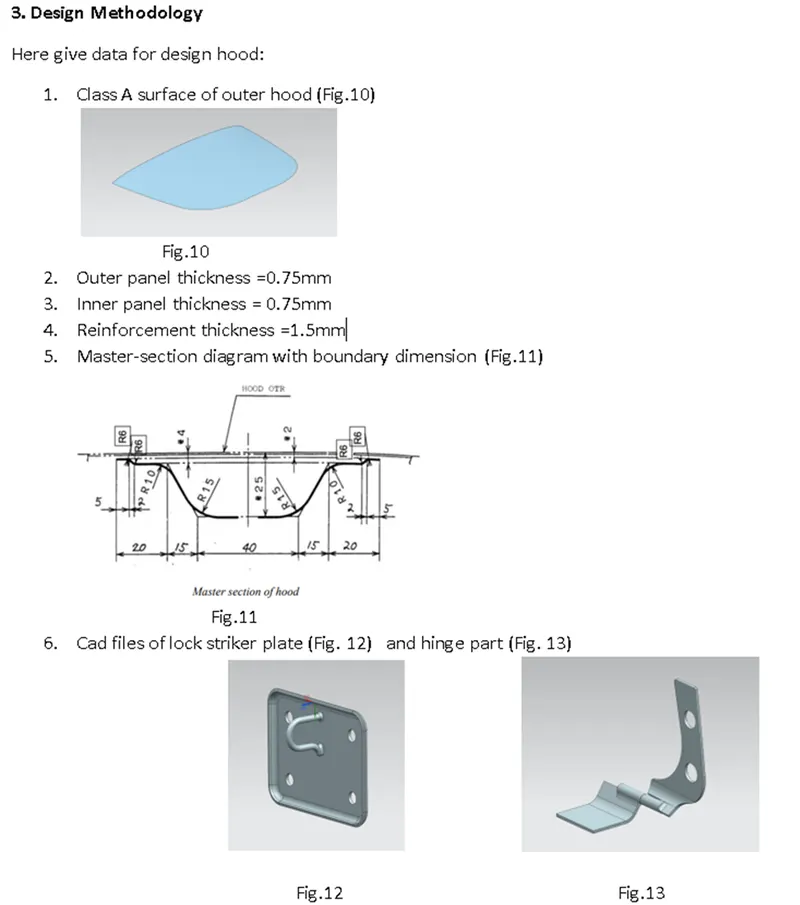
Methodology of Designing Engine Hood :
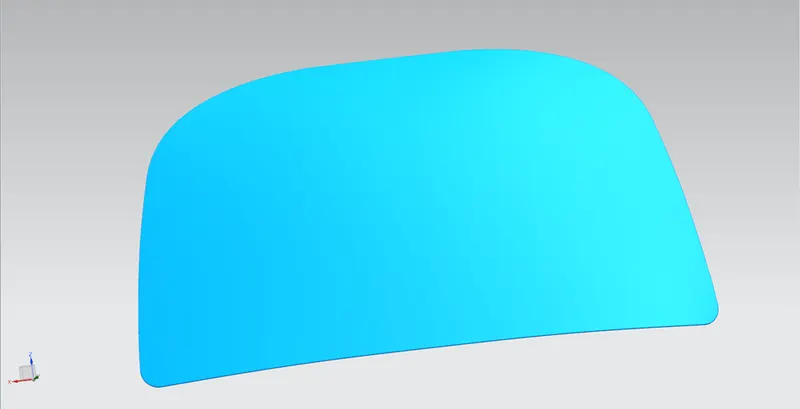
Outer panel of Engine Hood
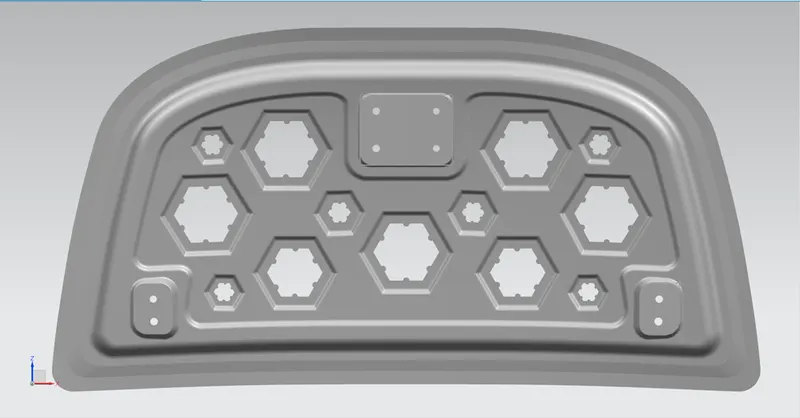
Inner Panel of Engine Hood
Manufacuring process (Forming of sheet metal):
Embossing is a metal stamping process for producing raised or sunken designs or reliefs by passing metal sheet or strip between rolls of the desired pattern. The process enables repeated production without variation and does not change the metal’s wall thicknesses.
Alliance Steel’s embossed sheet metal and coil service capabilities include slitting, shearing, blanking, degreasing and brushing, stretcher leveling and metallurgical support.
Applications for Embossed Steel Products
Embossed steel is ideal for customers looking to add aesthetic touches or functional improvements to a product. Embossing can help disperse liquid more effectively, reduce friction and static, bolster metal panel stiffness and rigidity, increase metal surface area for acoustic or heat transfer and improve traction. Applications that use textured sheet metal include:
- Appliance Panels
- Building Products
- Elevator Panels
- Garage Door Panels
- Automotive Trim
- Metal Office Furniture
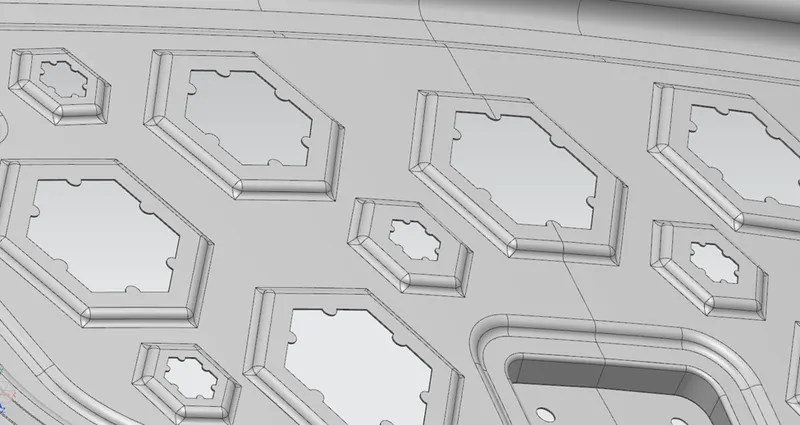
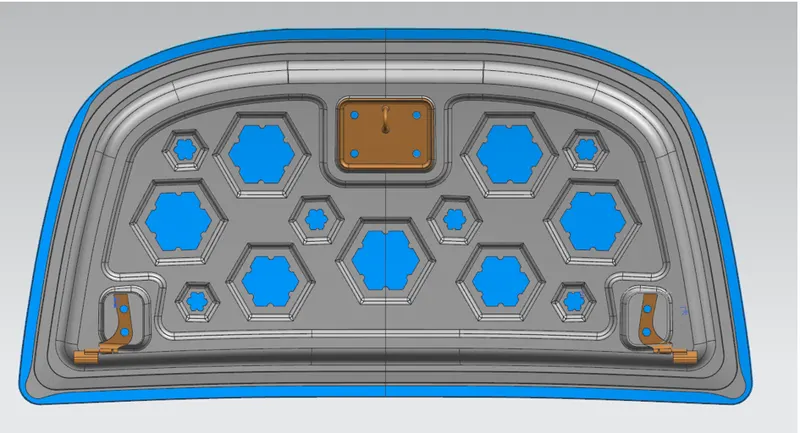
Embossed Feature in the Inner Panel
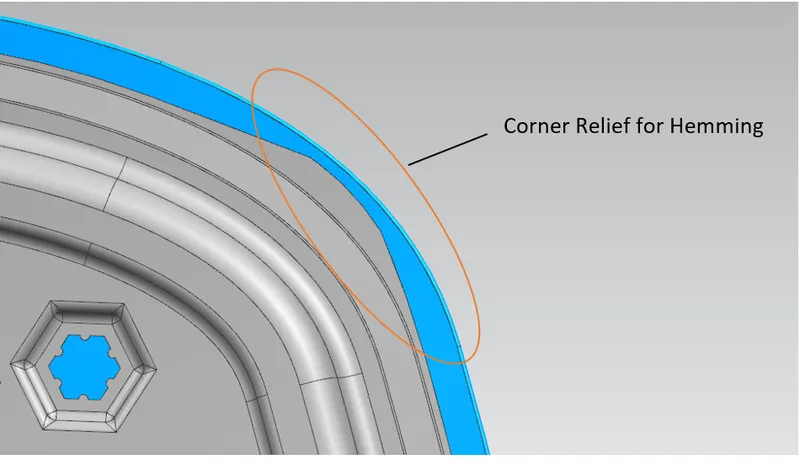
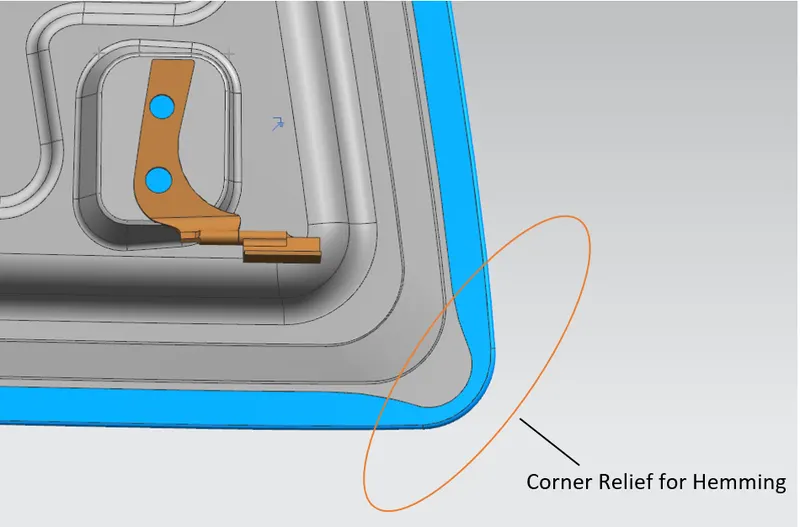
Hemming is a forming operation in which the edges of the sheet are folded or folded over another part in order to achieve a tight fit. Normally hemming operations are used to connect parts together, to improve the appearance of a part and to reinforce part edges.
In car part production, hemming is used in assembly as a secondary operation after deep drawing, trimming and flanging operations to join two sheet metal parts (outer and inner) together. Typical parts for this type of assembly are hoods, doors, trunk lids and fenders.
The accuracy of the hemming operation is very important since it affects the appearance of the surface and surface quality. Material deformations, which occur during the hemming process, can lead to dimensional variations and other defects in parts. Typical hemming defects are splits or wrinkles in the flange, material overlaps in the corner areas or material roll-in. This is why it is important to use simulation tools in order to, on the one hand, better understand the hemming process and, on the other hand, significantly reduce the number of “trial and error” loops during tryout und production.
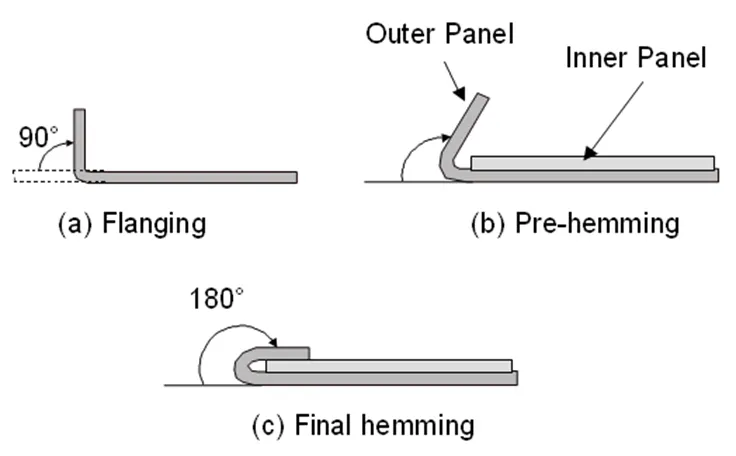
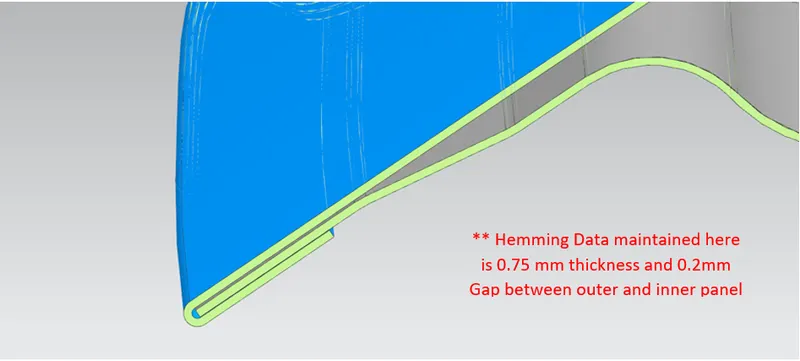
Hemming Region of Engine Hood
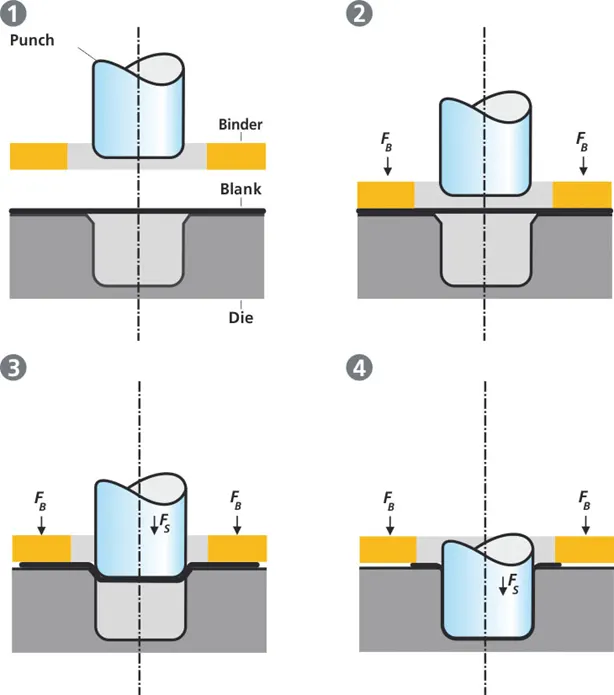
Deep drawing is one of the most widely used processes in sheet metal forming. Apart from its use in many other sectors, it is applied in the automotive industry for the manufacturing of car body parts.
Process definition:
The deep drawing process is a forming process which occurs under a combination of tensile and compressive conditions. A flat sheet metal blank is formed into a hollow body open on one side or a hollow body is formed into a hollow body with a smaller cross-section. [DIN 8584]
Deep drawing processes are divided into three types:
- Deep drawing with tools
- Deep drawing with active means
- Deep drawing with active energy
Mastic Data:
It is basically an NVH topic mastics are point / surfaces given on embosses for applying mastic sealant to join outer and inner and outer panel and at the same time gives good value of NVH.
So mastic sealants are joining materials used to join inner and outer panel and at the same times reduces the NVH Value.
One spot of mastic sealant provides strength locally at around 80 mm so we need to put these mastic points in such a way that it covers the most of the hood region except reinforcement area of latch and hinge because that alone provide good NVH so on worries there.
Here I have spotted points where I have applied mastic data when mastic sealant will be applied and while undergoing hot bath it gets hardened & make the joint strong. We use mastic sealant because we cannot provide spot welding on outer panel as it won’t look good from outer side and cars aesthetic will compromise in doing so.
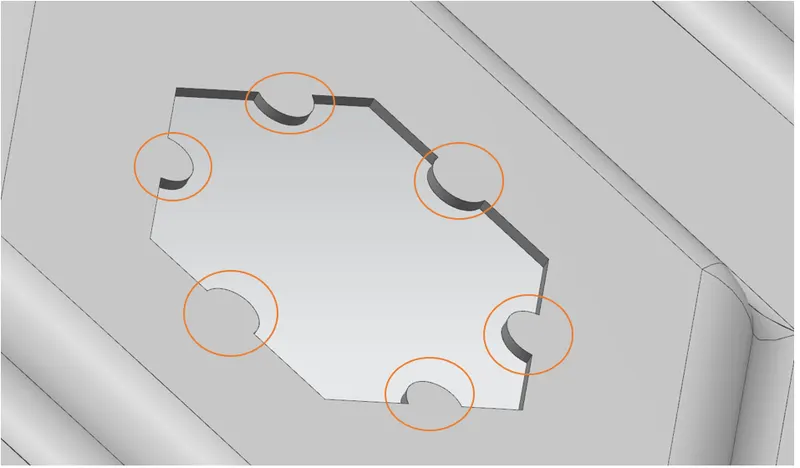
Mastic Point in the Engine Hood
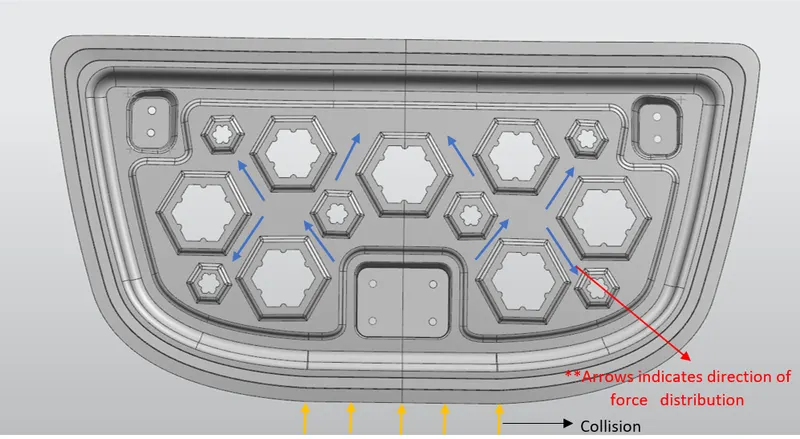
Force Tranfering during Collision
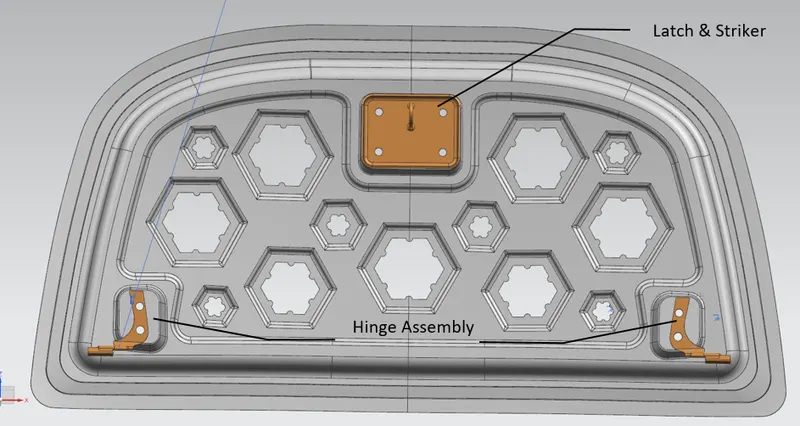
Latch and Hinge Assembly
Trajectory Circle:
A trajectory or flight path is the path that an object with mass in motion follows through space as a function of time. In classical mechanics, a trajectory is defined by Hamiltonian mechanics via canonical coordinates; hence, a complete trajectory is defined by position and momentum, simultaneously.
The mass might be a projectile or a satellite. For example, it can be an orbit — the path of a planet, asteroid, or comet as it travels around a central mass.
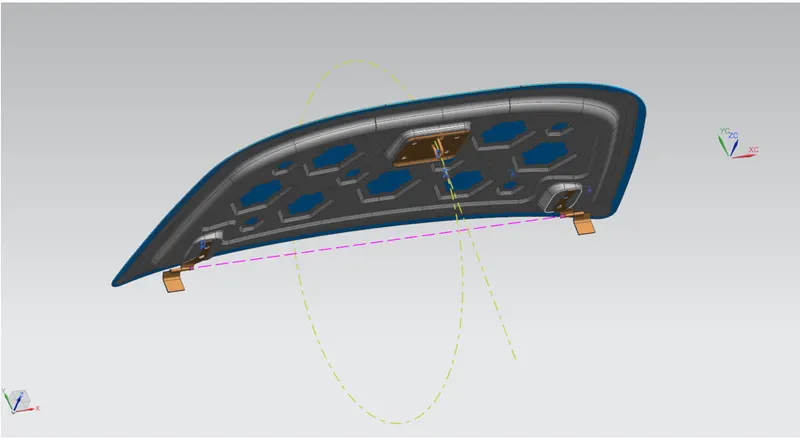
The trajectory of the hood is to be considered foe proper opening and closing of the hood. The First, we have to position the hinge axis and the trajectory of the hood is drawn. The trajectory helps to validate the position of the hinge and latch to find whether the latch is correctly aligned with an engine compartment. This can be achieved by having perpendicular between the trajectory and the axis of the latch. In this way, hinge and striker point correlate with each other.
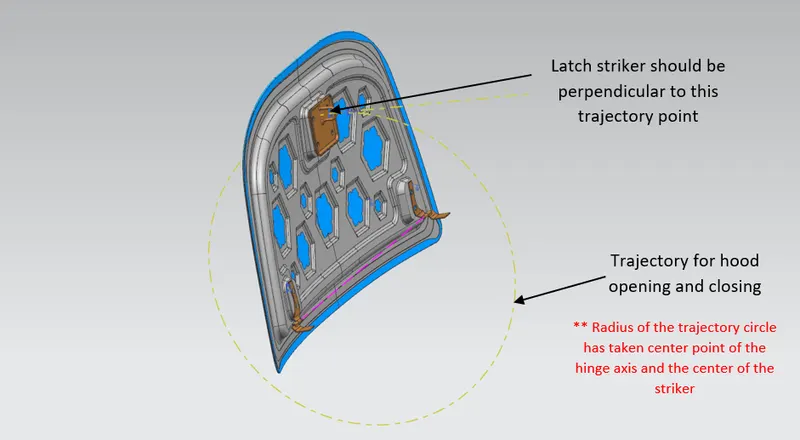
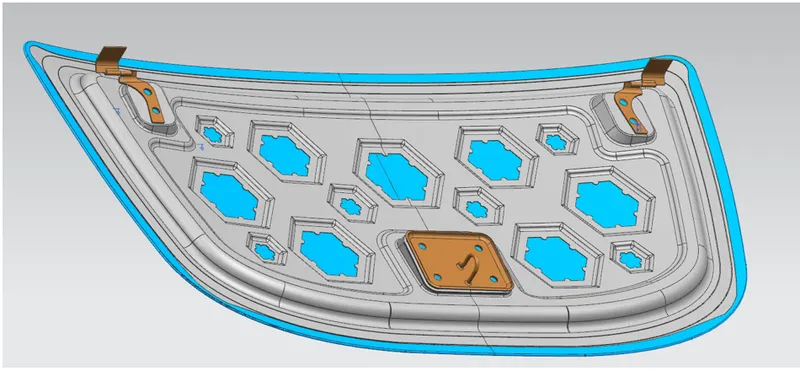
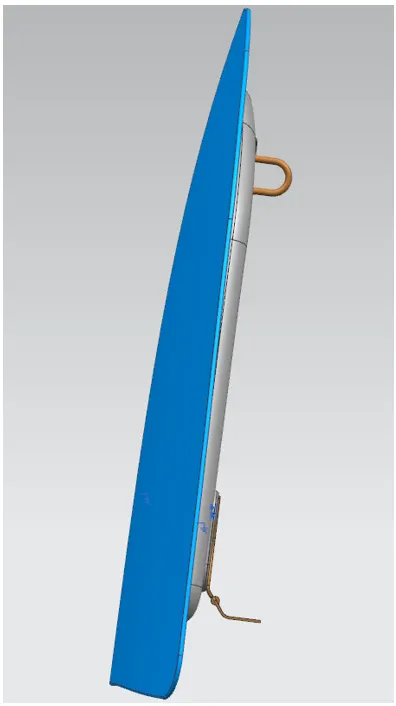
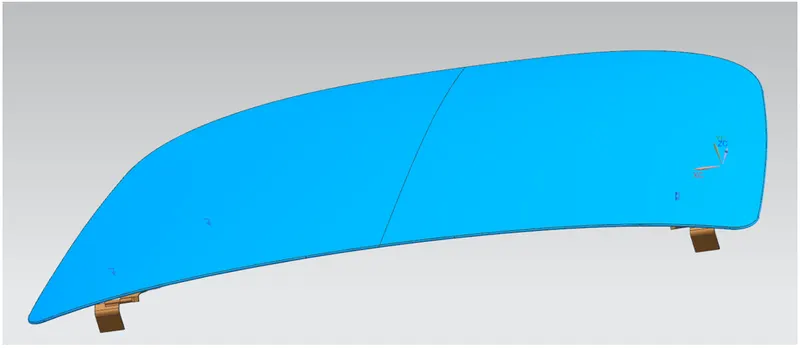
Isometric View of Engine Hood:
Conclusion:
The design approach of the automotive hood is has been accomplished by using the Euro N- Cap standards and consideration. The outer panel forming and inner panel design consideration and reinforcing it according to the safety standards and a Hood is assembled using the Latch and striker.