Hood design-Week 2
OBJECTIVE:-
Designing of hood outer panel, inner panel and reinforcement with the given skin of outer panel hood skin and given design parameters.
INTRODUCTION:-
The hood is generally called as bonnet. It is used to cover engine of the automobiles. It will be used for protection and allows to access the engine compartment of vehicle. While designing of hood we need to follow some parameters to get better results to meet some specific conditions like pedestrian safety, hood head zone for lock striker, force distribution while collision occurs from front, manufacturability etc.
In hood or bonnet they are consisting of outer panel, inner panel, latch and striker, hinge assembly, hood stay. Hood stay used to inspect the engine and check and refill the coolant and engine oil. They are two different types of the hood stays. One is rod type another one is gas stay. Rod type is very commonly used which is made by same as remaining parts of hood. But gas stay is costly and used in very costly cars. Gas stays doesn’t need manual operation to lift the hood. Where rod type will need manual operation to lift and fix the hood to rod. we will give embosses to inner panel to make them strengthen and light wight. We will remove the material from inner panel to reduce the effect of collision to pedestrian. And we create embosses with some angles to reduce collision effect on person who is inside the vehicle.
The thickness between the hood inner outer will be some fixed parameters for any vehicle and some thickness and design parameters will be same.
DESIGN PARAMETERS:-
Hood thickness information
Outer panel thickness=0.75mm
Inner panel thickness=0.75mm
Reinforcement thickness=1.5mm
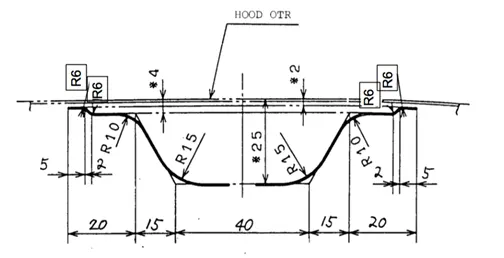
Master section
COMPONENTS:-
1.Hood outer panel
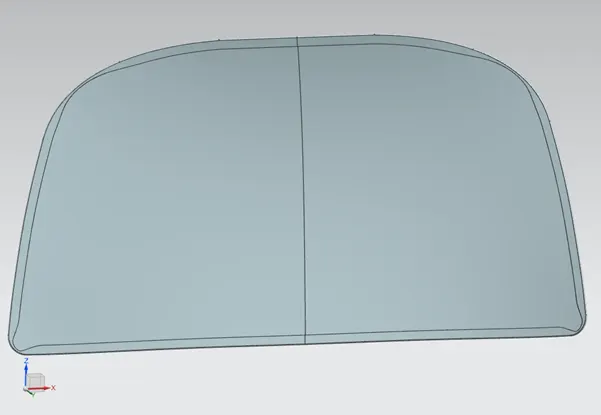
Hood outer panel is one of most important components to make vehicle more stylish. It is fixed with the inner panel of hood. It will give the safety to the pedestrian according to the design of the inner panels and embosses on the inner panel. This outer panel is wrapped around the inner panel using hemming and also given some reliefs on bend corners to give good manufacturability.
2.Hood inner panel:-
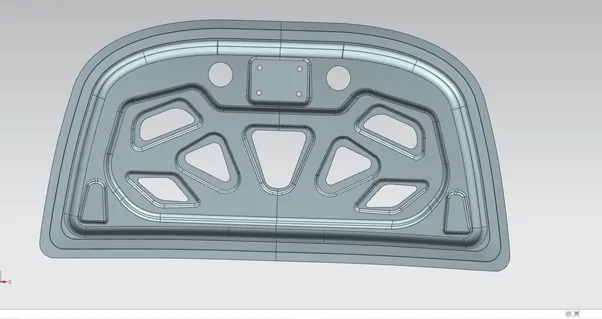
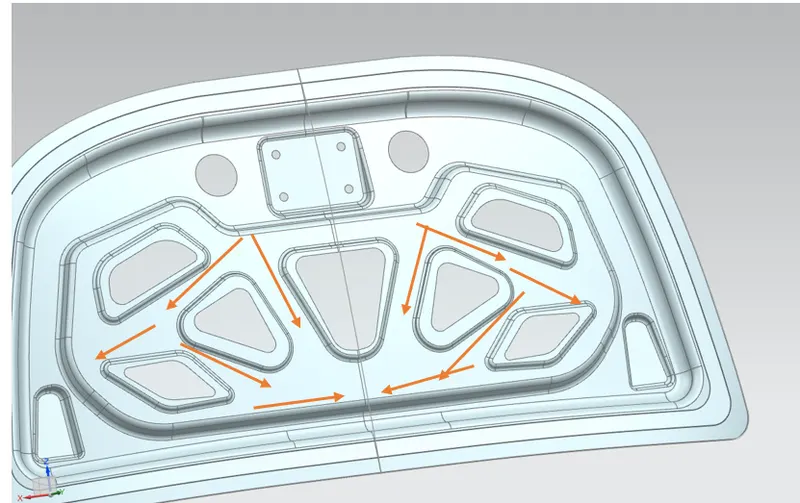
This most important component in hood to produce the better safety for pedestrian and people inside vehicle also. Initially we will create on sheet of 2mm offset from the give skin of outer panel. Then we create the deep drawings of that workpiece with 4mm and again 25 mm with given parameters. On 25mm of deep drawing we will create the embosses and trim sheet for better safety. This will be done on half sheet only. Then we will give blends to them. Then we mirror them. We sew both of them and apply thicken feature. Embosses are given for strengthen the inner panel and trim sheet is used to reduce the effect while collision. We create the embosses in V or Y direction to reduce effect for people inside the vehicle while frontal collision happens.
3.Reinforcement:-
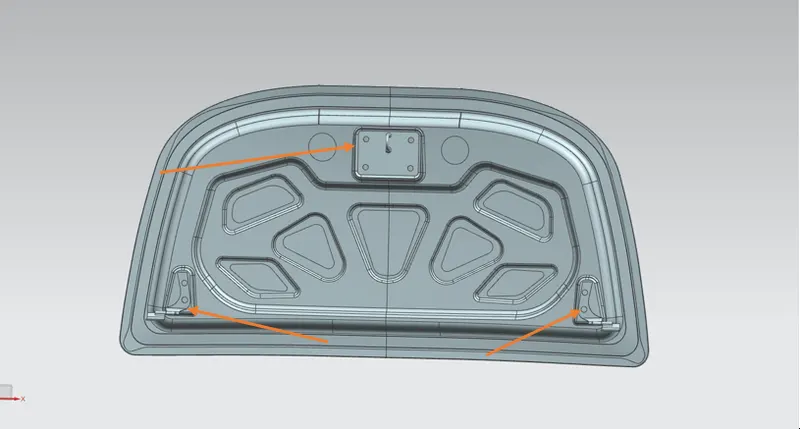
Reinforcement are will be provided according to requirement. Then will used to give the strength to hood while in lifting position. according to the design requirement we created the 1.5mm thickness of both hinge and latch reinforcement. This thickness will be depends on the requirement of the vehicle and cost of vehicle.
Latch trajectory:-
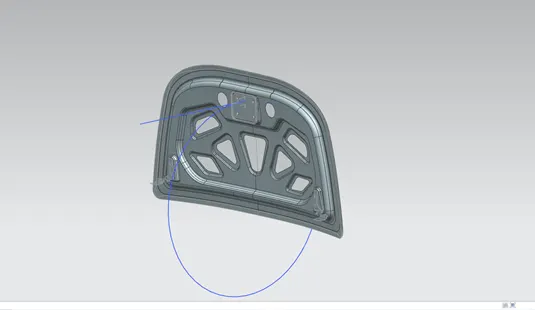
Latch trajectory is given by the circle drawn from the hinge axis point. Then we will draw and a tangent line to that circle. This will be drawn after joining the hinges. If we have fixed the hinges then we draw the center line from both hinges. Then we will create the circle to fix the striker. The drawn line will tangent to the circle. This line is used to place the striker on the inner panel.
Emboss definition:-
Embossing used to give the strength to the inner panel. It is mainly used to transfer the force while any collision happens. It will help to reduce the effect of injury while any accident happens from frontal. And also I will helps to reduce the effect of injury while any pedestrian hits the hood because there will be less material while hitting so injury will also happen less.
Mastic data:-
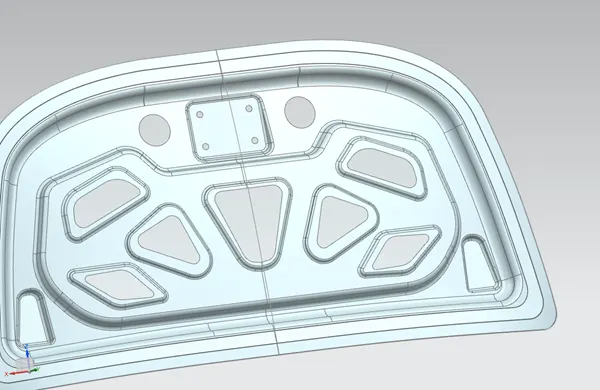
Hood commonly posses the large surface area and hemming can only be provided through its boundary. The gap between them can’t be filled with any material or welding because it may damage the aesthetic appearance. For that we will uses the mastic sealants to stick the inner panel and inner surface of the outer panel. They are elastic in nature like rubber. Each spot of mastic sealant has its around a circular region of 80mm diameter. By depending on that mastics will arrange in such a way from hemming to cover all area of the hood.
Deep drawing:-
This one of most widely used process in sheet metal forming. This used automotive industry for manufacturing of car body parts. This forming will occur with tensile and compressive conditions.
Deep drawing is a sheet metal forming process in which a sheet metal blank is radially drawn into a forming die by the mechanical action of a punch. The process is considered “deep” drawing when the depth of the drawn part exceeds its diameter. This is achieved by redrawing the part through a series of dies. This is used in making inner panel shapes.
HEMMING:-
Hemming is a forming operation in which used to fold the sheet metal edges or folded over one edge with another edge. This is normally used to connect the sheet metals for improve the appearance of the part and to reinforce part edges.
In production of cars, we hemming is used after deep drawing to make attachment between the inner and outer panel of the hood and also doors, trunk lids, fenders manufacturing. While creating the hemming it is necessary to create the relief at the corners to reduce the splits, material overlaps, wrinkle in flanges.
They are two types of hemming
- conventional hemming
In conventional die hemming, the flange is folded over the entire length with a hemming tool.
- roll hemming
It is the roll hemming process that is used for automotive sheet metals. Roll hemming is carried out incrementally with a hemming roller. An industrial robot guides the hemming roller and forms the flange. Roll hemming operation can also be divided into several pre-hemming and final hemming process steps. Roll hemming very flexible to use, the cost of hemming also significantly lower than the conventional hemming.
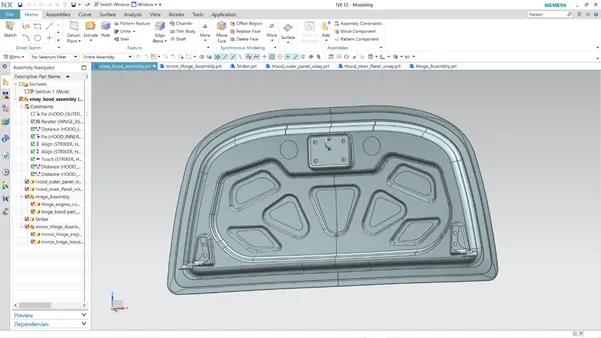
FINAL ASSEMBLY OF HOOD:-
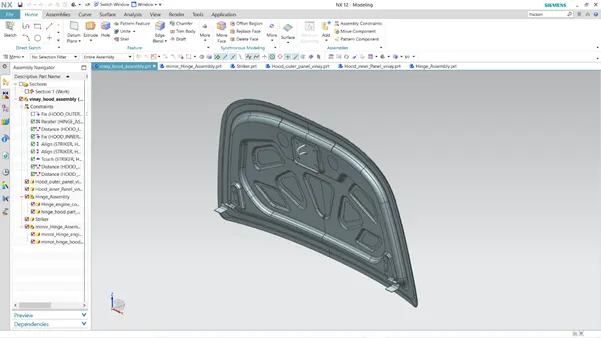
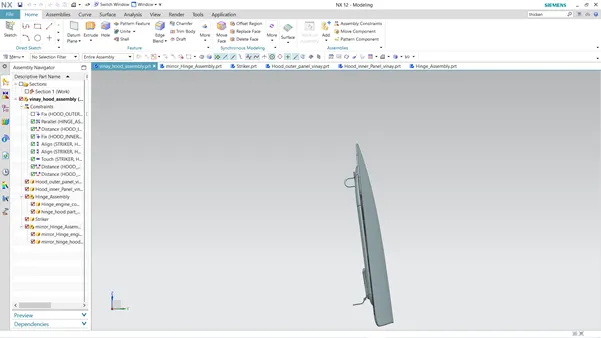
CONCLUSION:-
Hence the hood is designed for the car with given parameters and requirements.