Hood design
HOOD ASSEMBLY
AIM:
To design a hood outer and inner panel with necessary reinforcents by following the master section provided.
DESIGN INTENTION:
To design and develop a hood by the styling surface provided with appropriate considerations such as opening angle,hood stay,NVH,pedestrian rating,Euro Ncap rating etc.,
Provide informations implemented while designing the hood inner panel.
BRIEF DEFINITION ON HOOD:
Hood/Bonnet is nothing but a part which covers the engine of a car. Many design considerations are taken while designing a car. Hood is a critical component as it undergoes a lot of considerations while designing.It mainly focuses on pedestrian safety requirements and also the safety of the passengers.An extra information is that it is designed in such a way to reduce air resistance.
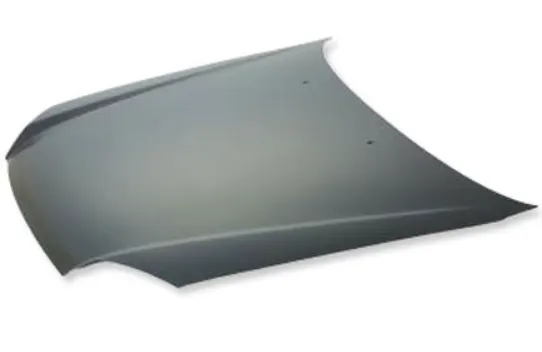
Components of Hood:
- Hood outer panel
- Hood inner panel
- Latch and striker and its reinforcements
- Hinge and its reinforcements
Provided Inputs:
Hinge Assembly:
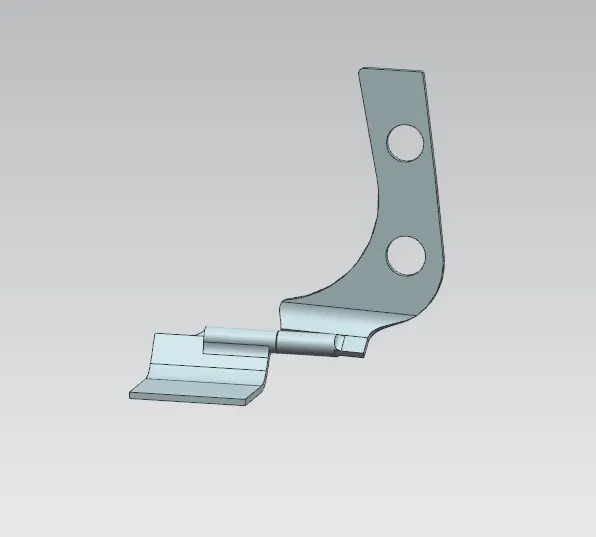
Hinge itself is an assembly comprised of hinge engine compartment part and hinge hood part. It is a pivoting point from which the hood opens/closes.
Striker:
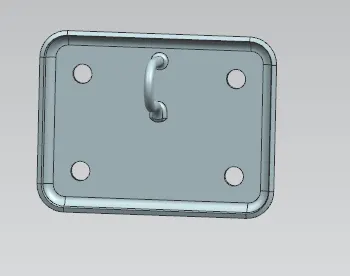
It attaches to the latch in order to lock the hood.
Hood outer panel:
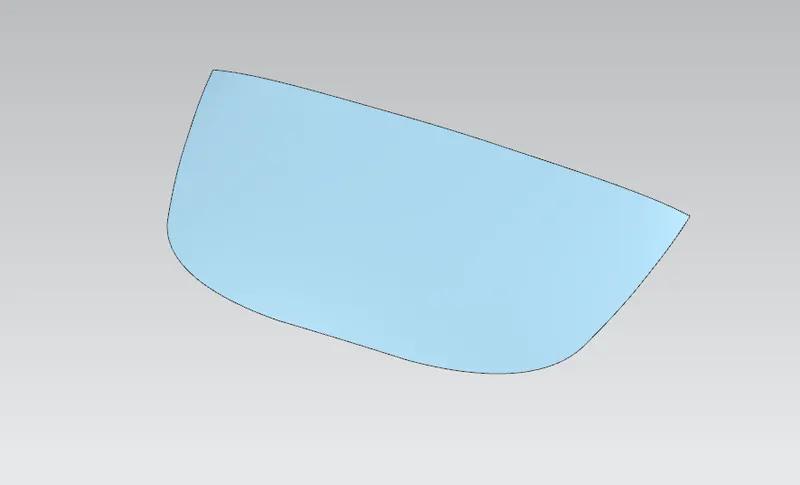
It is the styling surface which provides a good look to the car.
Design Requirements:
- No sharp corners are tolerated
- Mounting areas should be flat
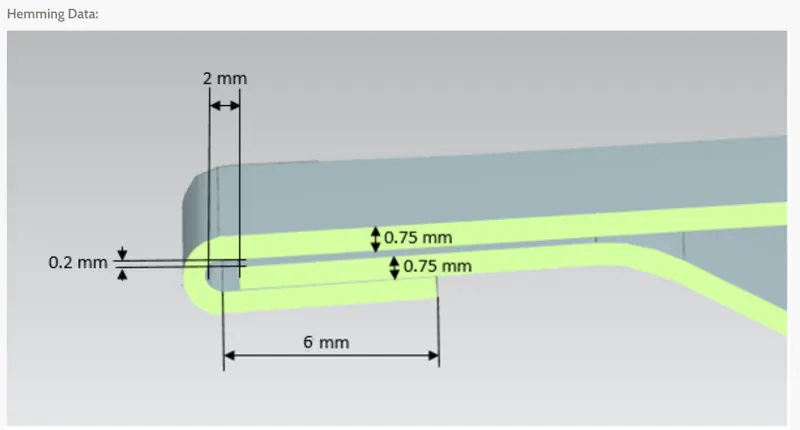
- Outer and inner panel thickness should be 0.75 mm
- Reinforcent thickness should be 1.5 mm
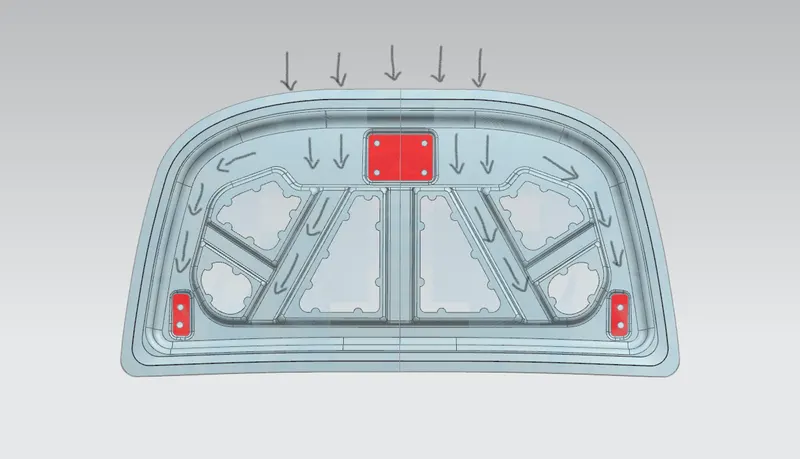
- Embosses should be created in a manner to dissipate the force towards the passenger cabin and also for pedestrian safety
- Place the Latch and striker with the trajectory angle procured by the help of hinge axis.
Manufacturing Process:
The process undergone for manufacturing the hood is deep drawing
Deep Drawing: It is a process which is used in sheet metal forming. It is widely used in automotive sector for manufacturing car parts.
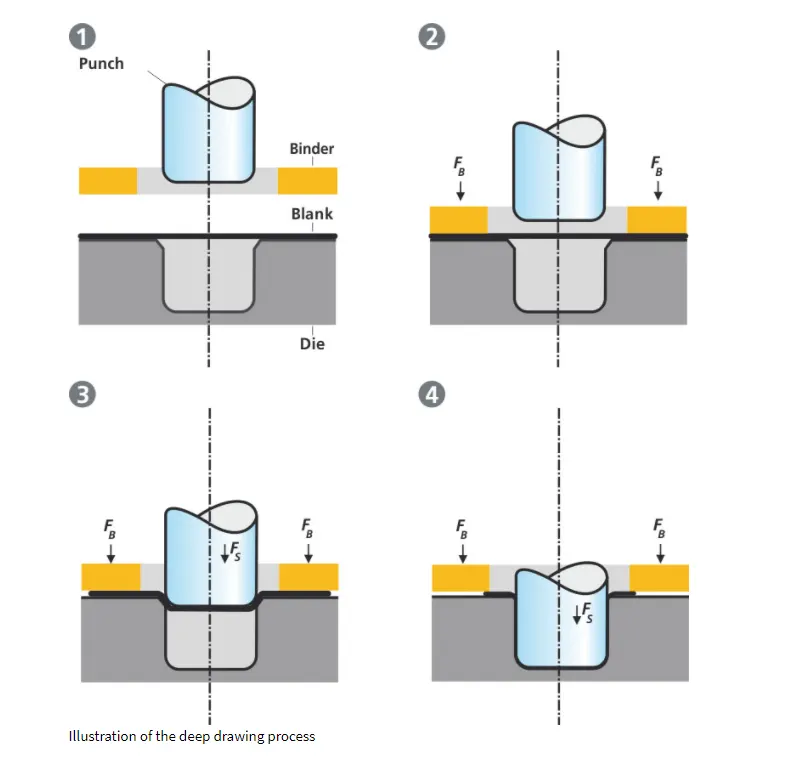
Whereas parts that are to be deep drawn are given a positive draft angle in order to achieve a smooth returning of the tool from the die.
Mastic:
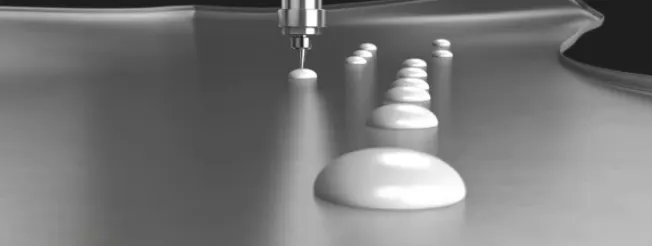
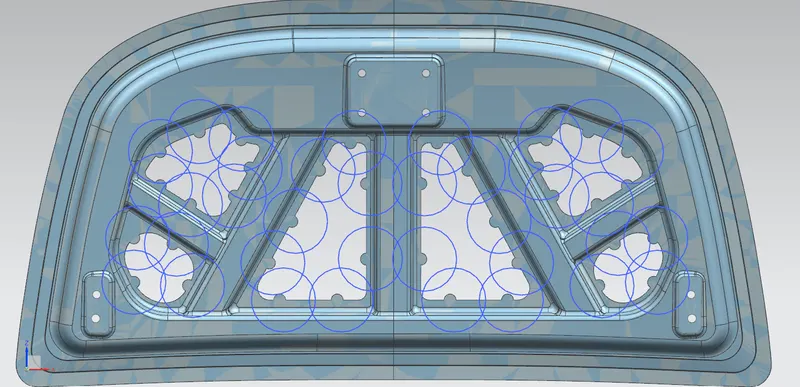
Mastic or mastic sealants which is applied between the hood inner and outer panel to glue both surface . In order to the mastic to be effective the maximum gap between the outer and inner panel must be 5-8 mm. Mastic has a influence for around 80-85 mm to absorb the vibration wherE it results in a less Noise vibration and harshness (NVH).
Hemming:
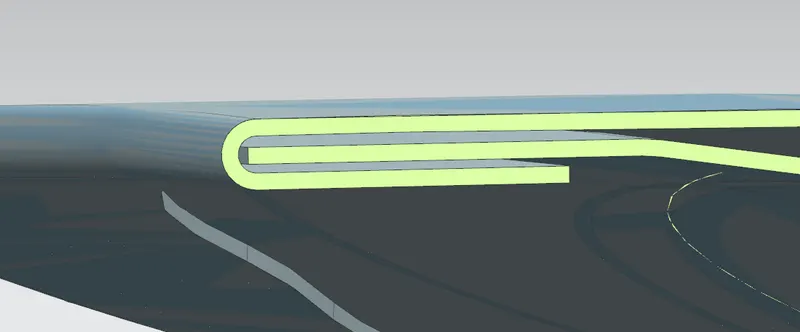
Hemming is a process which is used to connect the hood outer and inner panel together. It is an operation in which the edges of the outer panel are folded over the hood inner panel to achieve a tight fit.There are two types of hemming namely conventional die hemming and roll hemming.
Here roll hemming is carried out where the hemming roller is guided by an industrial robot to form a flange.
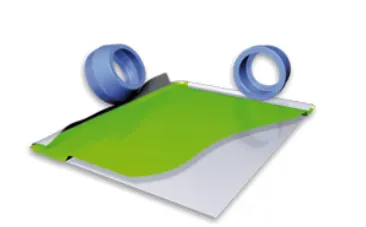
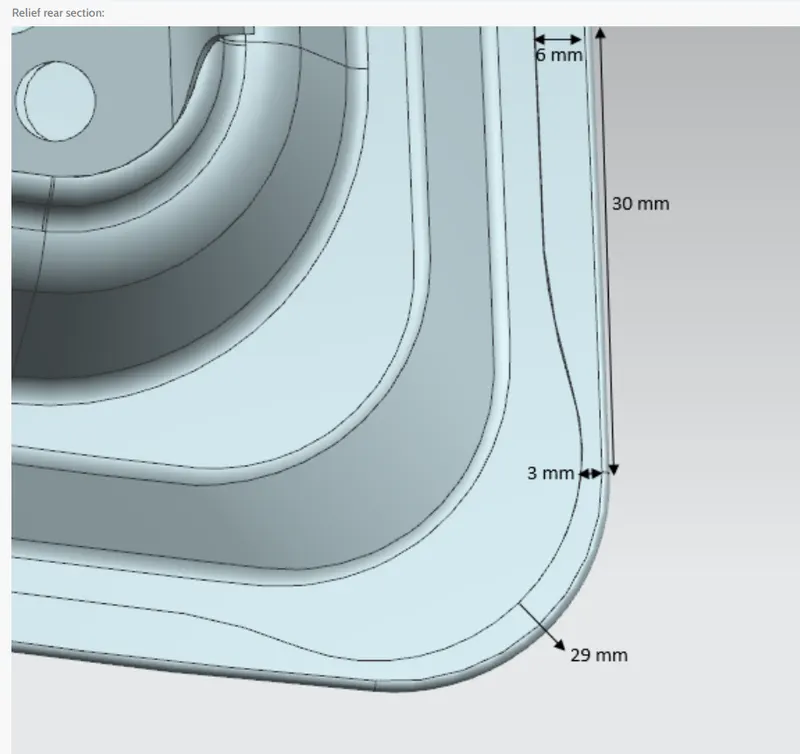
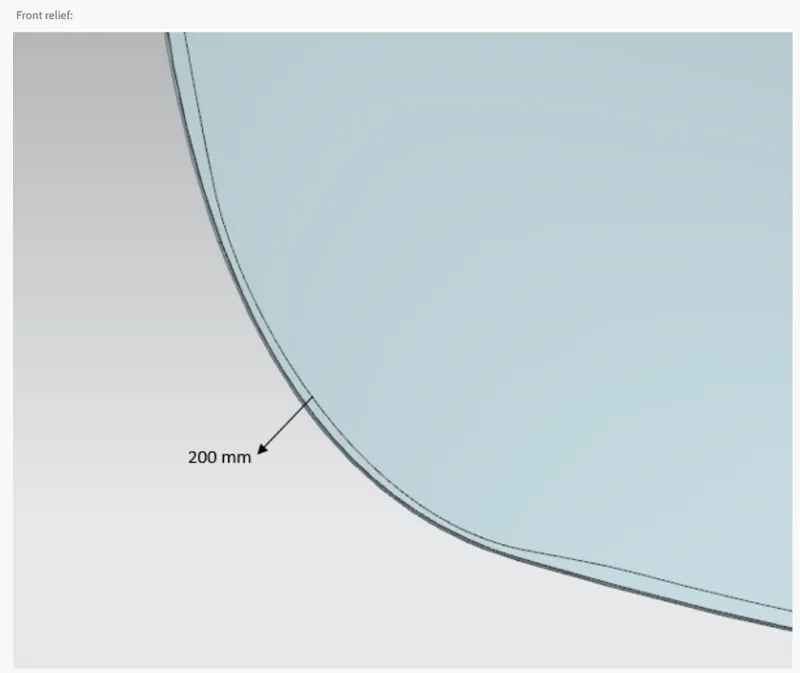
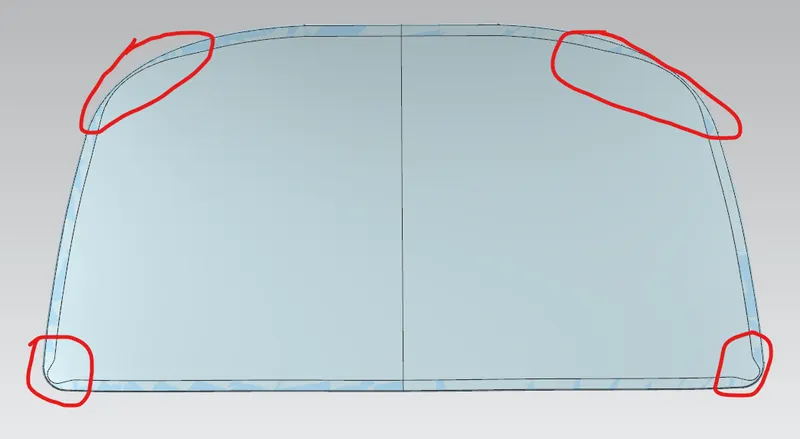
Corner relief :Rollers do not roll over the corner as the part will not spring back to its original shape . Here corner relief is given to the outer panel in a way where the roller will not completely roll over the corners.
Reinforcements:
Reniforcements are given for a particular reason for support/strength and also reinforcements are given wherever we lose the material locally in order to regain the lost materials strength via the reinforcements. Here while designing the hood we lose material where striker and hinge takes place.
Striker Reinforcement:
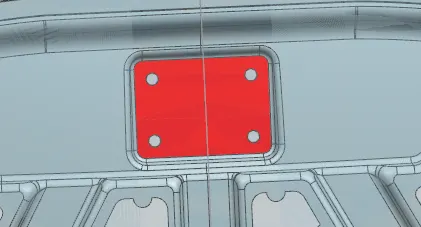
Here the one which is depicted in red is called the striker reinforcement . Reinforcement thickness = 1.5 mm
Reinforcement for Hinge:

Thickness for hinge reinforcement also stays the same as striker's reinforcement
These reinforcement data can be collected by benchmarking from our parent/competitor's car whichever stands out.
Safety requirement:
The Euro New Car Assesment Program(NCAP) tests car and give them safety rating where one star means people in the car have higher chances of being injured and five star means people have lower chances of getting injured in a crash.
Wrap around Distance:It is the distance from the point where the pedestrian stands to where the pedestrian's head collides in the hood.
We can put a convincing picture from the below given image of what wrap around distance really is
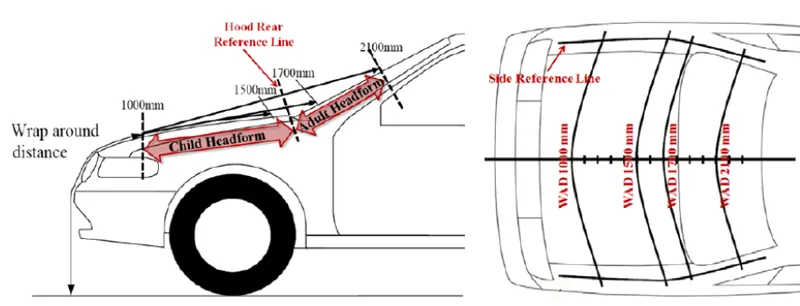
The above image represents the head impact zone for a child as well as for adults.
Pedestrian safety:
The most critical factor while designing a hood will be pedestrian safety from frontal collision.While designing the hood it is designed in a way to protect the pedestrian when he gets collided with the hood by removing some material from the hood inner panel to ensure pedestrian safety.
Side reference line:
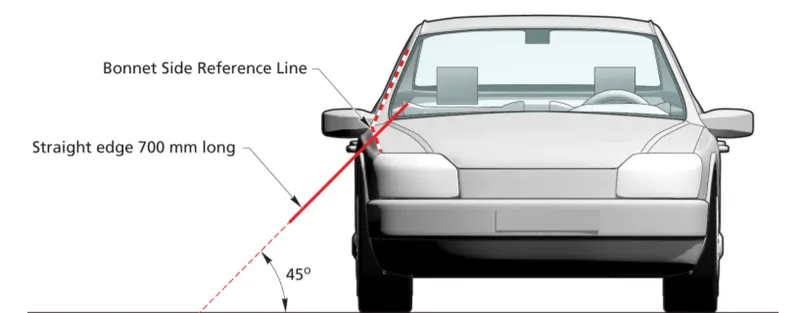
A line which is drawn from the ground to 45 degree where it touches the hood is called as side reference line.
Position of the side reference line is vital because if the side reference line is on the hood then it has a large hood then the WAD(Wrap around distance) will be less resulting more impact zone whereas if the side reference line fall on the fender which makes the hood small then the WAD will be high results lesser impact zone
Emboss:
After passing the initial stage in designing we create emboss locally to accomplish the strength and stiffness of a component.Embosses are provided in way where it dissipates the force towards the passenger and it diverts the force outside the car ensuring the saftey of passenger in the cabin.The draft angle for the emboss should be 5-10 mm minimum for the ease process of removing the tool from the die.
A reference on how the force is diverted outwards
Design Procedure:
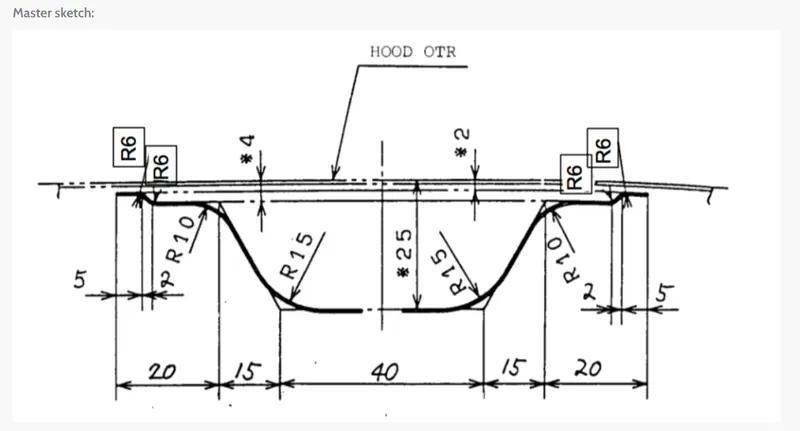
We are provided with a master sketch
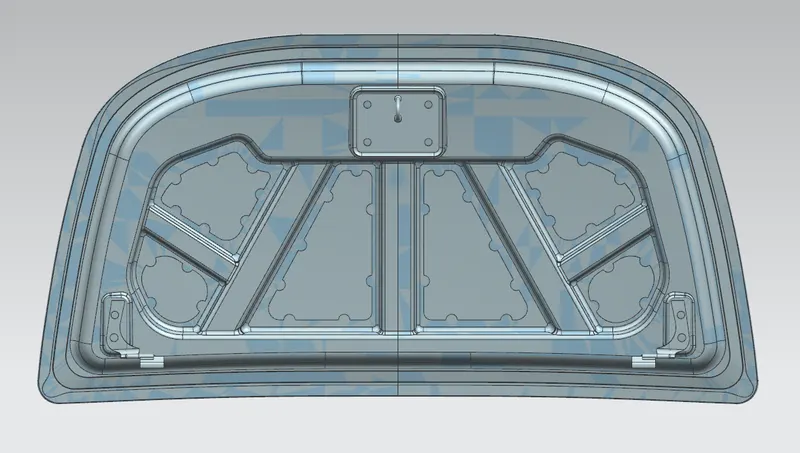
By the provided outer panel using the master sketch we will be able to create an inner panel with embosses accordingly
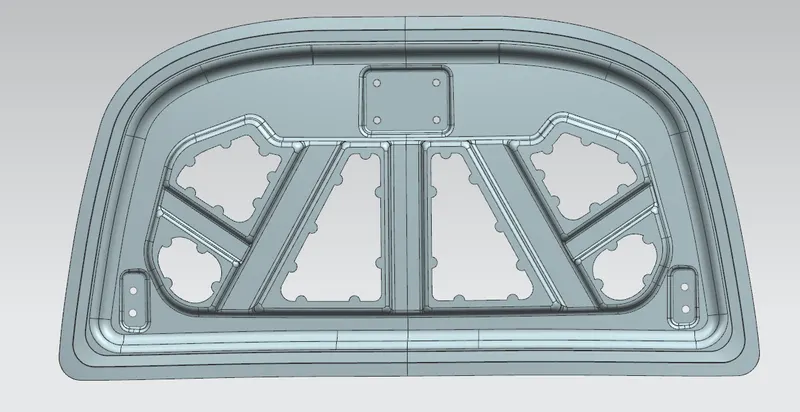
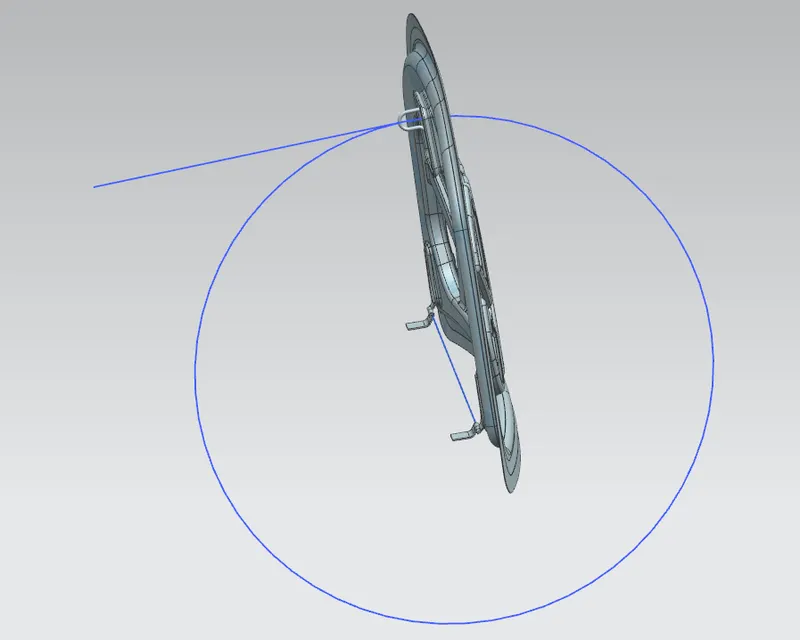
Now the position of the striker is determined with the help of hinge axis. By placing the hinge tentatively we will be able to get an axis passign through both the hinges,with the midpoint of the axis a trajectory circle is drawn and then a line is drawn tangent to the circle which will help to constrain the line drawn in striker.
Mastic sealants are applied to glue the inner panel to the outer panel .They also play a vital role in improving the car's NVH and it also helps the outer panel get to the original shape when it gets deformed. It has an influence area of around 80-85 mm.
Inner panel created with hinge and striker assembly
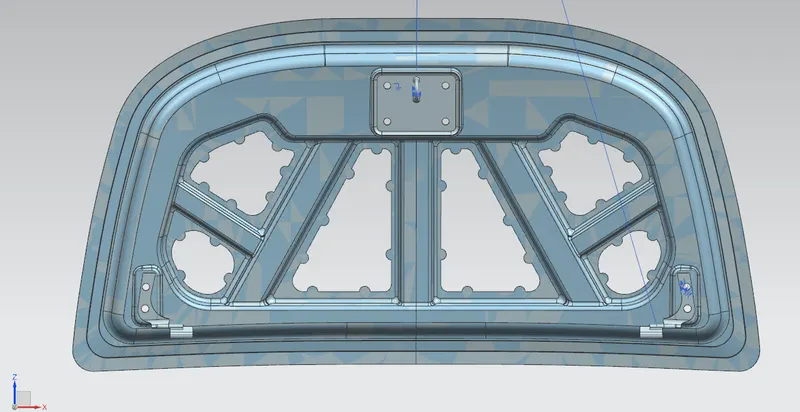
Hood Inner panel itself is an reinforcement for the hood outer panel.
Finally hemming and corner releifs are given in order to bind the inner panel with the outer panel.
CONCLUSION:
Concluding I have designed the hood inner panel and created a hood assembly with all the functional and saftey requirements(Euro NCAP standard) taken into account.
Software used : NX CAD