Hood design-Week 2
Hood
- The hood or bonnet is the hinged cover over the engine of motor vehicles.
- Hoods can open to allow access to the engine compartment, or trunk on rear-engine and some mid-engine vehicles) for maintenance and repair.
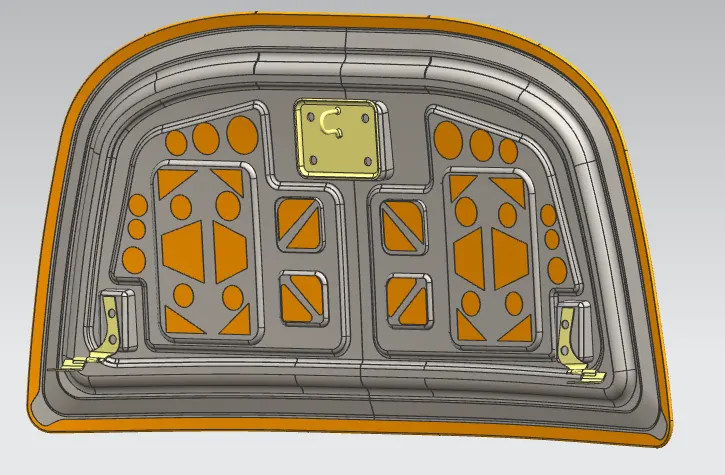
- The hood panel of the vehicle has a form in which an outer panel and an inner panel are combined, and has a frame structure for rigidity reinforcement in order to ensure hood rigidity and durability.
- It is constructed usually by steel sometimes by aluminum. In the recent trend like for a sports/car performance car it is made up of materials like carbon fibre, fibre glass or stay carbon. Over free decades concerns regarding the severity of a potential pedestrian great injury during collision with a motor vehicle have led to advanced good design on many models.
Functional and Safety Requirements:
The 1st and most important safety requirement to be considered while designing the Bonnet is the frontal collision requirements.
In this image, you can see the deformation on a hood that underwent a frontal collision:
It is clear that the design intention of the hood according to the frontal collision requirement is that the hood crushes and dissipates forces in the upward direction and to the hard points on the hood thereby deflecting the force on to the body and not the passengers.
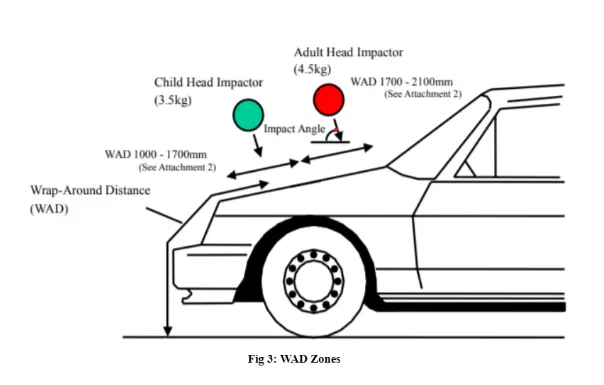
- Regarding the safety of the pedestrians, the above image shows the area of impact for a child and an adult.
- It is of utmost importance that we make sure not to place re-enforcement on the areas prone to high head impact. Also, the child impact area is designed with lesser thickness than the adult impact area so that in the event of a frontal collision where a child is involved, the bonnet will absorb the impact of the crash and crumble to protect the child’s head from absorbing the force.
Manufacturing process
Deep drawing
- The deep drawing process is a forming process which occurs under a combination of tensile and compressive conditions.
- A flat sheet metal blank is formed into a hollow body open on one side or a hollow body is formed into a hollow body with a smaller cross-section.
In the automotive industry, deep drawing is usually carried out using rigid tools.
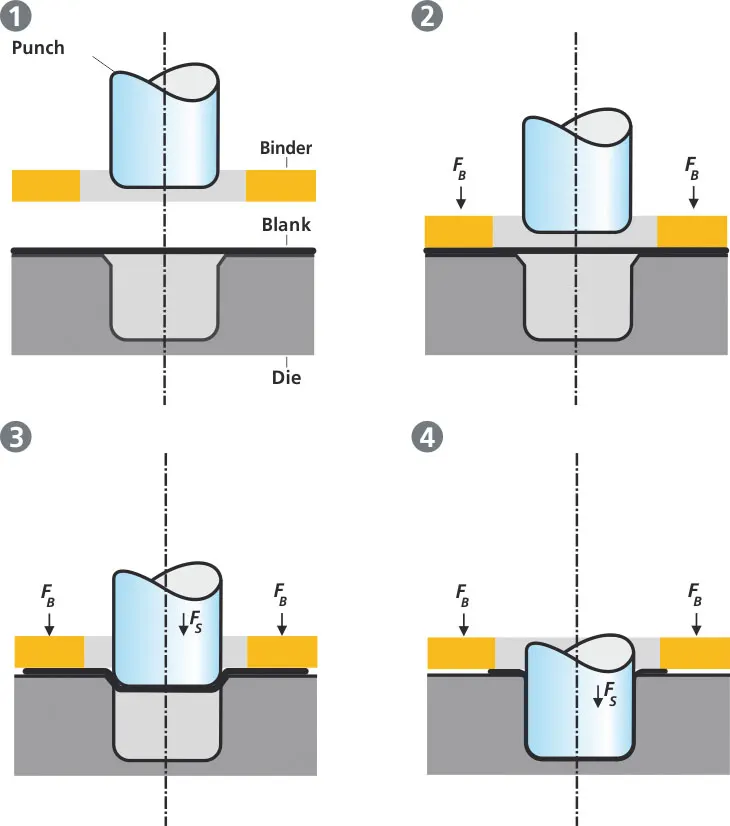
The figure illustrates the deep drawing process. The rigid tools consist of a punch, die and binder. In deep drawing, the plate holder closes after the metal sheet blank has been inserted.
- Next the sheet is clamped between the die and the binder. This process slows down the flow of the sheet while it is being drawn and thereby prevents wrinkles from forming under the binder. The punch stretches the sheet over the die radius and forms it in the die. The amount of punch force necessary for forming is thereby continually increased up to the lower dead center of the punch.
-
Whereas in pure deep drawing there is no reduction of sheet metal thickness, forming is achieved in stretch forming purely as a result of a decrease in sheet metal thickness. Stretch forming is extensively used for the forming of only slightly curved parts with low depth of draw (e.g. roofs, doors).
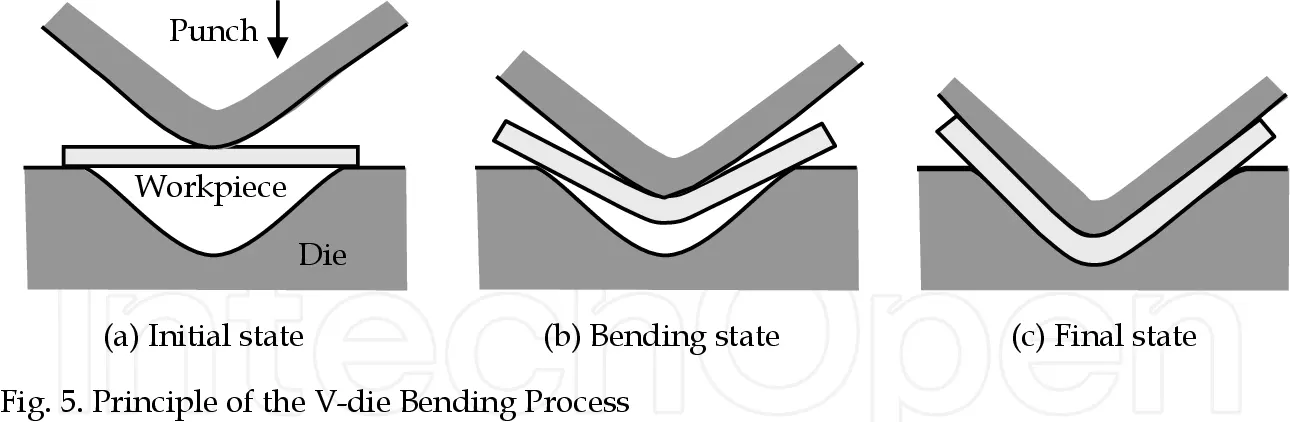
Bending: In bending, force is applied to a sheet metal workpiece to produce a curvature of the surface. Bending is generally used to produce simple curved surfaces rather than complex ones. A mechanically operated press drives a punch against sheet metal forcing it into a simple due with enough pressure to produce a permanent change in the metal shape. They amount of pressure is important. If not enough pressure is applied, the metal can simply sitting back into its original shape. If too much is applied, it can break.
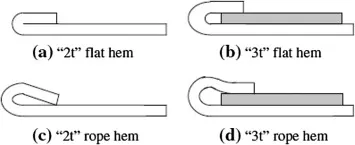
Hemming is a sheet metal forming process in which sheets are joined by bending it to 180°. Automotive body panels and automotive parts such as deck-lids, trunk-lids, doors, hoods and tailgates are formed by hemming process. In this process, usually a sheet is bent with the help of inner sheet in three different stages.
Requirements:
Hood Thickness Information
- Outer Panel Thickness = 0.75mm
- Inner Panel Thickness = 0.75mm
- Reinforcement Thickness = 1.5mm
Master sketch:
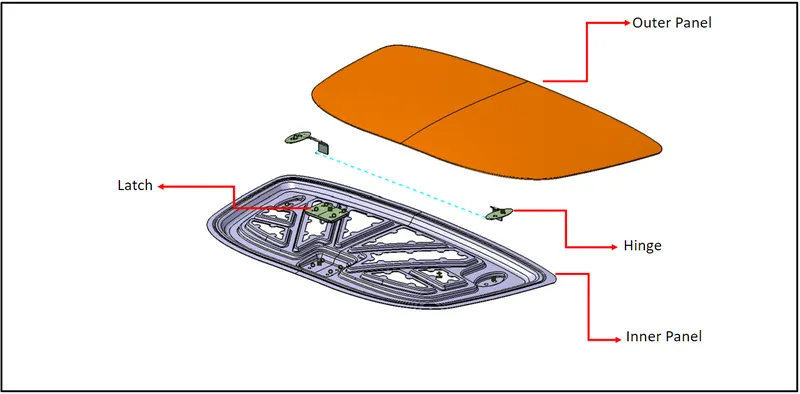
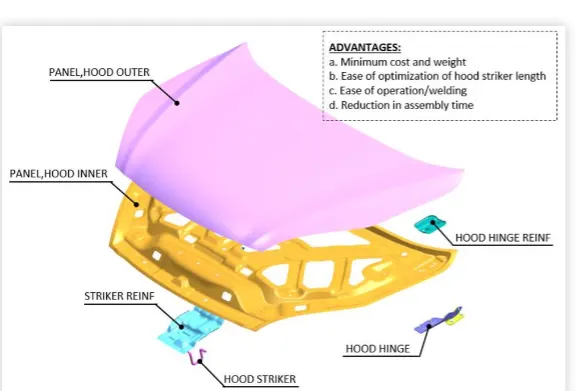
The hood or the Bonnet consists of the following parts.
- Hood outer panel
- Hood inner panel
- Latch and Striker re-enforcement
- Hinge re-enforcement
- Gas stay re-enforcement
Some of the most commonly used features in designing hood assembly are:
1. Offset surface creates a body by offsettinga set of faces.
2. Trim sheet time of a portion of sheet body.
3. Law extension from the edge of sheet metal/curve extended sheet metal is created.
4. Curve on surface creates a surface spline on the face of sheet metal.
5. Mirror geometry create the exact mirror of sheet metal body.
6. Face blend adds tangents blend faces between selected set of faces.
7. Edge blend rounds sharp edges between faces.
8. Projected curves projects the curves, edges, points on planes or surfaces.
9. Emboss modifies a body with faces made by projecting a section along with hector.
10. Extend sheet extend a sheet body by a distance.
11. Sew combines two adjacent sheet bodies making it as one.
12. Through curves creates a body through multiple actions where the shape changes through pass through each section.
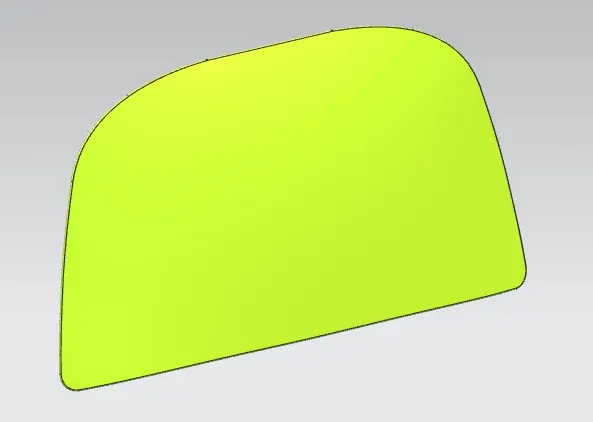
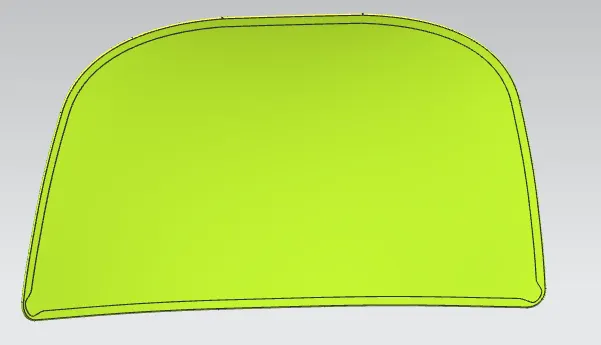
Hood outer panel
- outer panel provided aesthetic look for hood of car
- shape and size should be according to safety norms and padestrian safety
- by heming process the outer panel is made to attach with inner panel
Hemming:
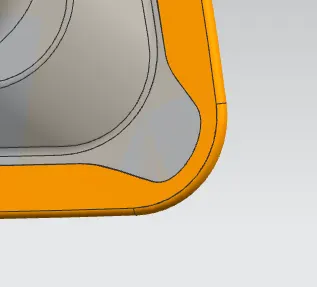
Hemming is the process of joining both the outer and inner panel together. The hemming process roles and wraps the hood outer panel around the inner panel and holds it tightly together. The following are the dimensions followed for hemming.
After the hemming process is done, now we need to provide corner relief on the corners of the hood so that the part is manufactural
Hood inner panel
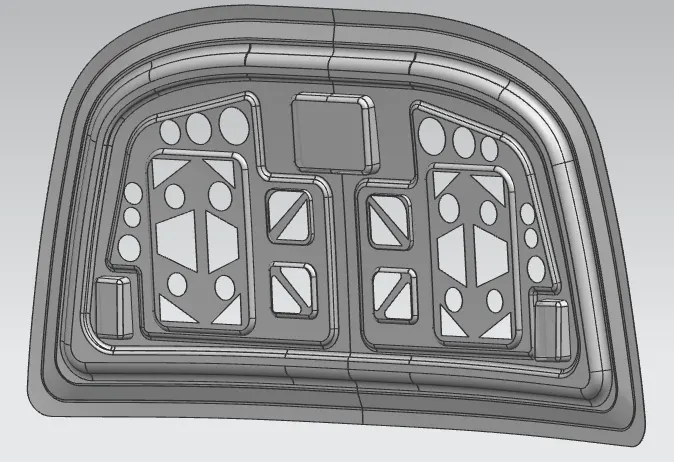
- it provides strength and rigidity to outer panel
- emboss is done inorder to give strength to the inner panel
- trim sheet was done on the inner panel to reduce the weight and to reduce the impact when car hits the pedestrian.
Geometry and emboss creation:
- The geometry is created based on the master section.
- After performing the initial stages of design, we will provide local embosses to strengthen the component.
- To make the component easy to manufacture, all the sharp corners from the embosses are removed. The curvature intersections from different nearby embosses are blended out to produce a smooth transition.
- The component will be strengthened based on the master section. When a force impacts the hood from the front, it travels in an upward direction. The component is designed to divert the force away from the passengers into the hinges, as shown in the image below:
After the development of the entire inner panel for the hood, we need to develop some additional necessary re-enforcements. The Latch striker and the hinges will need a re-enforcement that needs to be developed.
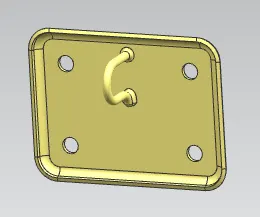
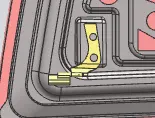
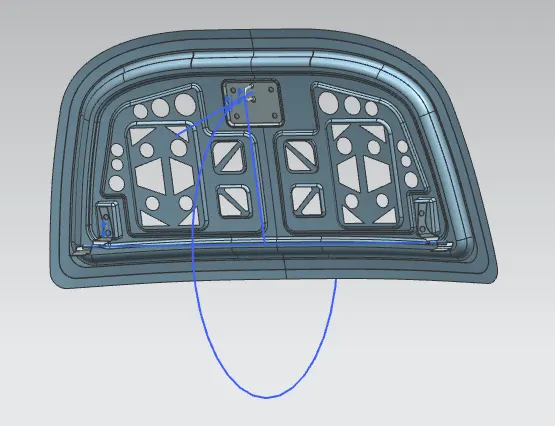
- The other major functional of the hood is the opening and closing of the hood. This is done with the help of the latch and striker. To position the latch and striker effectively, we position the hinge and draw the hinge axis.
- Now, using the hinge axis as the center we draw a big circle to the position where we need the latch to be placed. Then, we draw a tangent line to the circle at that point and place the latch in that region.
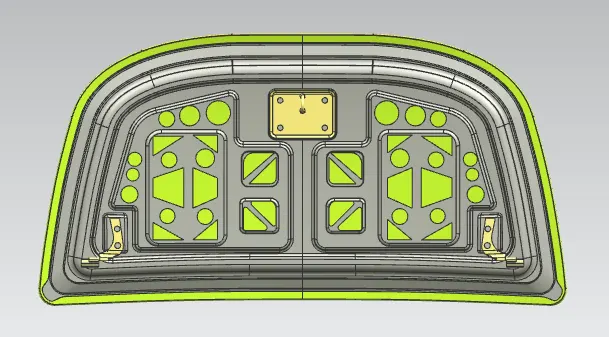
The re-enforcements are attached to the hood inner panel using the spot welding method. The positions to be spot-welded are provided by the design team.
Mastic data:
The Mastic sealant or the Mastic point is an elastic compound that behaves like a rubber. The mastic points are defined on the hood inner panel where the hood can easily deform. They help the hood outer panel to come back to its original shape after it gets deformed. The mastic has an influence area of 80mm
Conclusion : The hood design comprises of outer panel, inner panel, hinge assembly, striker mechanism. Referring according to the master section various vector are applied on the sheet metal to obtain desired output.