Hood design-Week 2
HOOD DESIGN CHALLENGE
INTRODUCTION :
Hood is a critical component of a car as it is of major consideration when it comes to frontal impact.And also Hood is one of the important styling area which gives a aesthetic look to the car. Hood plays a major role in acting as a cover/protector for the engine and transmission assemblies. But a well designed hood should also be capable of minimizing the impact to the passenger in case of frontal collision.Hood dissipates the energy outside the car body rather then sending it inside.
Apart from that, hood acts as a door to repair the car in case of failures as the most critical parts of a car are contained inside the hood starting with engine , transmission , suspension to steering modules.
COMPONENTS OF A HOOD :
The Hood assembly consists of various sub part assembly that makes up the final part, importantly it consists of Hood outer panel, hood inner panel and reinforcements.
The hood outer panel and inner panel are majorly joined together with the help of HEMMING, SPOT WELDING, GLUEING AND RIVETTING process.
The other sub assemblies that are mounted on the hood assembly include,
- Hinge assembly - Hinge assembly helps the opening and closing of the hood about an axis.
- Striker - Striker is a part of the hood assembly that helps keep the hood in a locked position. There are two latches given for any striker. One is a primary latch that is operatable from inside the car which opens up the hood by a marginal amount and then a secondary latch which must be operated manually at the striker area by moving a lever.
- Hood Balancer - There are two types which helps hold the opened hood in place.
1. Support rod : Support rod is easy and cheap mechanism. We have to open the hood manually and insert the support rod at the Grommets provided in the hood. In case of light weight hood this works well.
2. Gas stay : Gas stay only requires a intial nudge to open the hood. This type of support is operated pneumatically and mostly used for heavy hoods or luxurious purpose. The gas stay has Bolster/Stud ball at each ends and also mostly a external bracket is used for reinforcement.
PARAMETERS CONSIDERATION :
1) Hood opening angle (HOOD HEAD ZONE FOR LOCK STRIKER)
Hood opening angle should be the first thing to fix as the proper opening area is required so that an avarage tall person can stand comfortably below it. Otherwise there is a chance that striker part of the hood might cause injury to the user. Hood opening angle can be controlled by changing the length of support rod/ gas stay.
2) Pedastrian Head Impact Zone
Wrap around distance : It is the trace of the points received at the front structure , the distance from the ground to the end of the hood on which the body of a person is assumed to wrap around in case of a frontal collision.
Side Reference line : It refers to the trace of the highest contact point between straight edge inclined at an angle of 45 degree and side of the vehicle.
When the side reference line is located farther away like on a fender the wrap around distance will be more so the impact zone will be less.
When the side reference line is located on the hood it means that the wrap around distance is less and the impact zone on the hood will be higher.
Hence the wrap around distance and side reference line play a major role in determining the area of head impact zone.
Deformable brackets are provided to increase the green zone ( where the collision between a pedastrian at that area reduces the impact to the pedestrian since it easily deforms than the rest of the area).
Higher the green zone higher will be the rating given by NCAP for the Car.
Hood Inner Panel :
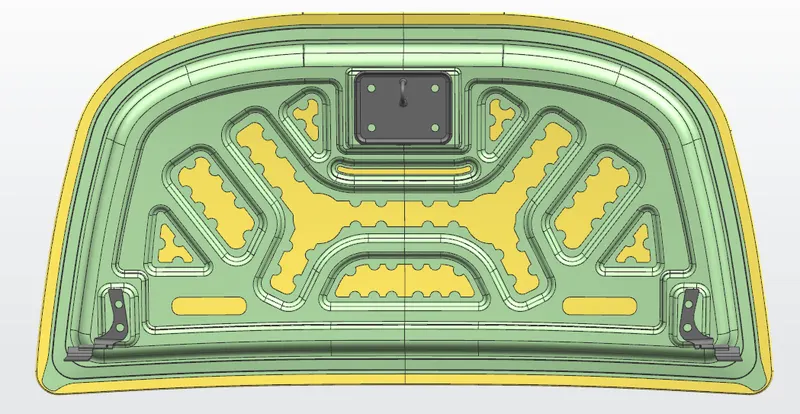
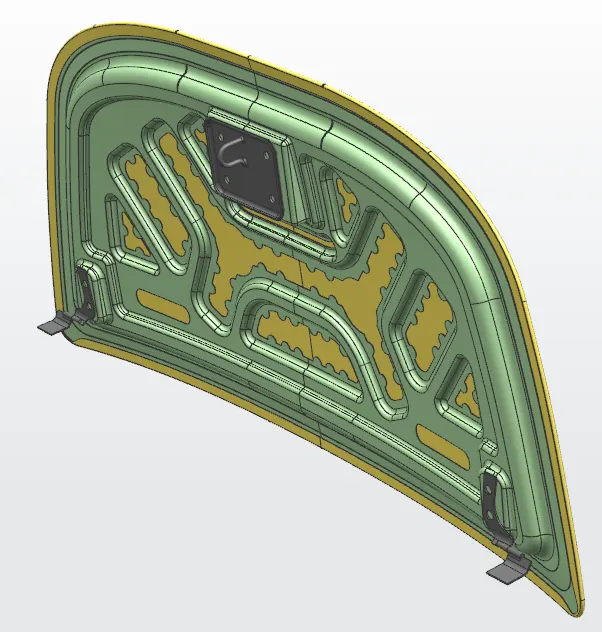
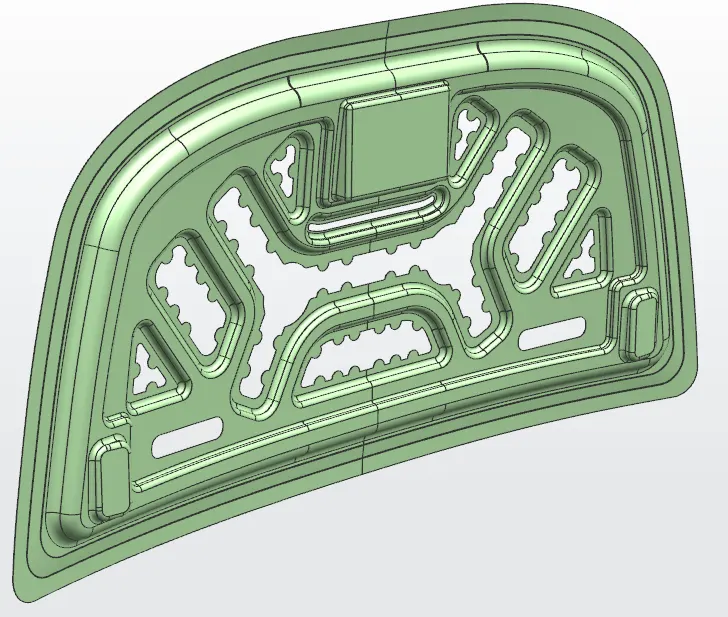
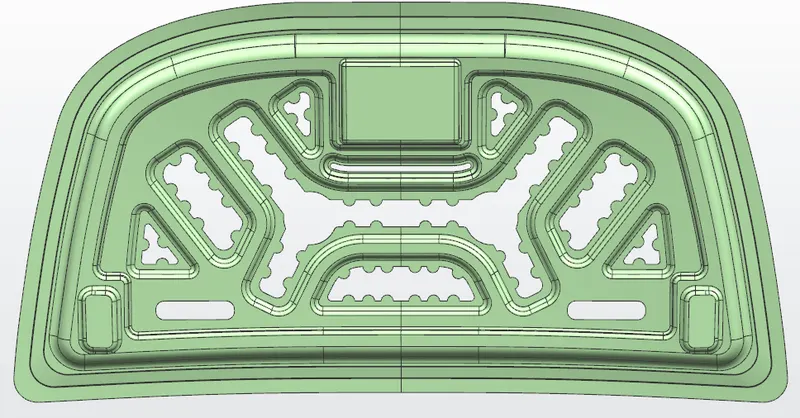
Hood Inner panel provides support to the outer panel. Basically it is a reinforcement surface for the outer panel. It consists of emboss, holes and various strengthening features. The Inner panel is designed in such a way to divert the impact or dissipate energy towards the hinges with the help of embosses and also add strength to the inner panel.
Taking look at the master section, Initially the outer panel is offset to a maximum of 25mm below which the engine will be mounted and it extends to a width of 40mm( almost standard across many vehicles) which is dependant on the width of the hood. And the particular area is opened up by 45 degrees to ensure feasibility for stamping process. This will be the bottom most part of the inner panel.
There are two more offsets from the Outer panel which are at 2mm and 4mm respectively. These are the areas where the mastic sealants are applied to hold both the panels together.
It is important to design the EMBOSSES in such a way that the forces are dissipated outside the car rather than traveling directly towards the passenger cabin. Adding proper emboss reduces the force that might get inside the car and does not eliminate it completely.
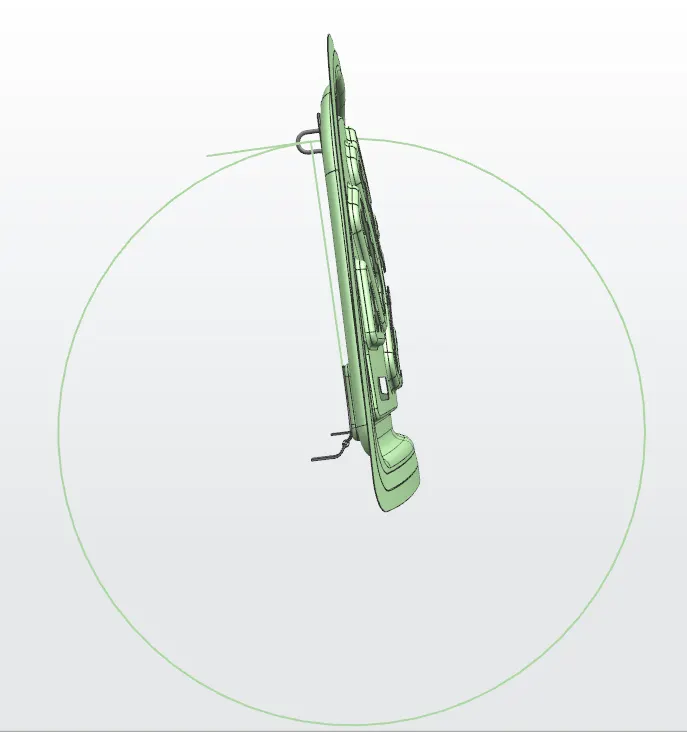
Hinge assembly and Striker concept drawing :
There are two hinges on either side of the hood and these both share a common hinge axis. The centre point of this axis line is called the Hinge axis point.
The centre point of the striker is taken from the previous vehicle and the distance from the Hinge axis point to the striker centre will be the radius of the circle.
This circle defines the trajectory of our hood opening and closing. At the area where the circle meets the striker centre, if striker is exactly perpendicular to the trajectory of the circle then the hinge position we haven chosen is the right one. Otherwise we have to adjust the hinge centre point/ axis. Since the striker area or lines is fixed across cars to cars we have to modify the hinge positions to get the striker perpendicular to the trajectory circle.
If the striker is not positioned perpendicular to the trajectory then the closing of the hood is hard since the latch present in the engine compartment is also positioned with respect to the trajectory.
The striker , the hinge and the trajectory all are interrelated which enable smooth functioning of the hood.
Stiffener Pad :
Stiffner pad is a rubber / sponge material present between the hood outer panel and Inner panel. The primary purpose of the pad is to dampen the noise if in case the outer hood withers /vibrates during motion. It helps improve the NVH criteria.
Mastic selants :
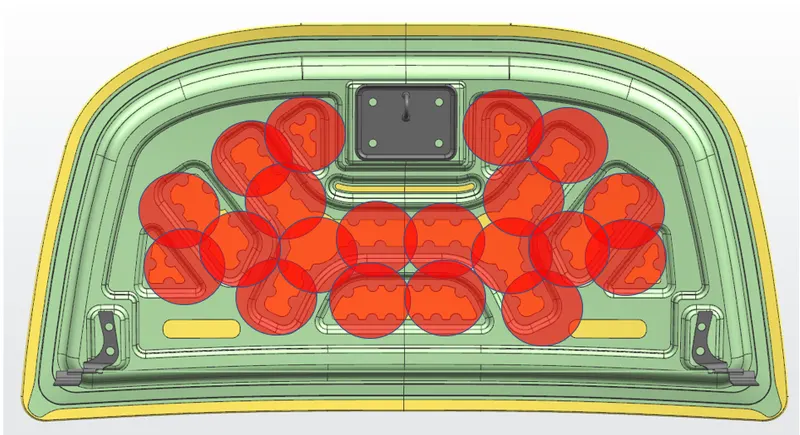
Mastic sealant is another type of adhesives/hard rubber used between a inner panel and outer panel. Every mastic sealant can improve the strength at around 80mm in diameter. So by positioning the mastic sealants on appropriate locations we can cover most of the regions of the hood panel and hence improve the overrall strength of the hood. It also helps in improving the NVH of the hood area. This sealant is a hrad rubber which gets hardened when dipped in the hot furnace and holds the inner and outer panel together.
Reinforcements:
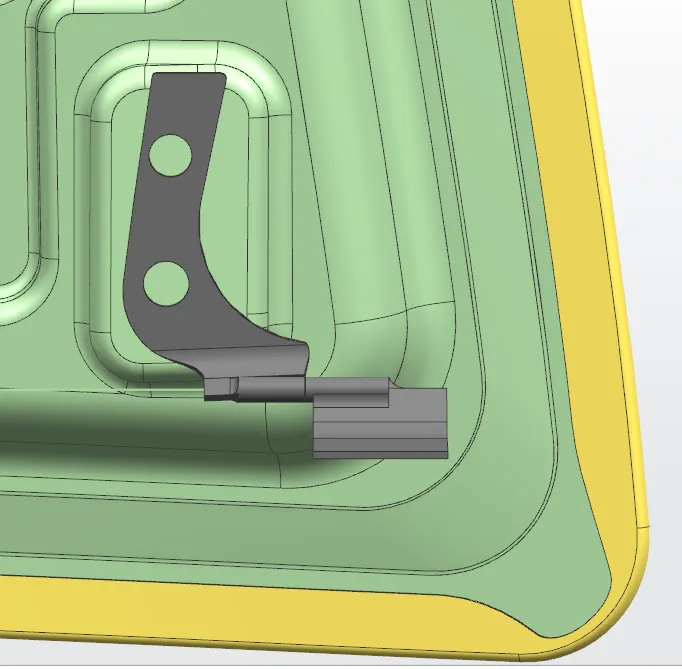
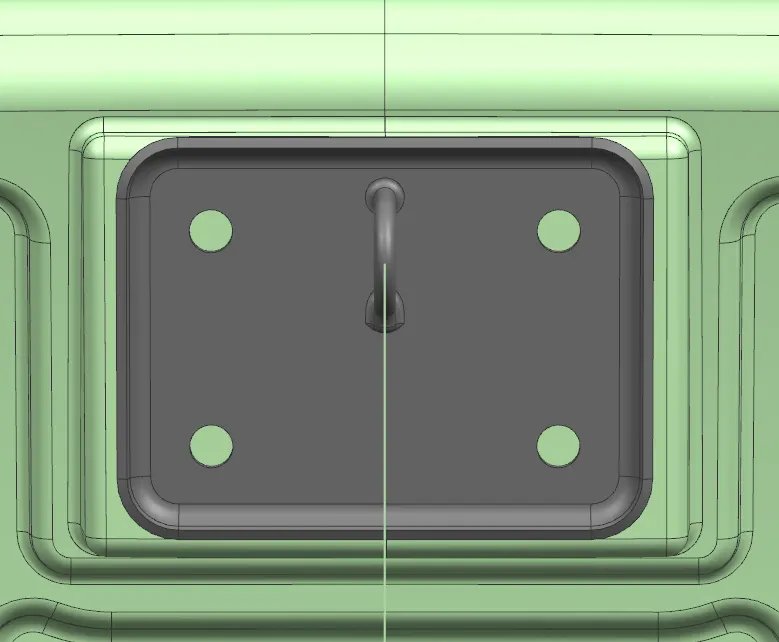
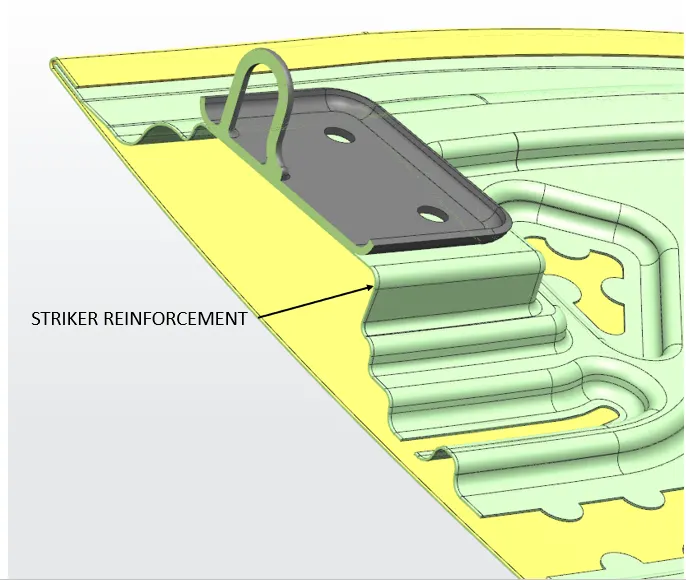
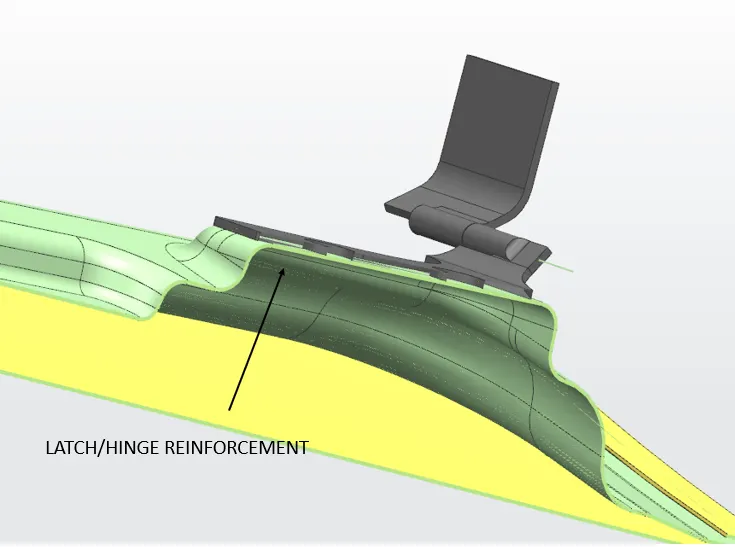
Reinforcements are given to compensate for the loss that occurs locally when a heavy sub component is assembled in a major assembly. In our case when latch and striker mechanism is assembled in the front - that particular area becomes weak and hence in order to improve the strength of the inner panel we add more material on that area. It's called as reinforcement latch & striker. Similarly for the hinge assembly reinforcements are added. Reinforcements are intentionally given to improve the strength of that area.
Hemming operation :
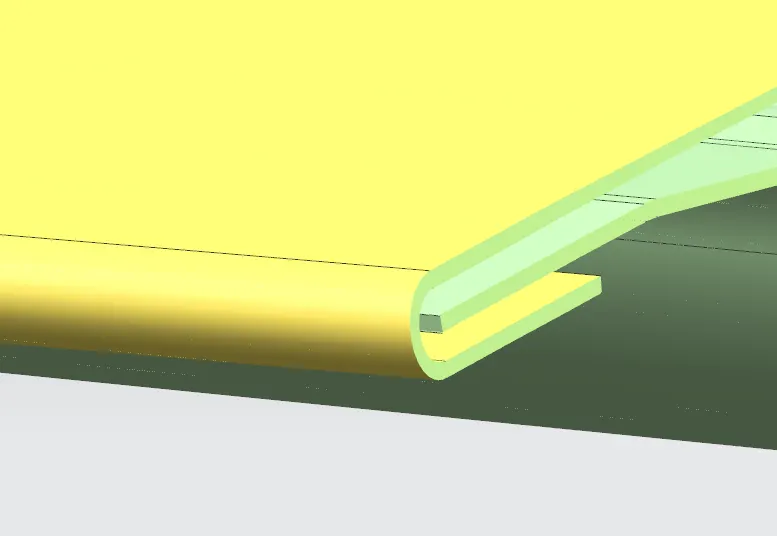
Hemming is one of the other operations which is done to clamp the inner panel with the outer panel effectively. During hemming operation the outer panel is bended and twisted inside so that the inner panel is safely packed inside. It is important to maintain appropriate gaps between inner and outer panel when dealing with a hemming operation.
There are different rollers present on the edges of the hood and each of these rollers roll over their alloted edges repeatedly to enhance proper closing over the inner panel.
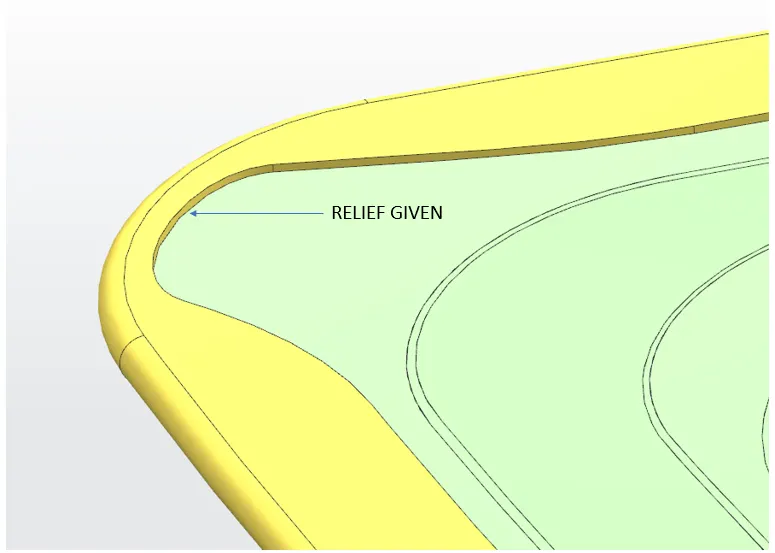
The force given during the hemming operation is studied to understand whether it helps the panel come back to its original position or changing the design of the part which in turn affects the outer panel aesthetics. This type of condition causes red zones which must be avoided. Hence a relief is given in the corners so that the roller doesn't pass over these corners completely.
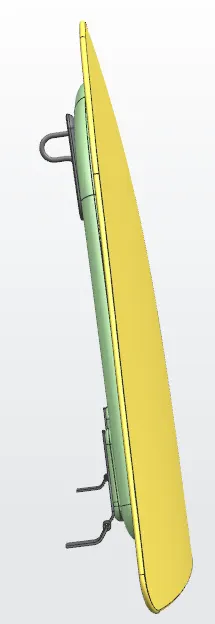
VARIOUS VIEWS OF THE HOOD ASSEMBLY :