Hood design-Week 2
Automotive Hood Design
- Objective:
To design the Hood outer panel, inner panel, latch, hinge and the necessary reinforcements by following the Master section & to achieve maximum safety for everyone in and around the vehicle.
2. Introduction:
The hood or bonnet is the hinged cover over the engine of motor vehicles. Hoods can open to allow access to the engine compartment for maintenance and repair.
Hoods are typically made out of the same material as the rest of the body work. This may include steel, aluminium, fiberglass or carbon fiber. However, some aftermarket companies produce replacements for steel hoods in fiberglass or carbon fiber to make the vehicle lighter.
The hood release system is common on most vehicles and usually consists of an interior hood latch handle, hood release cable and hood latch assembly. The hood latch handle is usually located below the steering wheel, beside the driver's seat or set into the door frame.
In Japan and Europe, regulations have come into effects that place a limit on the severity of pedestrian head injury when struck by a motor vehicle.
A typical hood assembly consists of hood outer panel, inner panel, latch, striker, hinge, hood stay and the necessary reinforcements. Hood stay is an apparatus for supporting the engine hood of vehicle in its open position. Common types of hood stays are Support rod & Gas stay.
- Design parameters:
Data to be used:
Hood Thickness Information
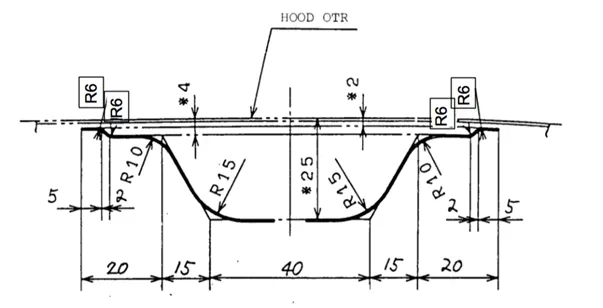
- Outer Panel Thickness = 0.75mm
- Inner Panel Thickness = 0.75mm
- Reinforcement Thickness = 1.5mm
Master sketch:
- Design Considerations:
Hood of an automobile is designed by considering many critical factors, out of those safety is one of the most important factor. We have to look out for both pedestrian and passenger’s safety. We have followed EURO- NCAP (European New Car Assessment Programme) standards while designing the hood. It plays an important role in raising awareness on safe and effective design of hood for pedestrian. It programs & develops a test series & Rating system for accessing design safety for pedestrian during impact with a vehicle. The test are generally conducted while the vehicle hits at around 40 Km/hr and covers the pedestrian body interaction with vehicle upon the collision.
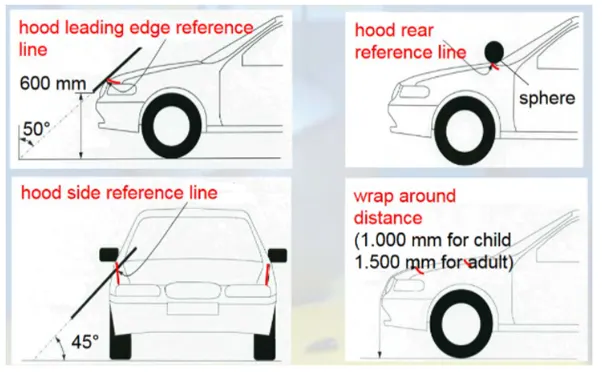
Fig. : Head impact region
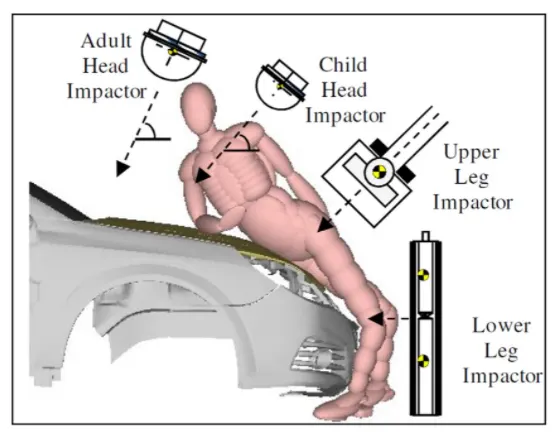
Fig. : Body Bonnet interaction
- Components of Automobile Hood assembly:
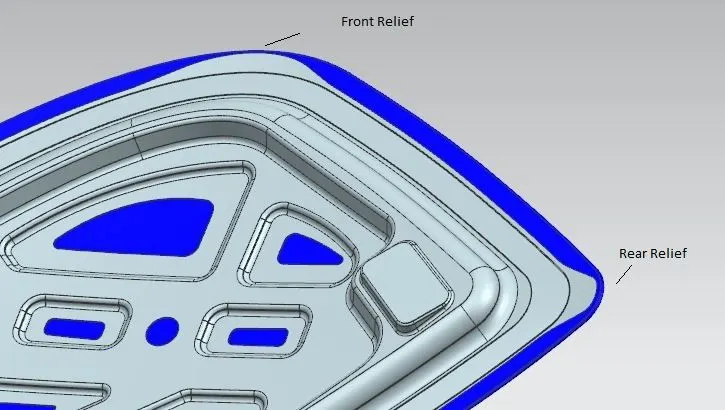
- Hood Outer Panel: Outer panels are the aesthetic elements of car. The styling team provides the skin for the outer panel. Most important consideration is pedestrian safety while designing the hood. The outer panel and inner panel are attached by the process called hemming. So, it is required to provide hemming flange and reliefs.
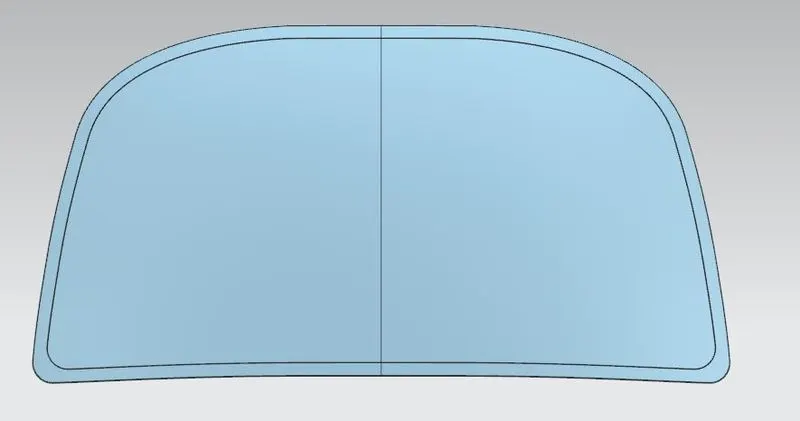
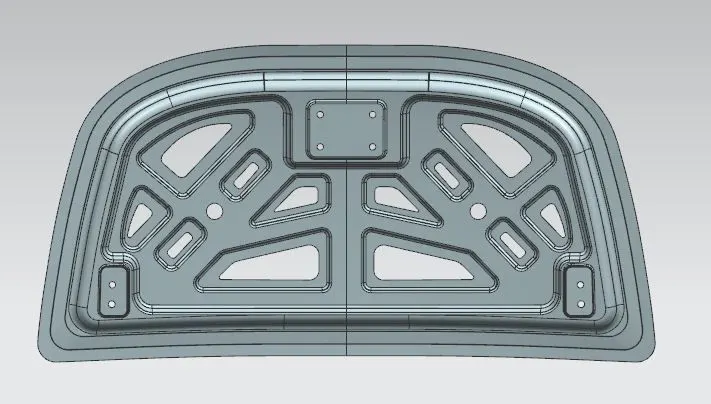
- Hood Inner Panel: Inner panel of the hood provides strength to the outer panel. The Hinges are mounted on the inner panel emboss. Inner panel is designed by considering the flow of reaction forces and ensuring sufficient energy absorption capacity.
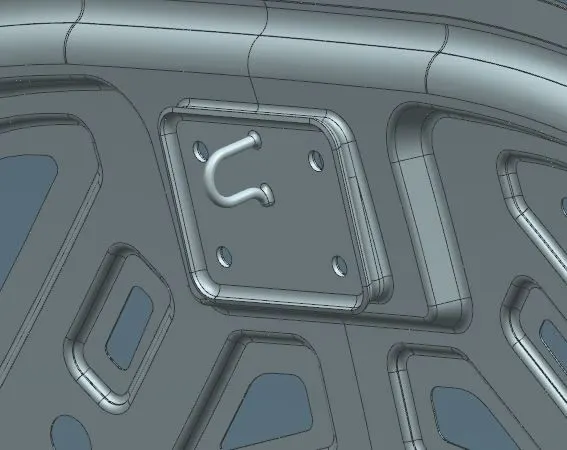
- Latch: It is basically the fastener that keeps your hood closed. The latch ensures that the hood is securely connected to vehicle and it doesn’t pops up during the movement.
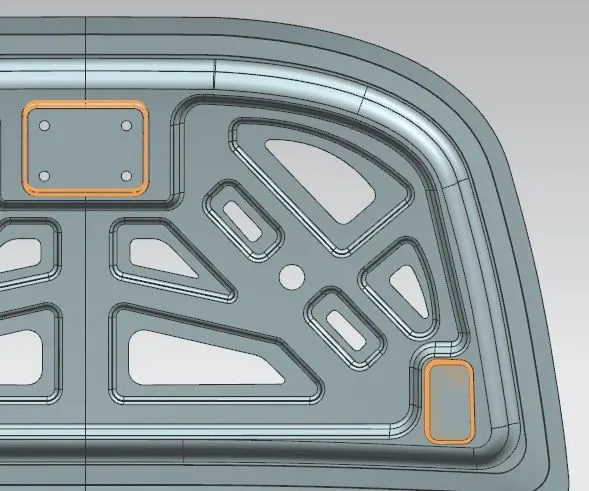
- Hinge/ Latch reinforcements: These are provided according to the design requirements. Reinforcements are used to provide strength mainly at the Latch & Hinge region.
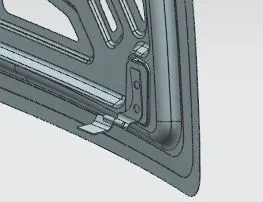
- Hinge: To actuating the open/ close motion of the hood, we require hinges. They are provided at both ends of the inner panel.
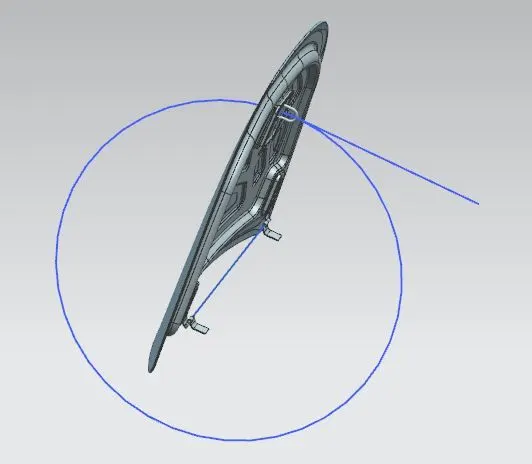
6. Latch Trajectory: While opening or closing the hood, the latch must be perfectly aligned to the fixing of striker point. It can be done by having a perpendicular relation between the trajectory (the circle) and the hinge axis. Also, if the striker is perpendicular to the trajectory then the Hinge position are correct.
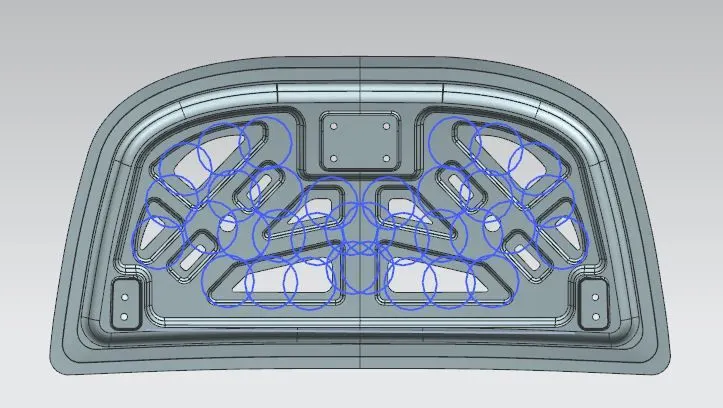
- Mastic data: A mastic sealant is used to combine the hood outer panel and hood inner panel.
Mastics provide thermal and acoustic insulation and serve as fire barriers. Also, they have electrical properties as well. Sealants can also be used for simple smoothening & filling.
A sealant has three basic functions: It fills a gap between two or more substrates It forms a barrier through the physical properties of the sealant itself and by adhesion to the substrate and it maintains sealant properties for the lifetime and environment. It also improves the performance.
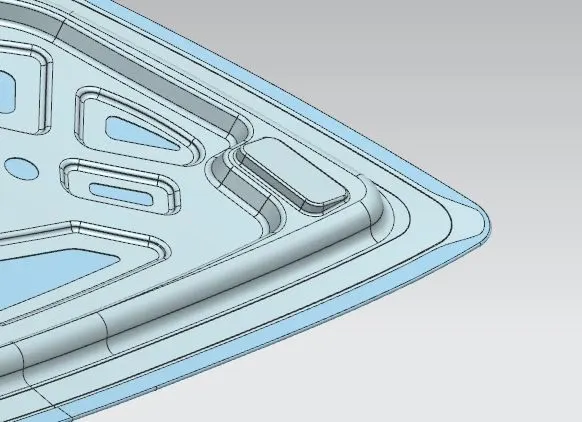
- Emboss: These are designed on the inner panel, whenever a collision happens, we try to dissipate the force on the outside the car as early as possible. So, that the passengers as well as the pedestrian will not feel the impact of the collision.
- Deep drawing: Deep drawing is a sheet metal forming process in which a sheet metal blank is radially drawn into a forming die by the mechanical action of a punch. It is thus a shape transformation process with material retention. The process is considered "deep" drawing when the depth of the drawn part exceeds its diameter.
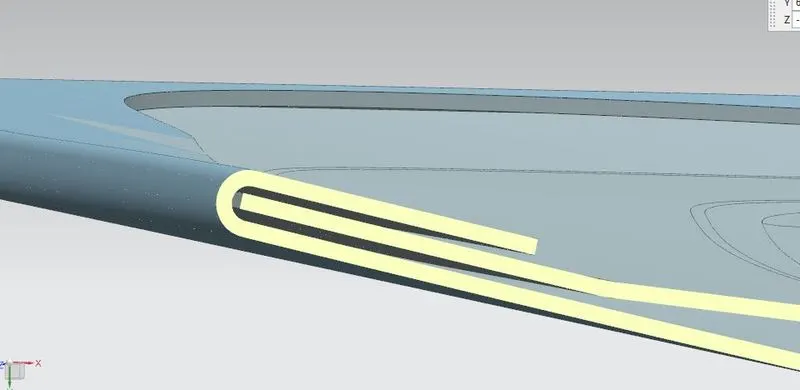
10. Hemming in Sheet metals: Hemming metalworking processes in which a sheet metal edge is rolled over onto itself. Hemming is the process in which the edge is rolled flush to itself.
Hems are commonly used to reinforce an edge, hide burrs and rough edges, and improve appearance. The process starts by bending the edge to an acute angle. A flattening die is then used to flatten the hem.
Final assembly:
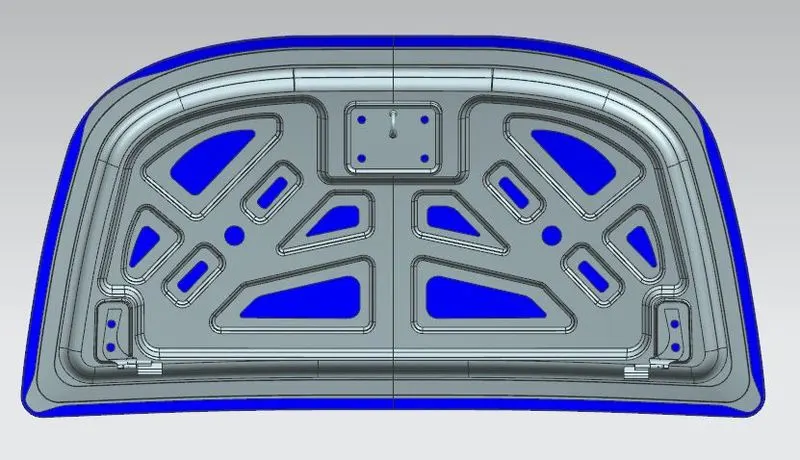
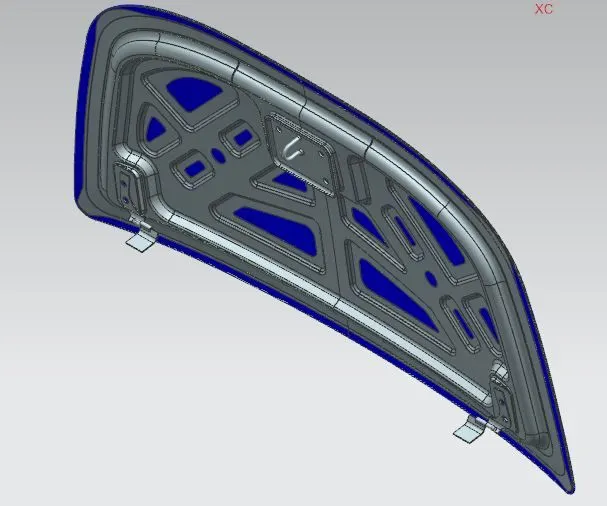
Conclusion: Hence, we have successfully designed the Automotive Hood assembly with maximum safety for everyone in and around the vehicle.