Hood design-Week 2
AIM:
To design hood inner panel, outer panel and the necessary reinforcements by following the master section mentioned with the design parameters.
INTRODUCTION:
The hinged cover that covers a front-engine vehicle's engine compartment is called a car hood, or "bonnet" in some other languages. The engine and related components are shielded from the weather by the car hood, which also makes maintenance and repairs simple.
A typical car hood assembly consists of hood outer panel, inner panel, striker and latch, hinge and hood stay or hood balancer. The inner panel provides the strength, where the outer panel functions as metal cover. Hood balancer or hood stay is a device for supporting the engine hood of a motor vehicle in its opening position.Hood are typically made out of the same material as the rest of the bodywork. This may include steel and aluminium. Deep drawing, hemming, blanking and piercing are the common sheet metal operations that are used in manufacturing hoods in automotive industries. Some of the joining operations are hemming, spot welding, glueing and revetting.
Types of Hood Stay:
- Support Rod : These are manually operated and they are cost effective and simple to design.
- Gas stay : no need of man power, but it is costly.
DESIGN PARAMETERS:
- Hood Outer panel thickness - 0.75mm
- Hood Inner panel thickness - 0.75mm
- Reinforcement thickness - 1.5mm
Given master section:
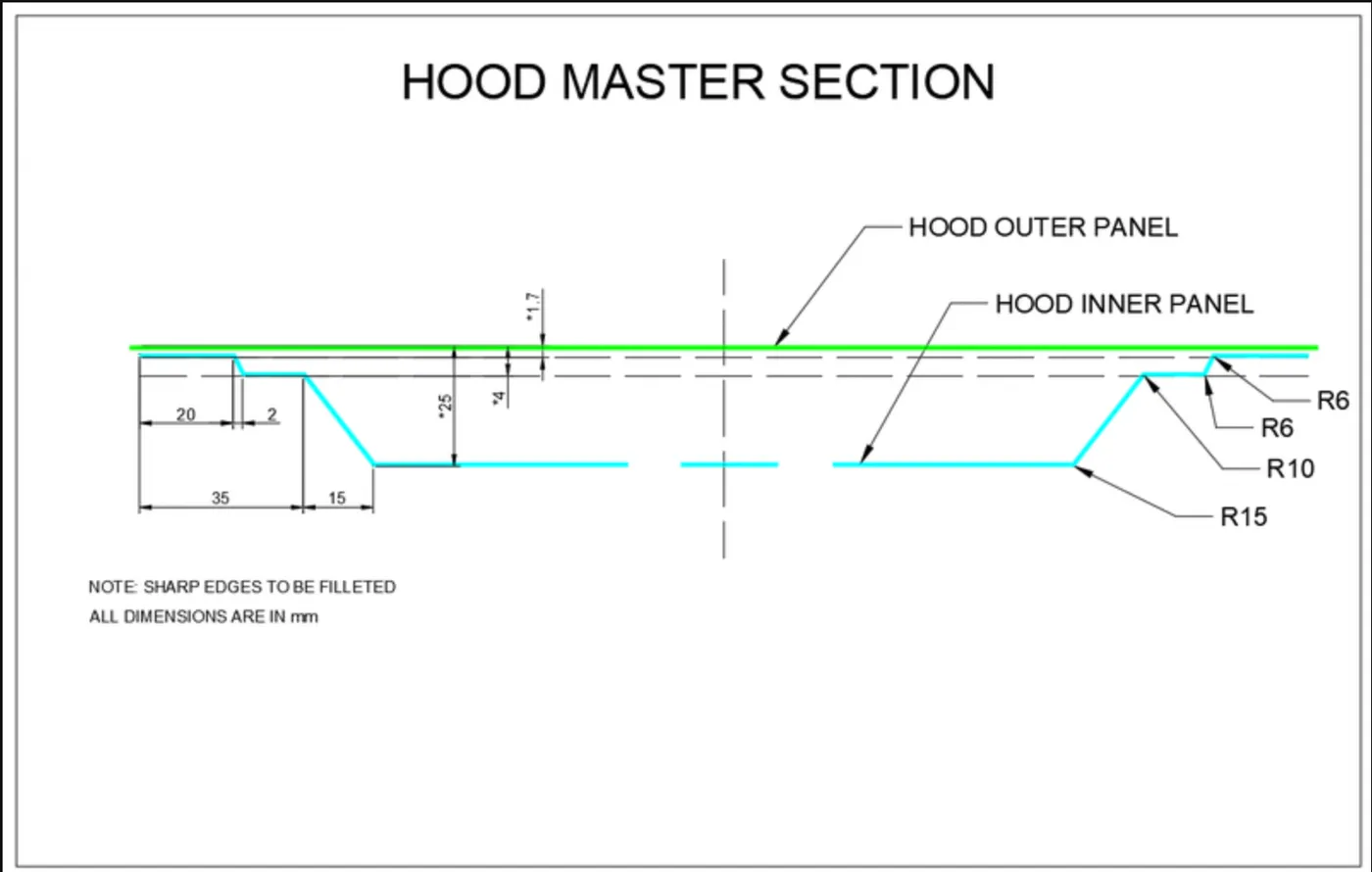
HOOD OUTER PANEL:
Outer panels are the aesthetic parts of the car. The outer panel of the hood plays a major role in giving the car a very nice aesthetic proportion. in order to fulfill the aesthetic demand and ensure that the outer panel is flawlessly produced. Therefore, those procedures must strictly not be followed in order to build the outer panel if the outcome of the sheet metal operation is visible on the outer panel or if it lowers the aesthetic value. For this reason, rather than joining the outer and inner panels together with welding, the hemming procedure is utilized.
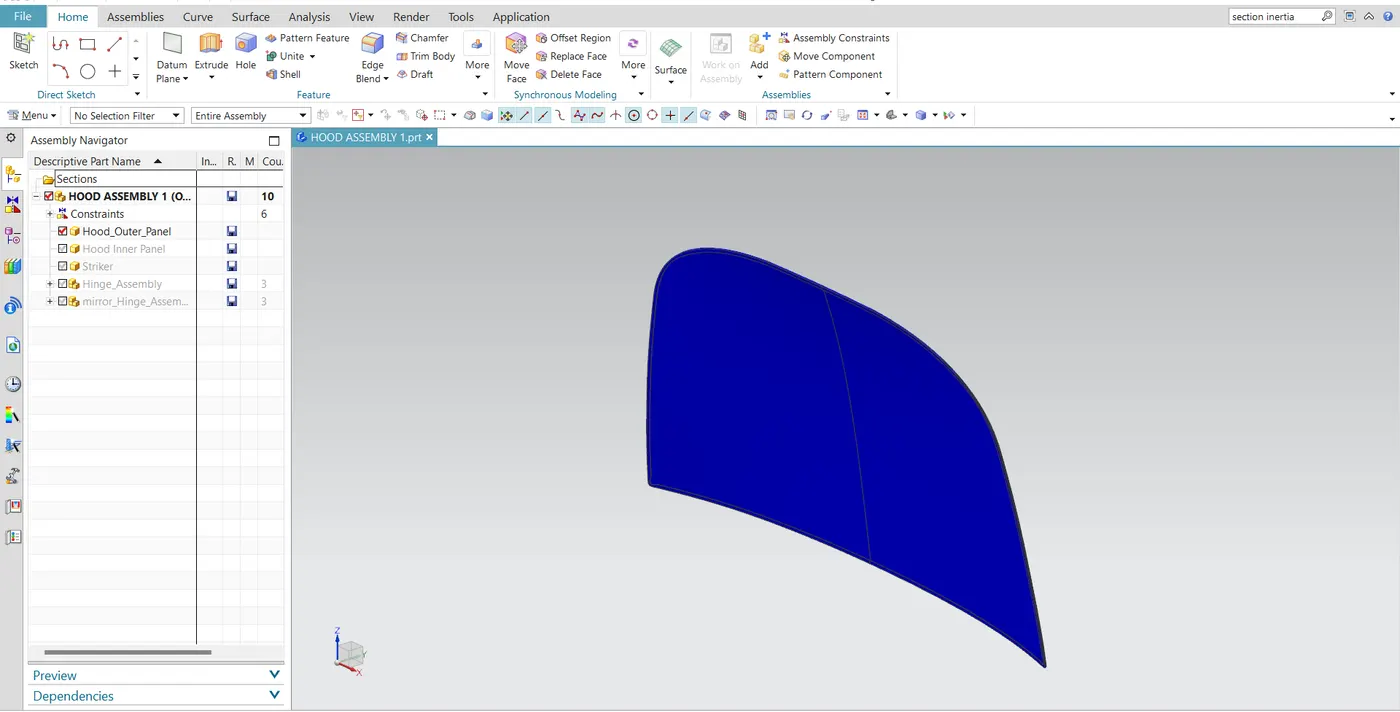
Figure.1 Outer Panel
HOOD INNER PANEL:
The inner panel is the main component that maintains the hood's rigidity and is used to direct impact as far out of the hood as feasible in the event of a collision. It is possible to do so because of the inner panel's excellent design and embossment direction.
In order to meet criteria for pedestrian and passenger safety, numerous design modifications and studies have been made to the inner panel.The necessary holes are drilled in this inner panel so that the hood can be moved from one station to another and fixed in place by using the holes as budding holes. The mastic points and embosses are also present on the interior panel.
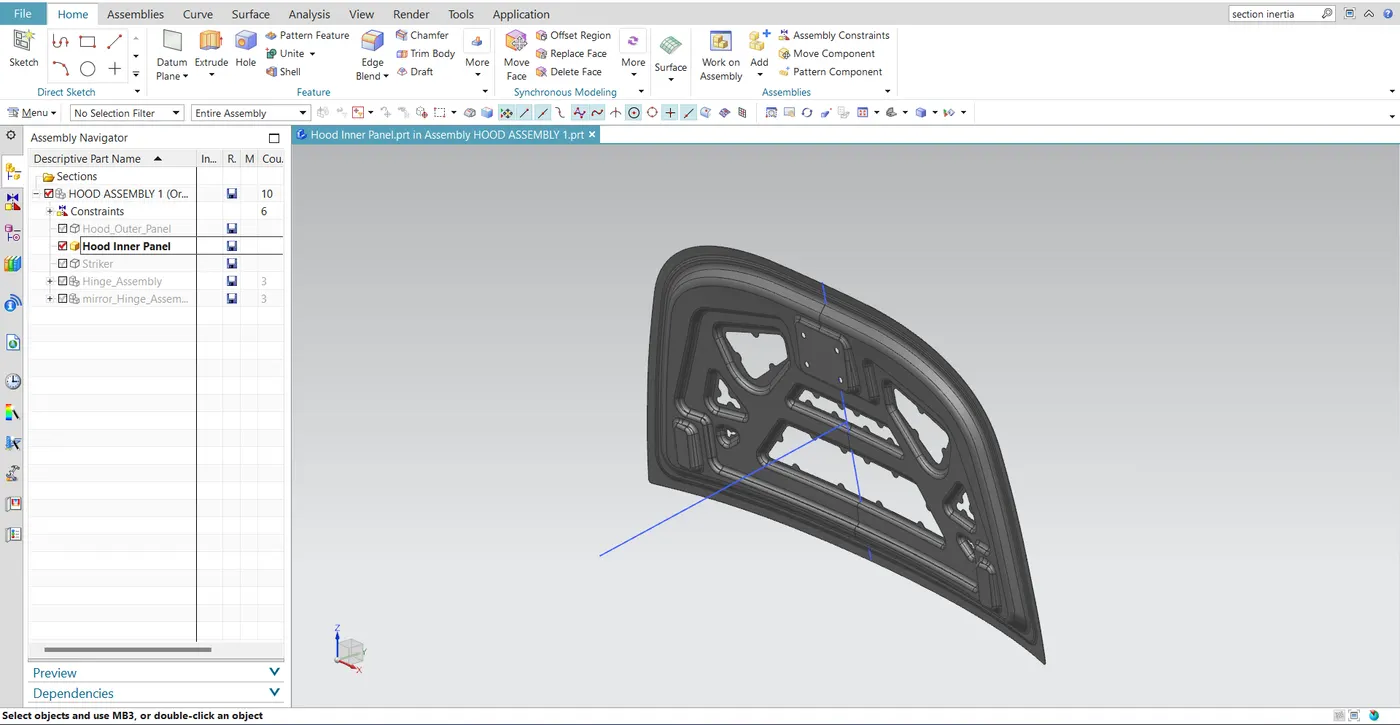
Figure. 2 Inner panel
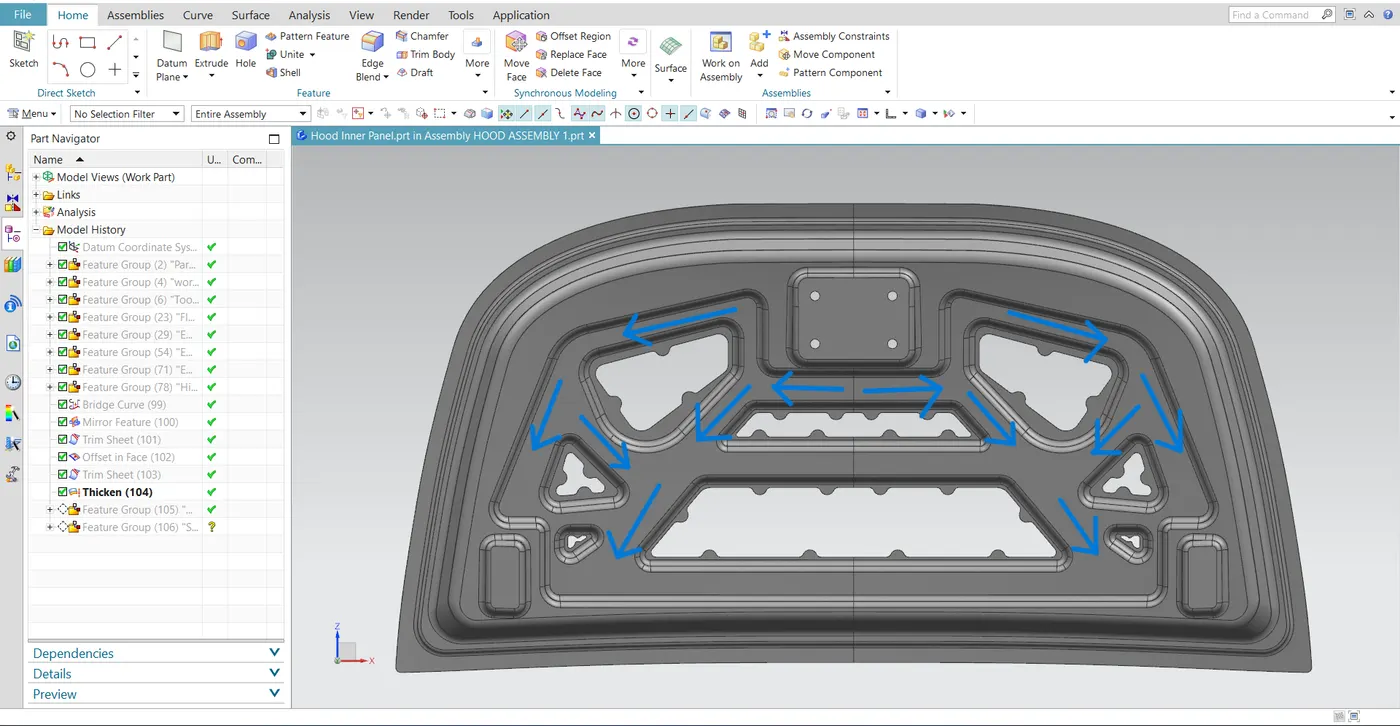
Figure. 3 Emboss definition
REINFORCEMENT:
Attached to the inner panel's lower side are the Striker and Hinges. If it is done directly, increased stress may be applied to that specific location of the inner panel, which could lead to deformation of that area. in order for the reinforcement to enter and be positioned between the hinge and the hood and the striker. It has the ability to strengthen the inner panel there and lessen deformation.
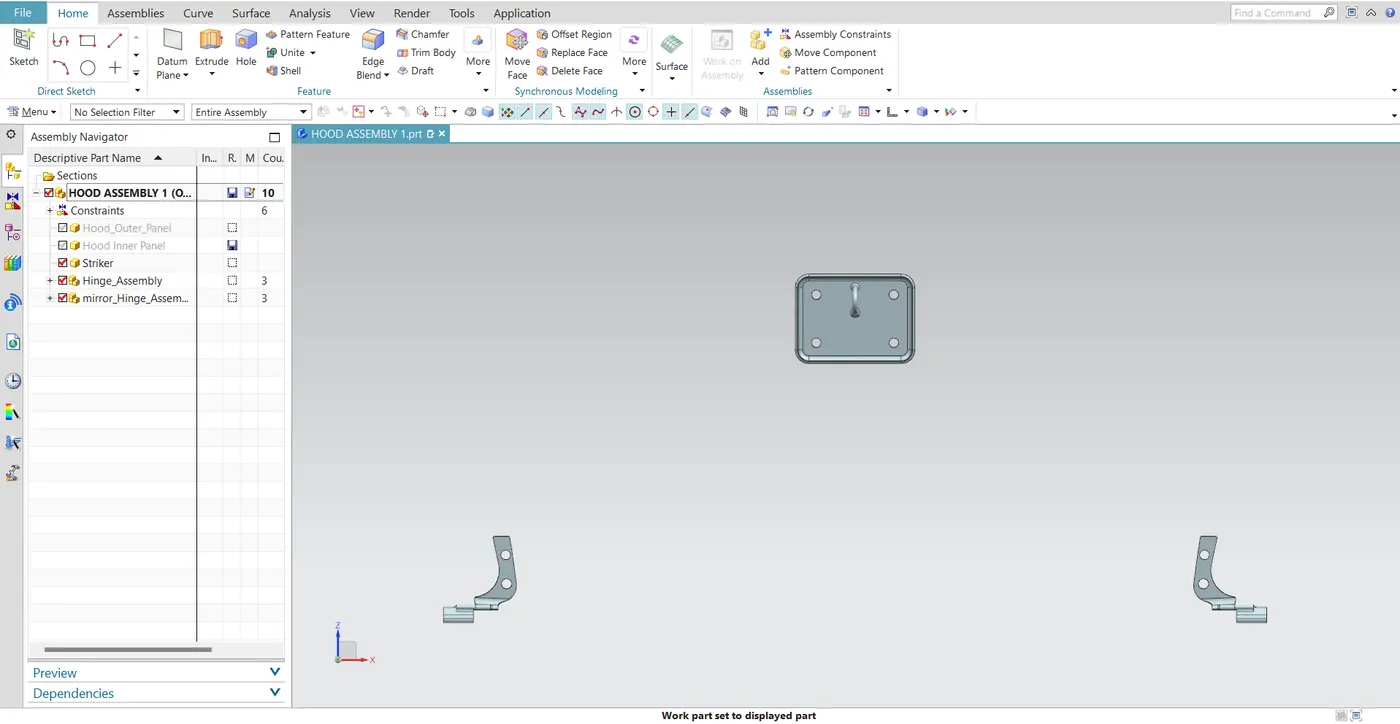
Figure. 4 Hinges and striker
LATCH TRAJECTORY:
The circle that is drawn from the hinge axis point indicates the latch trajectory. The hinge axis point is located at its center. We can first repair the hinge or the lock. We should plot the latch's trajectory circle if the hinge location has been fixed. The striker axis via the striker tip should be tangential to the latch trajectory in order for the mating condition to be correct.
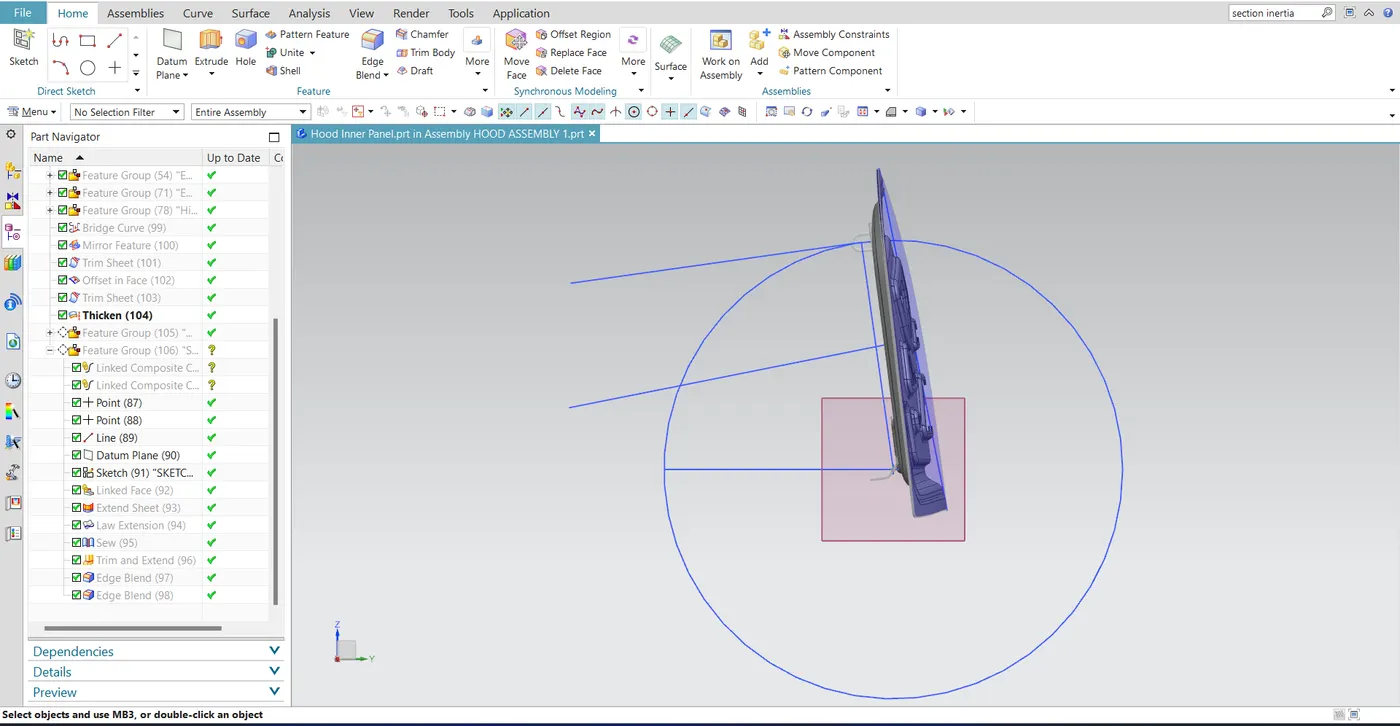
Figure. 5 Latch Trajectory
HEMMING:
Hemming is a shaping process where a tight fit is achieved by folding the sheet's edges over one another or under one another. Hemming procedures are typically used to reinforce component edges, join parts together, and enhance part appearance.
Hemming is a secondary assembly step used in automotive component production, following deep drawing, trimming, and flanging procedures, to attach two sheet metal sections (inner and outer) together. This kind of assembly often consists of fenders, doors, trunk lids, and hoods.
Since the hemming process has an impact on the surface's quality and look, precision is crucial. Dimensional deviations and other faults in parts might result from material deformations that take place during the hemming process. Hemming faults commonly occur as splits or wrinkles in the flange, material roll-in, or overlaps in the corner sections. For this reason, it's critical to include the necessary reliefs at the corners.
Conventional die Hemming:
- Using a hemming tool, the flange is folded over the whole length in traditional die hemming.
Roll Hemming:
- The method used for automotive sheet metal is called roll hemming. Using a hemming roller, roll hemming is done piece by piece. The hemming roller is guided by an industrial robot, which also produces the flange. There are various pre- and final hemming process phases that make up a roll hemming operation. Compared to conventional die hemming, roll hemming offers far reduced tool costs and greater tool flexibility. But because the hemming is done with a hemming roller that travels along a predetermined path, the cycle times are substantially longer.
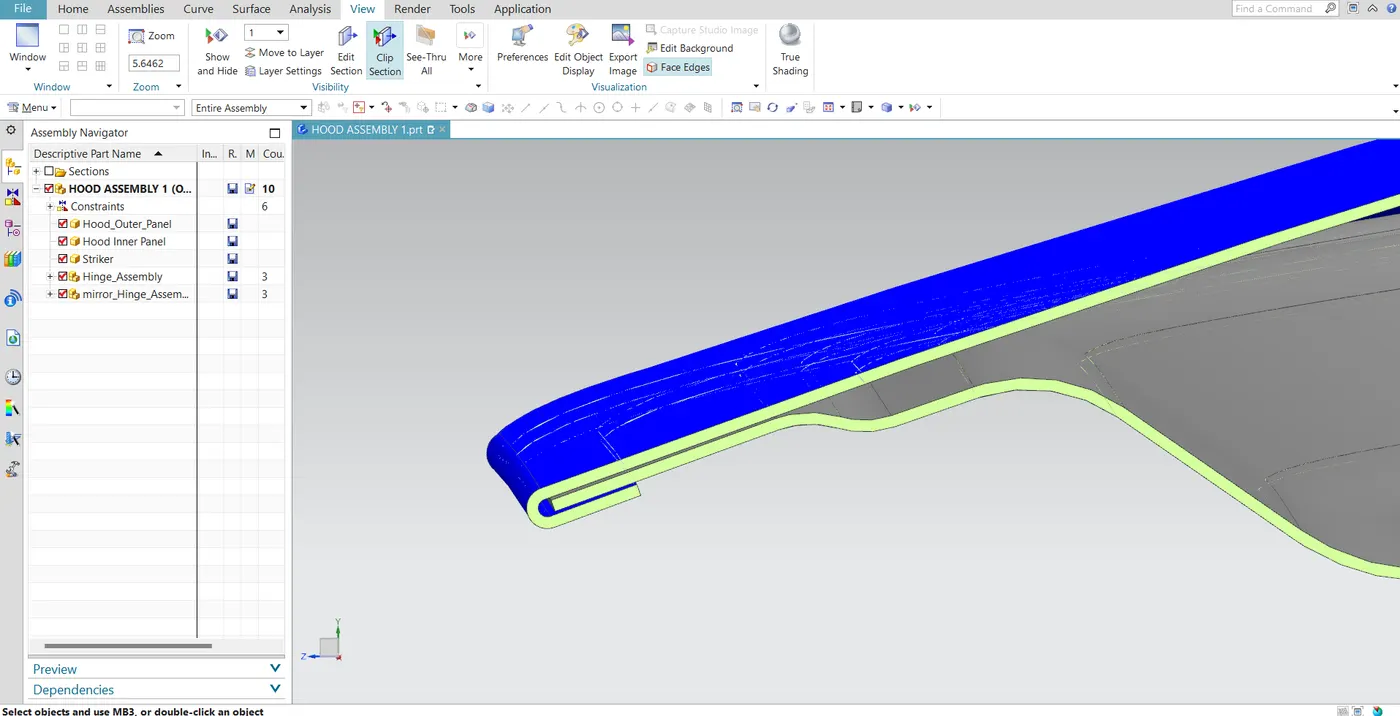
Figure. 6 Hemming
DEEP DRAWING:
One of the most used methods in sheet metal forming is deep drawing. In addition to being used in numerous other industries, it is used in the automotive sector to make automobile body pieces. Combining compressive and tensile forces results in the shaping process known as deep drawing.
Punch force mechanically draws a sheet metal blank radially into a forming die. So, it is a material-retention process involving shape alteration. When the sketched part is deeper than it is diameter, the drawing technique is referred to as "deep" drawing. To do this, the part is redrew using a number of dies. The material retention property causes a tangential compressive stress and a radial drawing stress to be experienced by the flange region, which is the sheet metal in the die shoulder area. Flange wrinkles are caused by these compressive forces, also known as hoop stresses. Using a blank holder, whose purpose is to permit controlled material flow into the die radius, can help prevent wrinkles.
RELIEF SECTIONS:
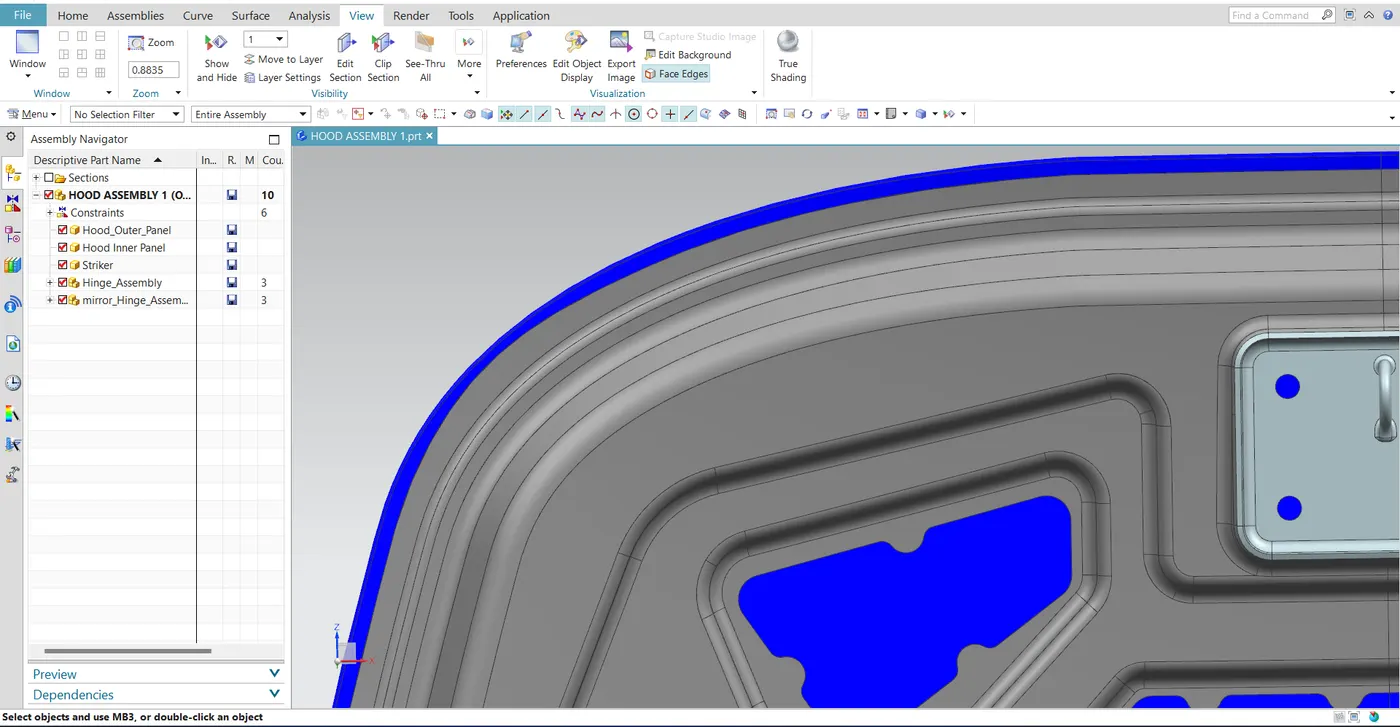
Figure. 7 Front relief section
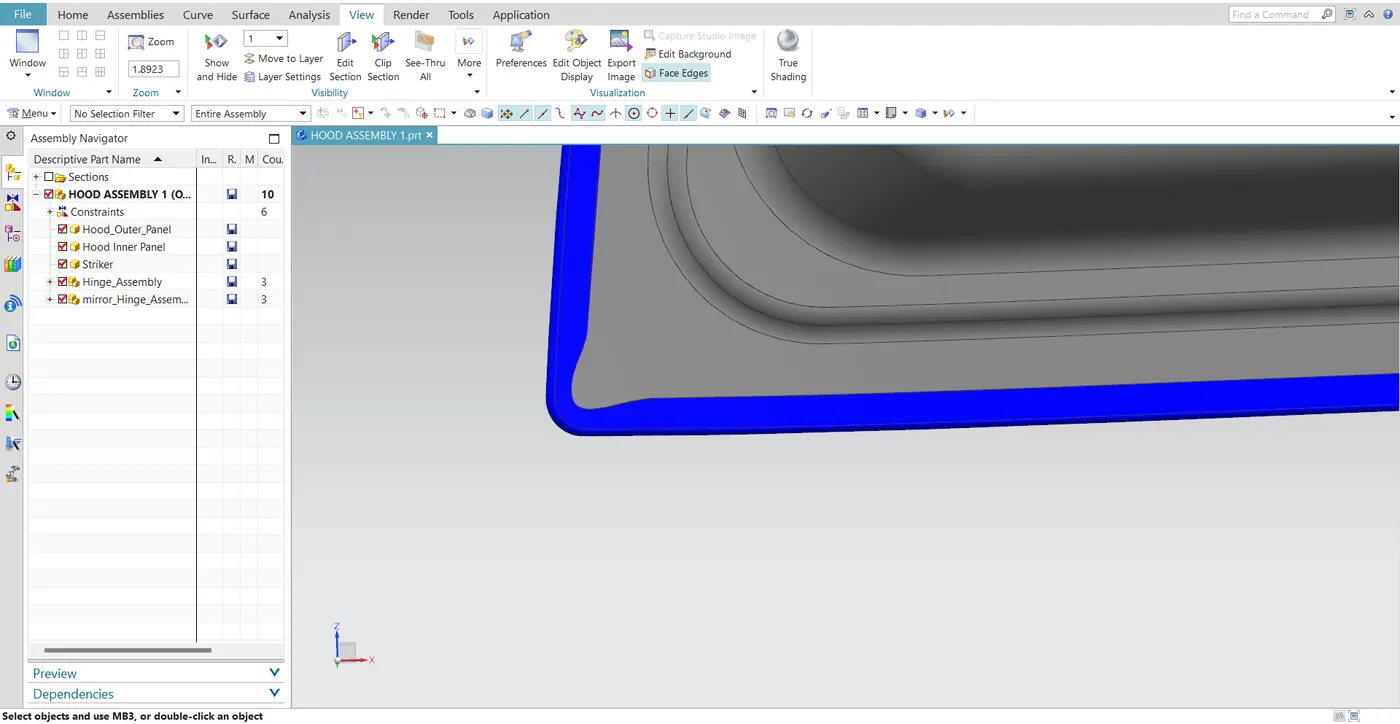
Figure. 8 Rear relief section
MASTIC DATA:
Hoods often have a lot of surface area, and the only way to give hemming is through the boundary. Other joining methods, including as welding and riveting, are not an option since they create markings on the outer panel that detract from the visual appeal of the piece. Thus, the inner and outer panels' inner surfaces are adhered to using mastic sealants. Mastic sealants are rubber-like, elastic compounds. It is applied at certain locations between the inner and outer panels. Every mastic sealant patch has an impact on an 80 mm-diameter circular area. As a result, the mastic points are positioned to cover the more vibration-prone sections that are farther away from the hemming.
DRAFT ANALYSIS:
The process of verifying the draft angle on different part faces with a certain orientation is called draft analysis. It need to be higher than 7 degrees.
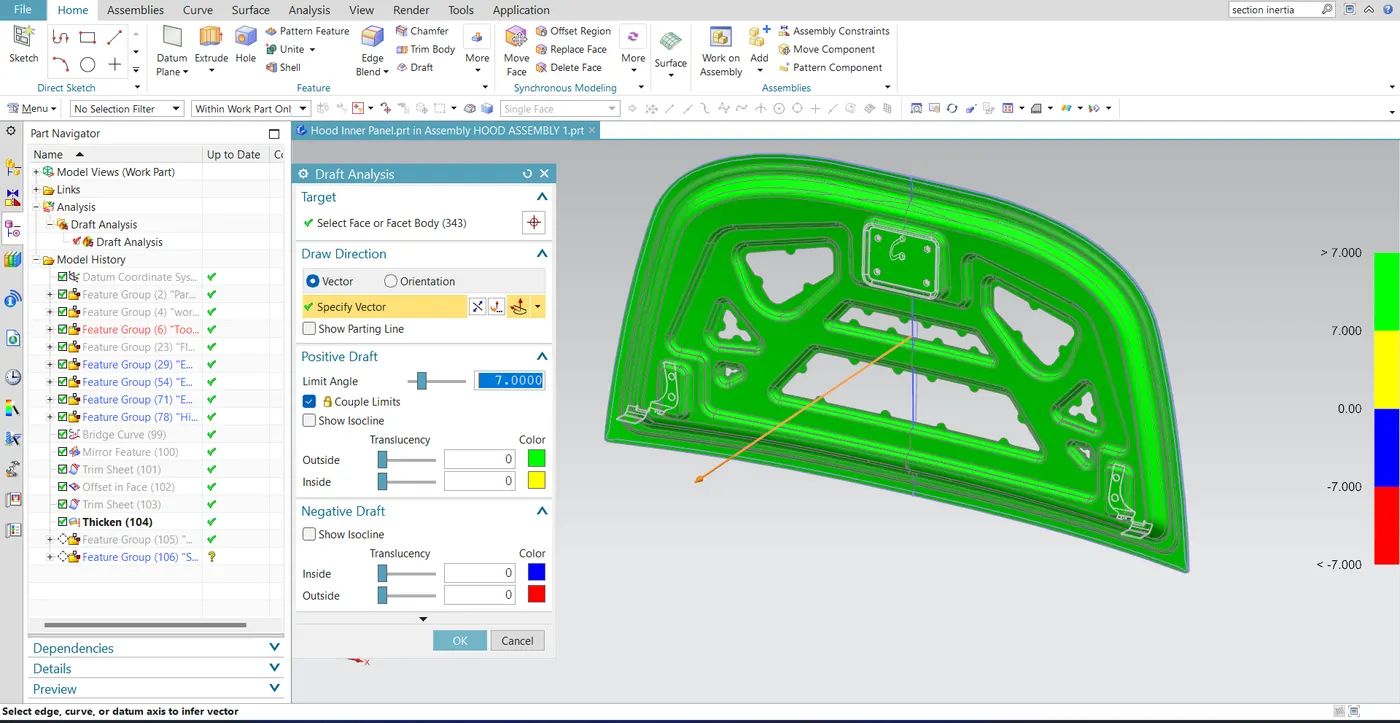
Figure. 9 Draft analysis
ASSEMBLED HOOD:
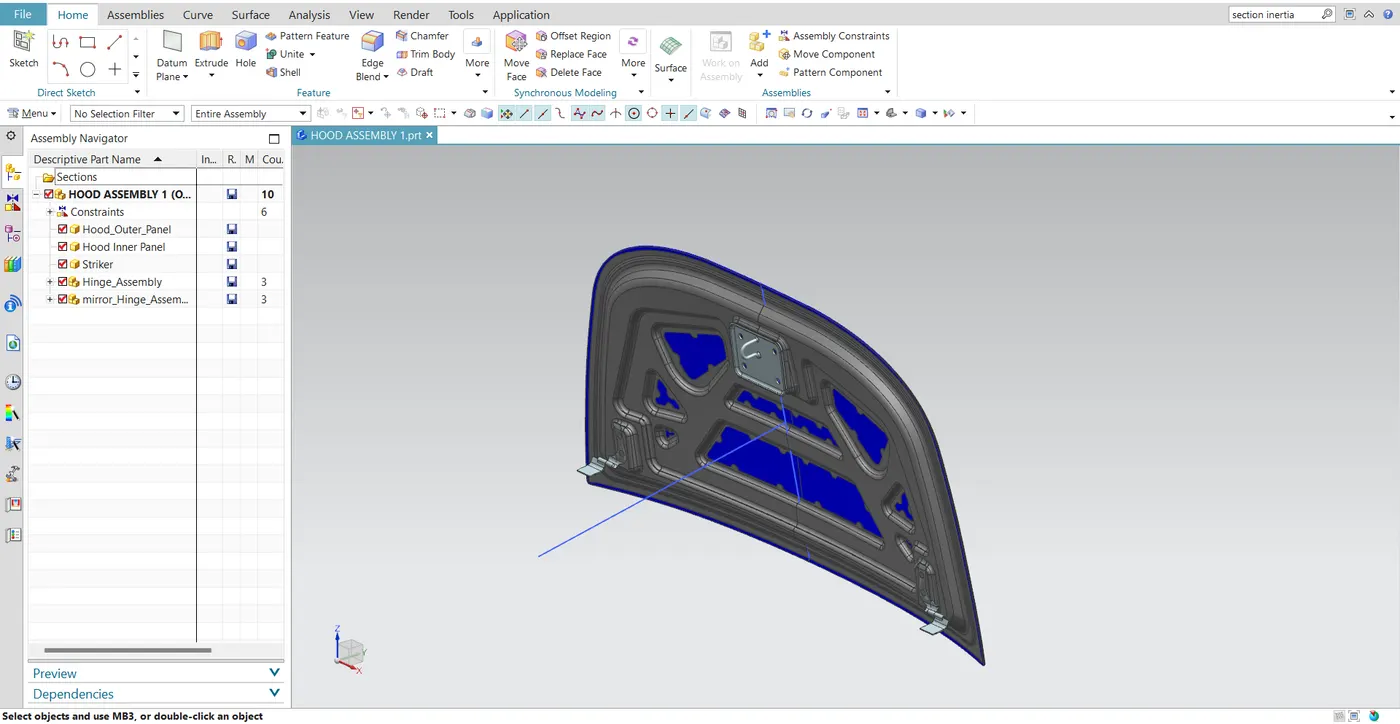
Figure. 10
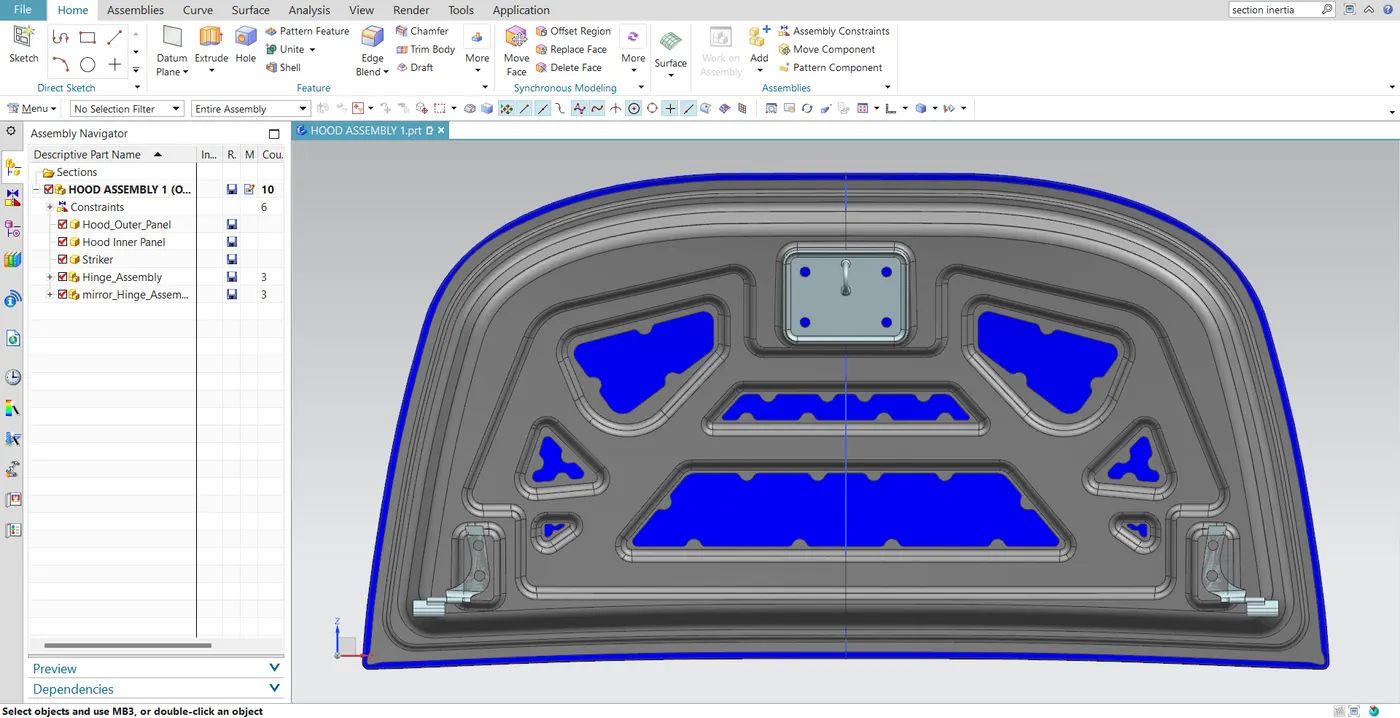
Figure. 11
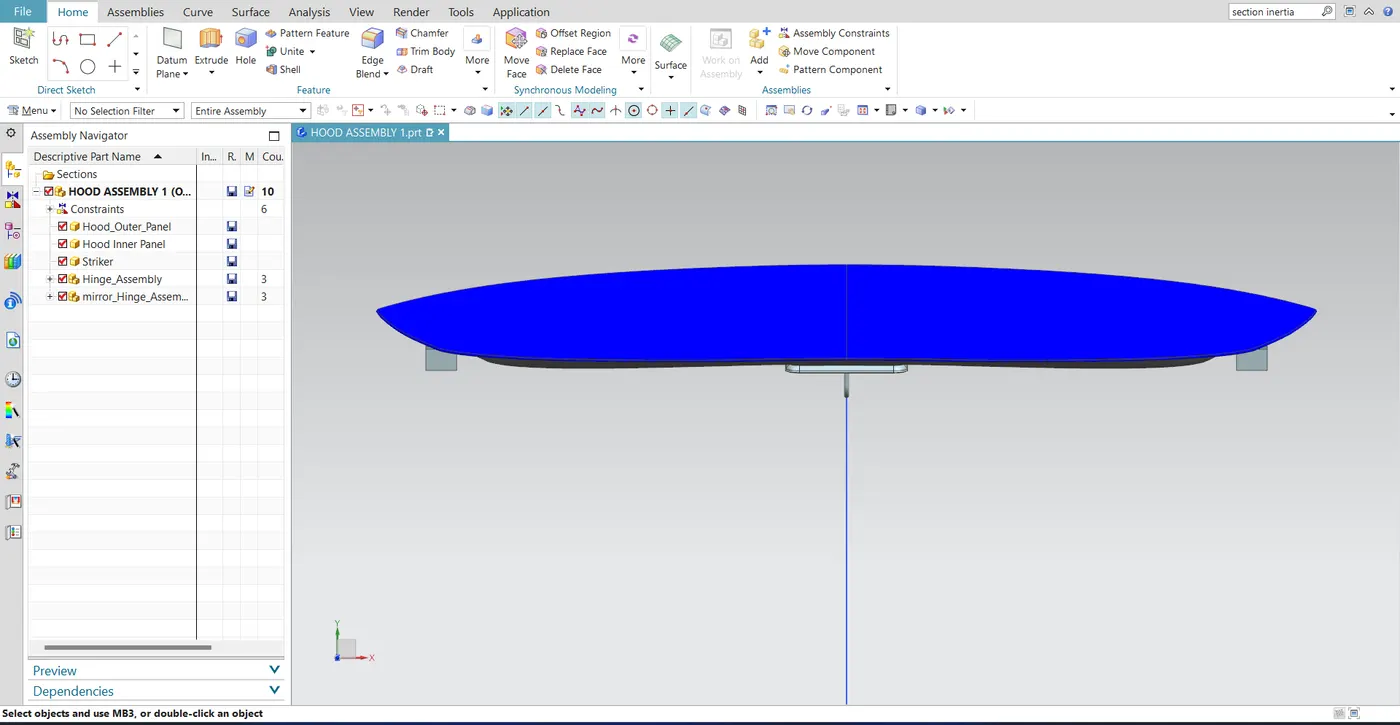
Figure. 12