Hood design-Week 2
HOOD DESIGN:
AIM:
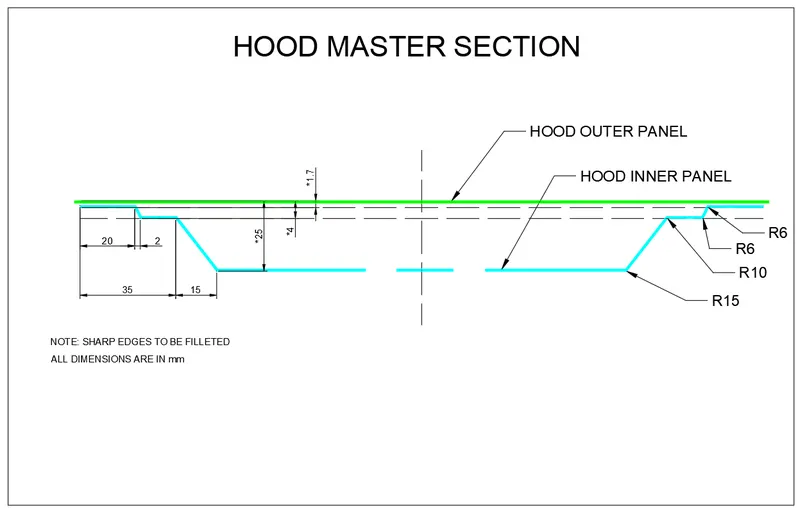
Design the hood inner panel, hood outer panel and necessary reinforcements by following given master section with design parameter. And Assemble the hood inner panel, outer panel, hinge assembly and striker.
OBJECTIVE:
The main objective of this project is understand the importance of car hood design development and its safety features as per the design consideration.
The following tasks are performed:
- Develop the inner panel with help of given Hood outer panel.
- Develop all necessary reinforments and provide the required emboss definition.
- provide Mastic data on the inner panel.
- Well placed to the hinge and striker on the inner panel.
- Design outer panel with the Hemming.
DATA TO BE USED:
Hood Thickness information
- Outer panel thickness = 0.75mm
- Inner panel thickness = 0.75mm
- Reinforcement thickness = 1.5mm
MASTER SECTION:
INTRODUCTION OF HOOD:
The hood (North American English) or bonnet (Commonwealth English excluding Canada) is the hinged cover over the engine of motor vehicles that allows access to the engine compartment, or trunk on rear engine and for maintenance and repair.
The car hood structure is the part made up of sheetmetal as a material with thickness of 0.75mm. It is used t cover the engine compartment with some locking mechanism inside like hinge assembly, latch striker reinforcement and a gas stay or stay rod.
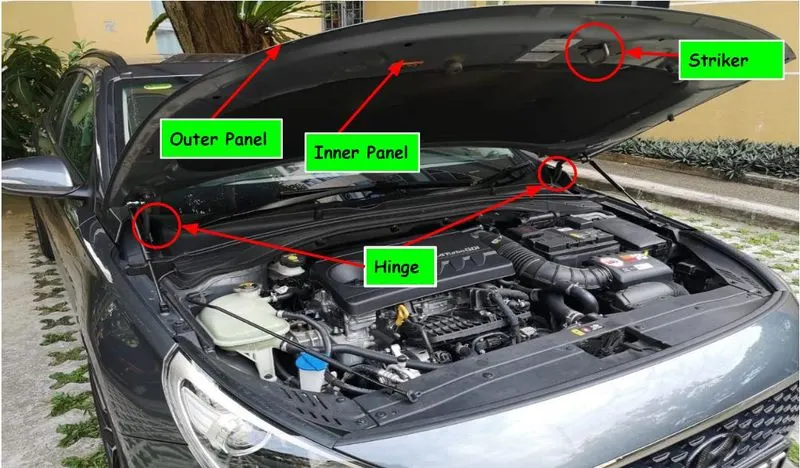
Basically the hood has outer panel, inner panel, reinforcement and Embosses (used to reduce the impact force and as well as it reduce the weight of the hood). Hinge and striker mechanism is used to open and close the hood whenever needed. These two have extra reinforcement for the strength.
TYPES OF HOOD:
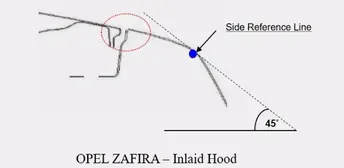
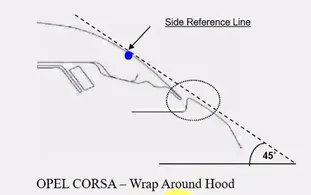
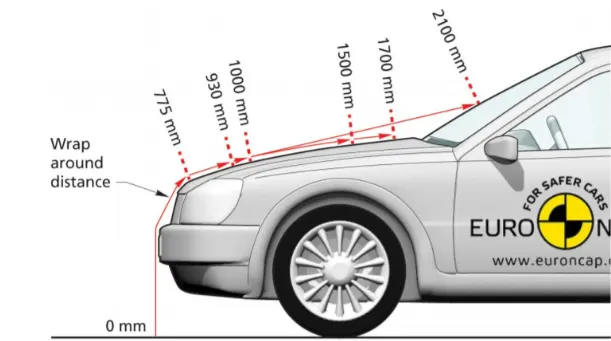
The hood is classified into two types by the side reference line. The line from the ground at 45 degree whish is taken till the end point of the car. This is necessary to follow pedestrain Euro N-Cap assessment.
- Inlaid hood or bulit in type,
- Wrap around hood.
1) Inlaid hood:
There is a gap between the hood and the car body. The end point or the side reference line of the car lies ont he fender which uses more damage to the pedestrains and hence affecting their EURO-NCap ratings.
2) Wrap around hood:
The end point or the side reference line of the car lies on the hood itself. This will reduce the head impact zone and hence can be able to achieve higher EURO NCap ratings. Thisis the most commonly used hood type these days.
The Hood can further be classified based on the hood stay types:
- Support Rod hood type,
- Gas Stay hood type.
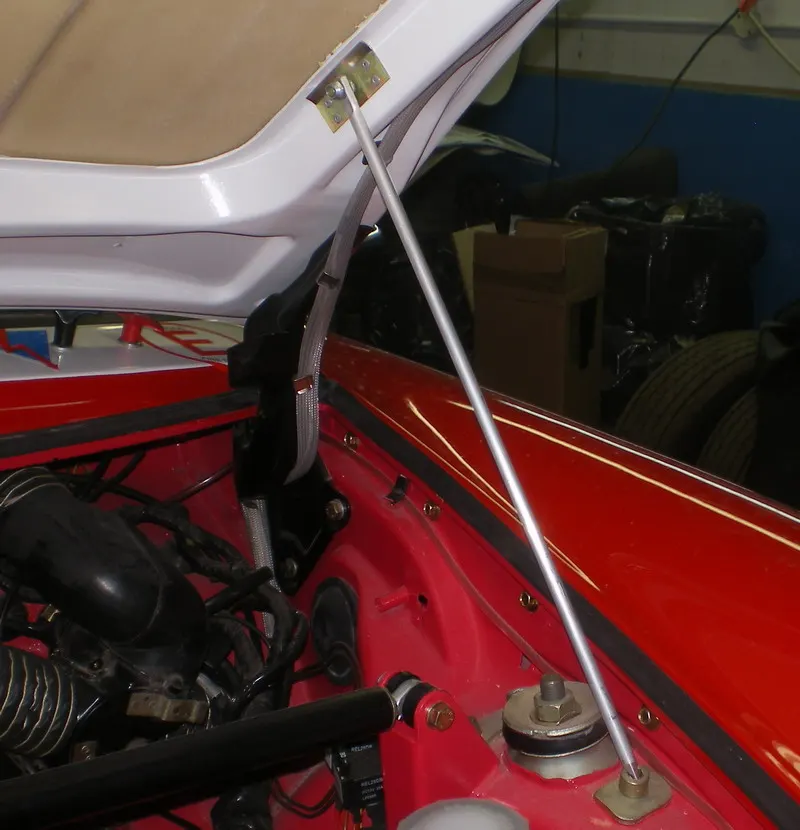
1) Support Rod hood type:
- It is the basic and most commonly used support for the hood in low cost and mid range cars, since it is cost effective.
- The support rod used is slightly bent intentionally. So that is adds strength and rigidity to the rod which can hold the hood effectively.
- Also there are restrictions to the design of the hood stay. The maximum distance a rod can be bent is less than 35mm and also the hood support rod should be fixed at the opposite end of the battery compartment enabling the ease of operation near the battery area.
- Gromets are used to fix the support rod.
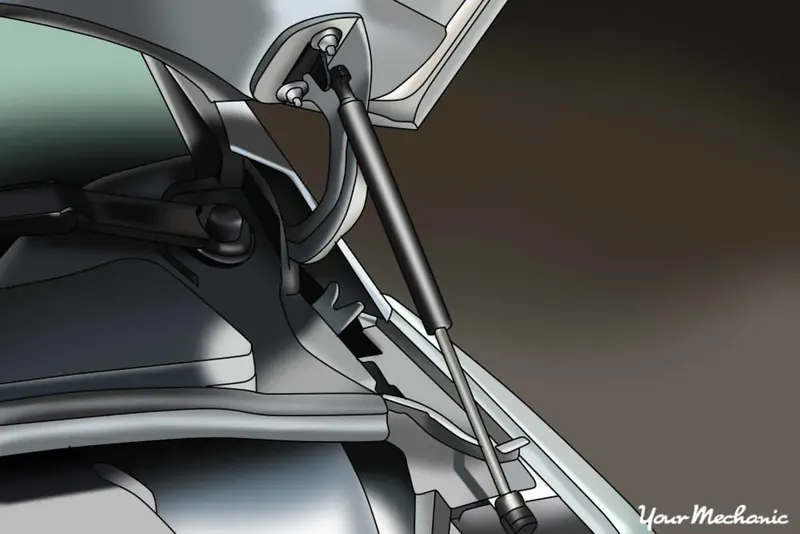
2) Gas Stay hood type:
- These types of hood support does not require much of man power and is very useful when the weight of the hood is more and difficult to lift. This is usually seen in bigger cars and also it is expensive. These gas stays are provided in the back door to all car segments these days.
- It has two ends where one end is fixed to engine compartment and the other to the hood itself. The length C & D is kept constant and only the (B-A) length is varies. We could say that if the length of the hood increases, (B-A) length also increases.
- Stud ball is used to fix the gas stay support.
HOOD ASSEMBLY COMPONENTS:
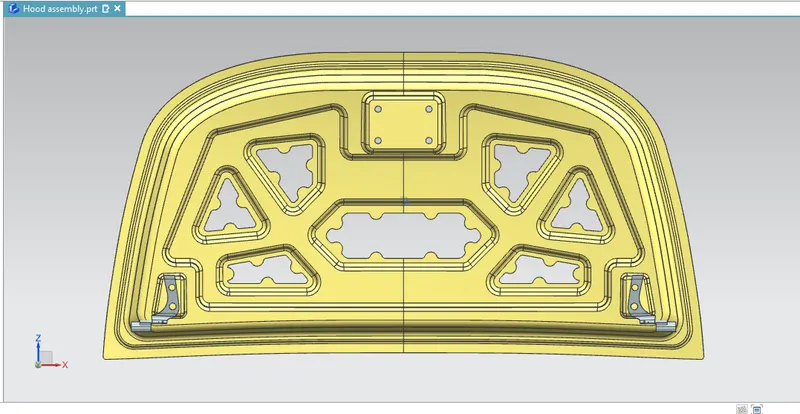
Let's have a brief discussion about how a hood assembly is done what are the main components involved in it. Also the hood have several parts. They are as follow below:
- Hood outer panel
- Hood inner panel
- Hinge assembly
- striker
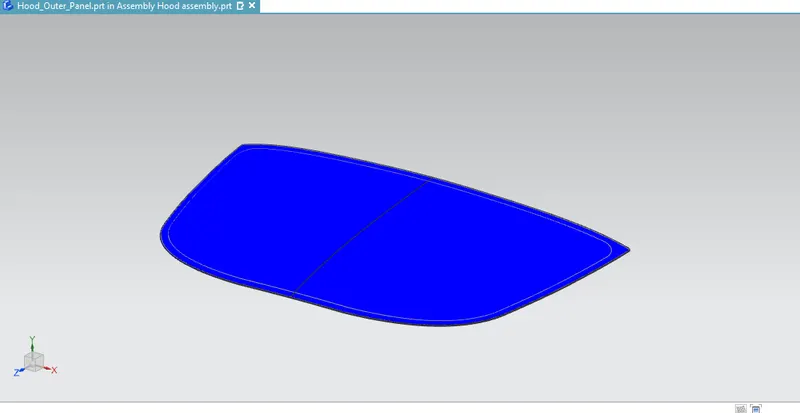
1) Hood outer panel:
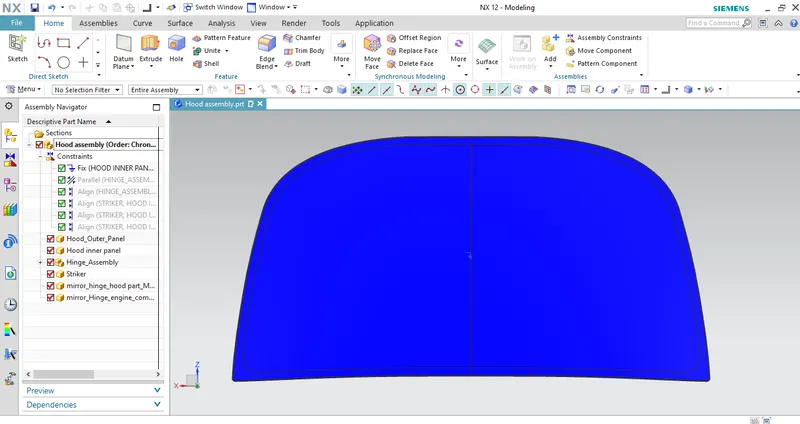
This is the part of the hood acts as a covering all the other parts of hood which are enclosed inside this part. The outer surface of this part is provided with a good surface finish, painted with corrosion resistant paint to prevent the inner parts from corrosion and also to give an aesthetic look to the car from the outside. This part forms the shape of our hood and it is given different styling and shapes to enhance the look and performance of the vehicle to reducce the forces exerted by air when the vehicle is in motion.
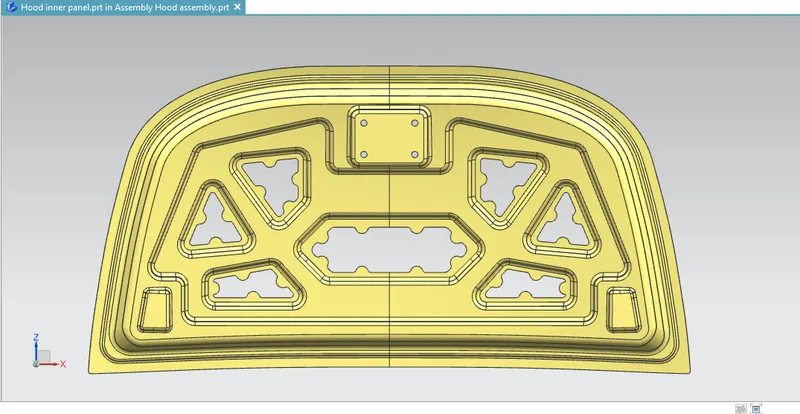
2) Inner panel:
This part is enclosed in the outer paenl. It forms on integral part of the hood and provides rigidity to the hood, it is the part on which hinges, striker are to be fixed to make our hood fully functional it also consists of embossed sections for proper force distribution and mastic sealant points are also located on this part with reinforcement for hinge and striker. To reduce the weight of our hood with help of some material is removed from the hood inner panel to the help of pedestrain safety consideration.
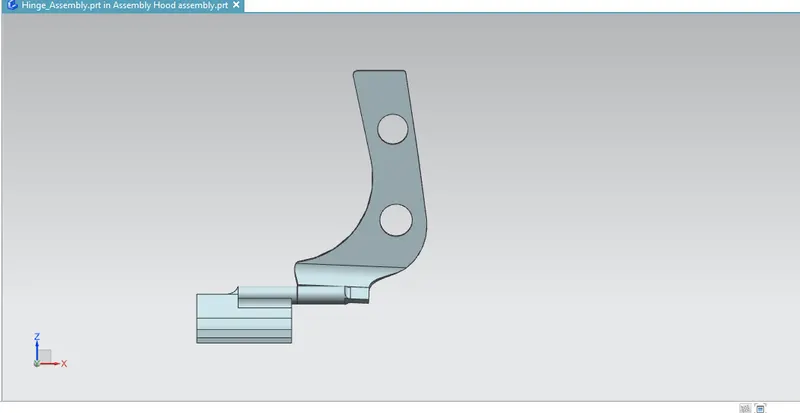
3) Hinge assembly:
It is an important part of our hood because the hood is able to open and close with help of this hinge assembly. This part should be strong enough to take the load of the hood and also the forces which acts upon the hood in case of crash. So, this part should be designed with utmost care that it should not fail during iits operation.
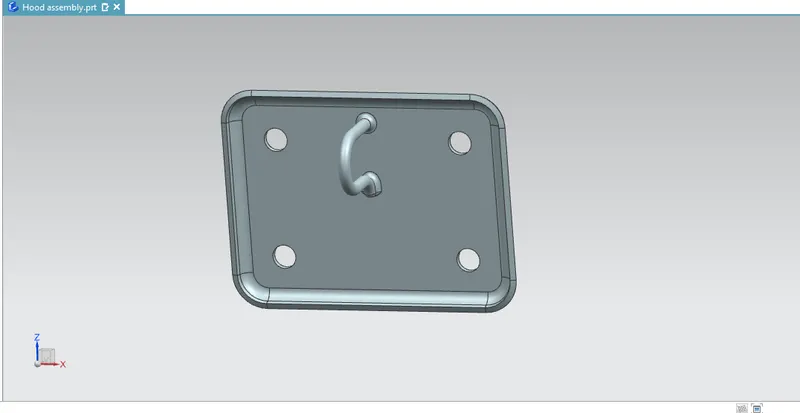
4) Striker:
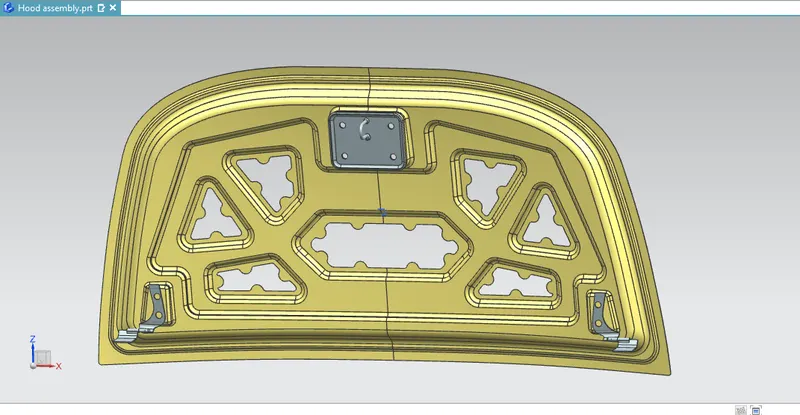
This part is used to provide locking to the hood. It consists of latch type mechanism and it is located on the inner panel of the hood to decide the position of our striker, the trajectory method is used to help of this method. So we can easily locate our striker. This part holds our hood in closed condition unless it is being open by pulling the latch lever to open our hood.
LATCH TRAJECTORY:
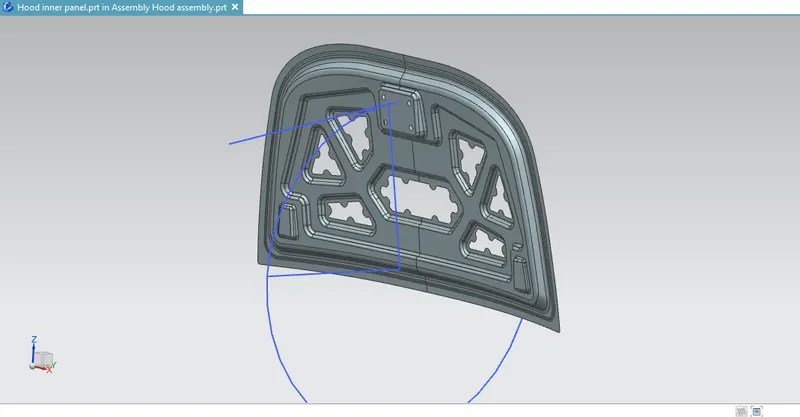
Latch trajectory is helped with the proper opening and closing of the hood. In hood open and closing function the hood and the striker should be perpendicular to the trajectory of the hood. Firstly the hinge is positioned and an axis is drawn. The trajectory is derived from the hinge axis and the centre distance from the striker. The trajectory path is denoted as a circle.
MASTIC DATA:
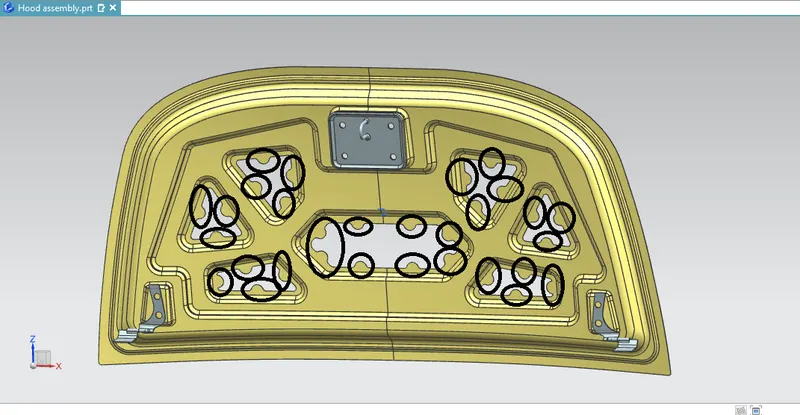
The hood inner panel is enclosed below the outer panel and thereby provides rigidity to the hood. When these parts are assembled to form a hood a small gap remains between these two parts as they are both metal parts this way lead to noise and vibrations when the vehicle is in running condition which is undesirable to avoid this mastic sealant is fillet between this small gap.
EMBOSS DEFINITION:
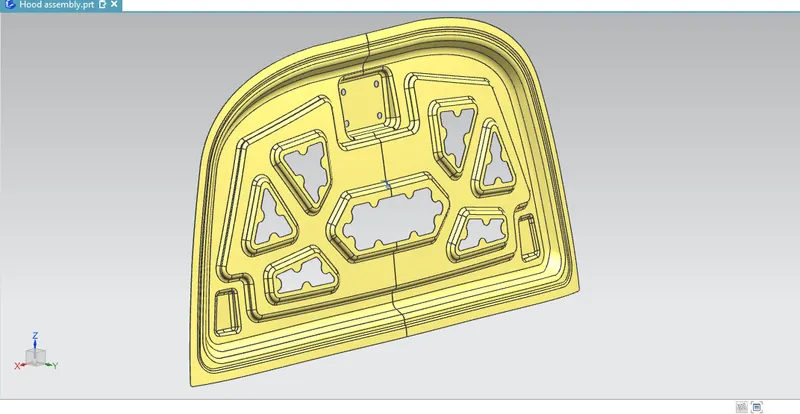
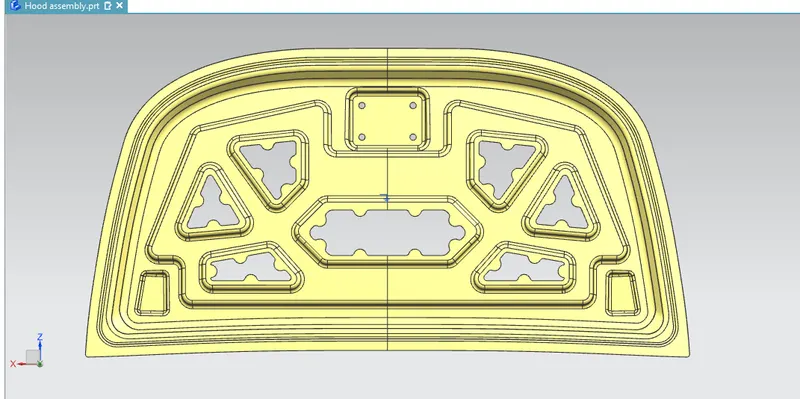
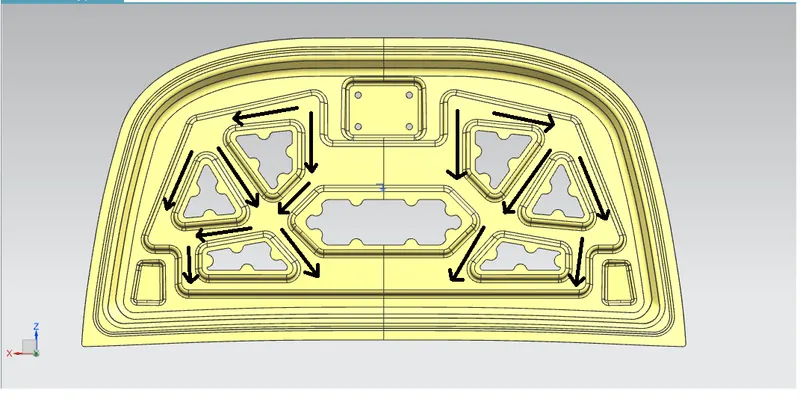
The implement of embosses are very important on the inner hood since it plays a important role in saving human life during a crash from the front side. The embosses are designed in Y direction so that during the crash the forces dissipates outwards or towards the hinge. This will reduce the impact on the passengers in the front.
MANUFACTURING PROCESS:
1) DEEP DRAWING:
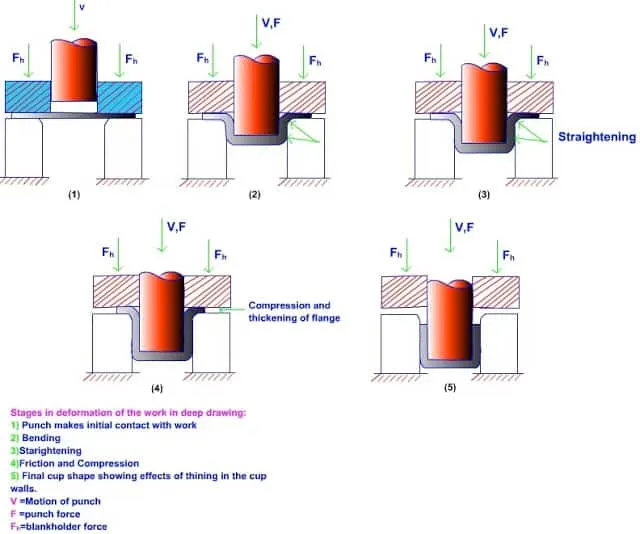
Deep drawing is a sheet forming process in which a sheet metal blank is radially drawn into a forming die by the mechanical action of a punch. It is thus a shape transformation process with material retention. The process is considered "deep" drawing when the depth of the drawn part exceeds its diameter. This is achieved by redrawing the part through a seies of dies. Flange region (sheet metal in the die shoulder area) experiences radial drawing stress and tangential compressive stress due to the material retention property. These compressive stresses result in flange wrinkles. Wrinkles can be prevented by using a blank holder, the function of which is to facilitate controlled material flow into the die radius.
Deep drawing processes are divided into three types:
- Deep drawing with tools
- Deep drawing with active means
- Deep drawing with active energy
In the automotive industry, deep drawing is usually carried out using rigid tools. The rigid tools consist of a punch, die and binder. In deep drawing, the plate holder closes after the metal sheet blank has been inserted.
Next, the sheet is clapmed between the die and the binder. This process slows down the flow of the sheet while it is being drawn and thereby prevents wrinkles fron forming under the binder. The punch stretches the sheet over the die radius nd forms it in the die. The amount of punch force necessary for forming is thereby continually increased un to the lower dear centre of the punch.
Whereas in pure deep drawing there is no reduction of sheet metal thickness, forming is achieved in stretch forming purely as a result of a decrease in sheet metal thickness. Stretch forming is extensively used for the forming of only slightly curved parts with low depth of draw(e.g. roofs, doors)
When drawing complex car body parts in practice, there is usually a coombination of stretch and deep drawing involved. It is necessary that the sheet metal is stretched as well as possible without reaching the material's limits (e.g. splits, wrinkles).There are approximately 300 to 400 sheet metal parts that fit together to form the body of a car. In order to manufacture high quality sheet metal parts optimally for their particular use, specialized software simulates the complete deep drawing process.
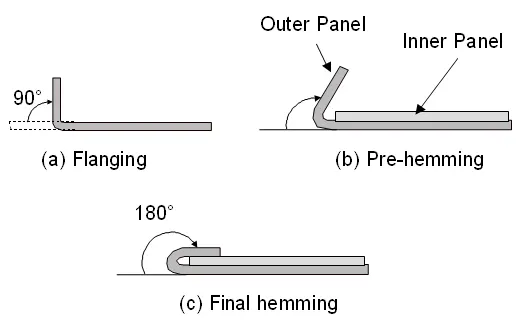
2) HEMMING:
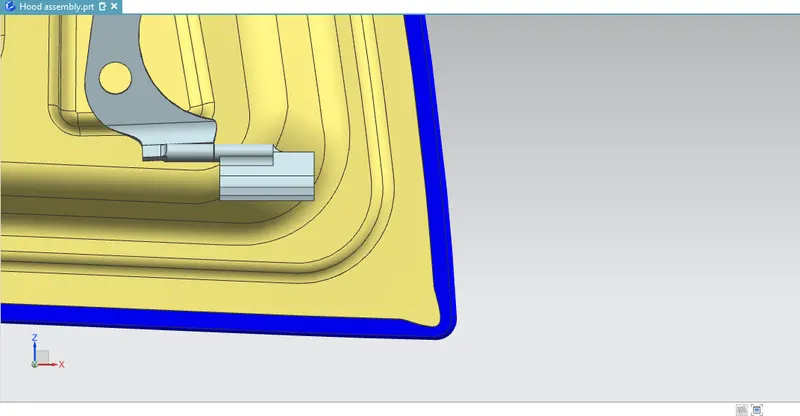
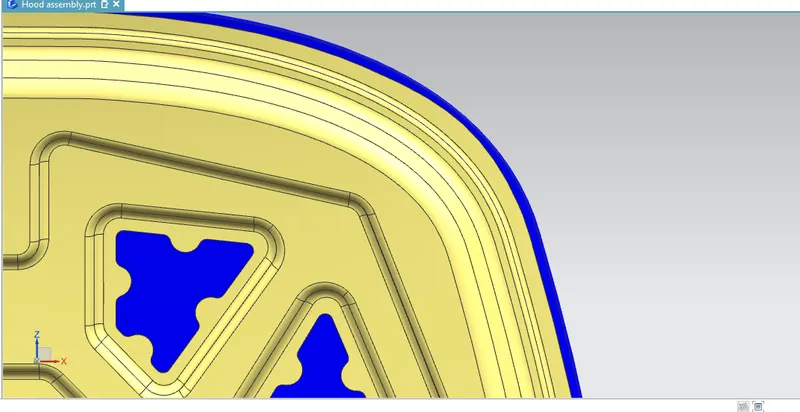
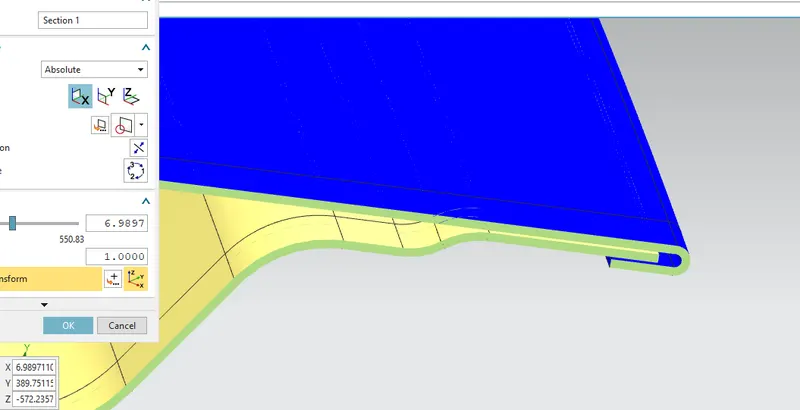
Hemming is a forming operarion in which the edges of the sheet are folded or folded over another part in order to achieve a tight fit. Normally hemming operations are used to connect parts together, to improve the appearance of a part and to reinforce part edges. In car part production, hemming is used in assembly as a secondary operation after deep drawing, trimming and flanging operations to join two sheet metal parts together. Typical parts for this type of assembly are hoods, doors, trunk lids and fenders.
The accuracy of the hemming operation is very important since it affects the appearance of the surface and surface quality. Material deformations, which occur during the hemming process, can lead to dimensional variations and other defects in parts. Typical hemming defects are splits or wrinkles in the flamge, material overlaps in the cornor areas or material roll in. This is why it is important to use simulation tools in order to, on the onehand, better understand the hemming process and , on the other hand, significantly reduce the number of "trial and error" lpps during tryout and production.
DESIGN CONSIDERATIONS:
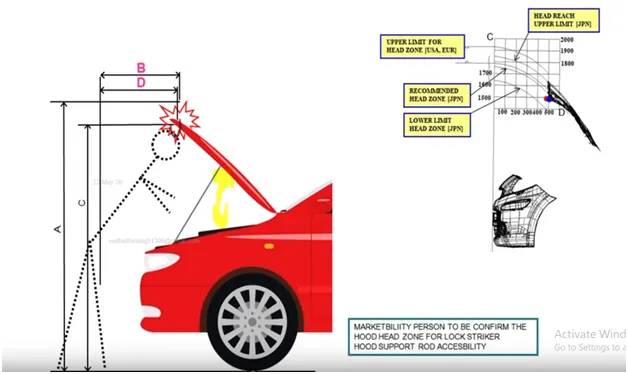
HOOD HEAD ZONE FOR STRIKER LOCKING:
While designing the hood this parameter should be taken into consideration because when we open the hood to get access to the engine compartment to perform any operation while the hood is in open condition the minimum height of the hood should be such that it does not collide or hit to heaf of the person who is operating. So, the height of the hood in open conditions should be more than the average height of humans in that region thereby no human gets hurt.
PEDESTRAIN SAFETY:
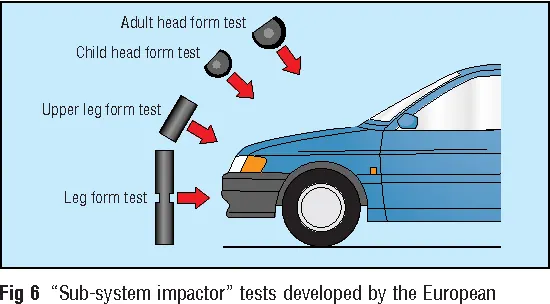
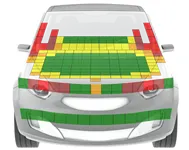
While designing the hood, it is vital to consider the safety of pedestrains as when your car hits the pedestrain during a crash, it is very important to study the areas over the hood where different body parts of pedestrains are going to hit. We should also take into account the average height of adults and children while designing our hood. So, whenever a new car is been launched, all these safety parameters are checked by taking a crash test and studying the data obtained from it to make changes accordingly to follew pedestrain safety.
EURO N-Cap:
They are the team who analyse and give ratings on how safer is our car for the pedestrains based on the crash tests performed by them. If the car gets high Euro NCap ratings then the car is very much safer for the pedestrains and also becomes a very good selling point in the market.
To improve Euro N-Cap ratings we can start removing materials inside the hood to make it more softer so that, the person when collides with the car will hit the empty area which will have less impact on him.
In some case small deformable brackets are given inside fender assembly to improve green zones and eventually to achieve better ratings.
MASTIC SEAL:
These are the hard rubber kind of materials which is placed in between the outer and inner panel which oozes out and helps in holding the outer and inner panel together. This is placed im the inner pannel in such a way that it covers the whole hood. These seals can improve strength locally of about 80mm in dia.
Mastic sealant is a paste like material that is applied on a surface and is hardened by heating.
FORCE DISTRIBUTION:
A good designer should always consider the safety parameters as a top priority, in the case of hood design, one should design the hood in such a manner that if the vehicle gets a frontal crash then all the forces must be distributed towards the hinge of the hood, as it is important to reduce the impact of the crash by diverting the force towards the hinges and thus safeguard the passengers in the vehicle.
Final compoent of Hood Panel:
CONCLUSION:
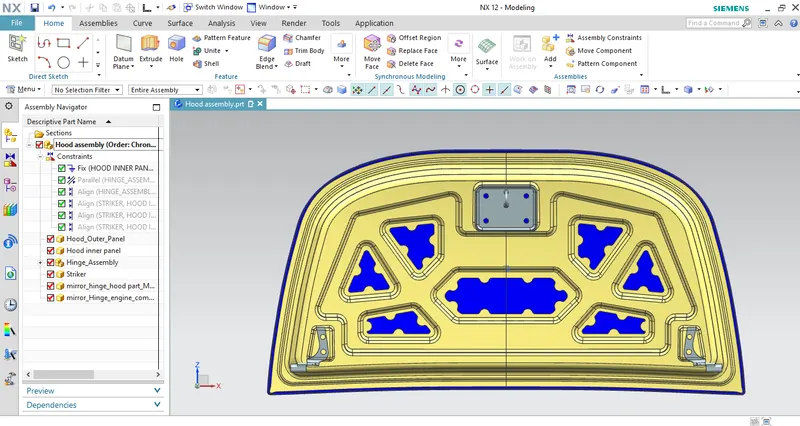
Finally we got a hood assembly with components of Hood outer panel, Hood inner panel, hinge assembly arrangement, latch and striker arrangement, mastic data, embosses and latch trajectory as per the design parameters and followed by the master section.