Hood design-Week 2
Hood:
The hood or bonnet is the hinged cover over the engine of vehicles. Hoods can open to allow access to the engine compartment or trunk on rear-engine and some mid-engine vehicles for maintenance and repair work.
Hood Angle:
One of design parameter for design of hood is opening angle. This opening angle is being control by supporting rod or gas stay. The length of supporting rod controls the opening angle of hood. Supporting rod is placed on engine and after opening is attached to hood or vice versa.
Parts of a Hood Assembly:
1.Support Rod:
The support rod is used to hold the hood at the hood opening angle and is usually hinged at the engine.
2.GAS STAY:
It is also called as Hood stay but it is automated or need some slight amount of force then gas itself actuates it and make it work desirably. Advantages: It is automatic in nature.
3.Reinforcements:
We give reinforcements in the area wherever there is an attachment given such as striker or hinger so that the strength in these areas increase.
4.Wrap Around Distance Concept:
WAD (Wrap-Around Distance) is the geometrically traced distance from the contact point with the Ground Reference Plane, vertically below the front face of the bumper, to any point on the vehicle front structure.
Hemming Process:
Hemming is a forming operation in which the edges of the sheet are folded or folded over another part in order to achieve a tight fit. Normally hemming operations are used to connect parts together, to improve the appearance of a part and to reinforce part edges.
Automotive body panels and automotive parts such as deck-lids, trunk-lids, doors, hoods and tailgates are formed by hemming process.
Deep Drawing:
Deep drawing is a process of sheet metal forming by the mechanical action of a punch. A flat sheet metal blank is formed over a single, rigid, shape defining tool half by a flexible rubber diaphragm under uniform hydrostatic pressure.
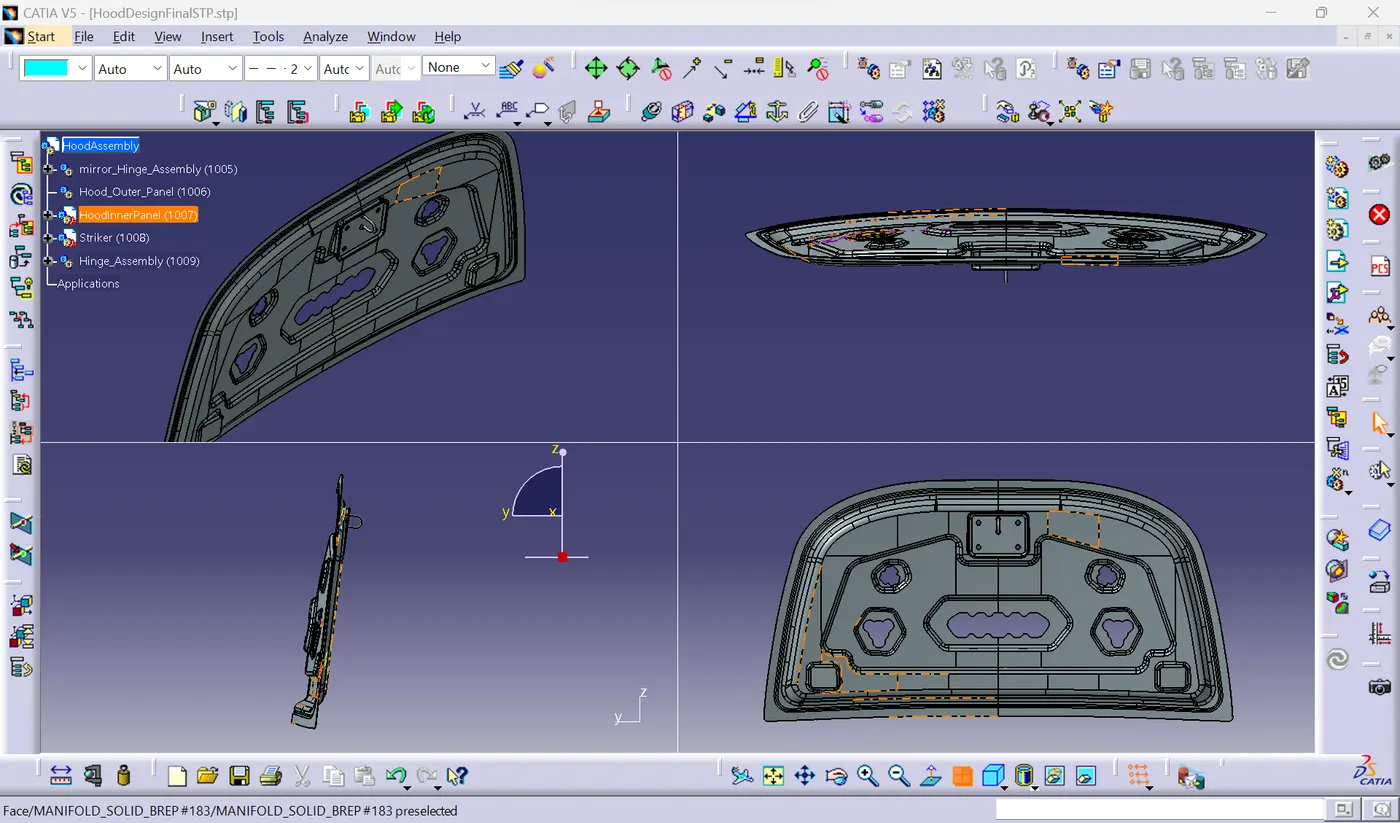
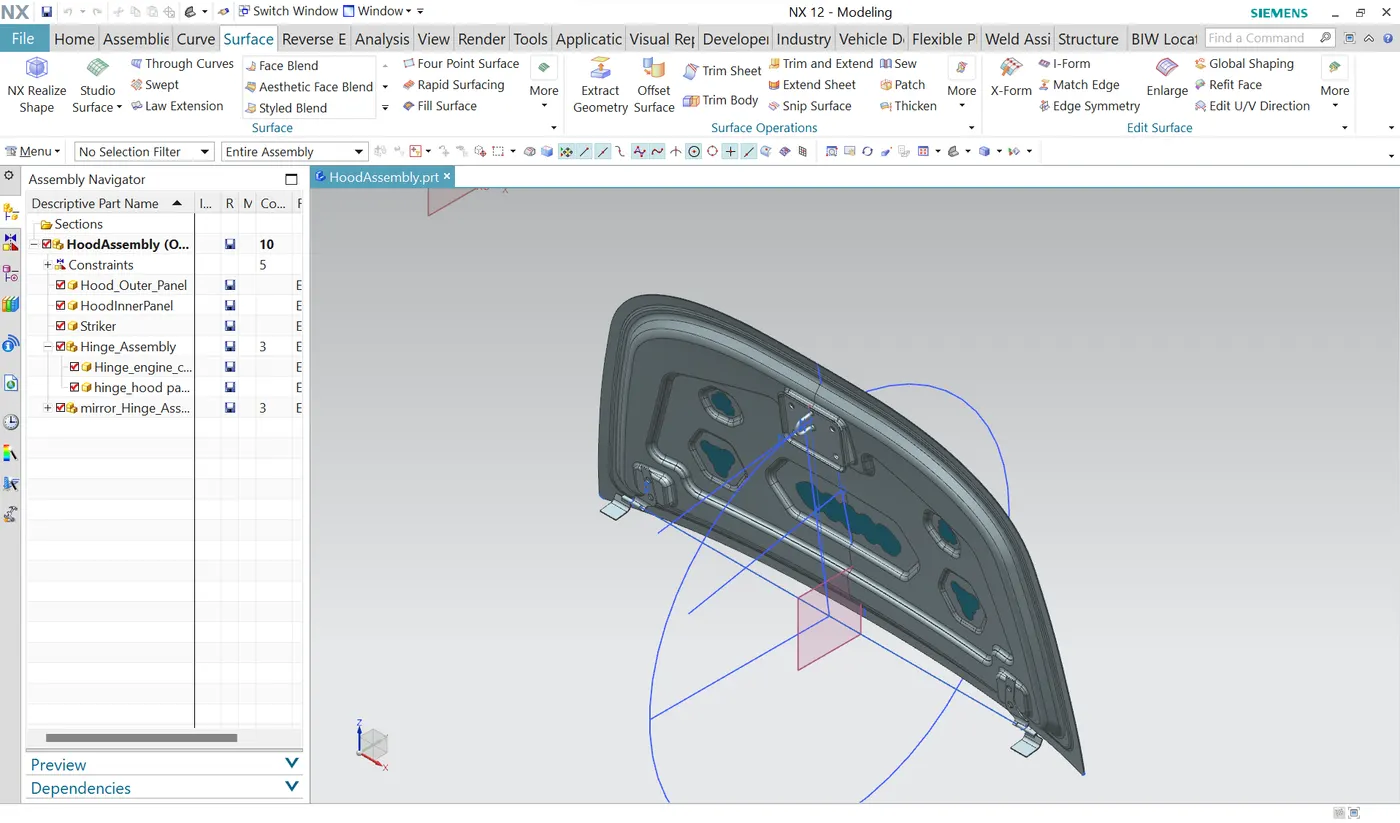
Latch Trajectory:
Its a trajectory or path of Latch & Striker, in which the closing and opening of the hood takes place in virtual circular arc or orbit.it is drawn from hinge axis point.
Mastic data:
Mastic sealants are used between upper outer panel & lower inner panel to stick both each other at certain locations. It is ealstic in nature and acts like rubber and have 80mm diameter area of handling effects. Mestic points always cover the regions which are away from hemming spot, which are easily affected by vibrations.
Emboss:
Embosses are provided throughout inner panel to distribute the forces due to accidents away from passengers by increasing its stiffness.