Hood design-Week 2
Design Hood Outer Panel, Inner Panel and the necessary reinforcements by following the Master Section which is provided.
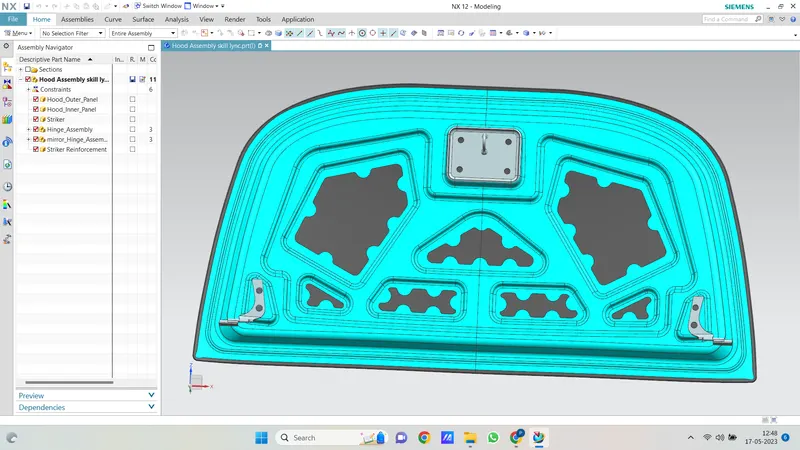
Introduction:- The project report focuses on the process and methodology employed in the construction of the HOOD Assembly for a car utilizing UG NX. By utilizing the styling surface and master section as a foundation, we successfully generated both the HOOD outer panel and inner panel, incorporating distinct characteristics such as embossments and mastic points. Subsequently, a comprehensive HOOD assembly encompassing the outer panel, inner panel, latch, hinge, and reinforcements was created. Lastly, to assess the components' feasibility for production, a Draft Analysis was conducted utilizing the main tooling axis.
given data about thickness :
- Outer Panel Thickness = 0.75mm
- Inner Panel Thickness = 0.75mm
- Reinforcement Thickness = 1.5mm
Hood:
The hood, also known as the bonnet, serves as the hinged cover positioned above the engine in motor vehicles. Its primary purpose is to provide access to the engine compartment or trunk for maintenance and repair purposes, particularly in rear-engine and certain mid-engine vehicles. Typically, the hood encloses the engine along with vital components like the battery, radiator, electrical components, and more that is exposed externally. Structurally, the hood comprises two distinct panels: an outer panel and an inner panel. The inner panel is responsible for providing structural integrity and support, while the outer panel is a metal cover that incorporates stylistic elements.
HOOD MASTER SECTION :
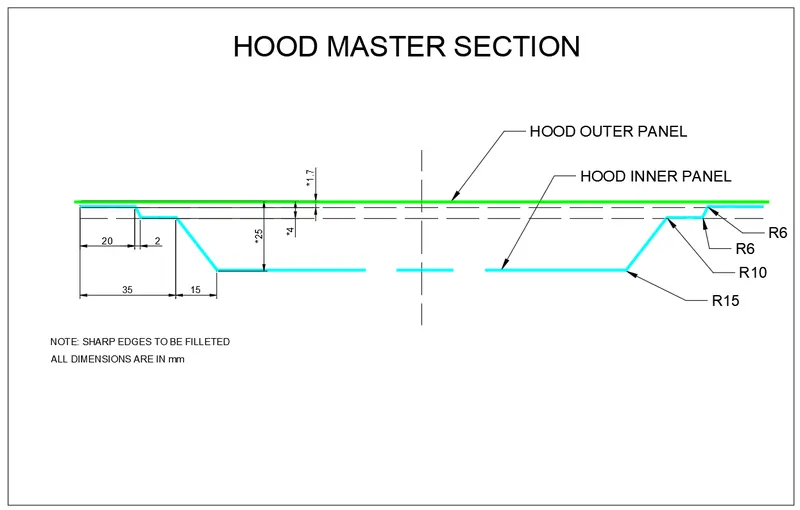
The master section is already provided as per the manufacturing requirements.
Hood outer panel:
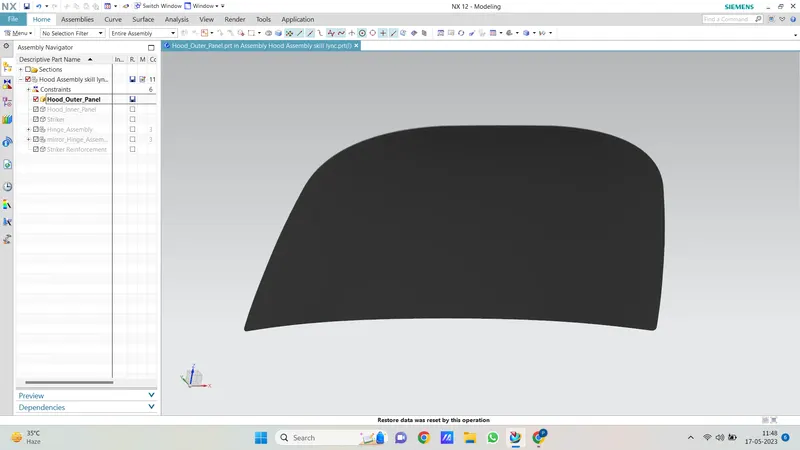
The outer panel of the hood serves as the visually appealing component of a car. It is the responsibility of the styling team to design the outer panel with a focus on aesthetics. However, it is crucial to ensure that the shape, position, and size of the hood adhere to safety regulations, particularly with regards to pedestrian safety. Therefore, when designing the hood, priority should be given to meeting these safety standards. The outer panel is connected to the inner panel through a process called hemming, which involves folding and securing the edges. To facilitate the hemming operation, it is necessary to provide appropriate hemming flanges and reliefs. Additionally, mastic sealants are applied between the outer panel and the inner panel to minimize vibrations and enhance stability.
Hood inner panel:
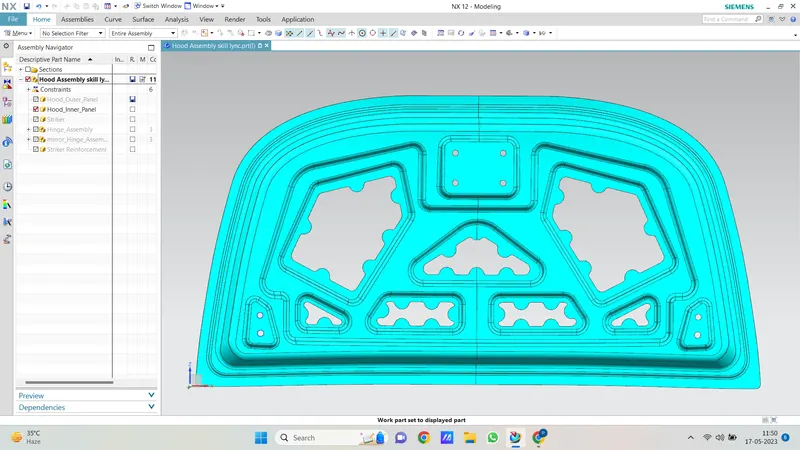
The inner panel of the hood plays a crucial role in providing strength and rigidity to the outer panel. It serves as the structural support for the hood assembly. The design process of the inner panel begins with the representation of the initial emboss shape and size using the master section. Once the master section is established, the next step involves incorporating the necessary embossments for accommodating the latch and hinge elements. These embossments are strategically positioned and integrated into the inner panel to ensure proper functionality and secure attachment of the latch and hinge components.
Latch and Hinge reinforcement:
In order to enhance occupant safety in the event of an impact, additional reinforcement is applied to the latch and hinge areas of the hood. When the latch and striker are installed, there is a decrease in the overall strength at those specific positions, necessitating reinforcement measures. To address this, reinforcement elements are incorporated to provide increased strength and structural integrity in the latch and hinge areas. Additionally, stiffness pads are installed to mitigate noise, vibration, and harshness (NVH) concerns. The thickness of the hinge and latch reinforcement is typically maintained at 1.5 mm, although it may vary depending on specific design considerations and requirements.
Mastic point:
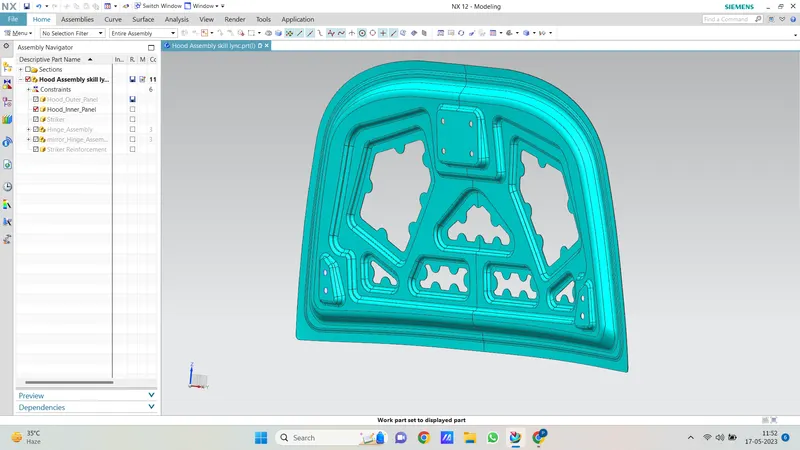
The mastic point is a flexible and elastic compound that exhibits rubber-like properties. These points are strategically positioned on the hood inner panel in areas where the hood is prone to deformation. The purpose of mastic points is to assist the hood outer panel in returning to its original shape after it undergoes deformation due to external forces or impacts. By absorbing and distributing the applied stress, the mastic points help in maintaining the structural integrity of the hood assembly. The mastic points typically have an influence area of approximately 80mm, indicating the region over which their impact and effectiveness are extended.
Cornering:
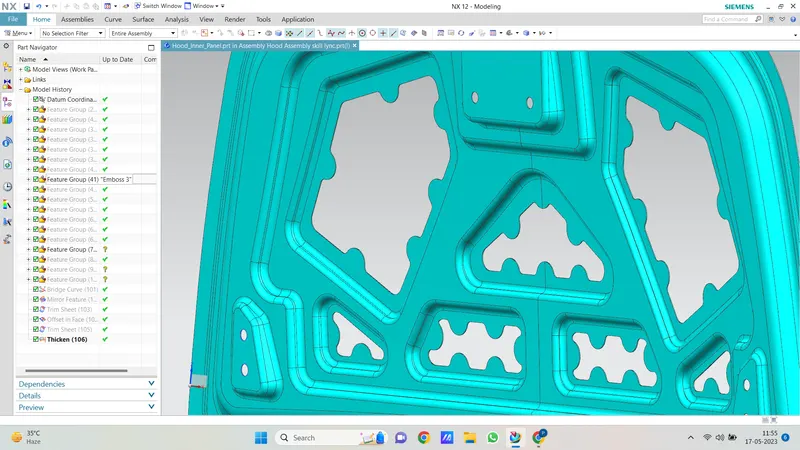
Cornering is a manufacturing process aimed at removing sharp edges from the corners of a part. During cornering, the edges of the part are precisely cut or shaped to create a smooth and rounded corner, eliminating any sharp or jagged edges. This process is typically employed to enhance safety, improve aesthetics, and reduce the risk of injury or damage caused by sharp edges. By removing sharp edges through cornering, the part becomes more visually appealing and safer to handle.
Hemming Process:
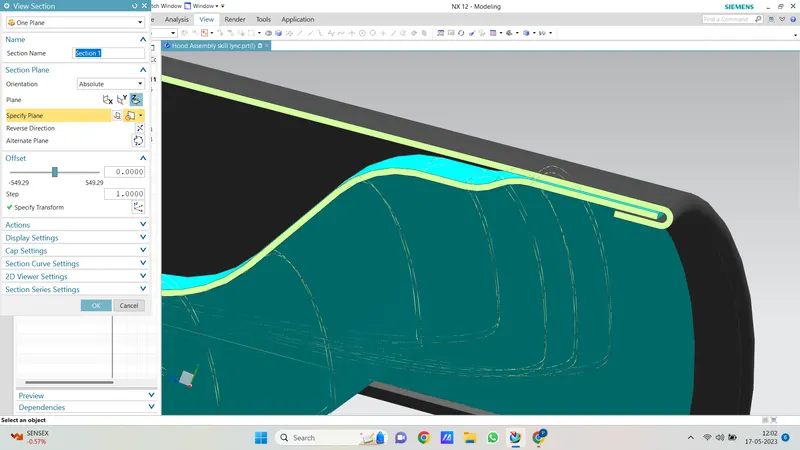
Hemming is a sheet metal forming technique utilized to join two sheets together by folding them at a 180° angle. This process finds extensive application in the manufacturing of automotive body panels and parts, including deck-lids, trunk-lids, doors, hoods, and tailgates. Typically, the hemming process involves three distinct stages, where a sheet is bent using an inner sheet. These stages ensure a secure and durable bond between the sheets, resulting in a seamless and cohesive assembly. Hemming plays a vital role in enhancing the structural integrity, strength, and overall aesthetics of automotive components.
Corner Relief:
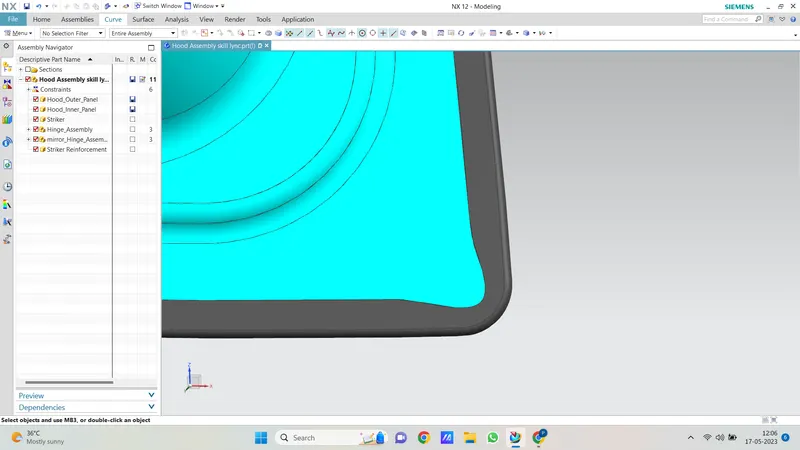
Corner relief refers to a technique used in sheet metal fabrication, involving the creation of small incisions or cuts in a piece of sheet metal to free the material between the two cuts. The purpose of corner relief is to separate the portion of the material that will be folded or bent from the rest of the part. This technique is typically employed when there is material present on both sides of a bend. By providing corner relief, the sheet metal can be more easily and accurately formed into the desired shape without the risk of deformation or damage. Corner relief helps to ensure precise and clean bends while maintaining the structural integrity of the sheet metal component.
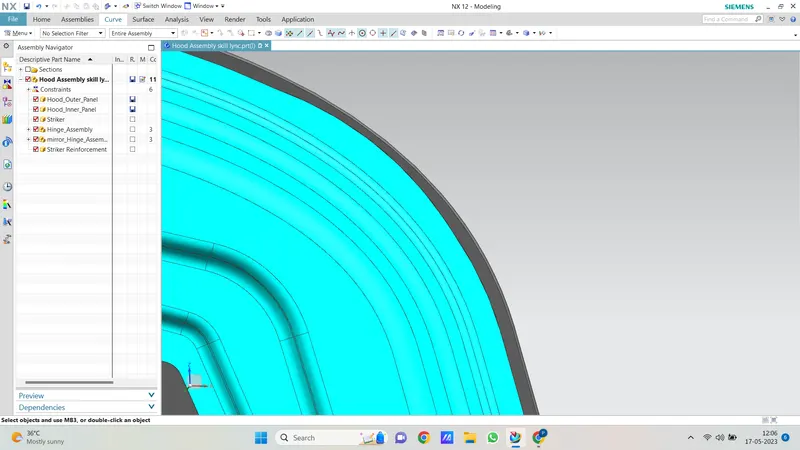
Total assembly: