Hood design-Week 2
Hood Design
Objective:
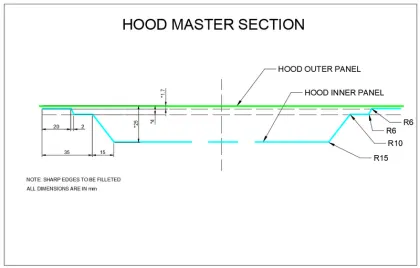
Design Hood Outer Panel, Inner Panel and the necessary reinforcements by following the Master Section mentioned with the Design parameters.
ASSEMBLY of Hood Inner Panel, Outer Panel, Latch, Hinge and the Reinforcements.
Description of Hood Panel:
A hood panel, also known as a bonnet, is a component of a vehicle that covers the engine compartment. It is typically located at the front of the vehicle, above the engine and between the fenders. The hood panel serves several purposes, including providing access to the engine compartment for maintenance and repairs, protecting the engine and other components from debris and weather, and contributing to the aerodynamics and overall style of the vehicle. Hood panels can be made from a variety of materials, including steel, aluminum, and carbon fiber, and may be designed with various features such as air vents or scoops to improve airflow and cooling.
Material used for Hood Panel:
Steel: Steel is a popular choice for hood panels due to its strength, durability, and affordability. It can be easily stamped and shaped to meet the design requirements of different vehicles.
Aluminum: Aluminum is a lightweight material that offers high strength-to-weight ratio. It is often used in high-performance vehicles to reduce weight and improve fuel efficiency.
Carbon fiber: Carbon fiber is a lightweight, high-strength material that is often used in high-performance vehicles and racing cars. It offers excellent strength and rigidity while reducing weight.
Fiberglass: Fiberglass is a composite material made from woven fibers and resins. It is lightweight, durable, and can be easily molded into complex shapes. Fiberglass hoods are often used in aftermarket applications for their customizability.
Plastic: Plastic materials, such as ABS or polycarbonate, can be used for hood panels as they are lightweight, impact-resistant, and can be molded into complex shapes. They are often used in electric or hybrid vehicles due to their lightweight and durable characteristics.
Euro NCAP Hood Testing of Hood:
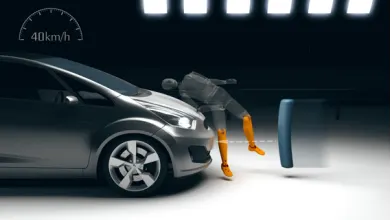
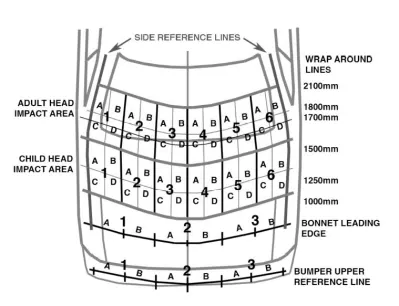
The pedestrian protection tests include a hood impact test, which evaluates the ability of the hood to absorb and distribute impact forces in the event of a collision with a pedestrian. During the hood impact test, a weighted impactor is used to simulate the impact of a pedestrian's head hitting the hood of the vehicle.
The test measures the severity of the impact forces on the impactor, as well as the amount of deformation and acceleration of the hood. The results of the test are used to evaluate the pedestrian protection performance of the vehicle and to assign a rating based on the Euro NCAP star rating system.
Euro NCAP also evaluates the hood latch and locking systems of vehicles during the frontal impact test. The latch and locking systems must be designed to provide a secure and reliable locking mechanism that prevents the hood from opening unexpectedly during a collision. The hood must remain in place and provide adequate protection for the engine and other components during the impact.
Euro NCAP Testing:
Head Impact:
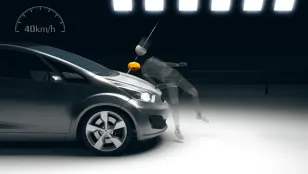
Most pedestrian accidents occur within city areas where speeds are moderate. The head, the lower body and the legs are amongst the most frequently injured body regions. To estimate the potential risk of head injury in the event of a vehicle striking an adult or a child, a series of impact tests is carried out at 40 km/h using an adult or child head form impactor. Impact sites are then assessed and the protection offered is rated as good, adequate, marginal, weak or poor.
Upper Leg Impact
The shape of the hood or bonnet leading edge can play a critical role in the outcome of a vehicle impact with a pedestrian and contribute to injuries to the pelvis and femur.
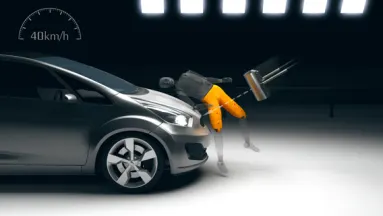
To estimate the potential risk of pelvis and upper leg injuries in the event of a vehicle striking an adult, a series of impact tests is carried out at 40 km/h using an adult upper leg form impactor. Impact sites are then assessed and the protection offered is rated as good, adequate, marginal, weak or poor.
Lower Leg Impact:
To estimate the potential risk of leg injuries in the event of a vehicle striking an adult, a series of impact tests is carried out at 40 km/h using an adult leg form impactor. Impact sites are then assessed and the protection offered is rated as good, adequate, marginal, weak or poor. The procedure promotes energy absorbing structures and a more forgiving geometry that mitigates injuries to the leg.
Hood Panel Components:
Outer Panel:
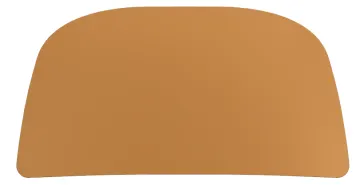
The hood outer panel is the visible part of the vehicle's hood that is exposed to the exterior environment. The primary purpose of the hood outer panel is to protect the engine compartment and its components from environmental factors such as rain, snow, debris, and dust.
Additionally, the hood outer panel can also play a role in the aerodynamics of the vehicle, as it can help direct air over the windshield and reduce wind resistance, improving fuel efficiency and reducing noise.
In terms of design, the hood outer panel is often one of the most prominent and visible features of the vehicle's exterior, and can have a significant impact on the overall look and style of the vehicle.
Inner Panel:
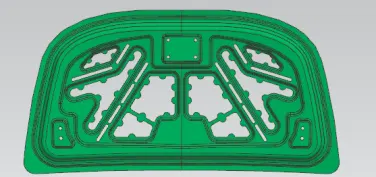
The primary purpose of the hood inner panel is to provide thermal insulation and soundproofing for the engine compartment. It helps to reduce the amount of engine noise that enters the cabin of the vehicle and also helps to prevent heat from the engine compartment from radiating into the passenger compartment, keeping the interior of the car cooler.
In addition to its insulating properties, the hood inner panel can also serve as a protective barrier between the engine compartment and the exterior environment. It helps to prevent dirt, debris, and moisture from entering the engine compartment, which can help prolong the life of the engine and its components.
Hinge:
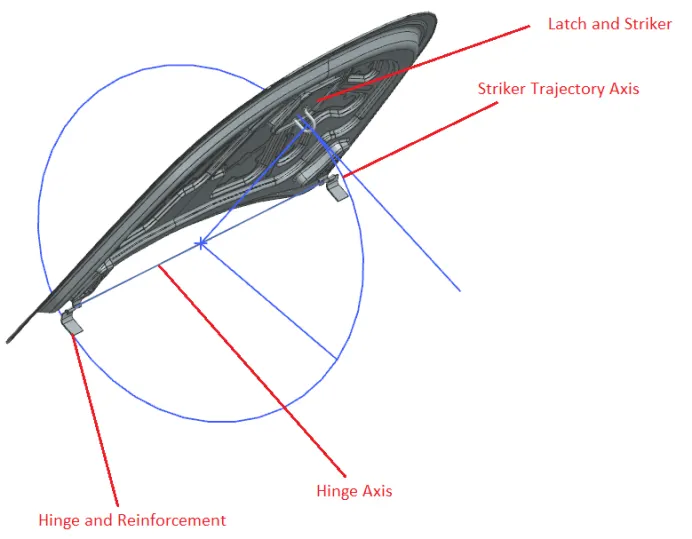
The purpose of the hood hinges is to provide a sturdy and secure connection between the hood and the car's body, while also allowing the hood to be easily opened and closed. The hinges are typically made of durable materials such as steel or aluminium and are designed to withstand the weight of the hood and the forces that are exerted on it while driving.
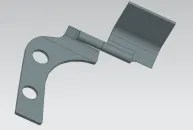
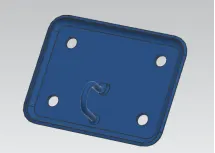
Striker:
The hood striker is the metal plate or pin that latches onto the hood latch and keeps the hood securely closed. The purpose of the hood striker is to ensure that the hood stays closed while the vehicle is in motion, preventing the hood from flying open and obstructing the driver's view or causing damage to the vehicle or other
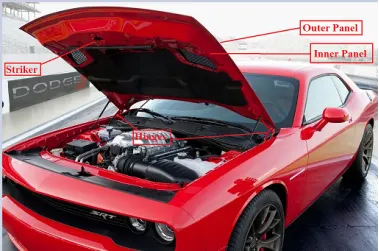
Assembly of hood Components in car:
Design Methodology used in Hood Design:
Hood Thickness Information
Outer Panel Thickness = 0.75mm
Inner Panel Thickness = 0.75mm
Reinforcement Thickness = 1.5mm
Design Approach:
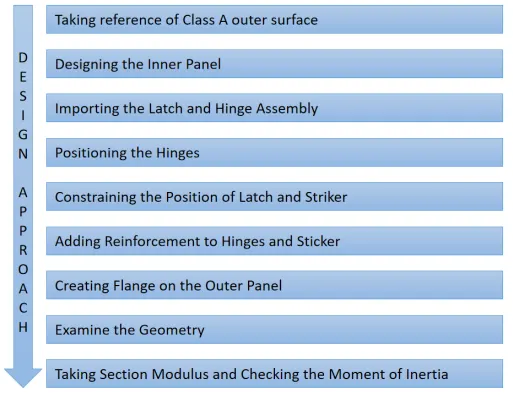
Creation of Master Section:
The master section is created based on the basis case over study of previous model or as a new product development as per new requirement from market.
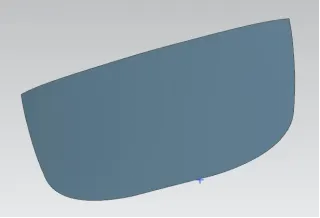
Class A Surface:
CAD team will receive the initial input from the Class A creation team, as a reference for creating the model.
Designing the Inner Panel:
With Further reference of Class A surface and providing local embosses to strengthen the component.
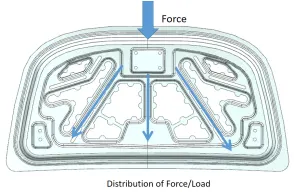
The component will be strengthened based on the master section. When a force impacts the hood from the front, it travels in an upward direction. The component is designed in such a way to divert the impact force direction away from the passenger.
Embosses in the inner panel are made according to the diversion of the load path.
Impact force direction from Hood
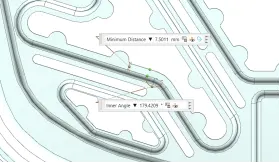
The emboss depth is kept at a maximum of 5mm to be on the safer side so that the part can be manufactured without any problems.
Importing Latches and Striker for Reinforcement:
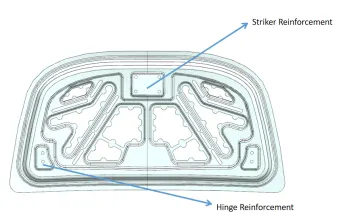
After designing the hood inner panel, we will import the Latch and hinge as explained in functional requirements section, while the development of the inner panel, we also need to develop some additional reinforcements for strengthening the area where we are going to mount the Latch and Hinge parts.
Master Sealant Points:
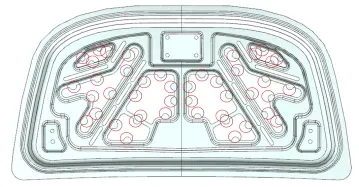
The hood inner panel is enclosed below the outer panel and thereby provides rigidity to the hood. When these parts are assembled to form a hood a small gap remains between these two parts as they are both metal parts this may lead to noise and vibrations when the vehicle is in running condition which is undesirable to avoid this mastic sealant is filled between this small gap.
Mastic sealant is a paste-like material that is applied on a surface and is hardened by heating.
Mastic sealant will be expand from 50mm to 80mm after application of heat.
Creating Flange on Outer Panel:
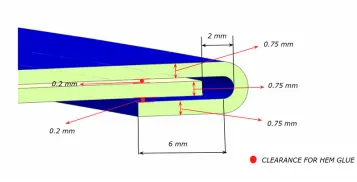
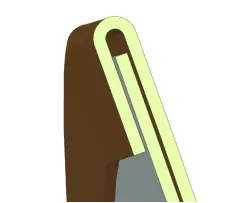
The hood outer panel around the inner panel and holds it tightly together & gap between the hemming flanges of hood outer panel to inner panel will be filled with sealants to make the joint as waterproof. After the hemming is done, we need to provide corner relief at the corners of the hood so that the part can be produced without defects. See the below pictures of Hemming and the reliefs provided at the corners.
Hemming Data:
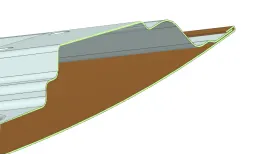
Relief rear section:
In Order to avoid the wrapage of the sheet metal during the hemming process, we add additional relief over the outer panel.
Front relief section
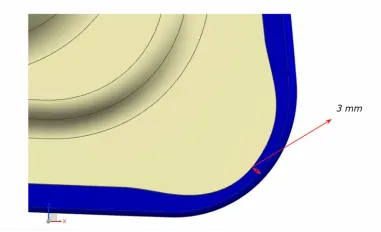
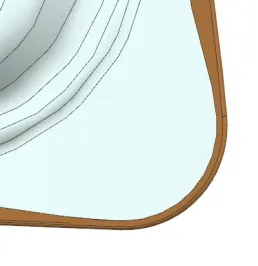
Assembly of Hood Panel:
Top down Approach
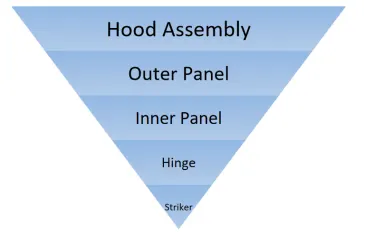
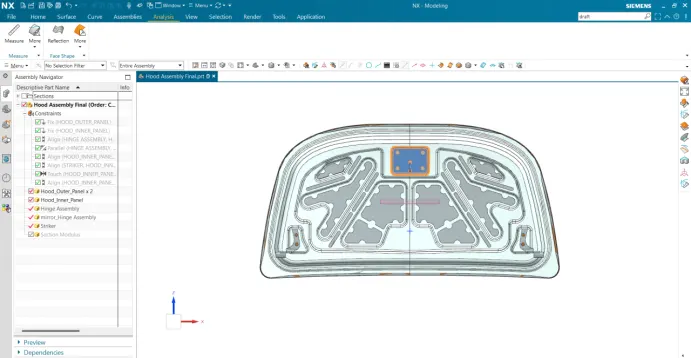
Position of Hinge and Striker:
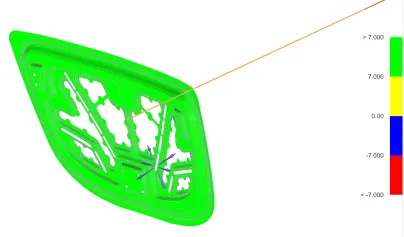
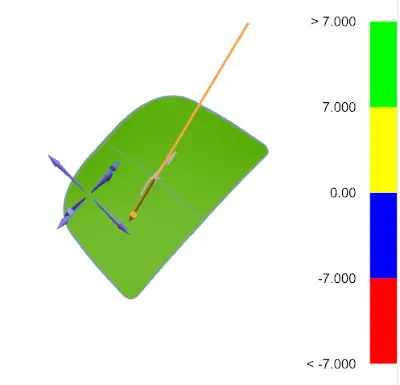
Draft Analysis
We have performed on each and every sheet metal component with minimum 7 degree draft angle and the results are satisfied.
Inner Panel:
Outer Panel:
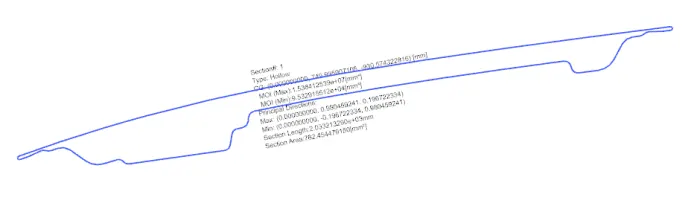
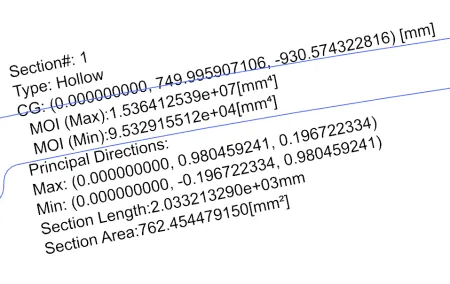
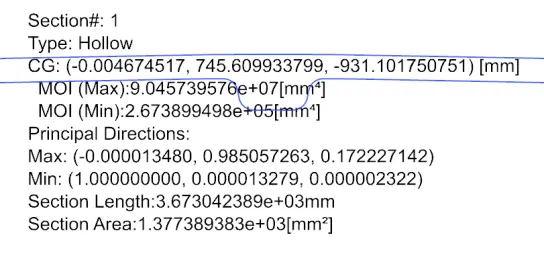
Section Modulus:
Along Y- Axis

Along X- Axis