Hood design-Week 2
Aim:
To create an outer and inner hood panel, positioning the striker, hinge, and their reinforcements.
Introduction:
In this project, a detailed model of an automobile hood is created using Catia V5 in order to understand and familiarize with different tools and methods of modeling. The Hood is the main component of a car at the front portion. It is used to decorate the car and add a luxurious look. The shape of the bonnet is made aerodynamic in order to minimize the air effect. Bonnet is generally used to access the parts easily such as a radiator, engine, and many other parts. In the automotive world, weight optimization plays an important role. In this paper, material changes are applied to the bonnet for the same design and finally showing the stiffest bonnet and less weight component.
Data to be used:
Hood Thickness Information
Outer Panel Thickness = 0.75mm
Inner Panel Thickness = 0.75mm
Reinforcement Thickness = 1.5mm
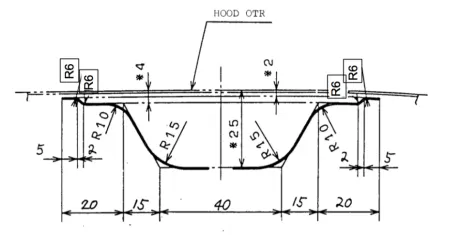
Master sketch:
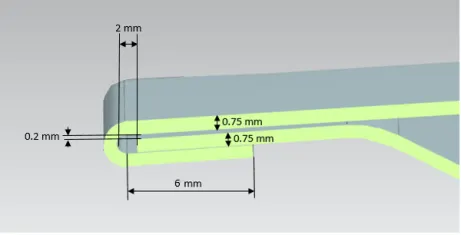
Hemming Data:
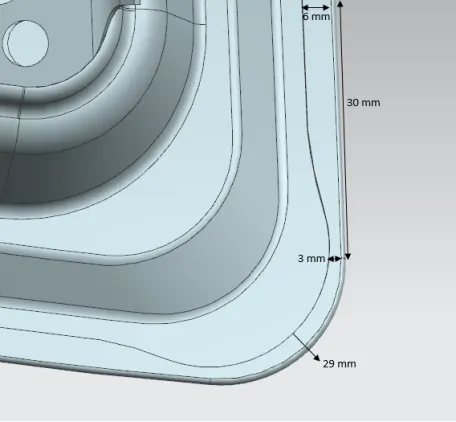
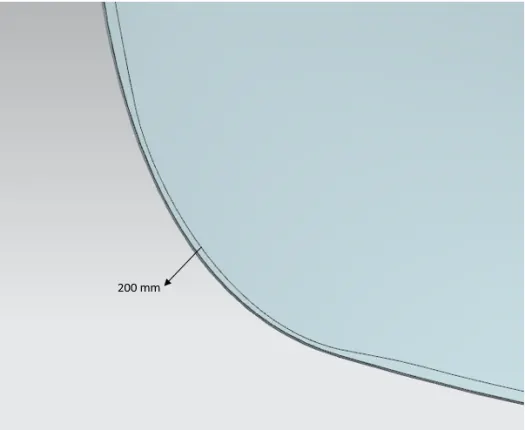
Relief rear section: Front Relief :
SAFETY CONSIDERATION WHILE DESIGN HOOD: -
Hood of engine design in such a way that reduces air effect and all the maintenance part easy to do and it should also protect from the external disturbance on the engine. When the car comes to an accident it must be impact force and distributed outside so it should be the Y-shape.
While designing Hood should take care of Safety, Quality, Styling, and manufacturing. The Most important safety requirement to be considered while designing the Hood is pedestrian safety from collision from the front side. Pedestrian safety, It’s a norm that provides a safety feature to the body when a car gets collides from the front side and reduces the injuries to the body.
Safety is the most important criteria in automobile designs which concentrate on both pedestrian and occupant safety. Pedestrians are the most vulnerable road users and are at high risk of traffic accidents. The major reason for the fatality of the pedestrian in a traffic accident is due to the head injury resulting from the hard impact of the head against the stiffer hood or the ground. This leads to the necessity of a new inner hood panel that is less stiff and pedestrian and pedestrian-friendly.
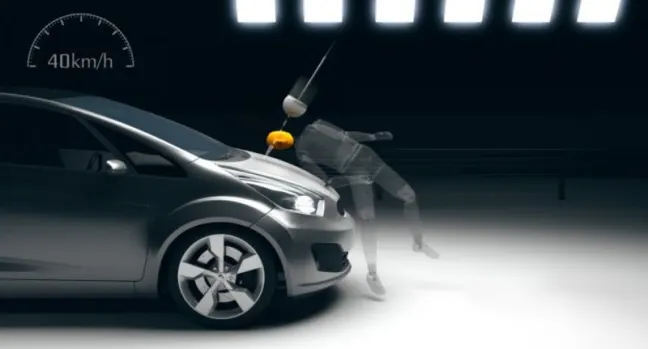
In this study, three kinds of sandwich hood structures are proposed for reducing pedestrian head injuries, including carbon fiber-reinforced polycarbonate, carbon fiber-reinforced foam, and aluminum-reinforced polycarbonate.
The finite element method is used to simulate the impact between the vehicle's hood and the head form impactor. The software used in the simulation is LS-DYNA. The results predicted by the head form-hood tests show that the hood structure with aluminum-reinforced polycarbonate material provides enough absorption capability to protect pedestrians from the impacts of accidents. It is also stiff enough to keep pedestrians' heads away from the inner parts of the engine cavity.
Child Head Impact:
car-pedestrian accidents account for a considerable number of automobile accidents in industrialized countries. Head injury continues to be more concerned with Automobile impacts. Because the head is the most seriously injured part in many collisions including in pedestrian automobile collisions. To reduce the severity of such injuries international safety committee have proposed subsystem tests in which head foam impacts are impacted upon the car hood
Currently in India, Automotive Indian Standard (AIS) 100, Amendment 1 is used to evaluate the performance of vehicles against pedestrian safety. This standard has been harmonized from the international evaluation standard Global Technical Regulation No. 9 (GTR 9), whose purpose is to bring about an improvement in the construction of the fronts of vehicles and, in particular, those areas which have been most frequently identified as causing injury when in collision with a pedestrian or other vulnerable road user. The tests required are focused on those elements of the child and adult body most frequently identified as sustaining an injury, i.e. the adult head and leg and the child's head. To achieve the required improvements in the construction of vehicles, the tests are designed in such a way that they will represent the rear world accident scenario.
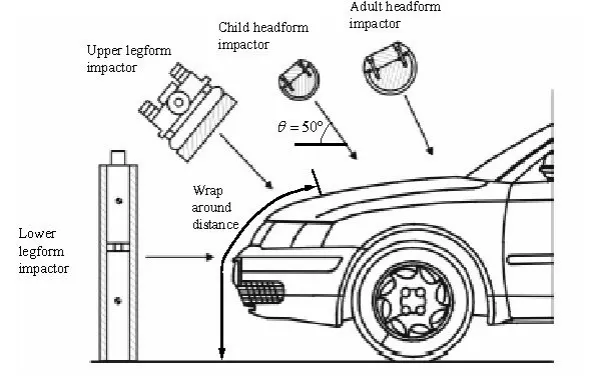
Wrap Around Distance (WAD):
When a car crashes on the pedestrian, the whole human body wraps around the front shape of the car, and the head impacts on the bonnet or the windscreen. The distance at which the head impacts on the car from the ground is mentioned as Wrap Around Distance (WAD).
To be specific the Wrap Around Distance is a measurement of the distance from the ground to the head impact zone over the outer surface of the car. The wrap-around distance is measured longitudinally in the center of the vehicle from the ground.
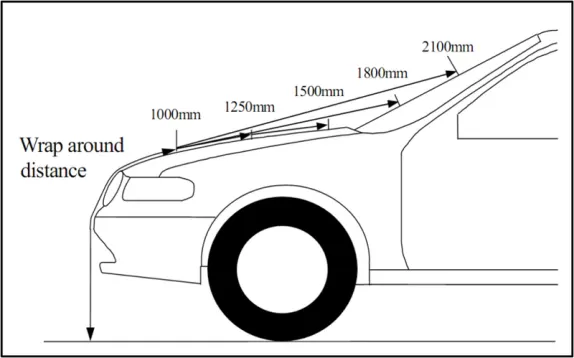
The severity of the injury caused by the frontal crash depends on the type and shape of the vehicle, the speed of the vehicle, and the movement of the pedestrian relative to the vehicle. In addition to these parameters, the wrap-around distance plays a major role in the safety measures of a pedestrian
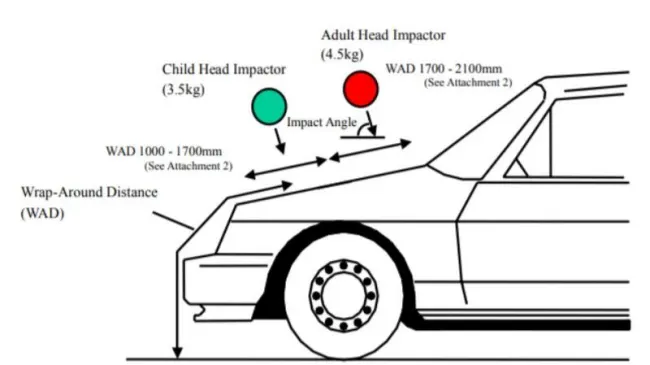
During the crash analysis, based on the Wrap Around Distance(WAD), two test areas will be created namely the Child head impact zone and the Adult head impact zone. The child head impact zone is between 1000 to 1700 mm WAD and the adult head impact zone ranges between 1700 to 2100 mm WAD.
Description:
The hood design along with the inner and outer panel has other important parts such as the latch trajectory, the mastic points, and reinforcements.
Latch trajectory:
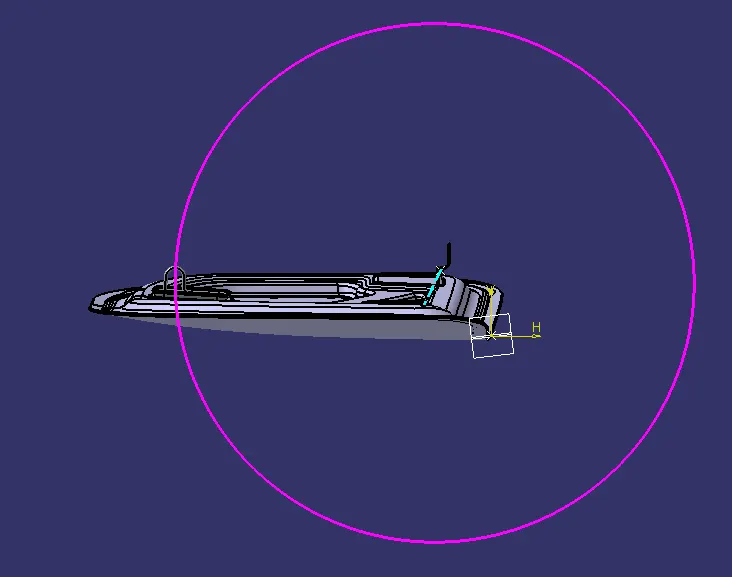
The latch trajectory shows the path of the striker when the hood is opened and closed on a vehicle.
The radius of the circular trajectory is determined by the set standard based on the average height of a person. The radius is measured from the hinge axis up to the latch.
Mastic points:
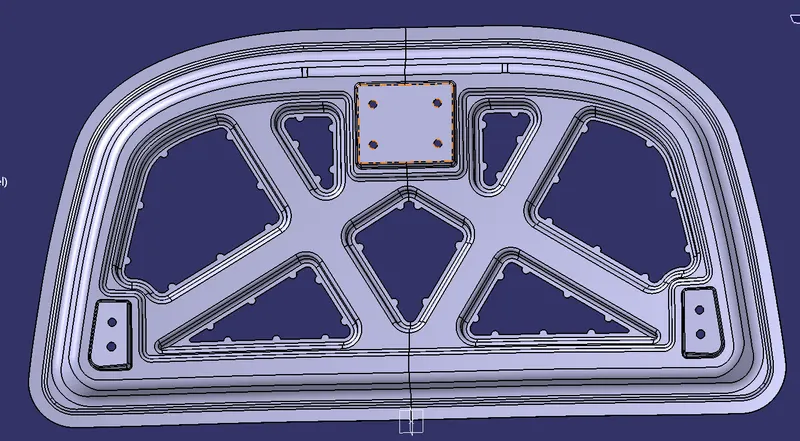
The mastic points are areas where the mastic is placed to attach the outer panel to the inner panel. We cannot use spot welding as it would give a less aesthetically pleasing result. Hence mastics are used to join the panels together as it does not melt the metal itself.
Emboss Definitions:
The inner panel consists of various embosses which help dissipate the force during impact. The width and depth of the emboss are determined by simulations and analysis to check for failure. These emboss definitions are created at an angle so that they point away from the centre of the hood when viewed from the front of the vehicle.
Reinforcements:
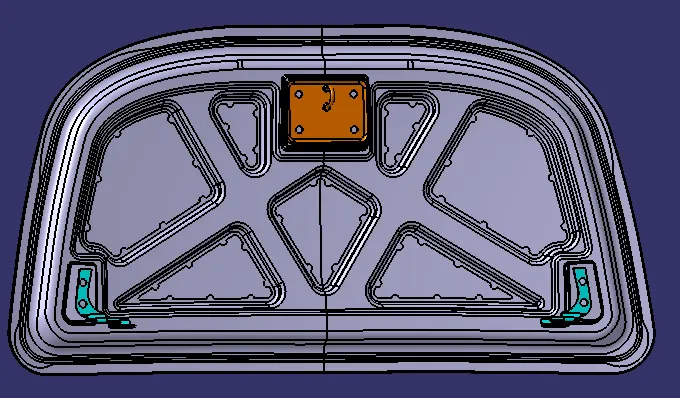
The area near the hinge and latch has more chances of failure in the hood panel. Hence to avoid any failure, the hinge and latch areas are reinforced with extra material whose thickness is usually determined by the type of vehicle.
To produce the hood in a manufacturing plant various processes are used. A few of these processes are deep drawing and hemming.
Deep Drawing: In this process, a sheet is drawn to the desired shape using a punch and die apparatus. The sheet is formed into the shape of the die by forcing the punch down on it. To avoid the sheet to fold on itself, the sides of the sheet are held down by binders.
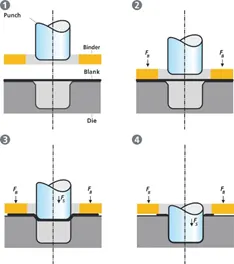
This process is the most common and efficient process in the automobile manufacturing industry.
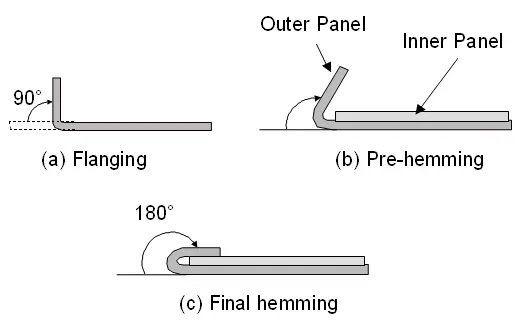
Hemming: The hemming process is used to lock two sheets together by folding one sheet around the other sheet. The hem is created by first creating a perpendicular flange. The flange is then bent beyond 90 degrees in the pre-hemming process. Finally, the hem is created by pressing the flange back on the sheet completely. Hems can be an open type or closed type. To lock two sheets together, generally open flanges are used.
Conclusion:
We were successfully able to design the inner panel of the hood with the help of the given master sketch and other dimensions. We also designed the hood according to the NCAP regulations and successfully assembled the hood inner panel, hood outer panel, hinge, a striker with their reinforcements.