Hood design-Week 2
AIM
The main objective of this project is to learn the essential tools, commands, and surface modeling of Hood designing using Siemens NX Cad. This project is to develop a design idea for hood BIW that satisfies the manufacturing requirements, functional requirements, and EURO NCAP standards.
HOOD OR BONNET
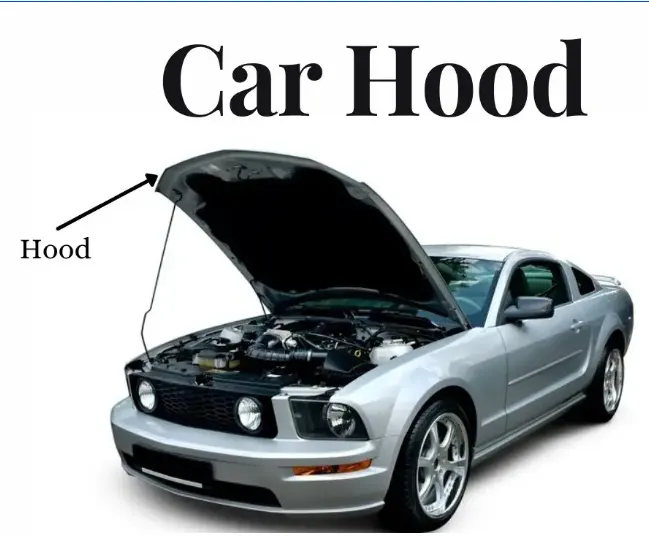
A car hood also referred to as a bonnet in some other countries is the hinged cover that rests over the engine of a front-engine vehicle. Its purpose is to provide access to the engine for repair and maintenance. Car hoods are typically constructed from steel and sometimes from aluminum.
On front-engined cars, the hood may be hinged at either the front or the rear edge, or in earlier models (e.g. the Ford Model T) it may be split into two sections, one on each side, each hinged along the centerline. A further variant combines the bonnet and wheel arches into one section and allows the entire front bodywork to tilt forwards around a pivot near the front of the vehicle.
Hoods are usually made from the same material as the rest of the body. This can be steel, aluminum, fiberglass, or carbon fiber. However, some aftermarket companies produce fiberglass or carbon fiber steel hood replacements to make the vehicle lighter. The hood release system is common on most vehicles and typically consists of an inner hood latch/lock handle, a hood release cable, and a hood lock assembly. The hood lock handle is usually located under the steering wheel, next to the driver’s seat, or in the door frame.
DESIGN CONSIDERATION OF HOOD
The human comfort factor for automobile design is first consideration. It is a method to safeguard and protect space for the human user and necessary components that make up the vehicle being designed. All safety regulations are ensured during this process. Ergonomical consideration consist of Hood clearance, Hood Opening angle and location of support rod or gas stay.
Hood opening angle is different for different regions or countries. It is decided by the average height of the human in that particular country.
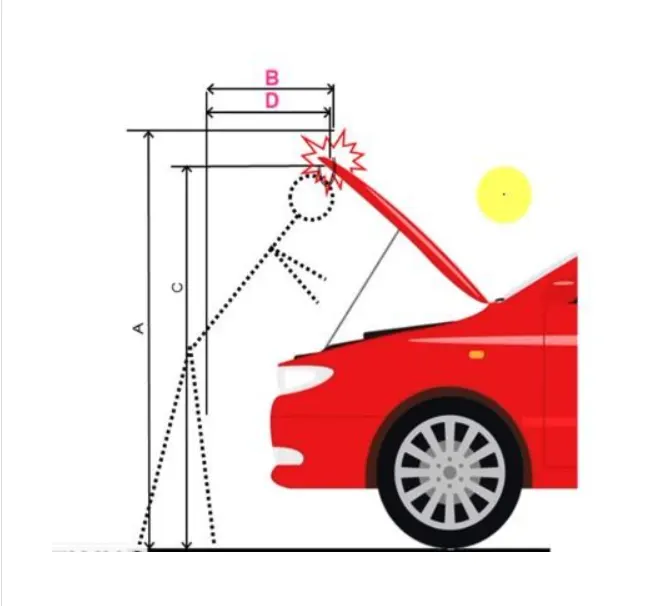
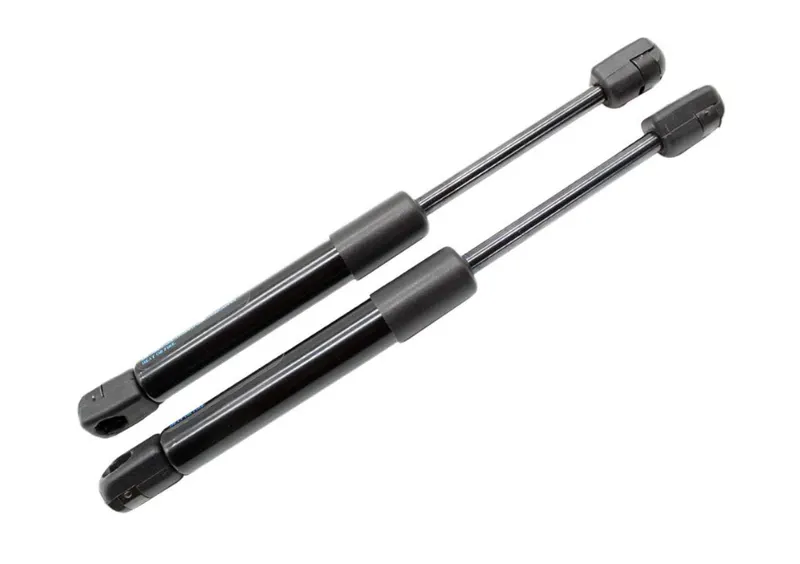
There are two types of hood stay, support rod and Gas stay which holds the position of hood at desired angle.
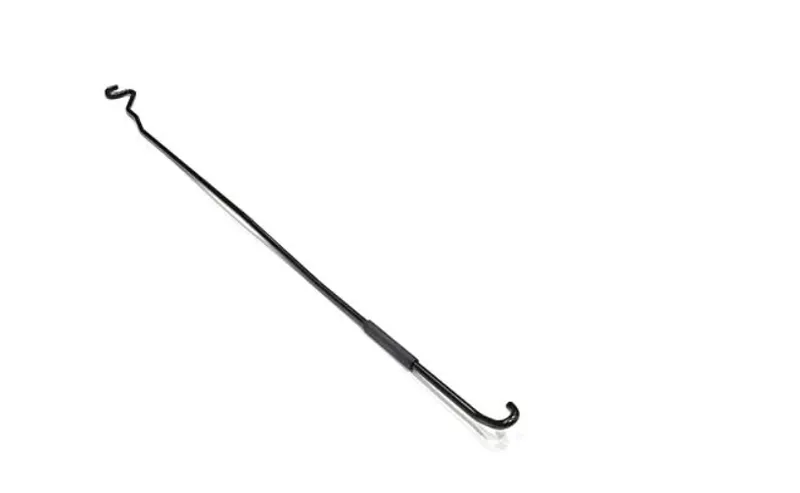
1.SUPPORT ROD
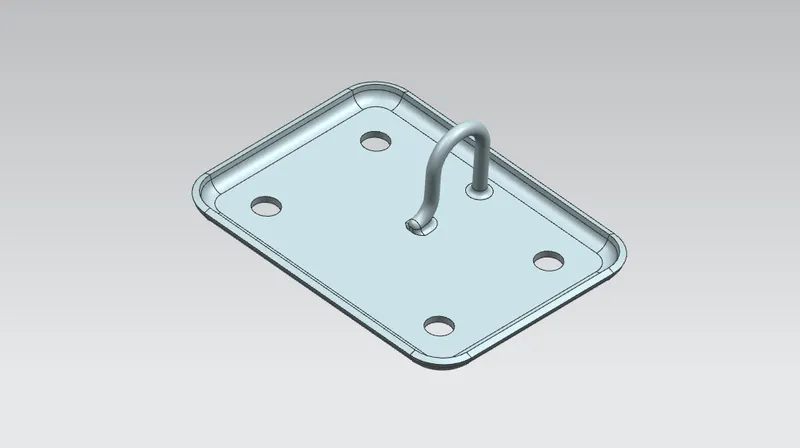
It is a simple metalic rod. It is not usually made linear to increase rigidity of rod but the length from line connecting support rod retaining point with retaing point on body side to maximum bending point should be less than 35mm to ensure the strength of support rod.
It should have sufficient clearance with other engine components to avoid rattling noise.
2.GAS STAY
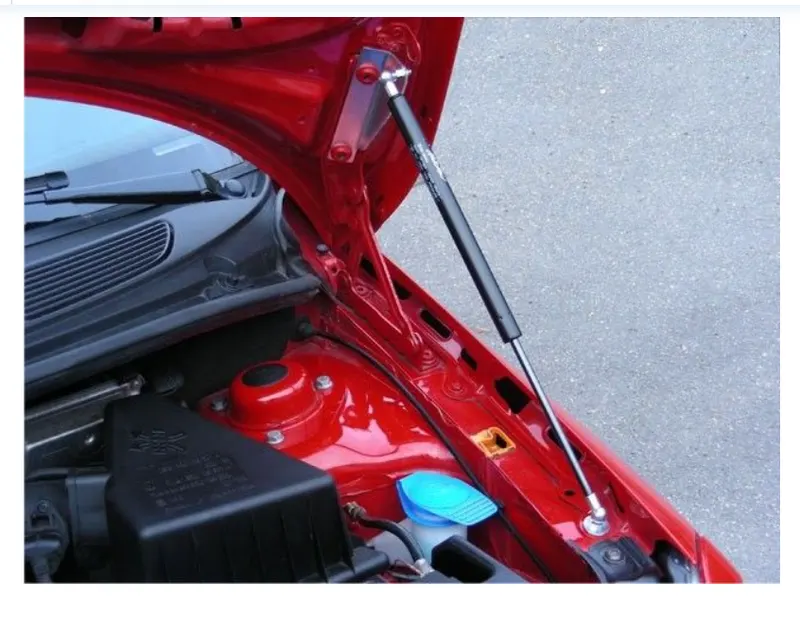
It is a device used for supporting the engine hood of a vehicle in its open postion by means of an actuator which is activated by gas.
In case of gas stay only intial force is required to open the hood then it automatically opens at desired angle with the extension of pneumatic piston in cylinder of gas stay assembly.
MAIN COMPONENTS OF HOOD ASSEMBLY
- OUTER PANEL
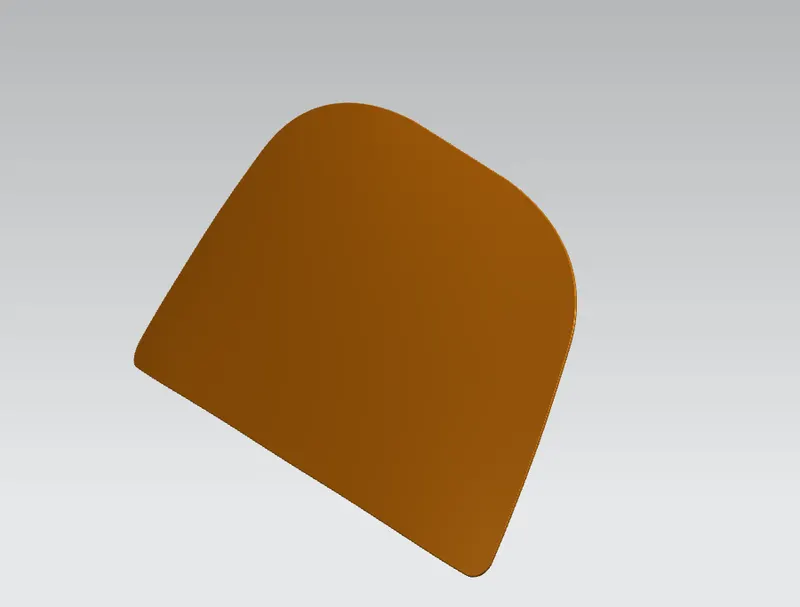
A car hood panel is one of the most important components of the BIW (body in white), it is considered the closure sheet-metal component. The outer panel has the aesthetic look to it but on its own is very weak and not capable of handling force during impact. Most automobile hood outer panels are made of traditional steel plates, and their quality does not meet the needs of lightweight development. For this reason, it is necessary to obtain lightweight effects through the application of automotive aluminium sheets. The most widely used car aluminium alloys in the market are deformed aluminium alloys of 6111, 6016, and 5182. The production process of the outer panel of the hood mainly includes blanking, deep drawing, trimming, turnup, and side turnup. Among them, deep drawing is a key process to ensure the quality of parts.
- INNER PANEL
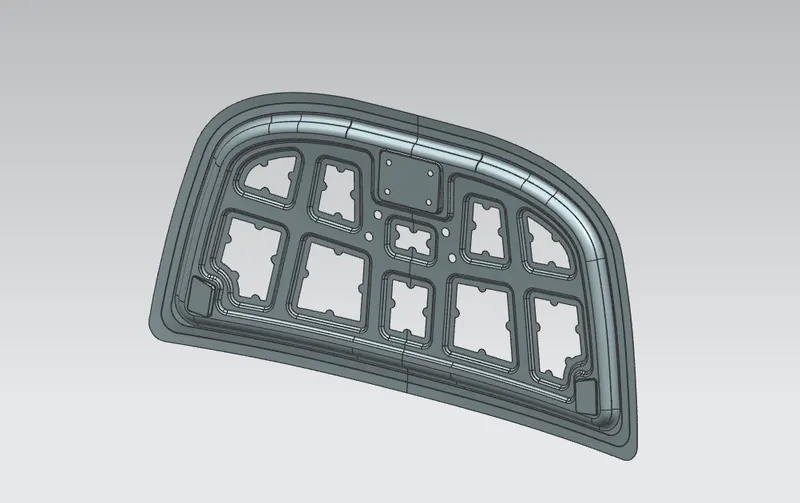
The inner panel of the hood is not visible to the customer, but this is the engineering feature of the outer panel. The hood panel is required to have a high initial reaction force against the impact exerted on the hood to enhance the energy absorption capacity. The hood is further required to minimize a reduction of a reaction force by deformation in a collision. A hood inner panel according includes an inner panel main body forming part of a hood of a vehicle, a front bead provided on the inner panel main body and extending along a vehicle width direction, and a rear bead provided on the inner panel main body, located on a rear side of the front bead and extending along the vehicle width direction. The front bead includes a centre portion in the vehicle width direction that is curved toward the front of the vehicle and located in front of each end portion in the vehicle width direction, and the rear bead includes a centre portion in the vehicle width direction that is curved toward the back of the vehicle and located behind each end the portion in the vehicle width direction.
- HINGE
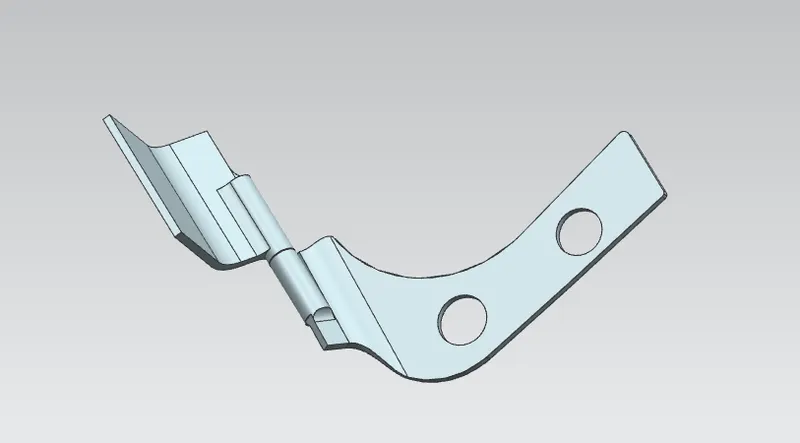
A hinge is a machine element that connects two bodies allowing angular movement about a fixed axis of rotation, all the while preventing translations and rotations on the remaining two axes. A hinge can be considered as a journal bearing with only one degree of freedom where a shaft is rotating in a hole. Hinges only allow one rotation, either yawing (the most common), pitching, or rolling. Hinges are a jointed and flexible device that is attached to any swinging part. Hinges are mechanical bearings that are used to connect two swinging objects or points and give them the freedom to move relative to each other. Hinges have limited movement, allowing the joint to move only at one angle and restricting the other movements of swinging parts.
- LATCH
Latchesare mechanical components that allow the temporary joining of parts that are moving relative to each other. They are actuated to release the coupling and allow the two parts to separate. Latches are mostly seen on doors and enclosure openings. They are also used in devices such as seat belts, clamps, straps, and objects with retractable parts. Different designs feature various methods of actuation, holding style, and mounting. The hood latch is extremely simple. When the hood is closed, the latch slides over what is called a catch, and spring covers the latch to keep it snug. When we pull the knob inside the car to open the hood, the hood latch cable opens the latch, allowing it to bypass the catch and open.
PARAMETERS USED
HOOD THICKNESS
- OUTER PANEL THICKNESS=0.75
- INNER PANEL THICKNESS=0.75
- RE INFORCEMENT THICKNESS=1.5
MASTER SKETCH
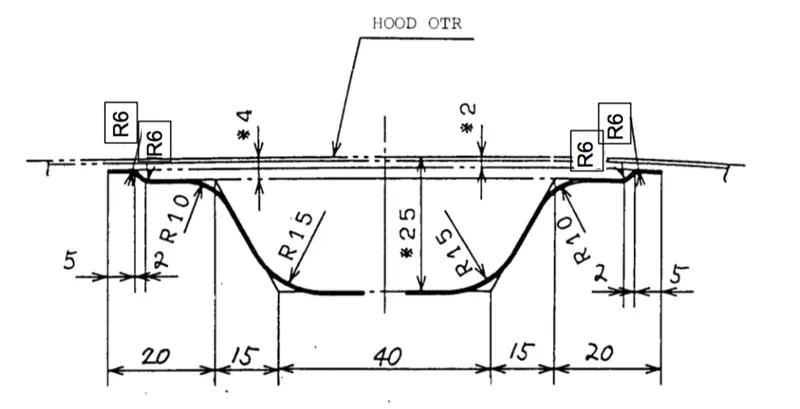
Master section is a predefined sketch which will be adaptable for different situations.
LATCH TRAJECTORY
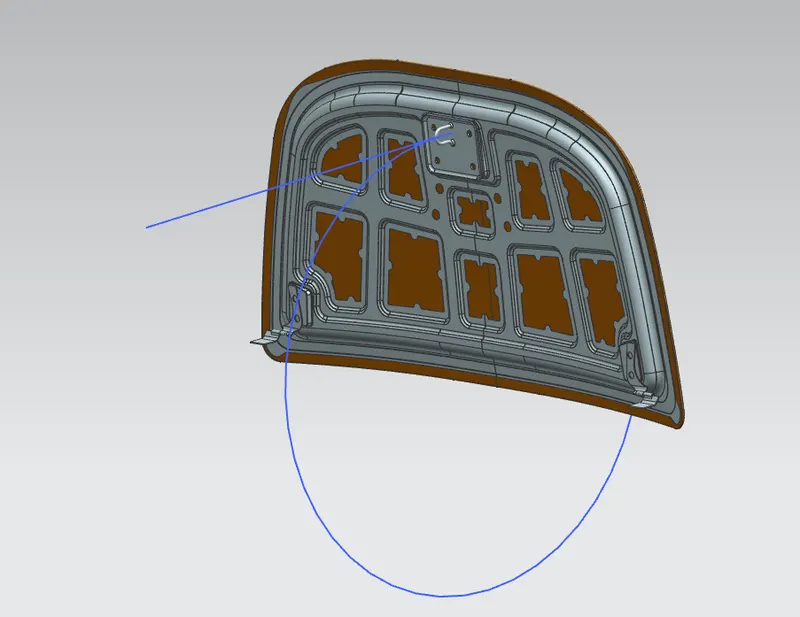
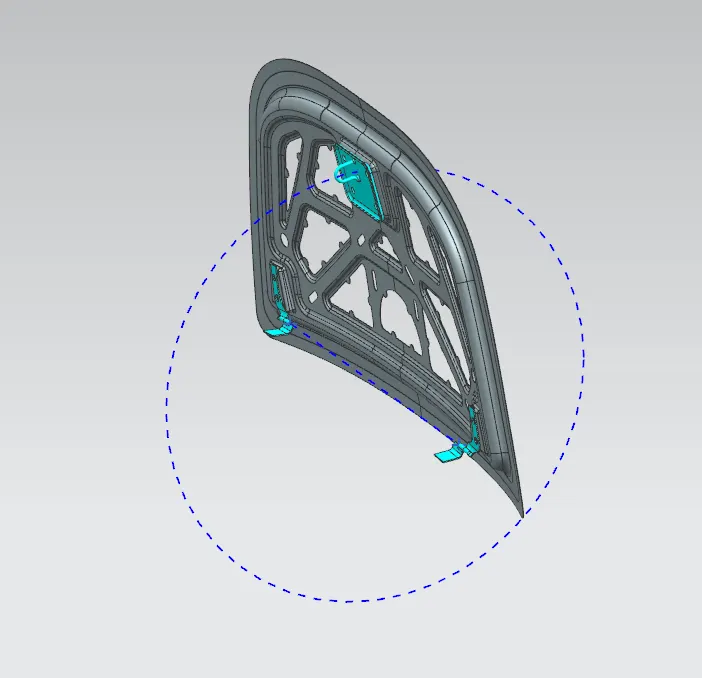
The latch trajectory shows the striker's way when the hood is opened and shut on a vehicle. The range of the round Trajectory is controlled by the set standard dependent on the typical stature of an individual. The range is estimated from the pivot hub up to the Latch. It is the Trajectory on which the movement of the hood (opening and closing are dependent). This circular Trajectory has a radius equal to the length from the centre point of the centre axis of the Hinge to the striker point on Latch. The striker point is also tangent to the Trajectory.
MASTIC SEALENTS
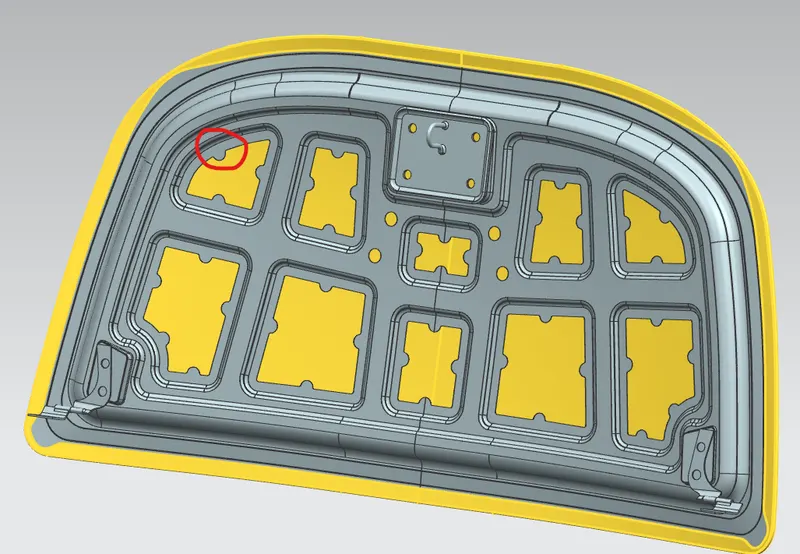
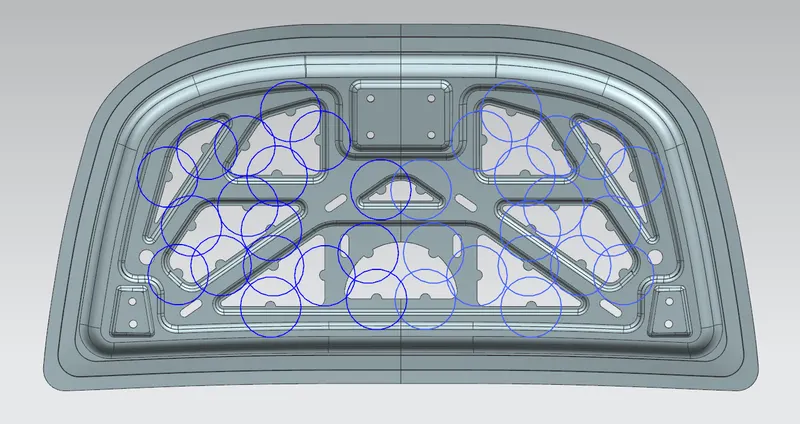
The mastic points are regions where mastic interferes with the outer panel to the inner board. We can't use spot welding because this gives less elegantly fulfilling results. Accordingly, mastic is used to join the panel as it doesn't modify the actual metal.
Mastic sealants used between the outer and inner panel. mastic sealants are the rubber like elasic compound which connects the outer and inner panels of car hood at specified points. Mastic sealants are used in the region between the inner and outer panel because other joining process like welding or riveting are not good for car asthetic design. It also helps in improving NVH (Noise, vibration, and harshness) characteristics.Mastic salant points are effective around a circular region of 80mm diameter.
EMBOSS DEFINITIONS
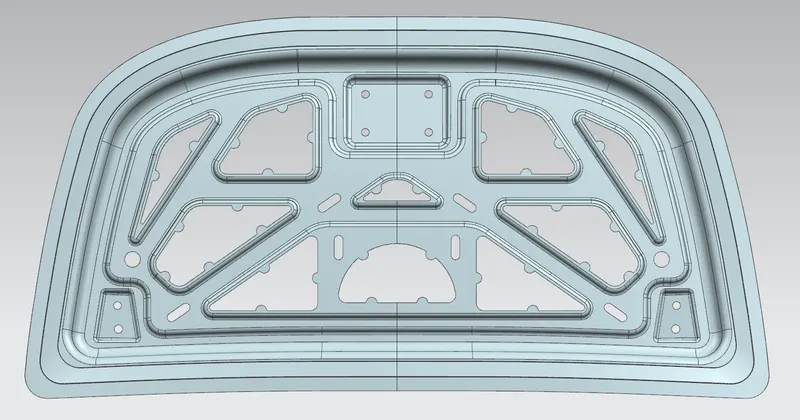
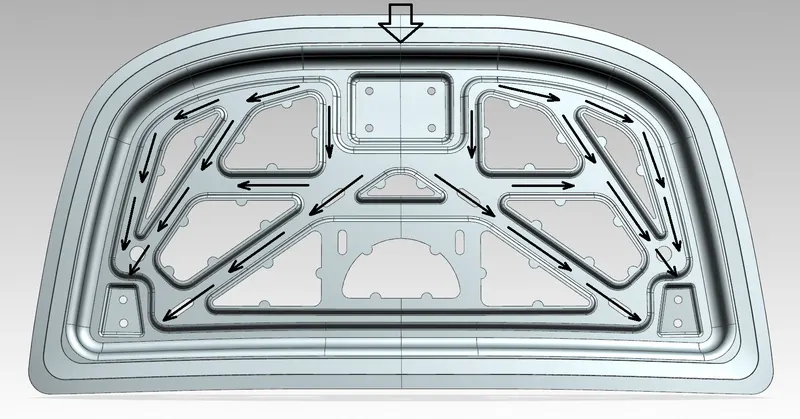
Embosses are provided to increase the strength of inner panel. Shape of embosses also determines the direction of collision force distribution. the shape of the embosses should be designed in such a way that, the collision forces should be directed towards outward side of the car (towards hinge side) .
SAFETY FEATURES
- PASSENGER SAFETY
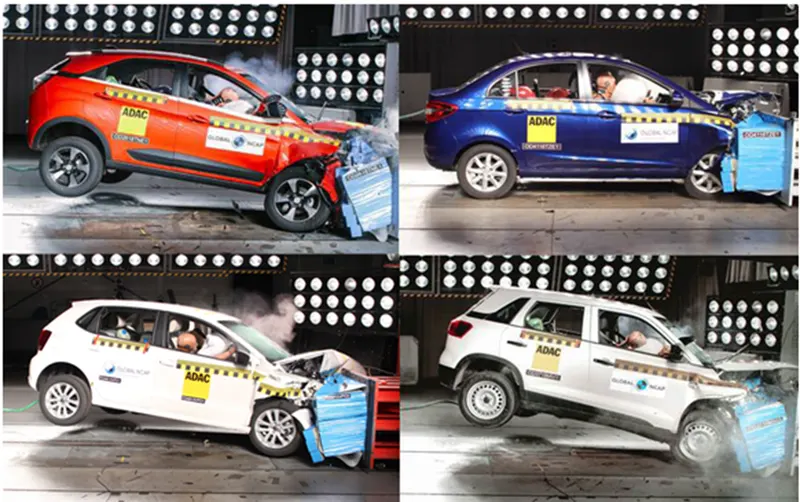
Whenever a frontal crash occurs in the car, the first part affected will be the hood. So must be designed in such a way that it should not come from the body of the vehicle and must absorb the energy as far as possible ad divert the force towards the side panel of the car so that the amount of force which is sent to the cabin is lesser since the force lesser the passenger will experience less amount of force so that passenger safety is ensured.
- PEDESTRIAN SAFETY
Safety of the pedestrians needs to be considered during the design as per the NCAP Euro assessment. Hood is of two types based on the side reference line. The side reference line is an imaginary line drawn from the ground at an angle of 45degree. If this line falls on the fender, then the hood is inlaid, and if the line falls on the hood, the hood is wrapped around the hood.
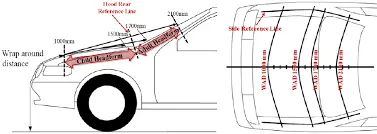
Child and adult impact areas on the hood are defined by wrap-around distance. The space between the wrap-around length of 1000- 1500mm in the child head impact zone and from 1500-2100 WAD is the adult head impact zone. We know the area where the pedestrian going to be hit; as a design engineers, we must make sure that they are exercising the most minor force such that they were not getting any serve injury without compromising the strength of the hood so that passenger safety must be assured .
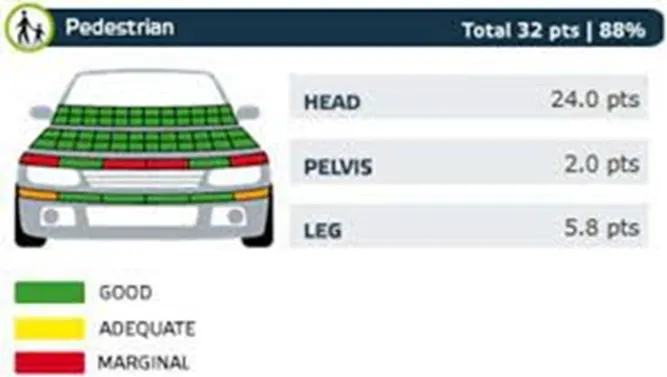
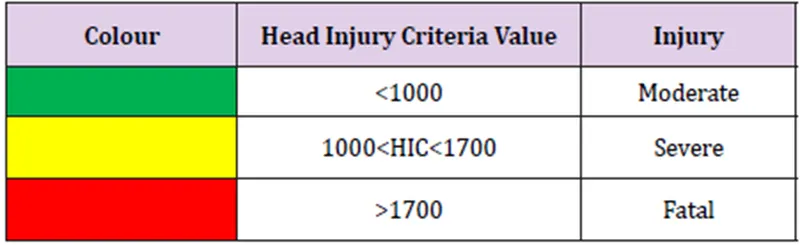
The Head impact area is defined as the side reference line and wrap-around distance. This zone will get a red, yellow, and green rating using the head injury criteria calculated using the expression. For this reason, the inner panel kept 25mm from the outer panel and created the embosses to improve the strength of the hood.
MANUFACTURING ASPECTS
The most important design consideration of any component is manufacturing aspect. In sheet metal, the component is manufactured by press tool dies. The Press tool is stamping which includes cutting operations like shearing, piercing etc. and forming operations like bending, Deep drawing, hemming etc. The main focus of manufacturing aspect is to manufacture hood assembly with minimum operation sequence and process time.
DEEP DRAWING;
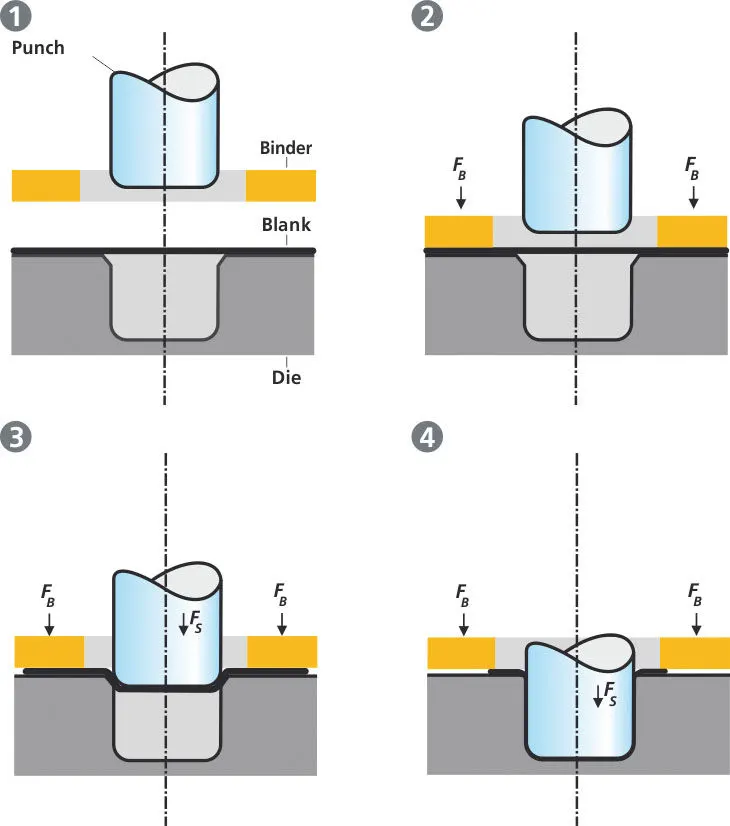
The manufacturing of deep, cuplike products from thin sheet metal is known as deep drawing. The process involves a punch with a round comer and a die with a large radius. The punch-die clearance is slightly larger than the thickness of the sheet metal to be deep drawn.As the load applied through the punch, the sheet metal is forced to flow radially and sink into the die cavity to form a cup. The process is best suitable for complex shaped problems.The deep drawing process is a forming process which occurs under a combination of tensile and compressive conditions. A flat sheet metal blank is formed into a hollow body open on one side or a hollow body is formed into a hollow body with a smaller cross-section.
Deep drawing creates a seamless effect on metal, allowing for the creation of a smooth, curved edge. Deep drawn metal parts are created using a single metal blank, not a repeated course of metal blanks as is typically the case with traditional metal stamping.
Deep drawing is one of the most widely used processes in sheet metal forming. Apart from its use in many other sectors, it is applied in the automotive industry for the manufacturing of car body parts.When drawing complex car body parts in practice, there is usually a combination of stretch and deep drawing involved. It is necessary that the sheet metal is stretched as well as possible without reaching the material’s limits (e.g. splits, wrinkles)
PIERCING;
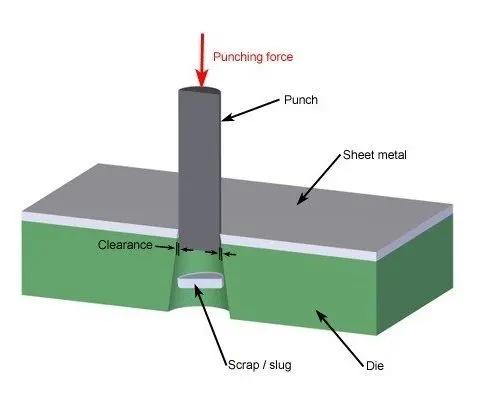
Piercing is a shearing process in which raw metal is pierced with a machining tool, resulting in the creation of a circular or other shaped hole.
HEMMING;
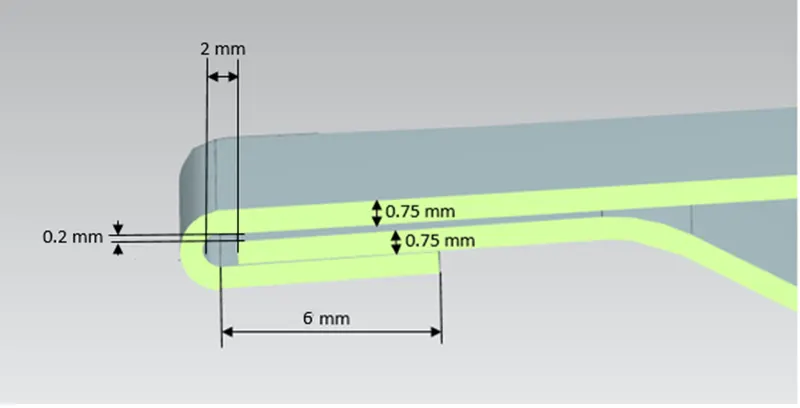
Hemming is a sheet metal forming process in which sheets are joined by bending it usually to 180°. Automotive body panels and automotive parts.
This assembly method is widely used in the final stages of production of automobile hoods, doors, or other closures for aesthetic purposesIt is a metalworking process that involves rolling the edge of sheet metal over and onto itself, essentially creating an area of two layers. During this process, the edge of sheet metal is folded over. The two newly formed layers then lie flush with each other.
The typical three-step bending process of the hemming operation comprising of the flanging, pre-hemming, and final hemming process.
FINAL ASSEMBLY OF HOOD
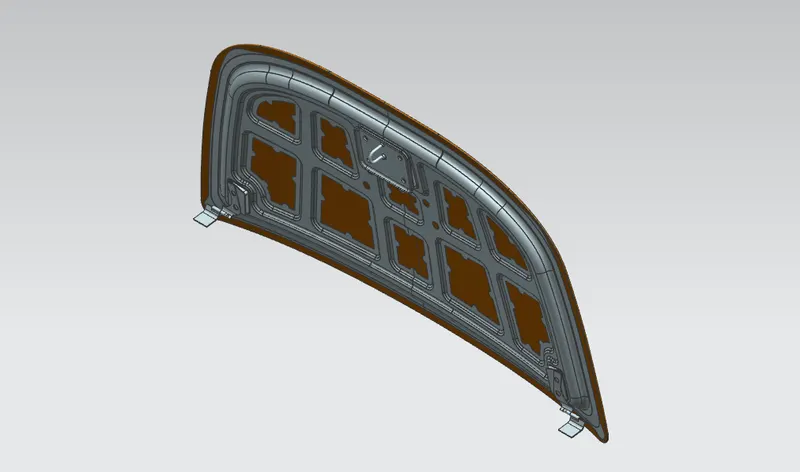
CONCLUSION
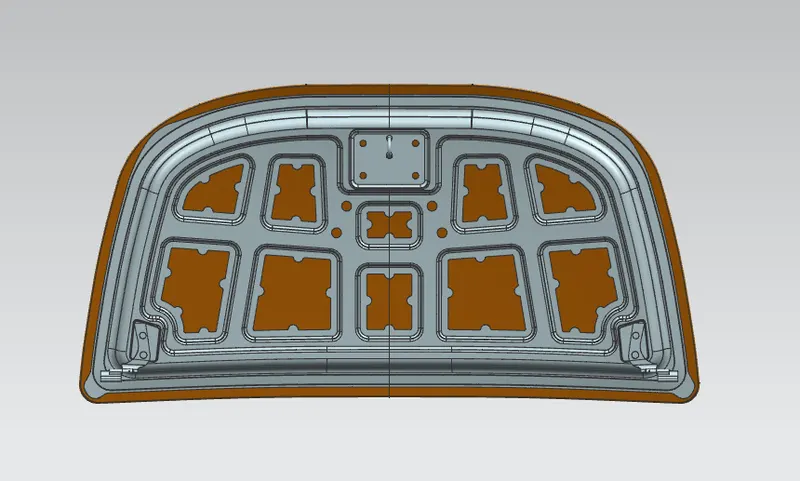
We designed a hood that falls under the rules & regulations of the manufacturer's standards.