Section Modulus calculation and optimization
AIM
To calculate the section modulus of the previously designed hood by analyzing its strength and also optimizing the design to see the difference in the bending strength of the hood.
SECTION MODULUS
Section modulus is a geometric property for a given cross-section used in the design of beams or flexural members. Other geometric properties used in design include area for tension and shear, radii of gyration for compression, and second moment of inertia and polar second moment of area for stiffness. There are two types of section modulus, the elastic section modulus and the plastic section modulus.
S=I/Y
where,
S=Section modulus (mm^3)
I=Moment of inertia (mm^4)
Y=Distance from the nutral axis to the extreme end of the object (mm)
Elastic section modulus:
For general design, the elastic section modulus is used, applying up to the yield point for most metals and other common materials.The elastic section modulus is defined as S = I / y, where I is the second moment of area (or area moment of inertia, not to be confused with moment of inertia) and y is the distance from the neutral axis to any given fibre. It is often reported using y = c, where c is the distance from the neutral axis to the most extreme fibre, as seen in the table below. It is also often used to determine the yield moment (My) such that My = S × σy, where σy is the yield strength of the material.
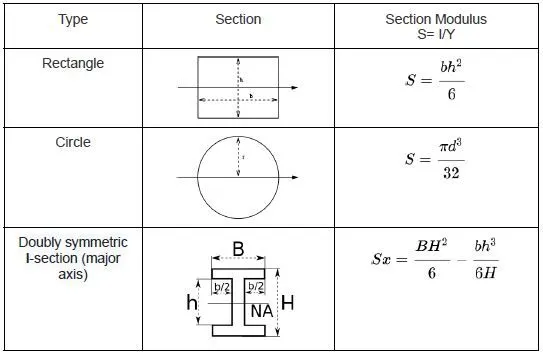
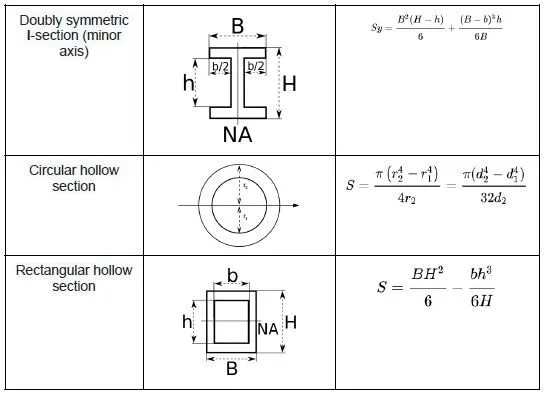
Plastic section modulus:
It is defined as the sum of moment of areas on each side of plastic nutral axis.An axis that divides the cross section in such a way that the tensile force from the area in the tension and compressive force from the area in compression are equal,is called plastic nutral axis.
It used to find the maximum bending moment at a point when all the fibers in a cross section have yield elastically. At this point, the entire section behave plastically.
MOMENT OF INERTIA
It is defined as the quantity expressed by the body resisting angular acceleration which is the sum of the product of the mass of every particle with its square of a distance from the axis of rotation. Or in more simple terms, it can be described as a quantity that decides the amount of torque needed for a specific angular acceleration in a rotational axis. Moment of Inertia is also known as the angular mass or rotational inertia.The SI unit of moment of inertia is kg m^2
SECTION MODULUS CALCULATION OF HOOD
CASE I,
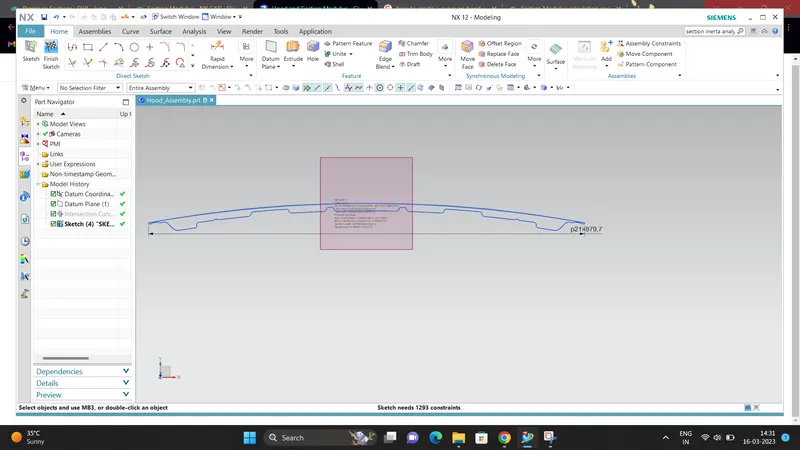
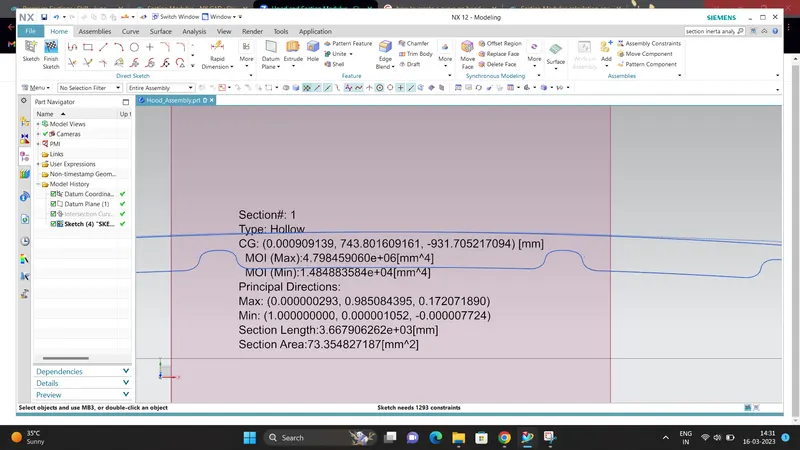
MOI(min)=1.484883584 x 10^4 (mm^4)
Length from nutral axis=879.7/2=439.85(mm)
S=I/Y
S=33.75 MM^3
CASE II,
Increase the area by offseting the curve by .5 mm,
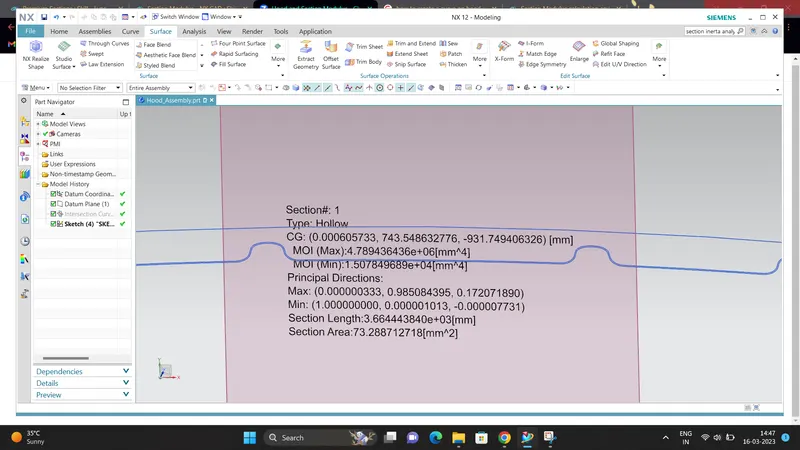
MOI(min)=1.507849689 x 10^4
Length from nutral axis =439.85(mm)
S=I/Y
S=34.28 MM^3
CONCLUSION
we can see the moment of inertia and section modulus increases with the increase in area,which means the strength of the material also increases.