Hood design-Week 2
Aim : To Design outer panel, inner panel and necessary reinforcements mentioned in the master section
Theory :
The hood or bonnet is the hinged cover over the engine of motor vehicles. Hoods can open to allow access to the engine compartment, or trunk on rear-engine and some mid-engine vehicles) for maintenance and repair.Body in white (BIW) is the stage in automobile manufacturing in which a car body's frame has been joined together, that is before painting and before the motor, chassis sub-assemblies, or trim (glass, door locks/handles, seats, upholstery, electronics, etc.) have been integrated into the structure. In car design, the "body in white" phase is where the final contours of the car body are worked out, in preparation for the ordering of the expensive production stamping die. Extensive computer simulations of crash-worthiness, manufacturability, and automotive aerodynamics are required before a clay model from the design studio can be converted into a body in white ready for production.
Styles and materials
On front-engine cars, the hood may be hinged at either the front or the rear edge, or in earlier models (e.g. the Ford Model T) it may be split into two sections, one each side, each hinged along the centre line. A further variant combines the bonnet and wheelarches into one section and allows the entire front bodywork to tilt forwards around a pivot near the front of the vehicle (e.g. that of the Triumph Herald).
Hoods are typically made out of the same material as the rest of the body work. This may include steel, aluminum, fiberglass or carbon fiber. However, some aftermarket companies produce replacements for steel hoods in fiberglass or carbon fiber to make the vehicle lighter.
Release/ safety and security mechanisms
The hood release system is common on most vehicles and usually consists of an interior hood latch handle, hood release cable and hood latch assembly. The hood latch handle is usually located below the steering wheel, beside the driver's seat or set into the door frame. On race cars or cars with aftermarket hoods (that do not use the factory latch system) the hood may be held down by hood pins. Some aftermarket hoods that have a latch system are still equipped with hood pins to hold the hood buttoned down if the latch fails.
HOOD – TYPES
There are two major types of hoods;
- Inlaid hood
- Wrap around hood
- Inlaid hood
It is lightest among all types of hoods. But it is easily subjected to border defects and body unevenness during manufacturing. Here I am designing an inlaid hood.
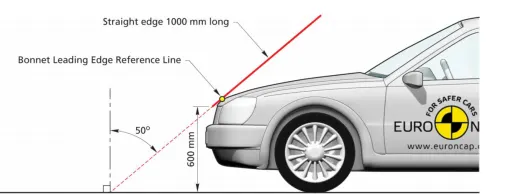
2.Wrap around hood
As name itself it wrap around the car body. It can mask the geometrical defects and provide adequate stiffness. It is relatively safer than other types as it provides more safer areas for the pedestrian during impact.
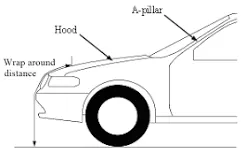
Manufacturing process
(a) Cutting and Shearing- Here the sheets are cut by using various tools. Blanking, piercing, perforation, notching etc. are various types of shearing operations.
(b) Bending Operation- The sheet metals are straining around a straight axis.
(c) Forming- Flanging and tube forming are forming operations to give shape to the sheets.
(d) Drawing Operations- Cupping, drawing, deep drawing are all drawing operations in which sheet metals are given cup or shell type shapes.
(e) Reducing Operations- Necking type of operations.
(f) Squeezing- For example coining operation is done in closed dies applying large force.
Bending:
It is a forming operation performed on a press to bend a sheet metal or a strip through required angle.
Salient features of bending are:
(a) It requires a press and tooling to do the bending operation.
(b) The sheet metal strip is permanently deformed to the required shape.
(c) When the sheet metal is pressed for bending in the die the outer portion is stretched while inner sides (towards the punch) are compressed.
(d) The radius of the corner should not be small i.e., the angle at the bent should not be too sharp—otherwise material can crack at the bend.
(e) After removal of the bent component from the press there is usually spring back up to about 4 degrees depending on the material hardness. Hard material have greater tendency to spring back while softer materials have less tendency to recover shape.
Blanking:
(a) Blanking is an operation of cutting an object of given shape from sheet metal strip. It may or may not be necessary to perform further operations on the blank. Piece detached from the metal strip is called blank. Examples are discs, washers.
(b) Blanking operations are extensively used in sheet metal working to make components like washers, discs etc. If needed other operations may be combined with the blanking operation. Blanking is usually the first operation in sheet metal.
(c) A blanking operation to make disc from a steel strip would require-
(i) A press
(ii) A punch and die with clearance at the lower side so that the disc can fall down freely.
(iii) The material for blanking operation is usually hard.
Piercing is a shearing process. Here raw metal is pierced with a machining tool, resulting in the creation of a circular or other shaped hole.
Sheet metal embossing is a stamping process for producing raised or sunken designs or relief in sheet metal.
Hemming is the process in which the edge is rolled onto itself. Hems are commonly used to reinforce an edge, hide burrs and rough edges, and improve appearance.
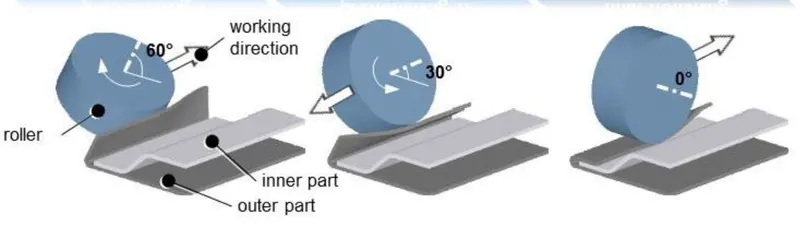
DEEP DRAWING
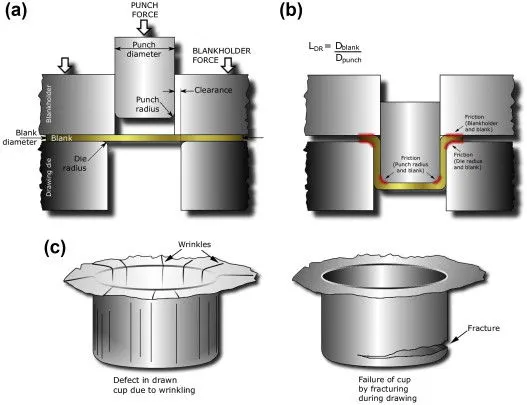
Here,
- Outer panel thickness = 75mm
- Inner panel thickness = 75mm
- Reinforcement thickness = 5mm
Design Methodology
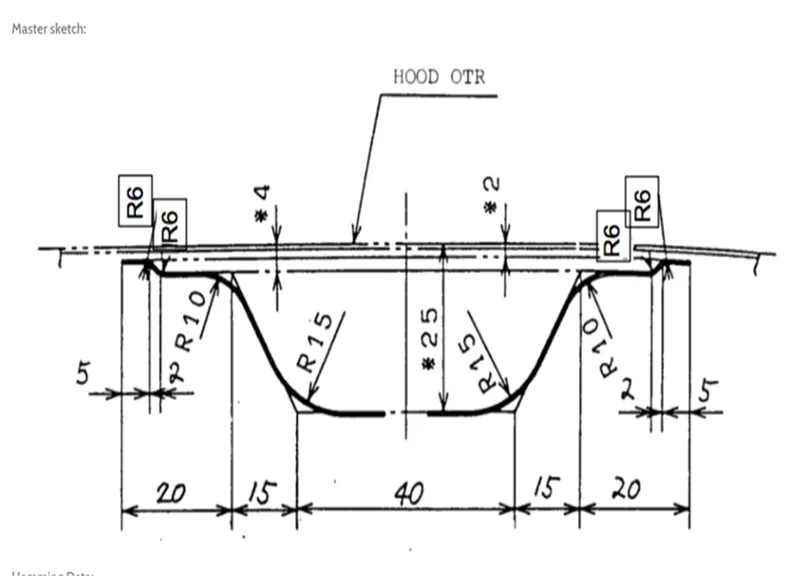
The master section of the hood inner panel is shown in the image below. It provides information such as distance between various layers (emboss), fillet radii, width, clearances etc.
Master section of hood
Hood inner panel was designed at first. The various stages of inner panel development are shown below. Here, the embossings were created. The main design consideration is to diverge any impact forces away from the passenger cabin.
Necessary cuts were provided for sufficient deformation of the outer panel without any restrictions caused by the inner panel in case of pedestrian impact. This also helps to reduce the overall weight of the hood. Also mastic sealant points were created on the inner panel. Provisions for attaching the fixtures, various holes for supplying viper fluid and ED bath drain holes, hinge and striker attachment holes etc. were designed. Diabolo embosses for fixing the hinges and striker on the inner panel were also created as shown below.
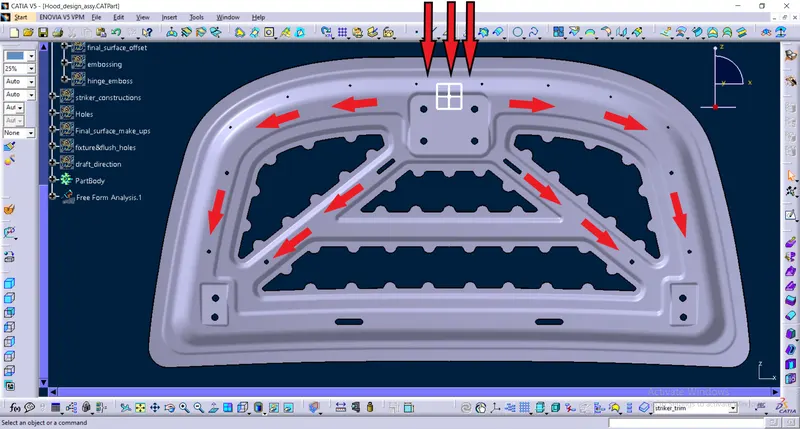
Impact forces diverging away from the passenger cabin
The draft analysis of the hood inner panel was successfully performed with a minimum angle of 7 degree with respect to the tooling direction.
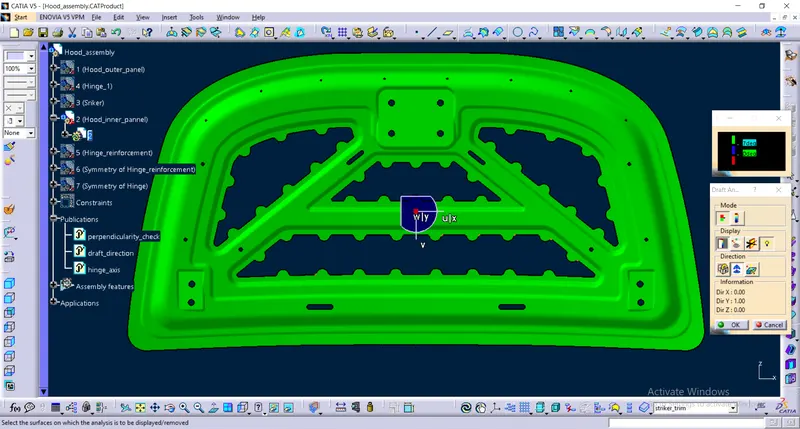
Draft analysis
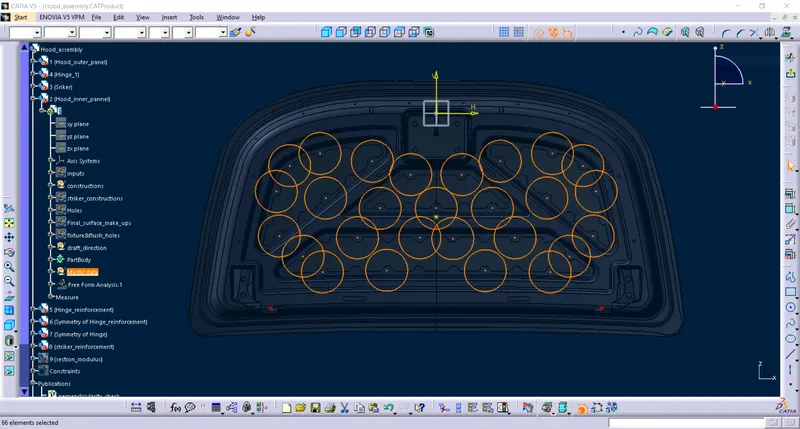
Mastic sealant data
Development of the hood outer panel was the next step. Thickness of the sheet metal used is 0.75mm. The hood outer panel and inner panel have a clearance of about 5mm at mastic sealant application points. Hemming is a sheet metal working process in which the edges are rolled over onto itself. 0.2mm clearance provided between the surfaces of inner panel and hemmed edges of outer panel for application of structural adhesives. Necessary corner reliefs were also provided.
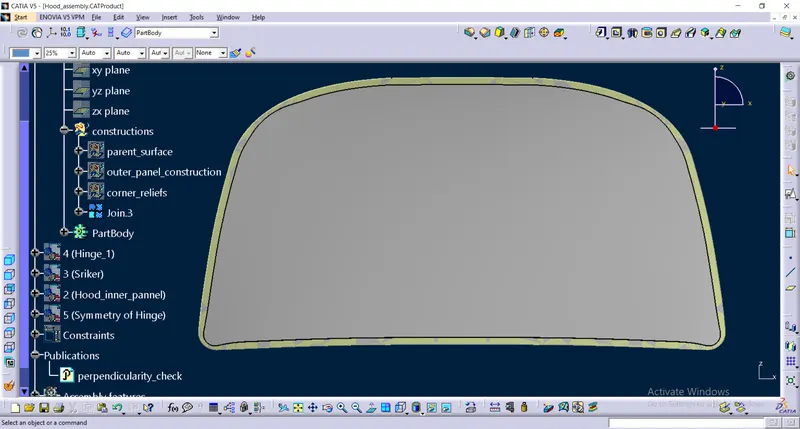
Outer panel of hood
Hood inner panel, outer panel, hinges, striker and all reinforcements were assembled together.
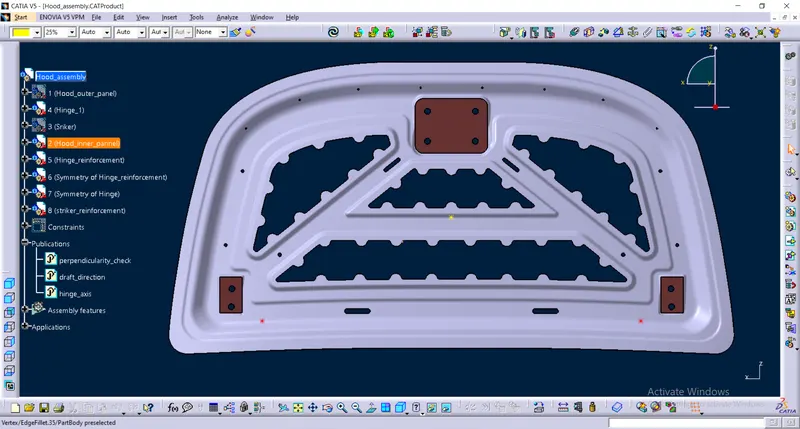
Hinge and striker reinforcements (Brown coloured)
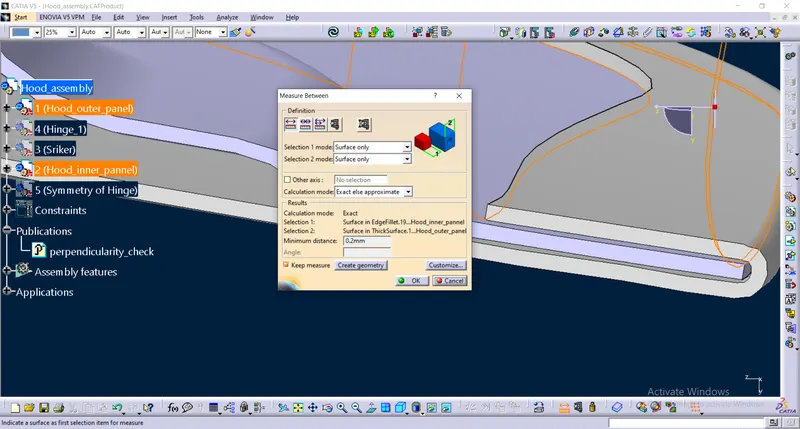
Hemming
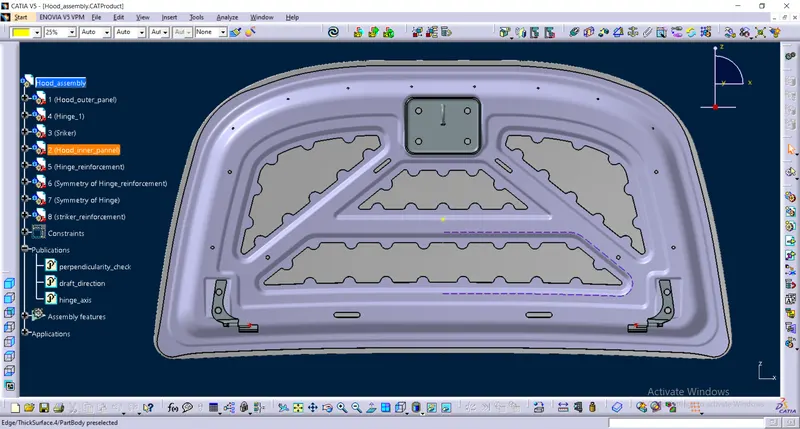
Full assembly
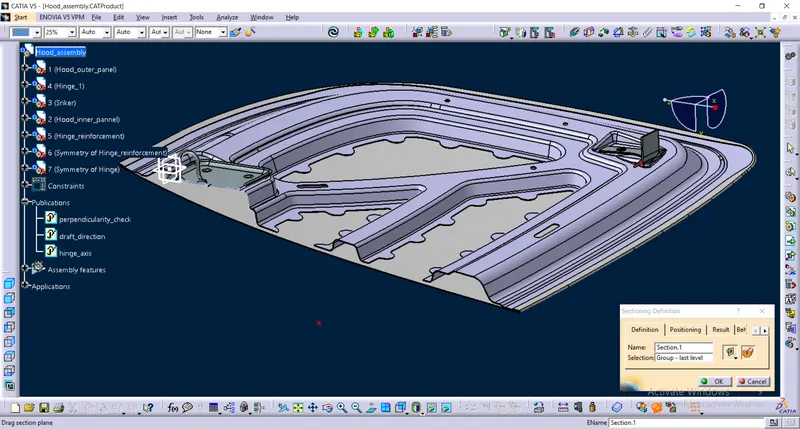
Cross sectional view
The striker is positioned in such a way that it’s tip perfectly follows the trajectory (cyan coloured circle) with hinge axis as centre. Then only the proper opening and closing of the hood can be performed.
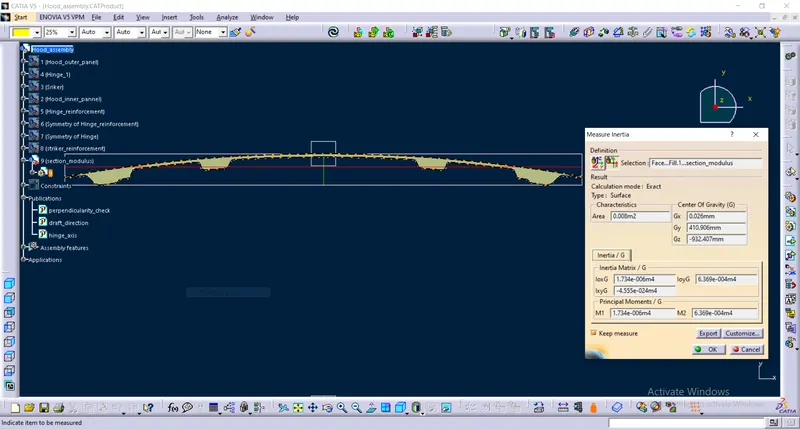
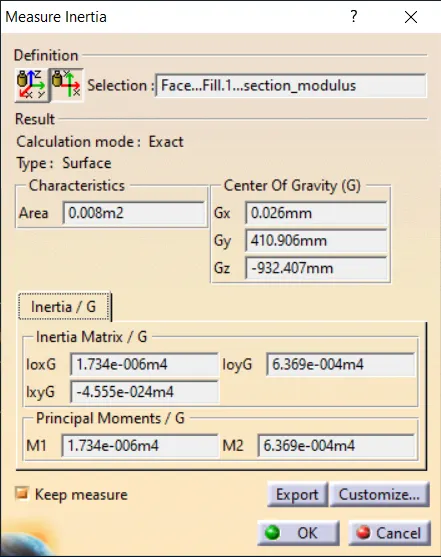
Section modulus & yield moment calculation
Section modulus is a geometric property for a given cross-section used in the design of beams or flexural members. For general design, the elastic section modulus is used, applying up to the yield point for most metals and other common materials. The yield moment of a cross section is defined as the moment that will just produce the yield stress in the outer most fibre of the section.
(y=882.069/2)
Section modulus, S = I/y
Where,
S - Section modulus
I - Area moment of inertia
y - Distance between neutral axis and extreme end of the fibre
Therefore, I = 1.734 × 10^6 mm^4
y = 882.069/2
= 441.0345 mm
So, Section modulus, S = 1.734 x 10^6 mm^4 / 441.0345 mm
= 3931.665mm^3
Yield moment, My = S × σy
where,
S - Section modulus
σy - Yield strength of material - Stainless steel AISI 302 - cold - rolled
(σy = 520 N/mm^2)
So, yield moment, My = 3931.665 × 520
= 2044465.8 N mm
(Note: 302 stainless steel is an Austenitic, non-magnetic, extremely tough and ductile stainless steel alloy. AISI 302 annealed stainless steel is highly corrosion resistant and maintains its strength at high temperatures up to 550°F (288°C). Additionally, 302 stainless steel is non-magnetic in the annealed condition and cannot be further hardened by heat treatment. As an added benefit both the hardness and tensile strength of AISI 302 can be increased by cold working)
References:
1) https://en.wikipedia.org/wiki/Body_in_white
2) https://www.autotechcollision.com/diminished-value-claims/
3) https://www.roadandtrack.com/new-cars/first-drives/reviews/a15530/2011-
4) https://www.carthrottle.com/post/66l83yq/
5) https://www.kame.com/classroom notes pdf
Conclusion:
Thus the hood was successfully designed by following the procedures. The model is passed to the CAE team for further analysis for optimizing the design. Hood inner and outer panels are usually manufactured through metal stamping processes. Metal stamping is a manufacturing process used to convert flat metal sheets into specific shapes. It is a complex process that can include a number of metal forming techniques — blanking, punching, bending and piercing, to name a few. Stamping — also called pressing — involves placing flat sheet metal, in either coil or blank form, into a stamping press. In the press, a tool and die surface form the metal into the desired shape. Punching, blanking, bending, coining, embossing, and flanging are all stamping techniques used to shape the metal.