Hood design-Week 2
Report On Hood Design of a Car.
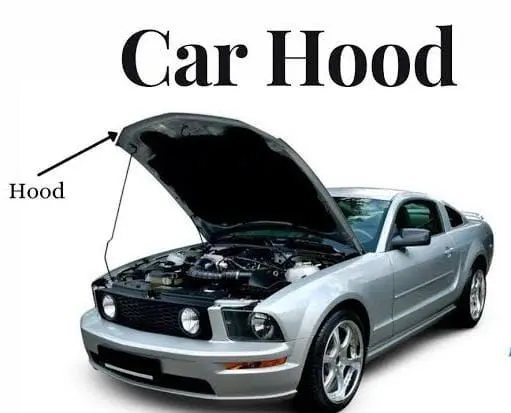
A car hood which is also called "Bonnet" is the hinged cover that rest over the engine bay of a front -engine vehicle. It protects the engine and its connected components and also it provides easy access for repair and maintainence. At first sight the hood of any car looks very simple from outside, but in reality the designing of hood is very complecated. Apart from providing the cover for the engine, its major role is to provide better safety to the passengers and pedestrians. The design of hood should be such that it dissipate the impact force outside the car and it tries to absorbs as much force as it can so that passengers inside the car will be safe. For pedestrians saftey, its design should be in such a way that when any pedestrians falls , the region where his head strike should absorb impact and tries to deform as much as it can.
There are some major components and Terms used while designing the Hood which is mentioned below.
- Latch Trajectory:
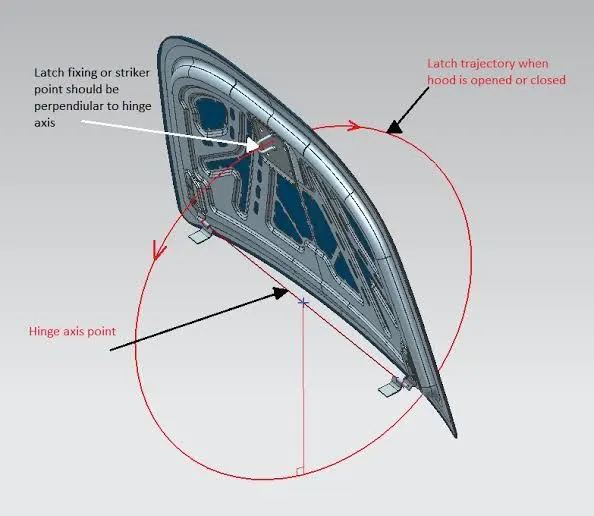
Latch trajectory is nothing but the circular path of the striker which get attached or locked with engine side body. It axis of rotation is the line joining the two higes which hold the hood or simply its axis of rotation is the hinge axis. The striker is positioned in such a way that it will be always tangent of the latch trajectory.
Mastic Data:
Mastic is the sealent which is used to join inner and outer pannel of a Hood. A study shows that 10mm dia mastic can provide strenght upto 80mm dia. These are generally placed where mastic cuts are made in the inner paannel of the hood. Mastic also helps to maintain distance between inner and outer pannel which is generally 5mm also it helps to absorbs sound coming from the engine side.
Emboss:
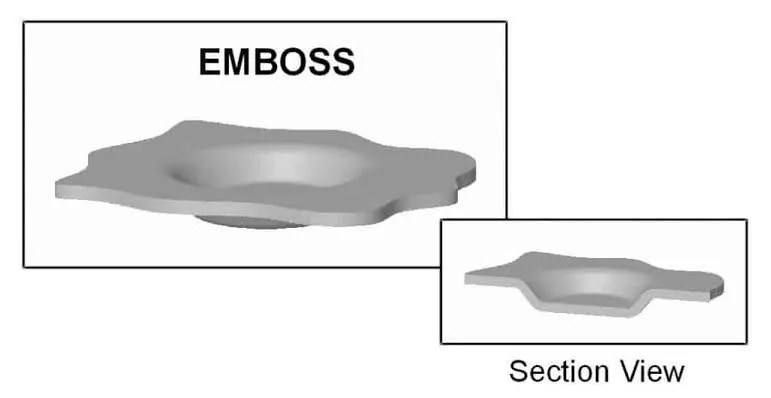
Sheet metal embossing is a stamping process for producing raised or sunken designs or relief in sheet metal. This process can be made by means of matched male and female roller dies, or by passing sheet or a strip of metal between rolls of the desired pattern. It is often combined with foil staming to create a shiny, 3D effects. It increases the strength of the sheet upto a certain limit.
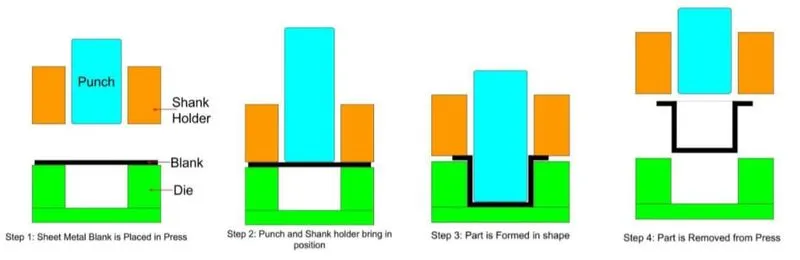
Deep drawing is a sheet metal forming process in which a sheet metal blank is radially drawn into a forming die by the mechanical action of a punch. It is thus a shape transformation process with material retention. The process is considered "deep" drawing when the depth of the drawn part exceeds its diameter. This is achieved by redrawing the part through a series of dies.
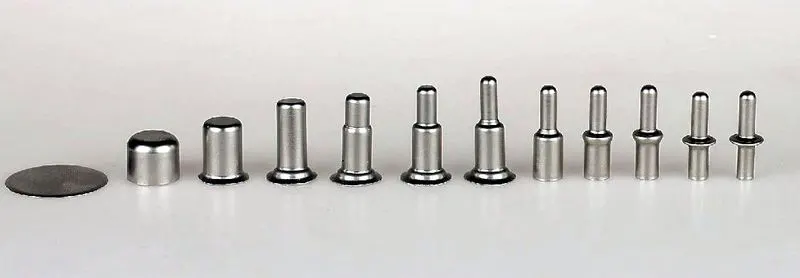
Caompressive and tensile forces are used in the deep drawing operation to concert flat sheet metal blank into hollow body. Following sheet metal forming operation can convert a sheet metal blank into a deep-drawn sheet metal part . After sheet metal forming , part finishing operation is done like triming, cutting, cleaning, and powder coating.
Hemming Process: Hemming is a forming operation in which the edges of the sheet are folded or folded over another part in order to achieve a tight fit. Normally hemming operations are used to connect parts together, to improve the appearance of a part and to reinforce part edges.
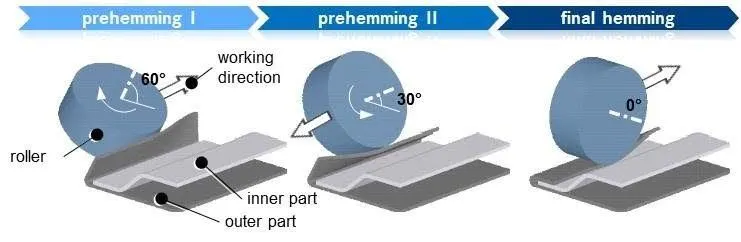
In car part production, hemming is used in assembly as a secondary operation after deep drawing, trimming and flanging operations to join two sheet metal parts (outer and inner) together. Typical parts for this type of assembly are hoods, doors, trunk lids and fenders.
The accuracy of the hemming operation is very important since it affects the appearance of the surface and surface quality. Material deformations, which occur during the hemming process, can lead to dimensional variations and other defects in parts. Typical hemming defects are splits or wrinkles in the flange, material overlaps in the corner areas or material roll-in. This is why it is important to use simulation tools in order to, on the one hand, better understand the hemming process and, on the other hand, significantly reduce the number of “trial and error” loops during tryout und production.
Support Rod:
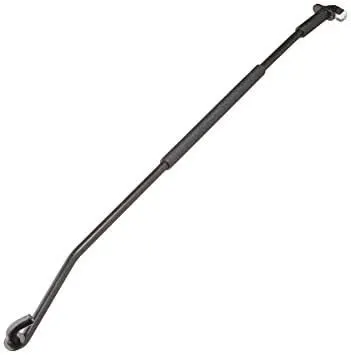
This is nothing but Iron or steel bar which is used to hold the opening of the hood at a certain angle. It is generally bend in patern to form a rigid structure so that it can hold the weight of hood which is generally 8-10kg without any failure. The holding position or angle of the rod should be such that the striker didnt hit person while in opening condition and engine maintainence or repairing work can done easily.
Report Prepared by : Vikash Rai (Mechanical Engineer)