Hood design-Week 2
HOOD DESIGN
AIM
A detailed report about the Hood Design which includes a detailed explanation about hood and its components, Latch Trajectory, Mastic Data, Emboss Definitions, Manufacturing process like Deep-Drawing and Hemming, and all the parameters followed in the design.
INTRODUCTION
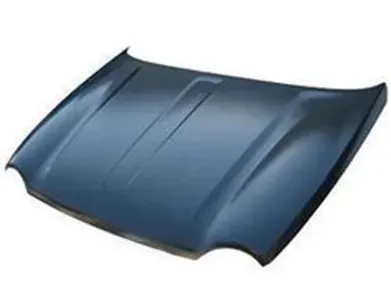
The hood or bonnet in white (BIW) is the hinged cover over the engine of motor vehicles. It's utilized to protect the engine and other accessories as well it absorbed the most of the impact force across the body which provides safety to the vehicle. It also allows access to the engine and its components for maintenance and repairs work. The car’s hood consists of an inner and an outer panel. The inner panel provides strength, while the outer panel is just a metal cover. It has only one opening and is closed on all other sides. It is hinged thin sheet which covers and protects the main parts of car like engine. This is the one which dissipates the energy outside the car body rather than sending to inside the car body. The hood design must be in aerodynamic shape, fancy and luxurious looks.

PURPOSE OF HOOD DESIGN
1. PROTECTION OF VITAL COMPONENT
- Hood generally is used to covering car engines, radiators, and many other parts, therefore, the hood must be designed in such a way that all the maintenance on the engine.
- The hood or bonnet is the hinged cover over the engine of motor vehicles that allows access to the engine compartment, or trunk for maintenance and repair.
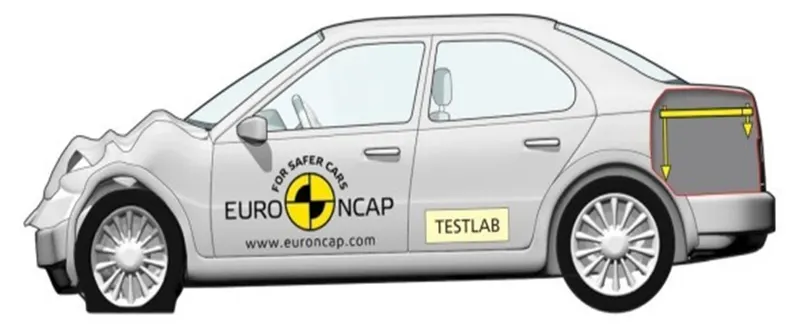
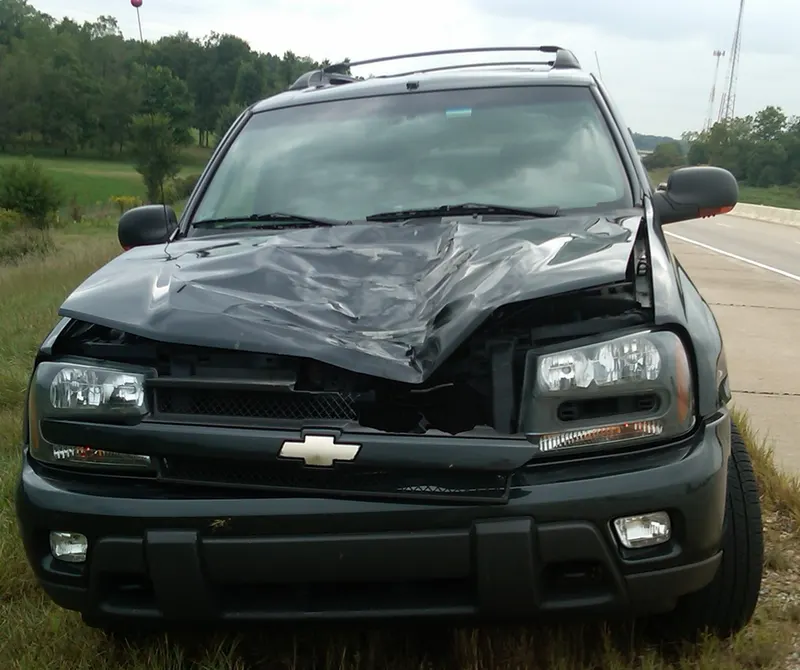
- When cars come across any accident from the front portion most of the time the hood system gets damaged and absorbs some part of the impact energy resulting from the crash.
2. PEDESTRAIN SAFETY
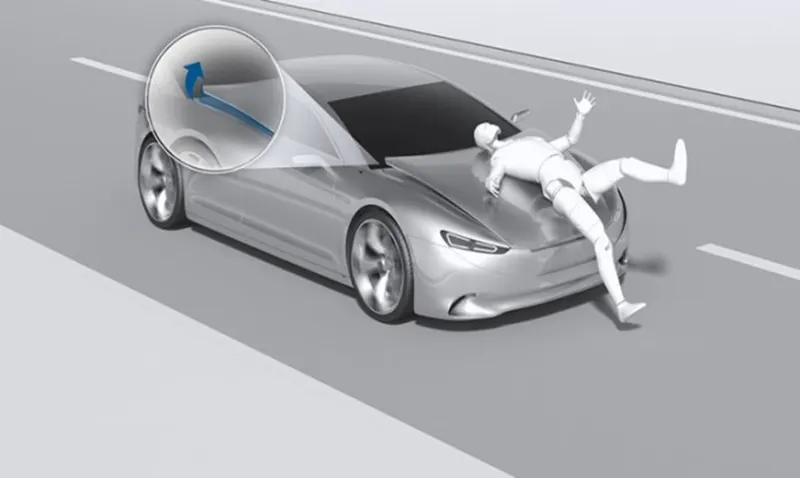
- With a constant rise in road accidents, it is high time safety standards are given the center stage. The number of injuries and fatal deaths has increased resulting from street accidents due to the increased urban population and amount associated with private vehicles. So the hood of the car designed in such a way that there is very little damage occurs.
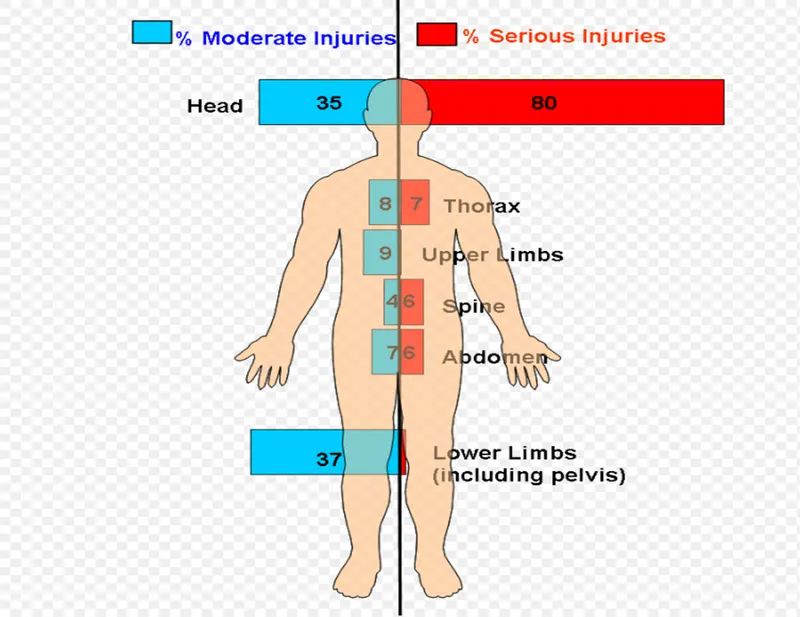
- Most pedestrian deaths occur due to traumatic brain injury, resulting from the hard impact of the human head against the vehicle's stiff hood or windshield. Therefore, how to design a pedestrian-friendly vehicle and propose a new hood structure is a matter of urgency for minimizing pedestrian head injuries.
- In this study, three kinds of sandwich hood structures are proposed for reducing pedestrian head injuries, including carbon fibre-reinforced polycarbonate, carbon fibre-reinforced foam and aluminium-reinforced polycarbonate. In assessing the friendliness of vehicle hoods, it is most importance that we make sure not to place re-enforcement on the areas prone to high head impact.
- Also, the child impact area is designed with lesser thickness than the adult impact area so that in the event of a frontal collision where a child is involved, the bonnet will absorb the impact of the crash and crumble to protect the child’s head from absorbing the force. The hood of most vehicles is usually fabricated from sheet metal, which is a compliant energy absorbing structure which poses a comparatively small threat.
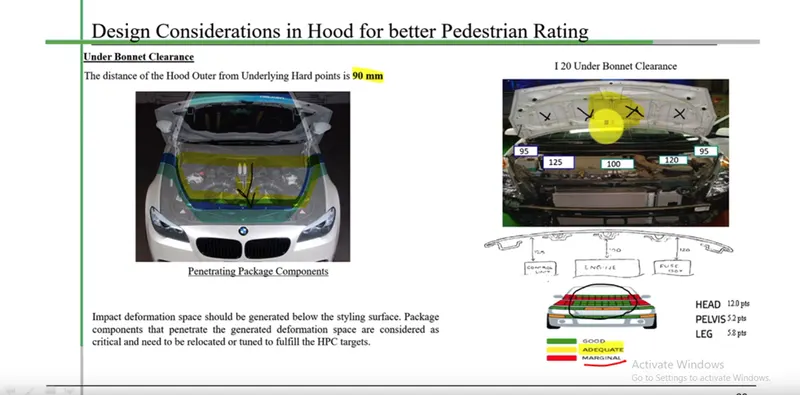
- Most serious head injuries occur when there is insufficient clearance between the hood and the stiff underlying engine components. A gap of approximately 10 cm is usually enough to allow the pedestrian’s head to have a controlled decleration and a significantly reduced risk of death.
3. INSIDE SAFETY
- The hood cover is important to protect engine, radiator, battery and other accessories along with this, it helps in keeping the passengers safe inside the car.
- This is how, when cars come across any accident from the front portion most of the time the hood system gets damaged and absorbs some part of the impact energy resulting from the crash. In this way it protects the passenger inside the car from several injuries.
4. AIRODYNAMICS
- Hood is made aerodynamic in shape to reduce air effect and used to decorate the front portion of the car and to add a luxurious look of car.
- Bonnets are designed to reduce air resistance as the air flows around the car.
- The design of the bonnet is vital since it affects the aerodynamic flow around the car.
- Drag reduction in cars is evident by the angle of windscreen inclination. Windscreen inclination affects the height of the vehicle.
- The curvature of the windscreen should be optimized in order to avoid the cross-wind effect.
- Hood inclination should be optimized for minimum drag.
- The angle of windscreen inclination proposed such that it does not affect driver visibility.
- It should accumulate the raindrops and dirt effectively.
- Windscreen inclination angle selected such that it does not affect the stability due to change in vehicle dimensions.
- The windscreen inclination is obtained by taking visibility concerns into account.
- The dimensions of the windscreen of a car are obtained from works of literature and modelled in modelling software. Firstly, the effect on windscreen inclination with respect to drag is studied using ANSYS Fluent. CFD analysis is done with inlet velocity of 25 m/s and the influence of vehicle height against the drag coefficient is identified. By varying inlet velocity of air, the pressure contours in the frontal hood of the vehicle are studied. From the studies, it is observed that 32 ° back windscreen angle gives the minimum CD. The front windscreen angle should be Below 45° for minimum drag and CD is decreasing linearly as hood inclination increases. The drag coefficient is reduced by optimizing the frontal area. From the studies, It is observed that front windscreen angle 60°, back windscreen angle 32° and 15° hood inclination gives the minimum CD as 0.320.

5. REDUCES ENGINE NOISE
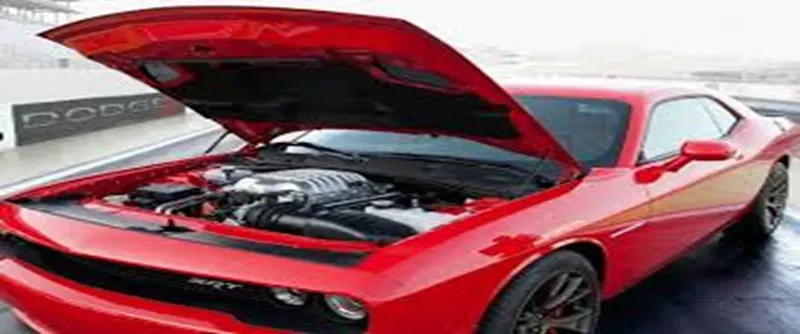
- The engine hood, additionally represents an aesthetic component on the engine cover, if it is well designed could be able to reduce noise emissions of the engine, producing a better acoustic comfort on the cabin and a better insulation outside of the engine compartment.
- The characterization of acoustic transmission of the engine compartment is performed with an experimental method. The technique was improved with an electroacoustic system including an inverse filtering method. The results on such characterization are achieved with the Sound Transmission Loss technique, (TL) which has been measured in several positions surround the vehicle hood.
DESIGN REQUIREMENT FOR THE HOOD
For perfect Hood design many criteria should be followed. The main criteria during designed of the
- Opening angle of Hood
- Hood thickness
- Hood master section
- Component of hood
- Manufacturing process (Hemming data)
- Important features
- Material of Hood
- Hood features
- pedestrian safety
1. OPENING ANGLE OF HOOD
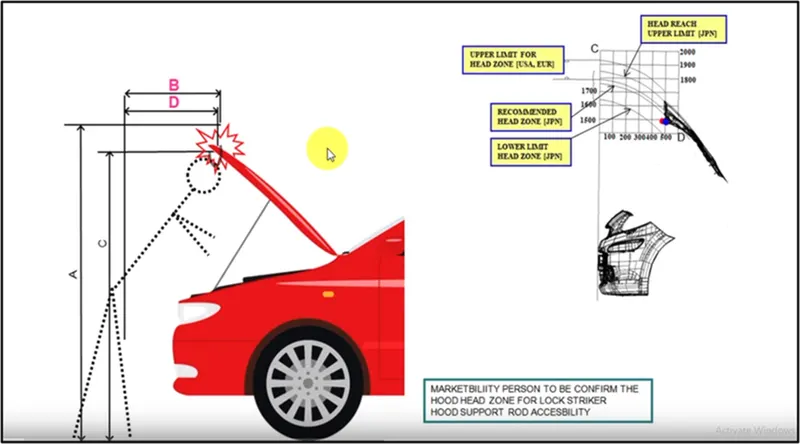
The first important criteria when the hood is designed is its opening angle. This opening angle is varies region to region. In India market, the average height of human being is 5.5’ and at that situation we apply the particular angle. But in other situation, the average height of human being is 6’. Which means, we have to increase the angle little more. It is controlled by gas stay and support rod. The important criteria for designed the hood angle is clearance between the tip points of the hood to the striker. A gap of approximately 10 cm is usually enough to allow the pedestrian’s head to have a controlled decleration and a significantly reduced risk of death. We generally assumed it from Japanese market.
TYPES OF HOOD BY OPENING
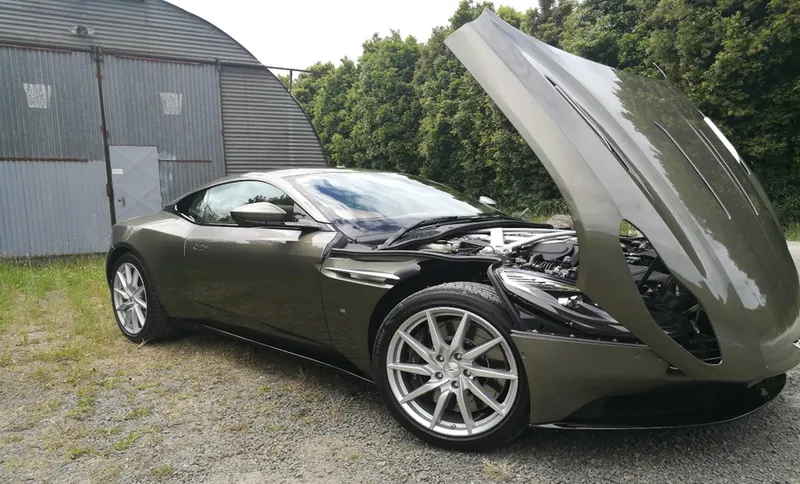
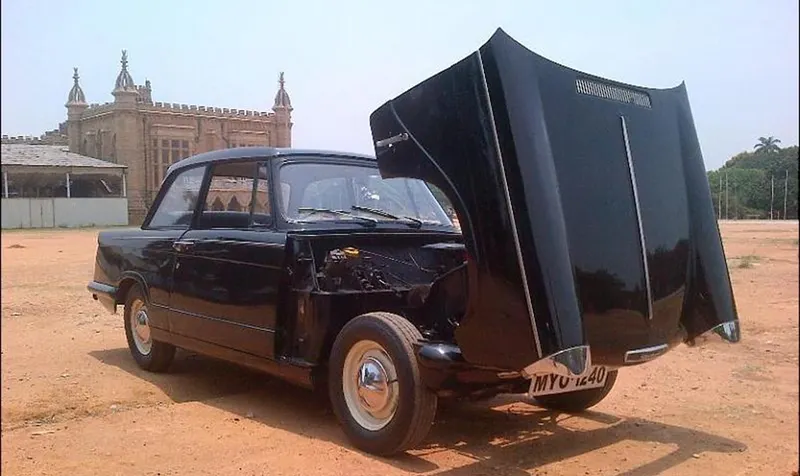
Most cars have their engine bays in the front of the cabin. To access the engine, one has to lift a bonnet, which is generally hinged just below the front windshield. In some cars, however, you will find bonnets which are hinged at the front end of the engine bay – near the radiator.
A. SAME SIDE OPENING HOOD-: Most conventional bonnets open at an angle of 45 degrees. This limits the headroom available while working on the engine. Front-hinged bonnets, on the other hand, can open at almost 90 degrees. This type hood is opened from front side of car.
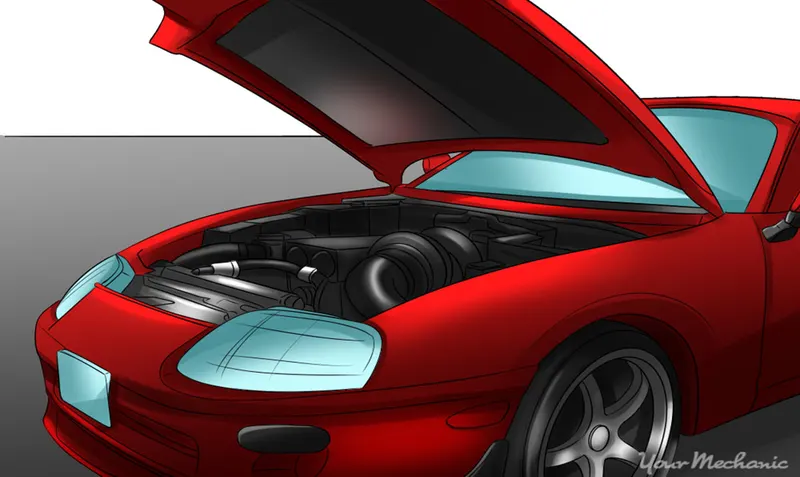
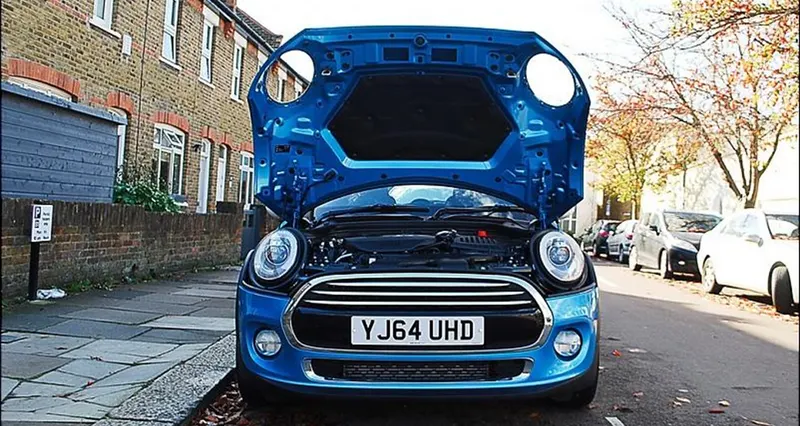
B. REVERSE SIDE OPENING HOOD:- In this type the Hood is opened from the reverse direction. Generally this type of car is not available in India.
HOOD STAY STUDY
The movement of the hood can be controlled by some device or apparatus and this apparatus used to rest the hood in an open state. This is important because while working on front compartment like engine, the external force is abruptly generated due to vibration and wind. So, it is important to keep hood in open state. It also allows access to the engine and its components for maintenance and repairs work. As Hood stay is done by-
- GAS STAY
- SUPPORT ROD
A. GAS STAY
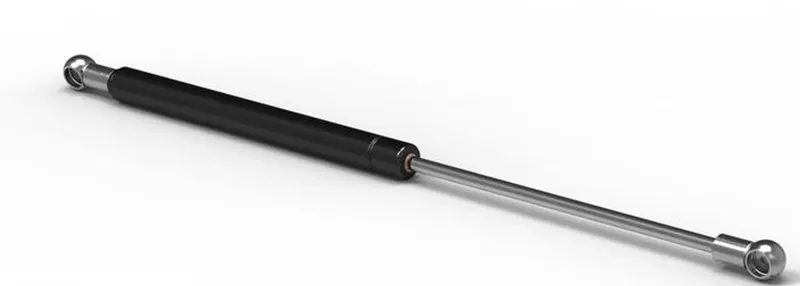
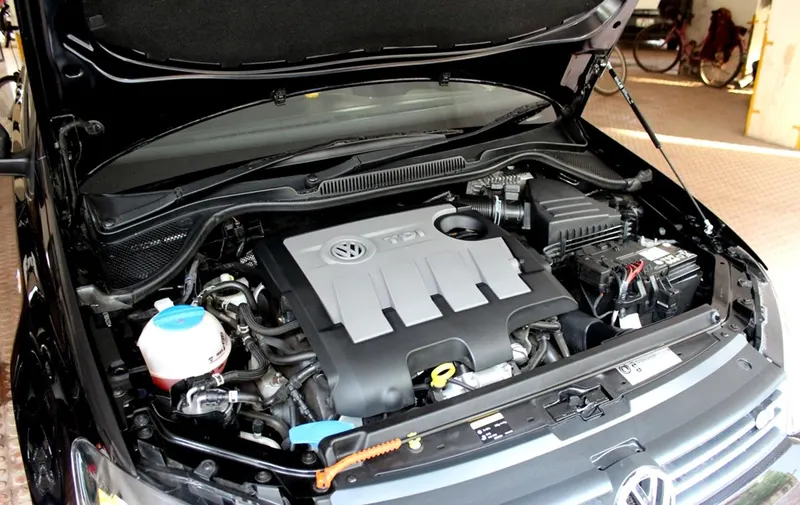
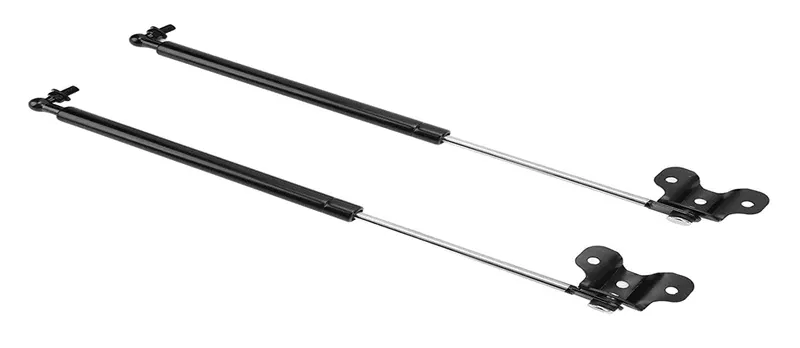
- A gas stayis a type of spring that, unlike a typical mechanical spring that relies on elastic deformation, uses compressed gas contained within an enclosed cylinder sealed by a sliding piston to pneumatically store potential energy and withstand external force applied parallel to the direction of the piston shaft.
- Luxury carmakers provide a gas stay to lift the hood and hold it in place. It takes minimum efforts to lift. Gas struts work by compressing the gas within a cylinder.
- The compressed air causes pressure to build on one side of the piston and decrease on the other, creating movement in an arc-like motion.
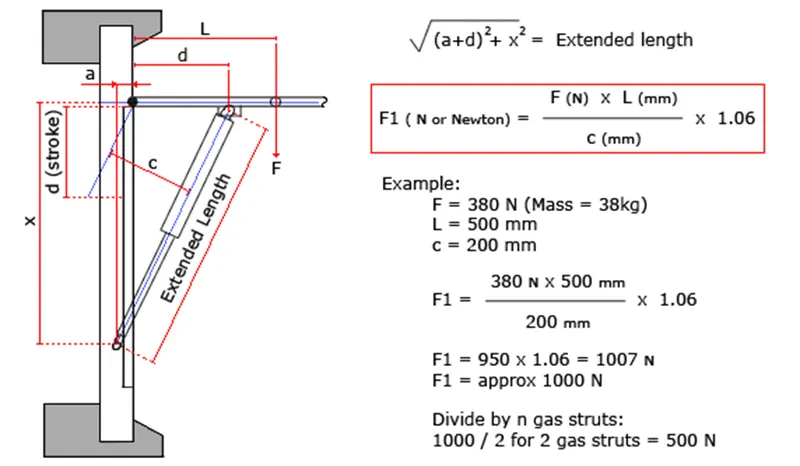
- It is not very hard to retrofit a gas strut in the engine bay to lift the hood of the car. All we need is a gas strut of a required force rating that can push the hood (the force rating is primarily determined on the basis of the weight of the hood) and the stroke length (which determines how high can the hood be held) and 2 clamps which will be mounted to the existing holes in the structure.
DESIGN OF GAS STAY
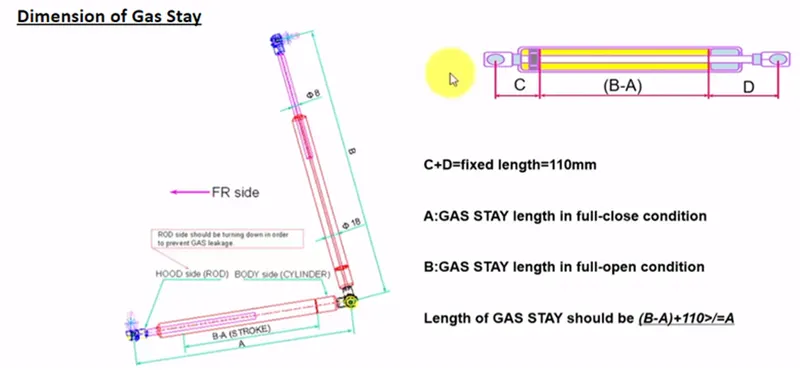
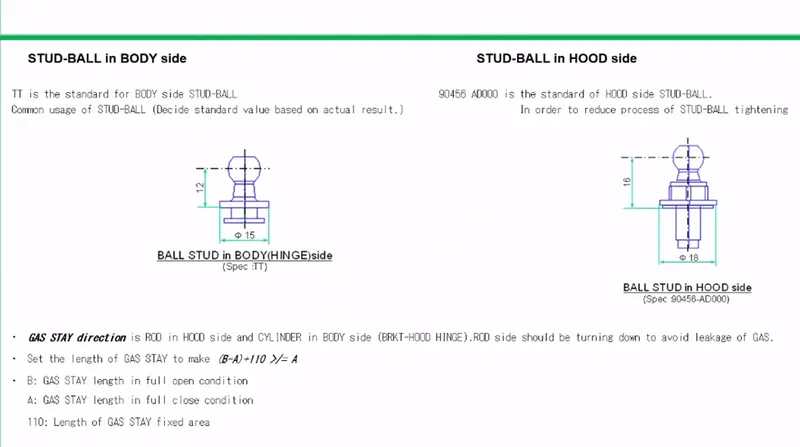
- Gas struts are connected at one end with a pin or ball sockets so that they can pivot easily from their stationary positions when mounted onto brackets. This is mostly used for where the car bonnet weight is heavy. Struts contain nitrogen gas under pressure and some oil to damp movement and to lubricate the seals.
STUD BALL
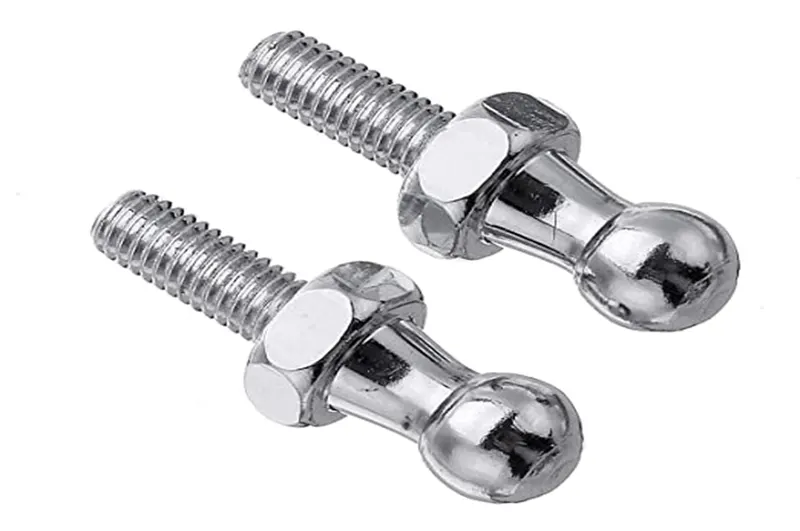
- As like grommet, stud ball is used to clamp the gas stay in both the corner. It fixed the gas stay.
- The stud ball which is show here is constructed from top grade stainless steel. It is heat-treated for enhancing its stable performance and durability.
- Constructed from top grade Galvanized iron, heat-treated for enhancing its stable performance and durability.
B. SUPPORT ROD
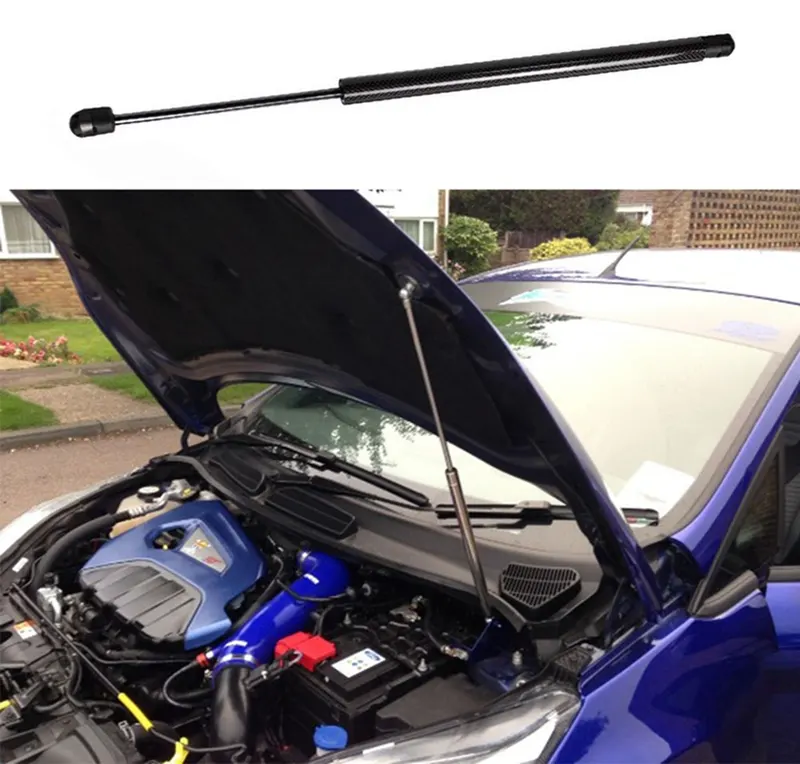
- This is the most commonly used rod for opening and closing the hood at a certain angle and also used to fix the hood in opening condition.
- The length of the support rod is predefined to open the hood. So, that the hood opening can be varied.
- Support rod will always be placed opposite side of the battery’s position. So that it doesn't interfere with rod.
- One end of the rod is hinged to the engine compartment and the other end is set free so that it can be locked to the hood inner panel when the hood is opened. This is usually used when the weight of the bonnet is small.
DESIGN OF SUPPORT ROD
- The support Rod structure is made of some curvature but too much curvature is create a problem. The maximum curvature cannot be more than 35mm to avoid the collision and vibration. It is defined after a lot of experience. Above 35mm of curvature may leads a problem due to weight of the hood and it can bend. Every product needs to be tested many times before being announced until make sure there are no problems like noise, stiffness and other common problems.
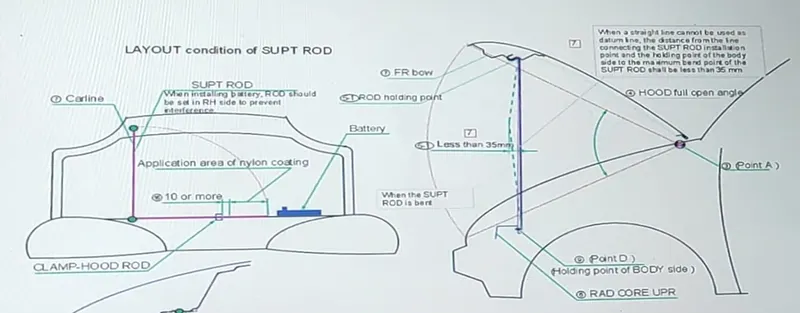
- A striker assembly and a latch assembly installed in the end of the hood and the end of a body. A support rod is installed in a fender to fix by opening the hood; and a hood release cable connected to a latch assembly to open the hood in the vehicle. The support rod consists of a pipe fixing rod installed in the fender with a guide pin; a moving rod having a guide groove inserting the guide pin and a joint groove in the upper part, and assembling with the pipe rod; and a hinge fixing the moving rod in the lower part of the hood through the joint groove. Two rods are assembled with sliding by installing rods in the vehicle body and the hood. Pollution is prevented with operating the hood stay rod without using the hand.
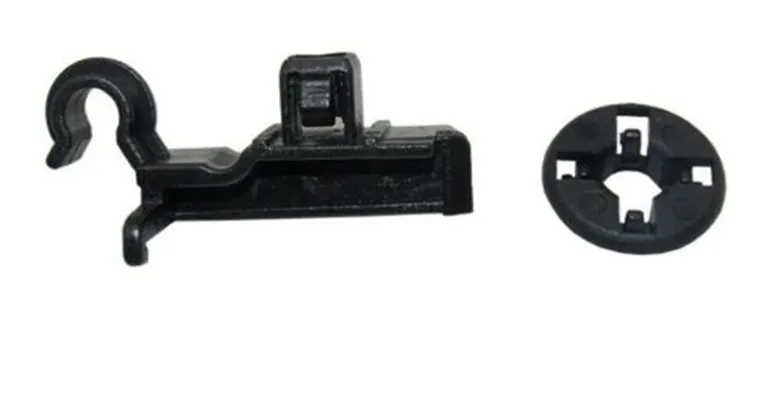
GROMMET
- These car hood support rod grommet made of high quality PP material, which is strong and wear-resistant, not easy to deform or break, and can still maintain good stability for a long time.
- These hood strut grommet are made to factory standard sizes and fit your car's hood strut rod perfectly.
- Grommet are standard part. It is used to keep the part in rest condition. This grommet are placed on engine compartment and also in hood compartment.
2. HOOD THICKNESS
Abstract
Almost two-thirds of the 1.2 million people killed annually in road traffic crashes worldwide are pedestrians. Despite the magnitude of the problem, most attempts at reducing pedestrian deaths have focused solely on education and traffic regulation. The hood of most vehicles is usually fabricated from sheet metal, which is a compliant energy absorbing structure and thus poses a comparatively small threat. Most serious head injuries occur when there is insufficient clearance between the hood and the stiff underlying engine components. Most limb injuries occur due to a direct blow from the bumper and the leading edge of the hood. This leads to contact fractures of the femur and the tibia/fibula and damage to the knee ligaments due to bending of the joint. Thus, attempts at reducing these injuries involve reducing the peak contact forces by making the bumper softer and increasing the contact area and by limiting the amount of knee bending by modifying the geometry of the front end of the car.
CONSIDERATION
Hood Thickness Information
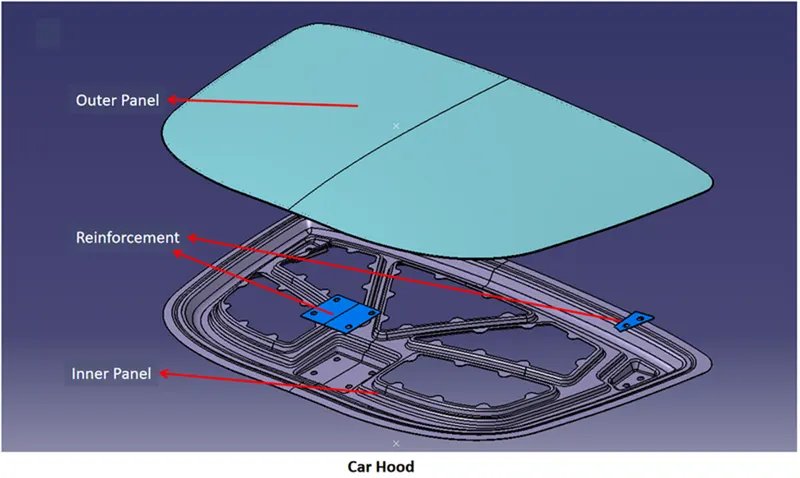
- Outer Panel Thickness = 0.75mm
- Inner Panel Thickness = 0.75mm
- Reinforcement Thickness = 1.5mm
- Give a relief at the corners with a 3 mm
It is considered by all consideration like bonnet clearance, absorbed impact energy etc. Besides functioning as an engine compartment cover, the bonnet of modern vehicles can also help manage the impact energy of a pedestrians head in a vehicle-pedestrian impact. However, a bonnets ability to absorb impact energy may be impeded by the proximity of the bonnet to components packaged inside the engine compartment, i.e., by it’s under bonnet clearance. For example, for a given bonnet design, the bonnets ability to absorb impact energy through deformation can be significantly reduced when the bonnet and engine block are in close proximity.
3. HOOD MASTER SECTION
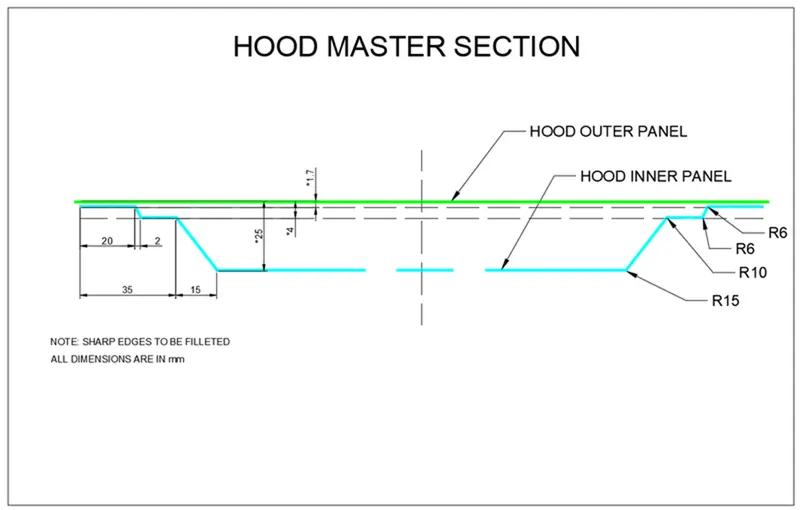
The master section is generally created is based on requirement from marketability team and this is done by taking all consideration that we saw before. The master section is predefined. The master section is little bit changes although same for all. The Hood master section is shown by image below here. Where all dimension is clear by this image.
4. COMPONENT OF HOOD
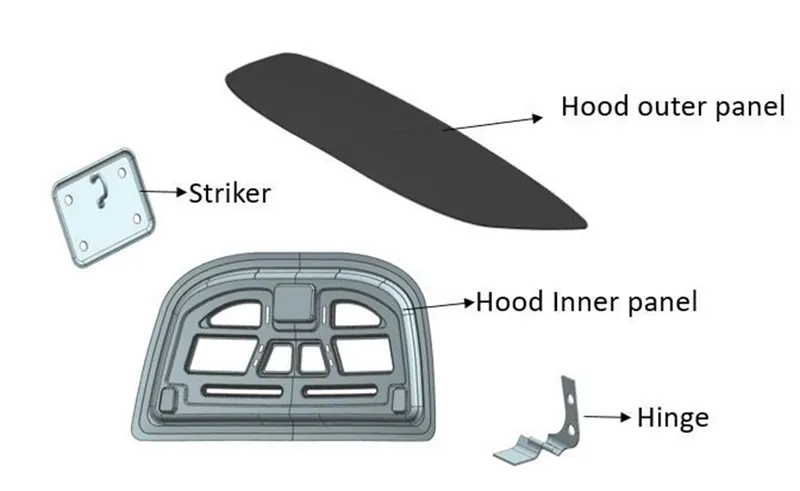
The hood consist of many component. So, before designing of we discuss all the parts of hood.
- HOOD OUTER PANEL
- HOOD INNER PANEL
- HINGE ASSEMBLY
- STRIKER
- Rubber pad
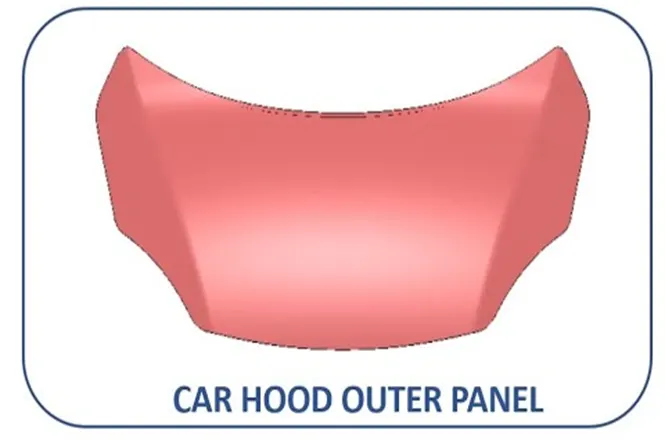
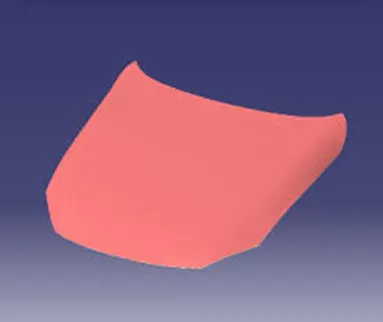
A. HOOD OUTER PANEL
A car hood panel is one of the most important components of the BIW (body in white), it is considered as the closure sheet-metal component. A hood panel consists of two panels that are hemmed together to form the automotive hood assembly. The hood panel is installed in the front of the vehicle so as to protect parts in the engine compartment and the engine compartment and at the same time open and close the hood panel for replacement and repair of components in the engine compartment.
- The main function of outer panel is to cover all the parts of hood which is enclosed inside the part.
- The outer surface of this part is provided with a good surface finish, painted with corrosion-resistant paint to prevent the inner parts from corrosion and also to give an aesthetic look to the car from the outside.
- The outer panel has the aesthetic look to it but on its own is very weak and not capable of handling force during impact. Most automobile hood outer panels are made of traditional steel plates, and their quality does not meet the needs of lightweight development. For this reason, it is necessary to obtain lightweight effects through the application of the automotive aluminum sheets.
- This part forms the shape of our hood and it is given different styling and shapes to enhance the look & performance of the vehicle to reduce the forces exerted by air when the vehicle is in motion.
- The production process of the outer panel of the hood mainly includes blanking, deep drawing, trimming etc. Among them, deep drawing is a key process to ensure the quality of parts.
- Its thickness is considered as 0.75 mm maximum.
B. HOOD INNER PANEL
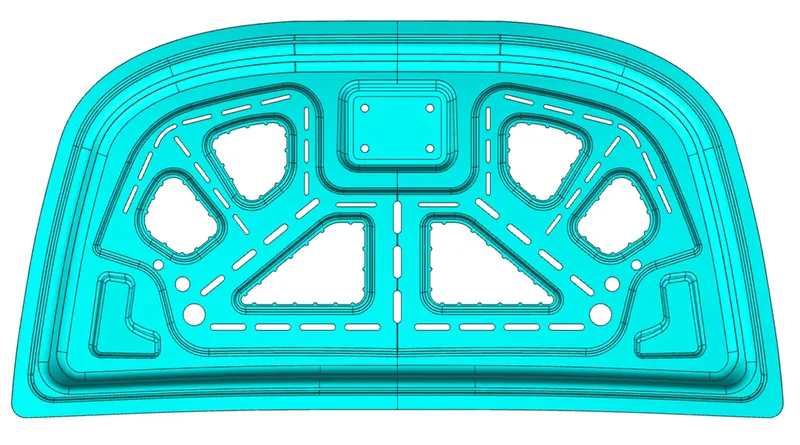
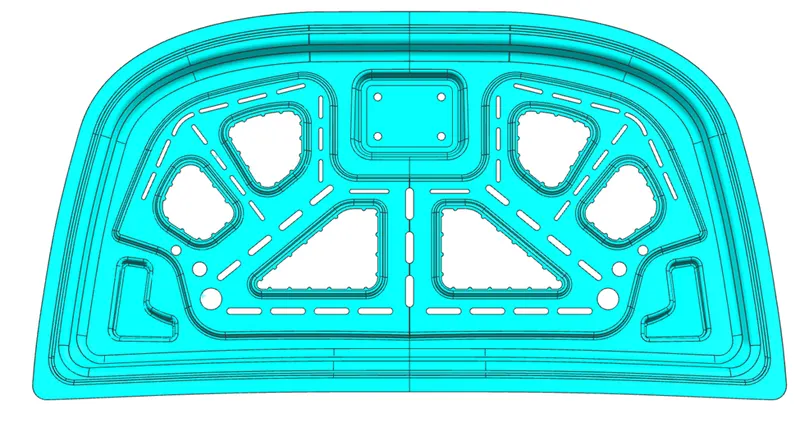
The second part of panel is its Inner Panel. The inner panel of the hood is not visible to the customer but this is the engineering feature of the outer panel. A method of lightweight design based on material selection and structural optimization is developed for engine hood inner panel.
- Hood Inner panel is integral part of the hood panel and it provide the regidity, durability and pedestrian protecting performance by comprising a composite structure in which a multi-cone structure and a frame structure are individually arranged on the front and the rear.
- A conventional hood inner panel for automobiles is secured by reinforcing rigidity through a frame structure of type A or a frame structure.
- An inner panel in which a multi-con part composed of a plurality of cones formed to protrude on one surface, and a frame part composed of a plurality of bridges integrally connecting the multi-con part and the side part. It provides a hood panel for automobiles, characterized in that configured to include.
- The hood inner panel for a vehicle according to the present invention is capable of increasing rigidity / durability and weight reduction, and at the same time improves frontal collision and pedestrian protection.
- The inner panel thickness is considered as 0.75 mm maximum.
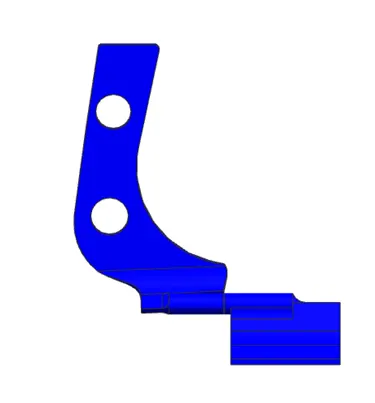
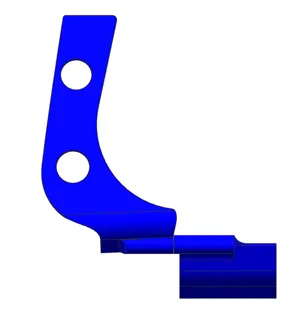
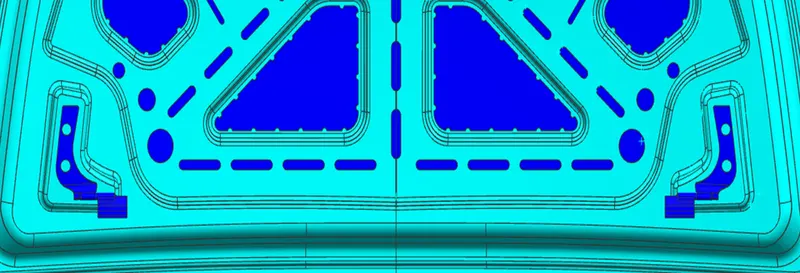
C. HINGE ASSEMBLY
Hinge is attached on the inner panel of hood and in engine compartment. The main function of hinge assembly is to provide opening and closing of hood. Positioning of hinge is very important because it give the rotary movement to the hood.
- A hinge linkage mechanism adapted to fasten a hood of a vehicle to a body of a vehicle while permitting movement of the hood in a first direction between an open and a closed position as seen in relation to the body of the vehicle.
- the vehicle hood hinge assembly may further comprise a holding element operative to prevent the link element from moving relative the hinge linkage mechanism during normal operation such as opening and closing of the hood. The holding element, or locking element, may be a spring element or a brake element such as a pop rivet, a clip or a shear pin.
- This part should be strong enough to take the load of the hood and also the forces which act upon the hood in case of crash.
D. STRIKER
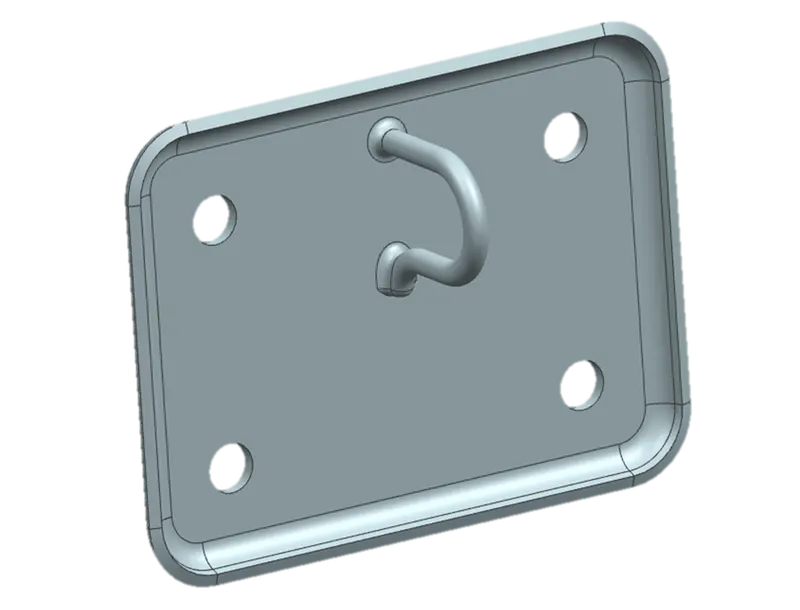
- Striker pin operably connected to the hood for engaging a rotatable latch, wherein such engagement places the hood in the secured position.
- Further included is a releasing mechanism operably connected to one of the striker and the latch for lifting a front region of the hood in response to a signal from the sensors.
- This part is used for providing locking to the hood it consists of a latch-type mechanism and it is located on the inner panel of the hood to decide the position of our striker, the trajectory method is used with the help of this method we can easily locate our striker. This part holds our hood in closed condition unless it is being open by pulling the latch lever to open our hood.
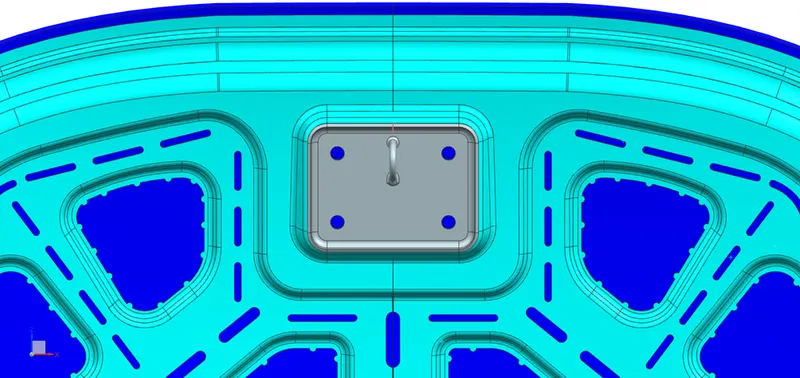
E. Rubber pad
- The engine is very noisy, especially while cruising at highway speeds.
- Rubber pad is used at the middle of the Hood to improve NVH as during motion hood may produce noise so to compensate that we use it but somehow we achieve good NVH value. So this pad is mostly removed at the end as cost reducing entity.
- The best way to sound deaden your vehicle’s engine is to place damping or deadening mats with adhesive backings underneath your car’s bonnet. Just measure your car bonnet, cut the mat according to its shape and size, and carefully insert it under the hood.
- Rubber pad used to reduce Vibrations also.
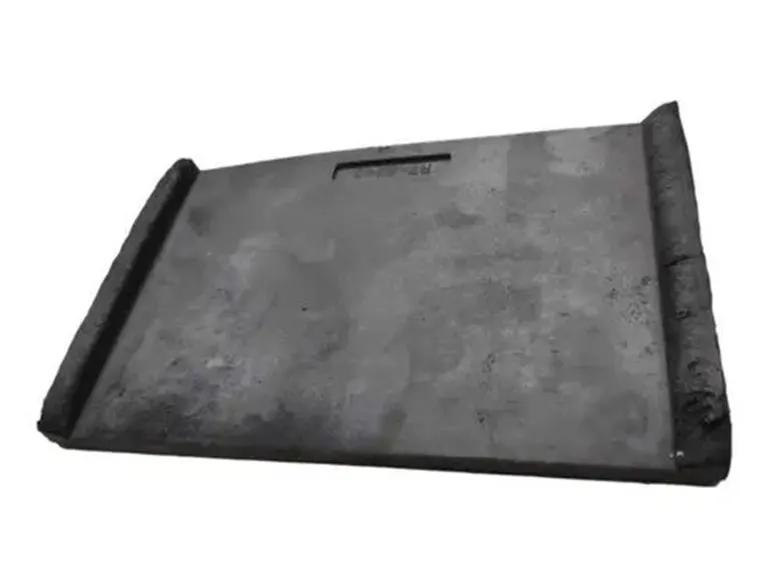
5. Manufacturing process
Hood inner & outer panels can be manufactured by performing forming operations on a thin metal sheet.
A. Deep Drawing
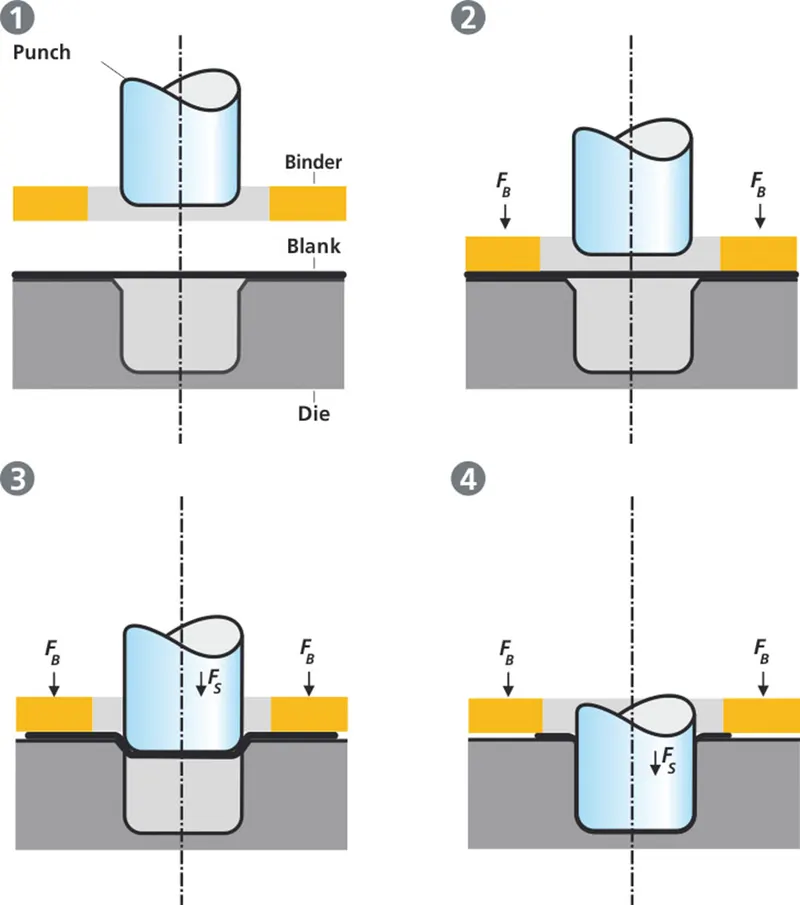
- Deep drawing is a sheet forming process in which a sheet metal blank is radially drawn into a forming die by the mechanical action of a punch. It is thus a shape transformation process with material retention.
- The total drawing load consists of the ideal forming load and an additional component to compensate for friction in the contacting areas of the flange region and bending forces as well as unbending forces at the die radius.
- Deep drawing is a sheet forming process in which a sheet metal blank is radially drawn into a forming die by the mechanical action of a punch. It is thus a shape transformation process with material retention.
- The process is considered "deep" drawing when the depth of the drawn part exceeds its diameter. This is achieved by redrawing the part through a series of dies.
- The flange region (sheet metal in the die shoulder area) experiences radial drawing stress and tangential compressive stress due to the material retention property. These compressive stresses result in flange wrinkles (wrinkles of the first order).
- Wrinkles can be prevented by using a blank holder, the function of which is to facilitate controlled material flow into the die radius.
- The thinnest part thickness determines the maximum stress that can be transferred to the deformation zone. Due to material volume constancy, the flange thickens and results in blank holder contact at the outer boundary rather than on the entire surface.
- The maximum stress that can be safely transferred from the punch to the blank sets a limit on the maximum blank size (initial blank diameter in the case of rotationally symmetrical blanks).
- There are approximately 300 to 400 sheet metal parts which fit together to form the body of a car. In order to manufacture high quality sheet metal parts optimally for their particular use, specialized software simulates the complete deep drawing process.
Deep drawing processes are divided into three types:
- Deep drawing with tools
- Deep drawing with active means
- Deep drawing with active energy
B. HEMMING
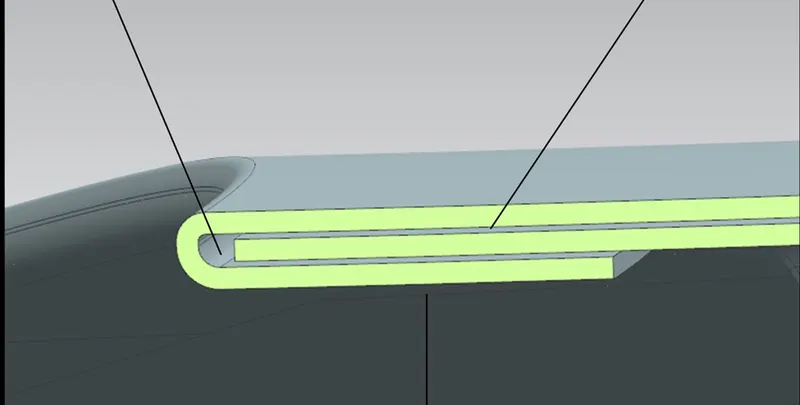
- Hemming is the process of joining or assembling both the outer and inner panel together. The hemming process roles and wraps the hood outer panel around the inner panel and holds it tightly together. The following are the dimensions followed for hemming.
- Hemming is a sheet metal formation process in which sheets are joined by bending it usually to 180°.
- Hemming is a forming operation in which the edges of the sheet are folded or folded over another part in order to achieve a tight fit. Normally hemming operations are used to connect parts together, to improve the appearance of a part and to reinforce part edge.
- The accuracy of the hemming operation is very important since it affects the appearance of the surface and surface quality.
- Material deformations, which occur during the hemming process, can lead to dimensional variations and other defects in parts.
- Typical hemming defects are splits or wrinkles in the flange, material overlaps in the corner areas or material roll-in.
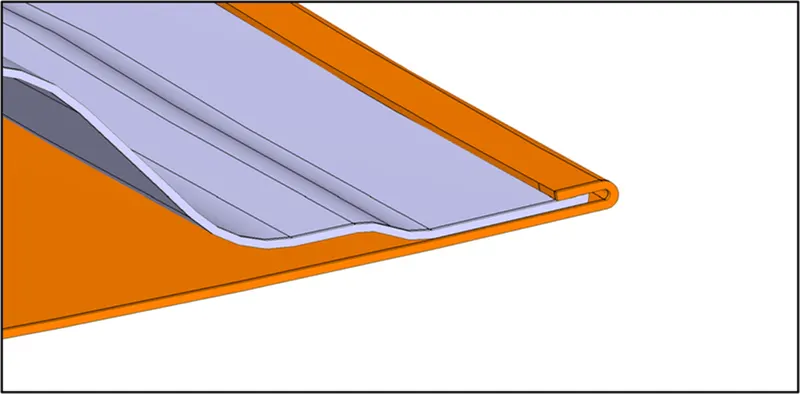
Complete list of hemming benefits on a sheet metal product is as follows:
- Hems strengthen the sheet metal edge
- They improve the surface appearance and surface quality
- They hide defects such as rough edges and burrs
- They can connect parts
- They make the edges safer to handle
Hem Types
The different sheet metal hems based on the hem shape are as follows:
- Flat or closed hem
- Open hem
- Teardrop hem
- Rope hem
- Rolled hem
i) Flat or closed hem-: In a flat or closed hem, the part of the edge that bends sits completely flush over the rest of the metal sheet. The angle between the returning flange and the sheet metal is 180 degrees. The inside radius is zero and thus, there is no gap between the returning flange and the metal sheet. Closed hems require a lot more power and tonnage from the presses than open or teardrop hems and it is also not advised for metal sheets that are over 2-3mm in thickness since the sheets are likely to fracture.
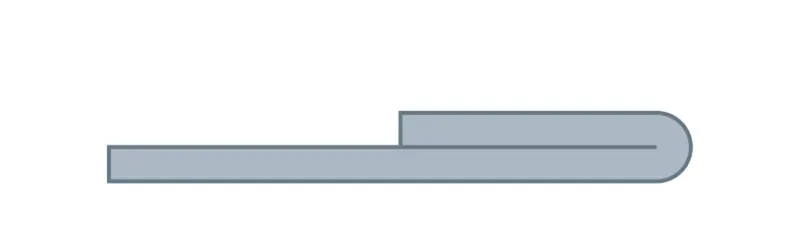
ii) Open hem-: In an open hem, the returning flange is folded over the sheet metal but there remains an air pocket between the two. The bend angle in this hem type is also 180 degrees.
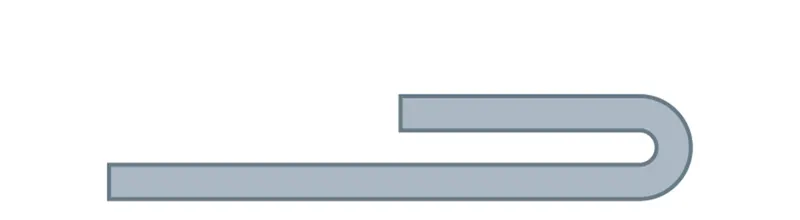
iii) Teardrop hem-: In a teardrop hem, the returning flange is bent beyond 180 degrees. The resulting shape resembles a teardrop.
It is perfect for materials that do not have the required ductility to provide closed hems. Teardrop hems are used for fragile materials such as aluminium.

iv) Rope hem-: A rope hem has a returning flange at a bent of more than 180 degrees. Once the hem achieves the shape of an open hem, the returning flange is pressed onto the part surface through a flattening die.
The edge is bent in shape similar to an open hem and then the second piece to be connected is inserted into the gap between the metal sheet and the returning flange. Further pressing takes place making the second parts sit flush between the metal sheet and the returning flange and create a joint.
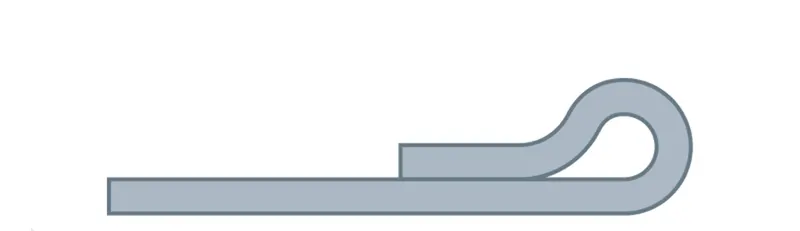
v) Rolled hem-: In a rolled hem, the bent portion of the sheet metal is tucked back into itself. This creates smooth round edges all around for holding the part from the hemmed edges. This process is also commonly referred to as curling.
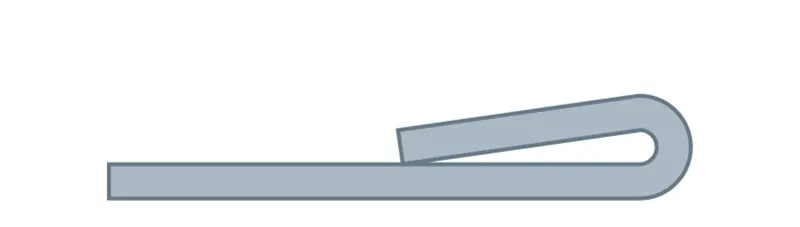
The hemming process can be carried out in one of the following two ways:
- Die hemming process
- Roller hemming process
I. Die Hemming Process
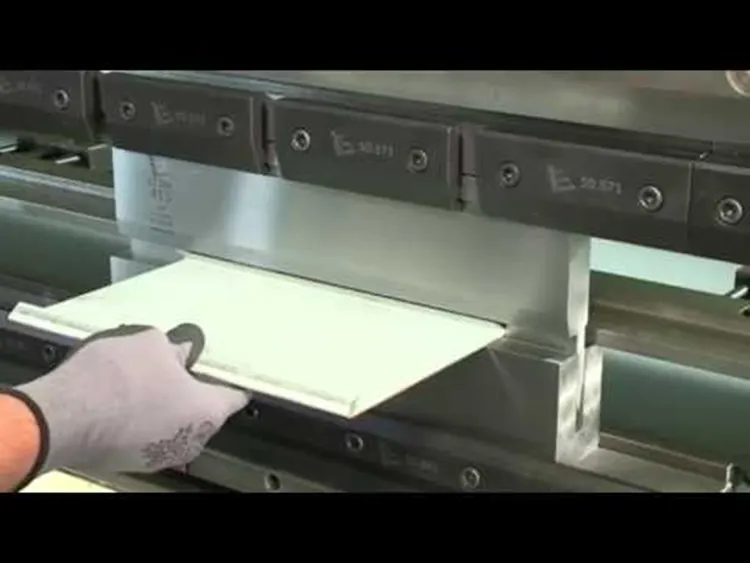
- Die hemming is the conventional hemming operation that uses a die and press to carry out hemming. In this process, the bending occurs along the full length at predefined angles in multiple steps. These steps are known as pre-hemming and final hemming.
- For instance, when forming a closed hem, the edge will be bent to 45 degrees in the first step by passing it through a press back. The next bent occurs by means of the same press brake but a different part of the tool that completes the closed hem.
- The die hemming process is not very flexible and is generally restricted to the production of flat, uncomplicated panels. The investment in the equipment is high but the cycle times can be brought down to be quite low.
II. Roller Hemming Process
- The Roller hemming process was invented to increase the flexibility of the hemming operation. It generally uses robots to control rollers that bend the edges but there are simpler manual roller hemming machines available that can handle only simpler tasks with less accuracy. The rollers travel along the edges and bend the part edge to the desired angle in multiple steps.
- The orientation of the sheet may be changed multiple times during the hemming process to reduce the travel of the roller and increase the cycle time. Apart from the robot itself, this method is considered economical both for low and high-volume tasks. Robot roller hemming allows for jumping back on forth between producing different parts through quick program changes.
C. EMBOSSING
- The geometry is created based on the master section that was designed above. After performing the initial stages of design, we will provide local embosses to strengthen the component.
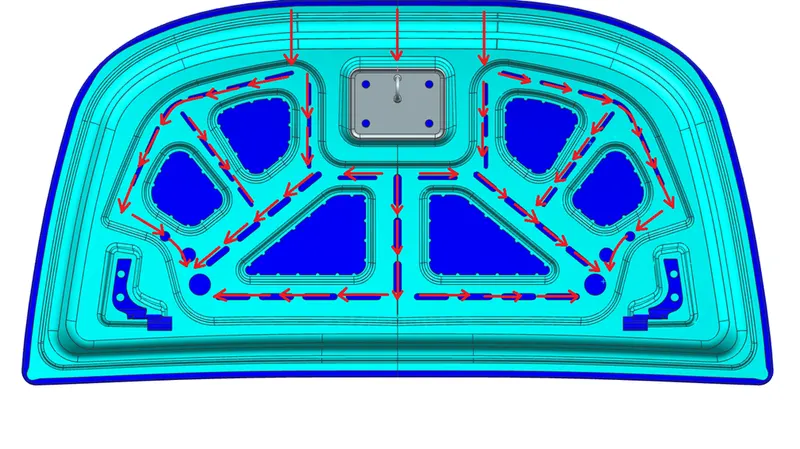
- Emboss is given so that during the crash the energy is dissipated outside / away from the vehicle occupants and along with the other cut outs to reduce the weight.
- This is also helps in weight reduction of the hood.
- The component will be strengthened based on the master section. When a force impacts the hood from the front, it travels in an upward direction.
- Mostly embosses are designed in such way that it divert the force towards the hinge assembly so that the force do not act on the passenger inside the car directly.
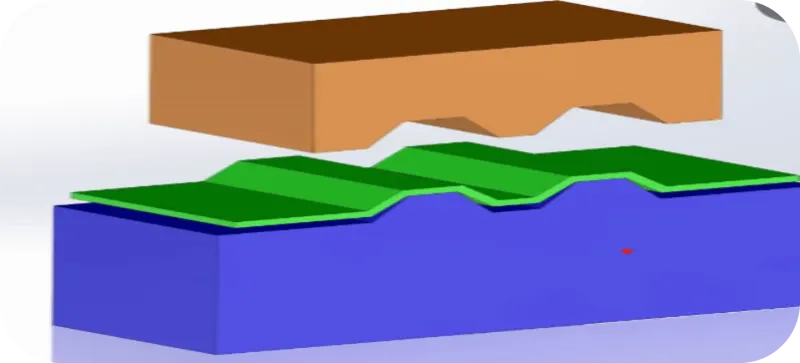
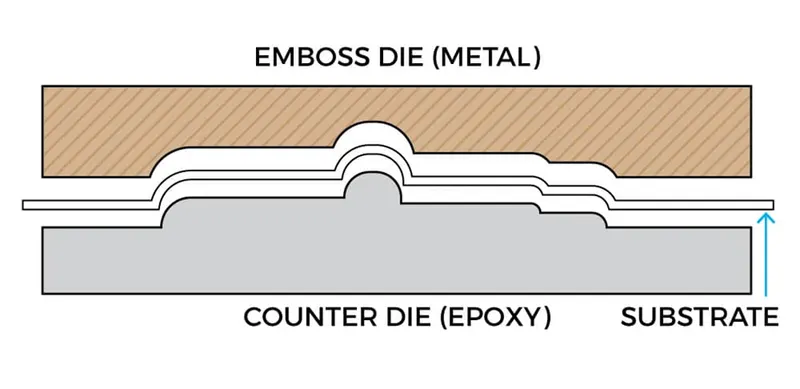
- Sheet metal embossing is a stamping process for producing raised or sunken designs or relief in sheet metal.
- The purpose of providing these embosses is to reduce the intensity of the front impact by diverging the forces into different directions rather than in the straight direction.
PROCESS OF EMBOSSING
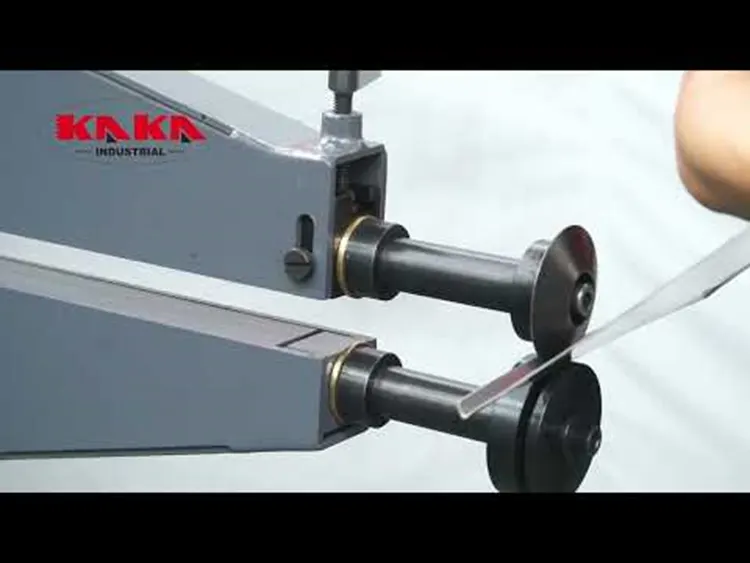
- This process is done by matched male and female roller. This process is also done by passing sheet or a strip of metal between rolls of the desired pattern.
- An Embossing is created by pressing a female Die into a male Counterforce with the substrate to be embossed between the two.
- The metal sheet is drawn through the male and female roller dies, producing a pattern or design on the metal sheet. Depending on the roller dies used, different patterns can be produced on the metal sheet. The pressure and a combination of heat actually "irons" while raising the level of the image higher than the substrate to make it smooth.
- In most pressure embossing operation machines, the upper roll blocks are stationary, while the bottom roll blocks are movable. The pressure with which the bottom roll is raised is referred to as the tonnage capacity.
EMBOSS CREATION FOR INNER PANEL
- Embosses has been given to create extra strength in inner panel and embosses design needs to be inspired by force dissipation phenomena.
- If any object hit from front most of the force will get dissipated by its design towards the upper left & right corner so that less force reach at occupants end.
- Embosses are given to make the inner panel stiffer and good endurance while crash. It is created in Y shape to allow the force to flow and get dissipated outside and hence to protect the vehicle occupants.
- Emboss is given so that during the crash the energy is dissipated outside / away from the vehicle occupants and along with the other cut outs to reduce the weight.
EMBOSS CREATION FOR HINGE
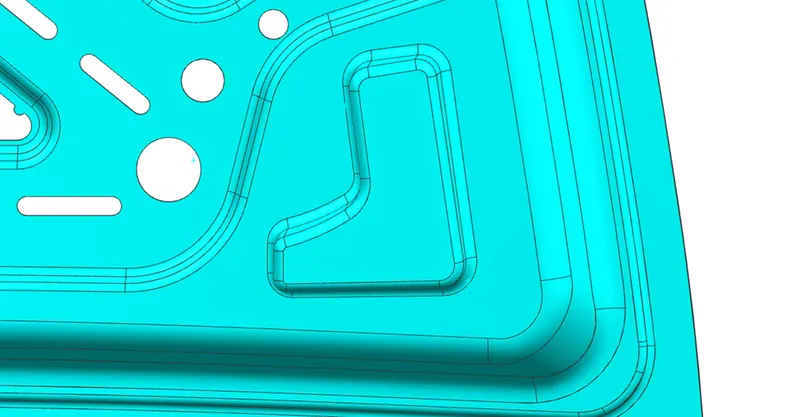
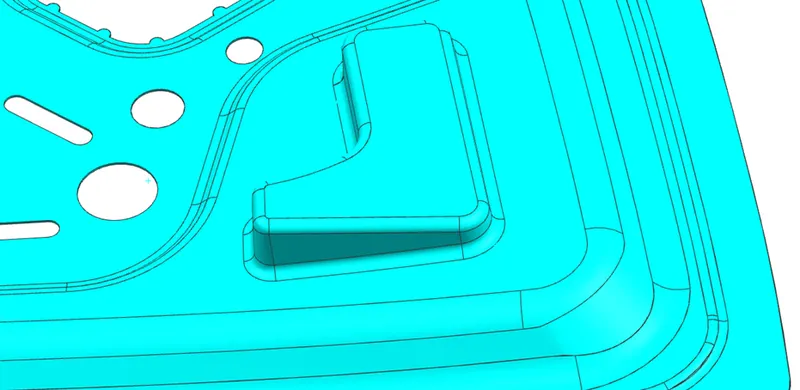
- The inner panel surface is not a flat one. It is a curvy surface. Hinges will not fit properly on a curvy surface. So, the flat surface is created at some distance from the inner panel, and using law Extension, emboss is created onto.
- Hinge axis is taken as center to draw a circle at the middle of the backdoor and latch is placed perpendicular to that circle. So, emboss is created to place the hinge.
- To define a striker section, trajectory and perpendicularity is taken. Once we get the hinge axis position, a local emboss is done to have a reinforcement here to assembled the hinge.
- Emboss is important on hinge because rotation is only possible if there is a hinge. So, positioning of hinge is very important.
EMBOSS CREATION FOR STRIKER
- As the inner panel is not flat and have some curve. So embossing is done to create a flat surface for striker.
- To define a striker section, trajectory and perpendicularity is taken. Once we get the striker position, a local emboss is done to have a reinforcement here.
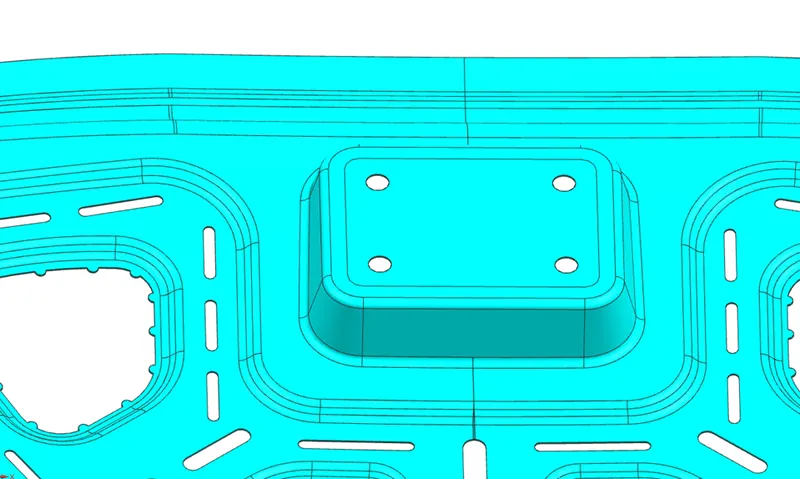
FINE TUNING EMBOSS:
- To make the component easy to manufacture, all the sharp corners from emboss are removed.
- The curvature intersections from different nearby embosses are blended out to produce a smooth transition.
- After embossing the required amount of material is trimmed accordingly and are given with a fillet radius by maintaining the minimum value of 3 + 0.75, so that no emboss is left out with sharp edges.
6. IMPORTANT FEATURES
To designed the hood many other factors also important. There are as-:
A) RELIEF REAR SECTION AND FRONT RELIEF
- After the hemming process is done, now we need to provide corner relief on the corners of the hood so that the part is manufactural. The rear and front relief section is given of 3mm.
- When each roller is crossing over the edges, the roller cannot go through all the region. And when similar roller passed over the sheet, there are some tendency when the sheet metal vibrate during the motion. If the forces come back to the panel to the initial position then we have to changing the design of part. If that force brings back to the sheet to the original condition. Then the force which is given is right then those zone considered as red zone. Here in corner it show a similar situation. And that is why to avoid the red situation we normally give relax over all the corner. So, that it completely rolled over here.
- Relief is given on the outer panel to decrease the stress concentration.
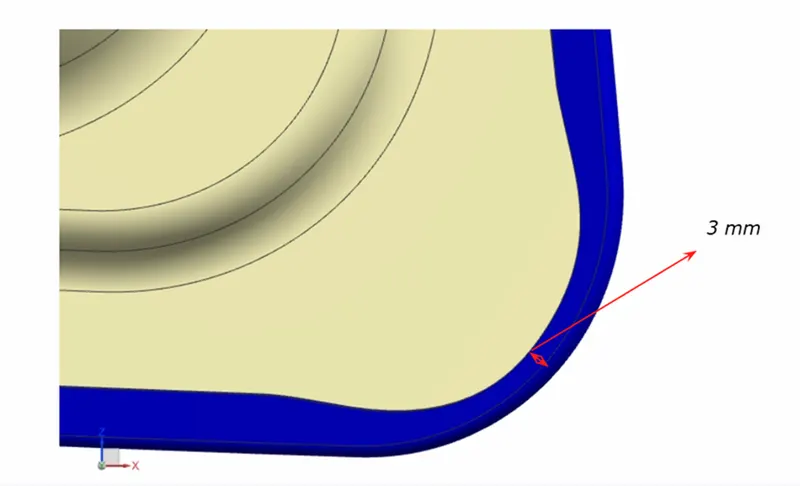
RELIEF REAR SECTION
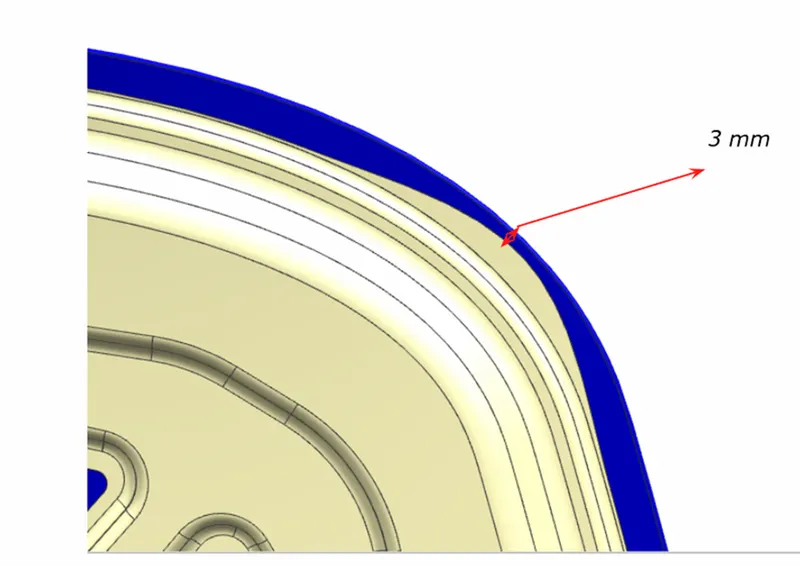
FRONT RELIEF SECTION
B) LATCH TRAJACTORY MOTION
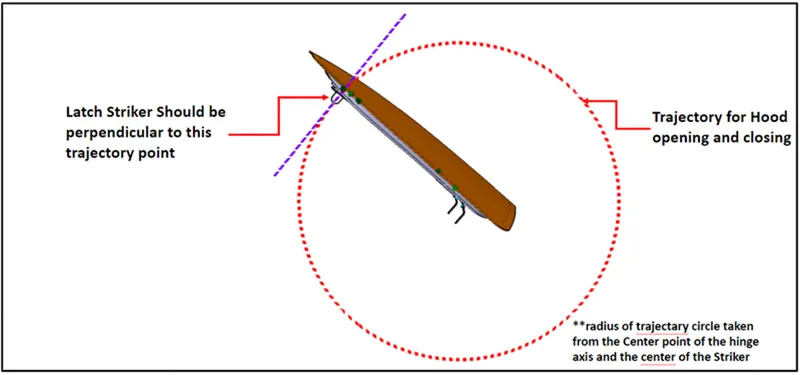
- To ensure proper closing and opening of the hood panel, the striker is placed in such a way that its trajectory is perpendicular to the hinge axis.
- Hinge axis is taken as center to draw a circle at the middle of the backdoor and latch is placed perpendicular to that circle.
- So here the positioning of latch totally depends upon hinge axis because when striker hits the latch system built in body compartment it must be tangentially perpendicular to the circle made from hinge axis or the moment it hits the latch system it inserted or get locked smoothly because slightest deviation may result in improper closing of hood.
- For the proper opening and closing of the hood, the striker should be positioned at a correct position. The striker should be perpendicular to the trajectory of the hood. The flanges are positioned at their respective positions. Then the line is drawn at a straight. Now the trajectory is derived from the hinge axis and the center distance from the striker.
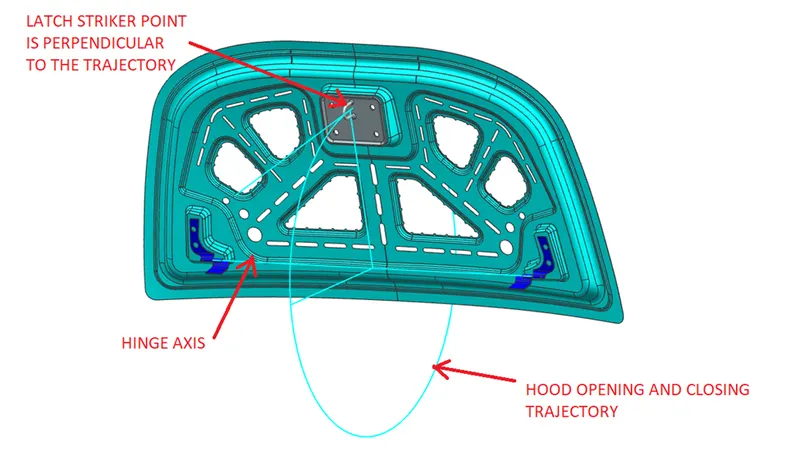
C) MASTIC DATA
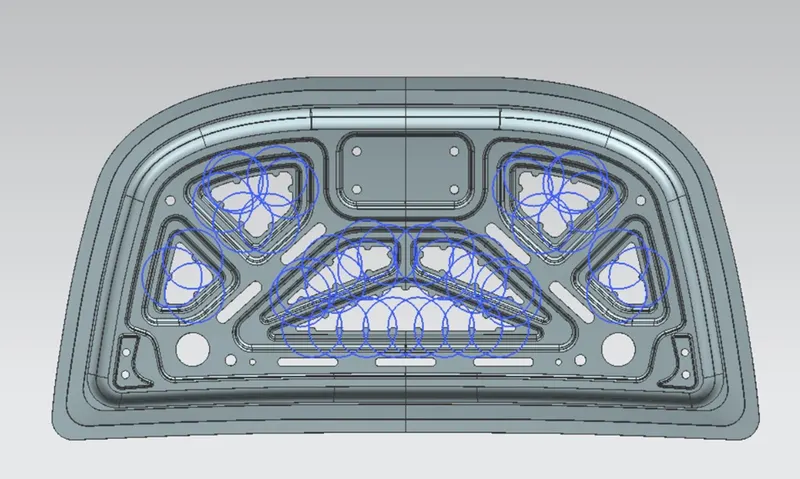
- Mastic is used to join the inner and outer panel with 5mm gap.
- It is basically an NVH topic mastics are point / surfaces given on embosses for applying mastic sealant to join outer and inner panel and also give good value of NVH.
- Mastic points are provided in the inner part of the hood. The inner and the outer part of the hood do not contact directly during assembly, there is a gap between them through which the mastic sealant is applied for joining.
- Mastic sealant provides strength at around 80 mm so we need to put these mastic points in such a way that it covers the most of the hood region except reinforcement area of latch and hinge because that alone provide good NVH so no worries there.
- Mastic sealants are elastic compound that behaves like the rubber.
- It is placed between the outer and inner panels. Initially is it in paste form, but after the hot furnace bath, it gets hardened thus joining the outer and inner panel.
D) REINFORCEMENT
- Reinforcements are given at Hinge and Latch.
- Latch reinforcement is provided because of latch emboss, strength in that area was compromising so to balance that, latch reinforcement with thickness up to 1.5 mm has been given.
- This can be done to give extra support to the movement parts such as hinge, support rod and the latch and sticker mechanism.
- The thickness of reinforcements will be higher than that of the inner panels and the value varies according to cost and requirement.
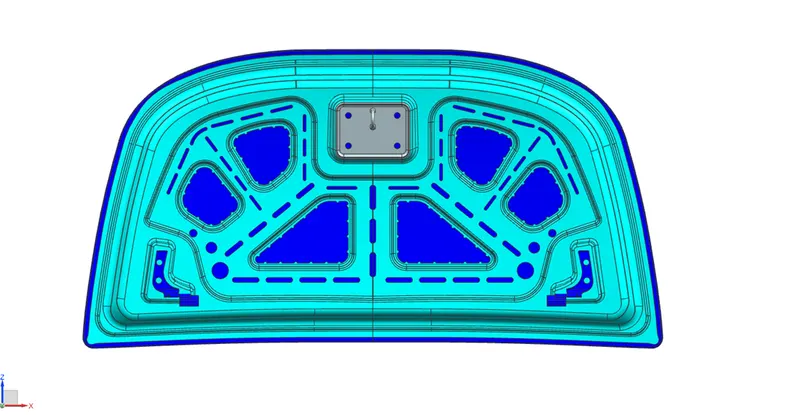
E) DRAFT ANNALYSIS
- Draft analysis is done to see whether the metal drawn with particular design without any tear in the metal of disfiguration.
- It also helps to find the negative draft present in the component which can cause difficulty in manufacture ability.
7. MATERIAL OF HOOD
Because the hood is usually detachable from the rest of the frame with relatively minimal effort, vehicles may sport hoods made from different materials than the rest of the body.
A. STEEL
- Steel is synonymous with strength and durability. It has been the go-to metal for engineering needs, including automobiles.
- The varying formulas for steel have a large impact on its performance, so the standard form of steel used for cars has a higher weight than the alternative hood materials. Its low price is still a major reason for its continued usage as the standard hood material.
B. ALUMINIUM
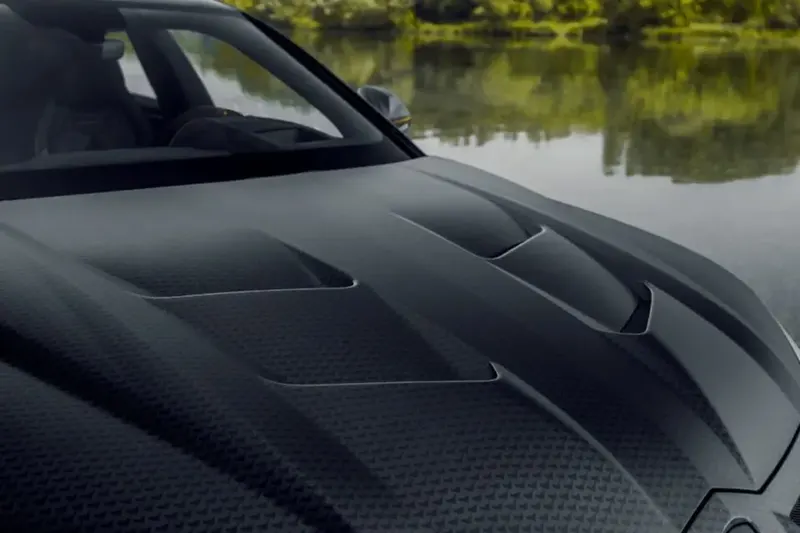
- Although most people interact with aluminum as a lightweight foil, thick aluminum is a durable metal that’s resistant to rust while weighing less than heavier elements.
- Aluminum isn’t quite as strong as steel, so these hoods can be dinged and dented more easily. The durability isn’t as significant in a crash where the vehicle will be reliant on crumple zones and other safety features more than the strength of the hood.
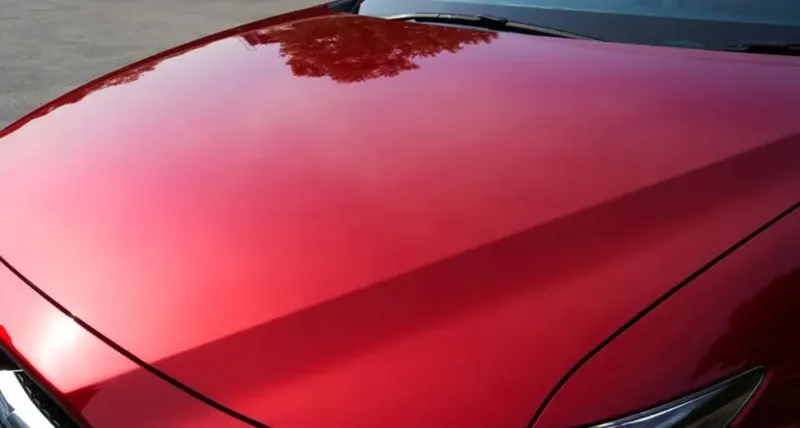
C. FIBERGLASS
- While lightweight, inexpensive, and convenient, fiberglass is the least durable of the common hood materials. It’s also prone to ignition and produces toxic fumes. These problems rear their head in cheaper fiberglass products, but higher quality ones are less prone to issues.
- That offsets some of the price reduction, but a good fiberglass hood will cut vehicle weight without sacrificing much safety or durability.

D) CARBON FIBER
- Specially engineered strands of carbon can be turned into a light yet incredibly durable material. The extra chemical and mechanical processing does make it the most expensive option, but using it can easily shave up to half of the hood’s weight.
- It’s not a major cut off of the overall weight, but it can add up with other weight reduction measures when trying to maximize performance.
- Fiberglass weighs about the same while being cheaper, but you can make the majority of a car out of carbon fiber without sacrificing structural integrity or safety
8. HOOD FEATURES
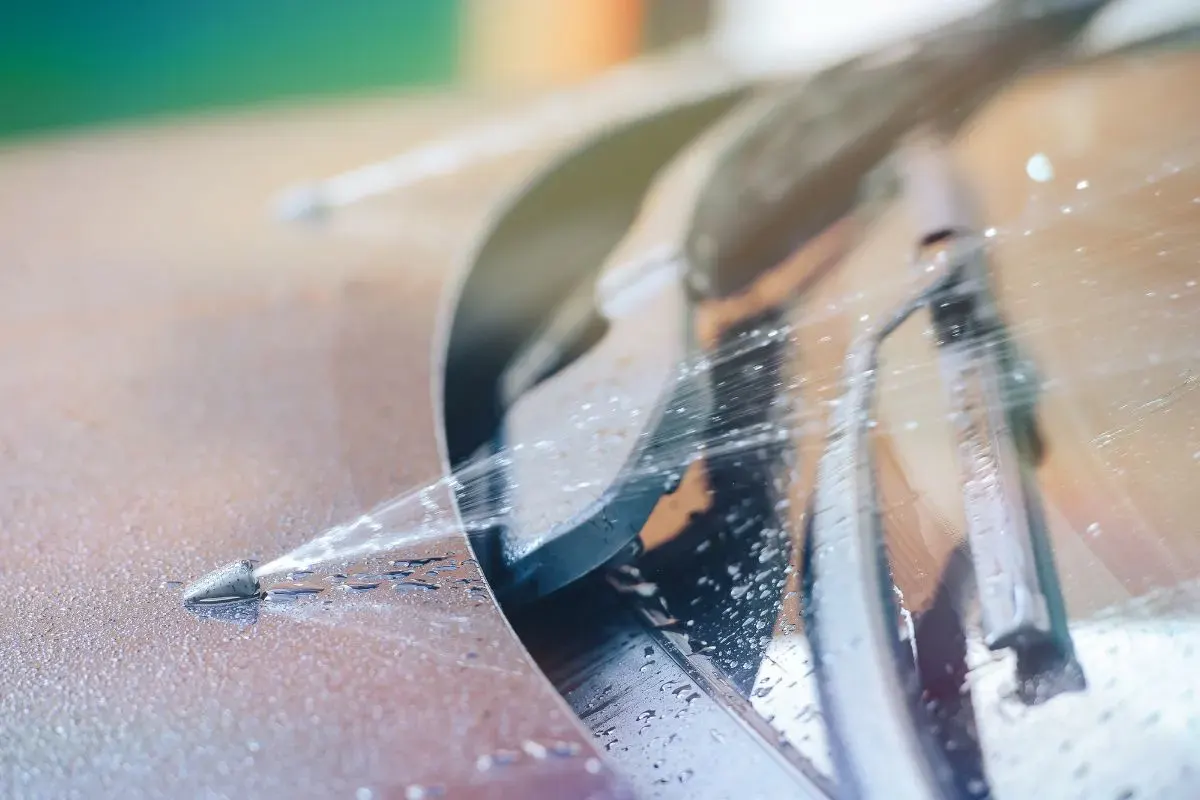
I) Windshield Washer Nozzle
- Windshield washer nozzles are the most common additional feature of vehicle hoods. A quick touch of a lever inside the cabin mists the windshield with a special cleaner that improves visibility as the wipers do their job.
- They are fairly cheap and easy to install if your vehicle lacks nozzles.
II) Scoops
- Combustion engines rely on the interaction between fuel, heat, and oxygen to create power. They also use the surrounding air to cool down the engine.
- Hood scoops alter the airflow in ways that can help one or the other, depending on the style of scoop. The extra openings allow more sound to escape the bonnet, so the noise level of the engine may be a concern as you add scoops of any type.
a) Ram Air Intake Scoops
- These scoops face forward to get more cold air into the engine as the vehicle moves faster. The air pushes its way through a narrow opening before spreading out into the engine, cooling the air while manipulating the pressure within the compartment.
- Even with protected openings, the additional front-facing vents of these scoops will allow more dirt into the engine and can become blocked by larger debris.
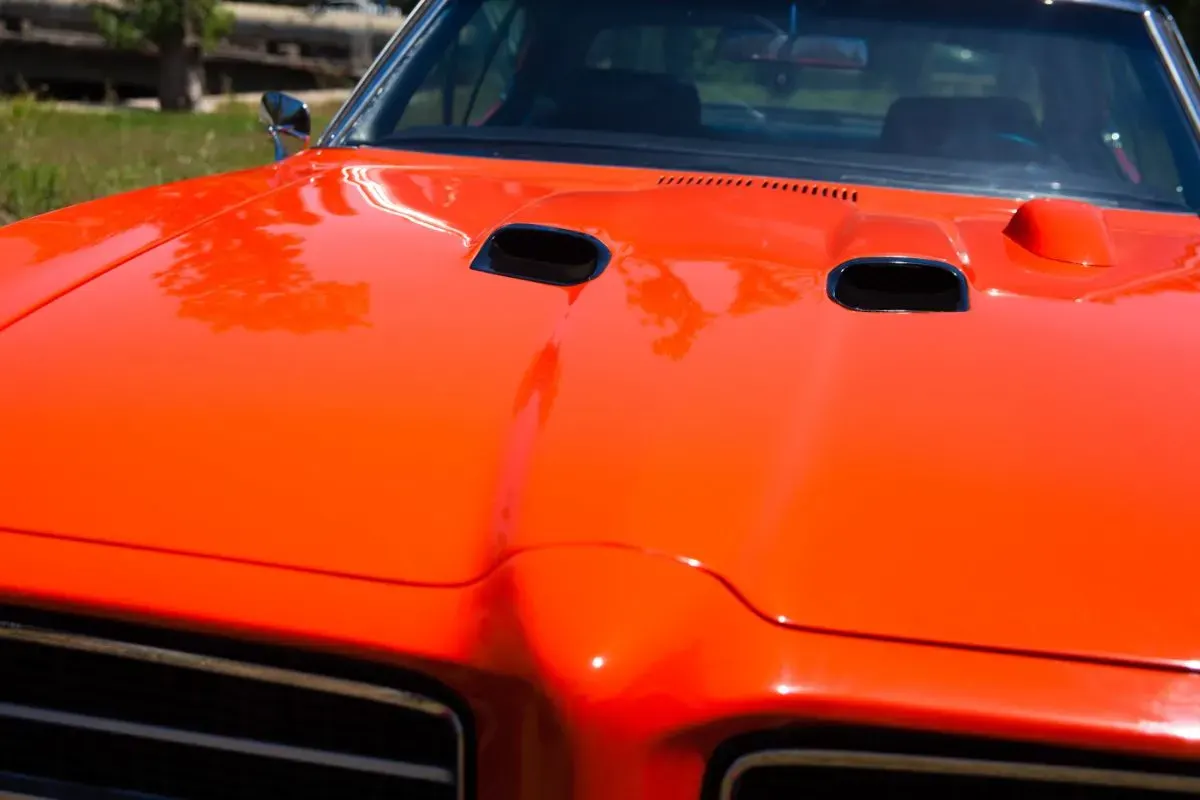
b) Shaker Scoops
- Named for its tell-tale rumbling while the engine is running, shaker scoops are attached directly to the engine. Since the extra air is expedited to the parts that need it most, they are great at reducing heat and improving performance.
- Even the best shaker scoop is incredibly noisy, though, and larger ones may obstruct a bit of your view.

c) Cowl Induction Scoops
- It’s easy to mistake a cowl induction scoop for just a variant hood design. An opening near the window catches the air splashing off of the vehicle’s windshield, sends it shooting down the scoop, and helps bring the engine’s temperature down.
- Unlike other scoops, cowl induction scoops are definitely better to purchase as part of the core design than to install as a modification.
- It’s not impossible, but the savings become less attractive when you add in the extra time to modify the hood and weld the scoop into place. Ordering a new one is just much easier unless the part simply isn’t available.

d) Intercooler Scoops
- Turbochargers allow vehicle designers to either improve overall performance or get the same performance out of a smaller engine. The extra oxygen along with the fuel creates a more powerful explosion with a lower quantity.
- An intercooler scoop is similar to a ram air scoop, but the air is directed to the turbocharger to cool it down from the hot gasses that power it.
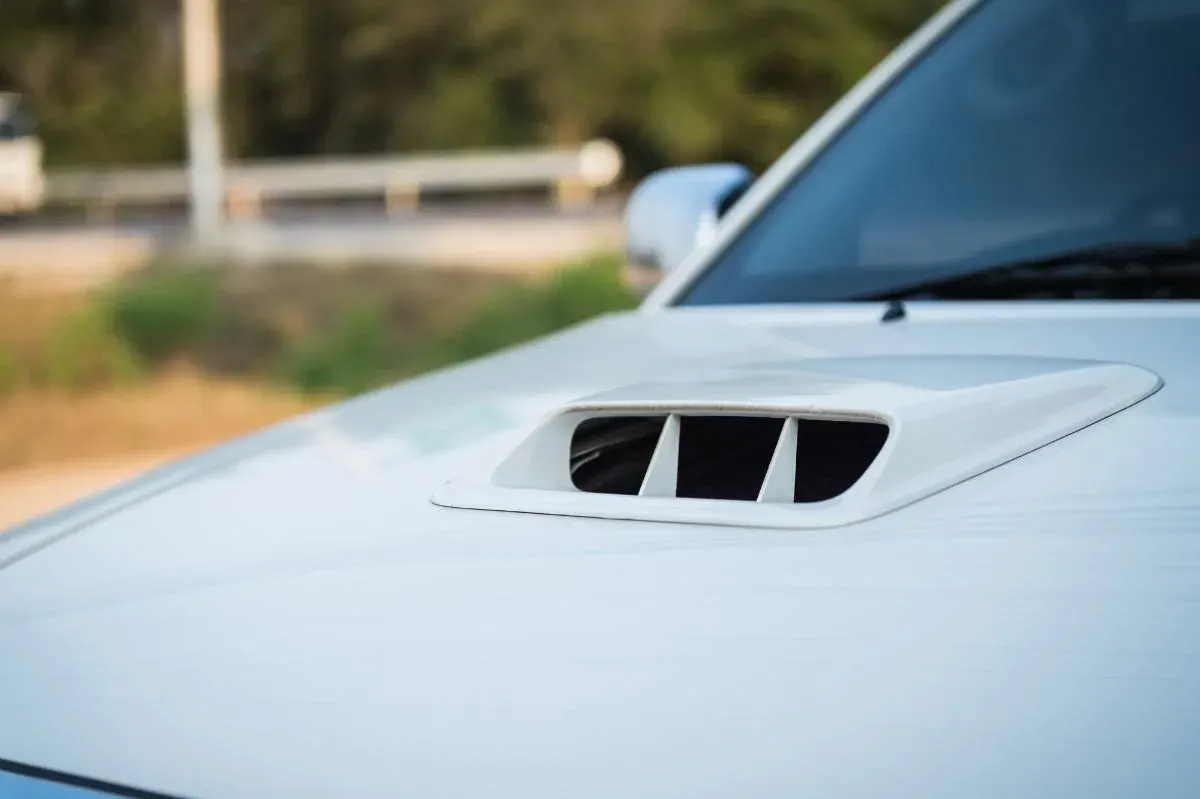
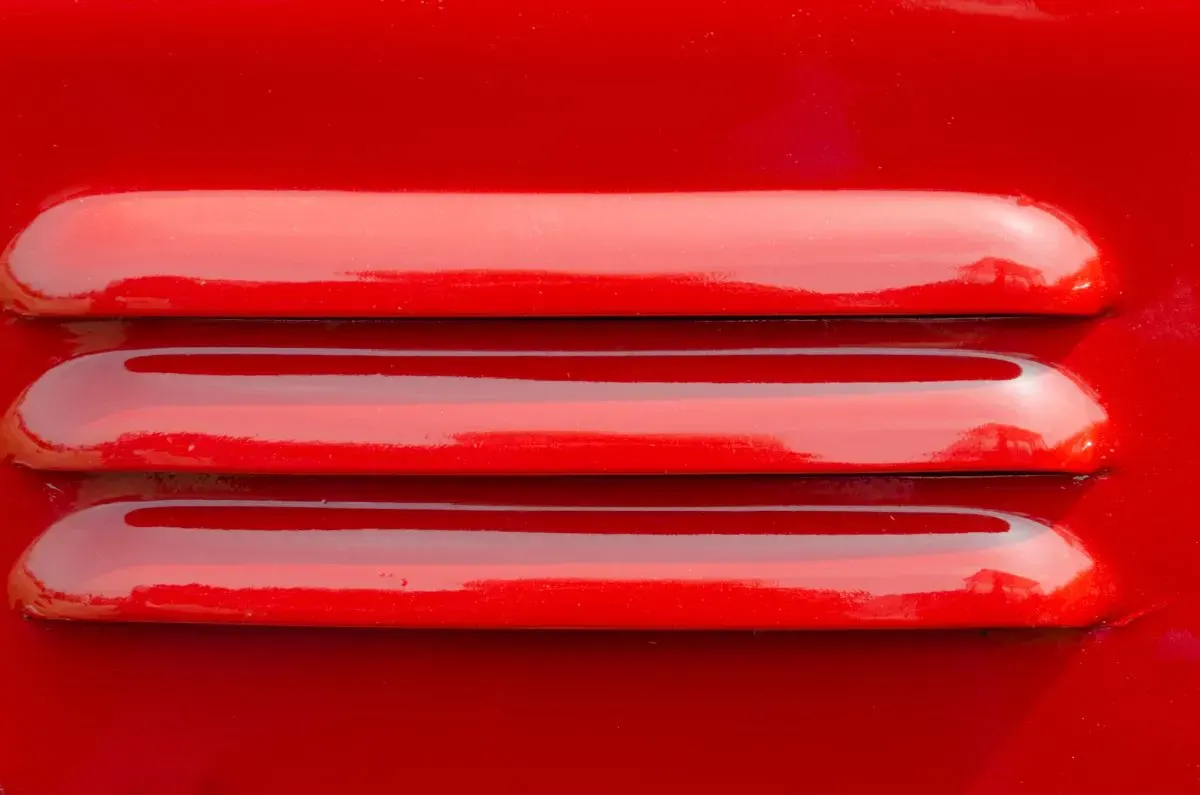
III) Louvre Vents
- As has been established, more cool air into the engine is good, but extra gunk carried in the wind can inhibit performance and cause damage. Louvre vents in a vehicle’s hood allow the hot air inside the engine to go up and out of the compartment.
- They also keep any debris from falling into the engine through the opening. Installing them does require permanent hood modification, similar to installing smaller scoops, but it can be done with minimal cost or experience.
IV) Hood Pins
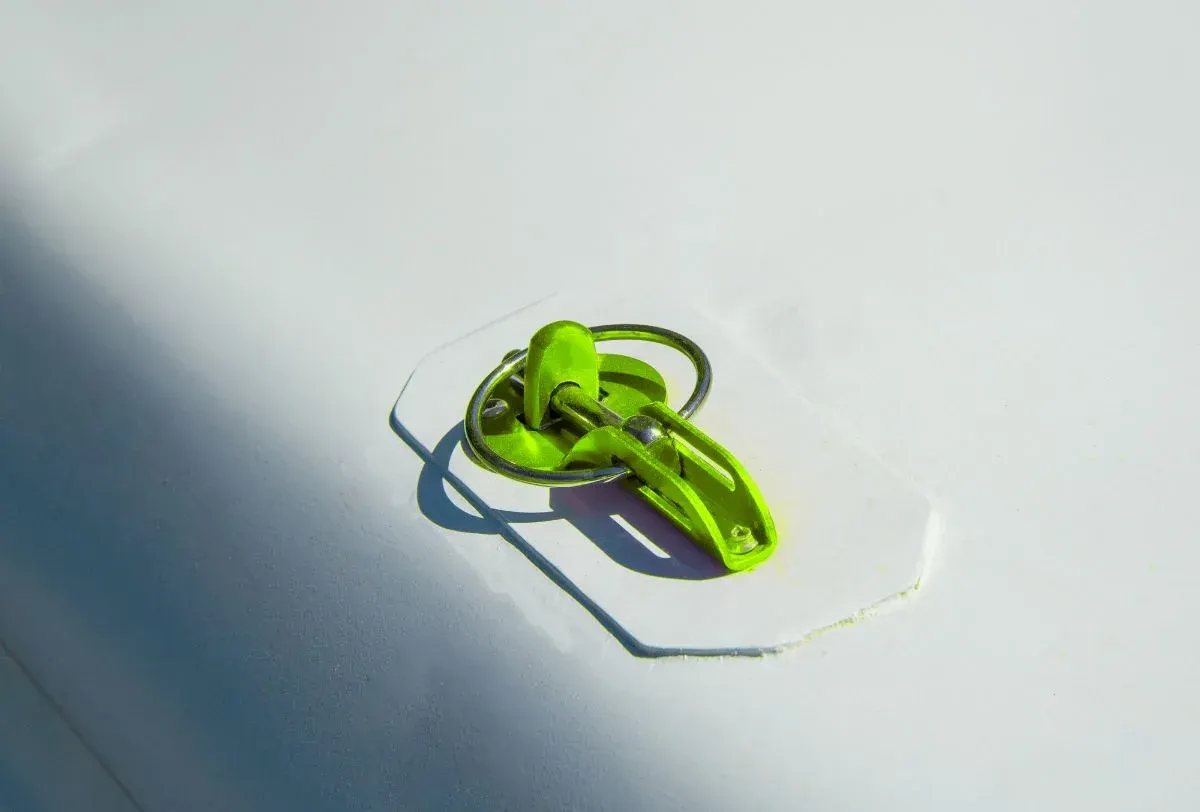
- A single latch that is properly used is secure enough for most vehicles. A double latch is even more secure. Still, if a driver wants to be absolutely sure that the hood stays in place, pins are the most reliable method.
- Proper hood pins require holes drilled through the hood, so installing them makes a permanent modification to it. Since they are typically an aftermarket addition, making sure they are properly installed is important for safety purposes.
- Some people really enjoy the appearance of hood pins, but they don’t want to put holes in their hood. For those people, stick on hood pins mimic the appearance without permanent damage to the hood.
V) Hood Locks
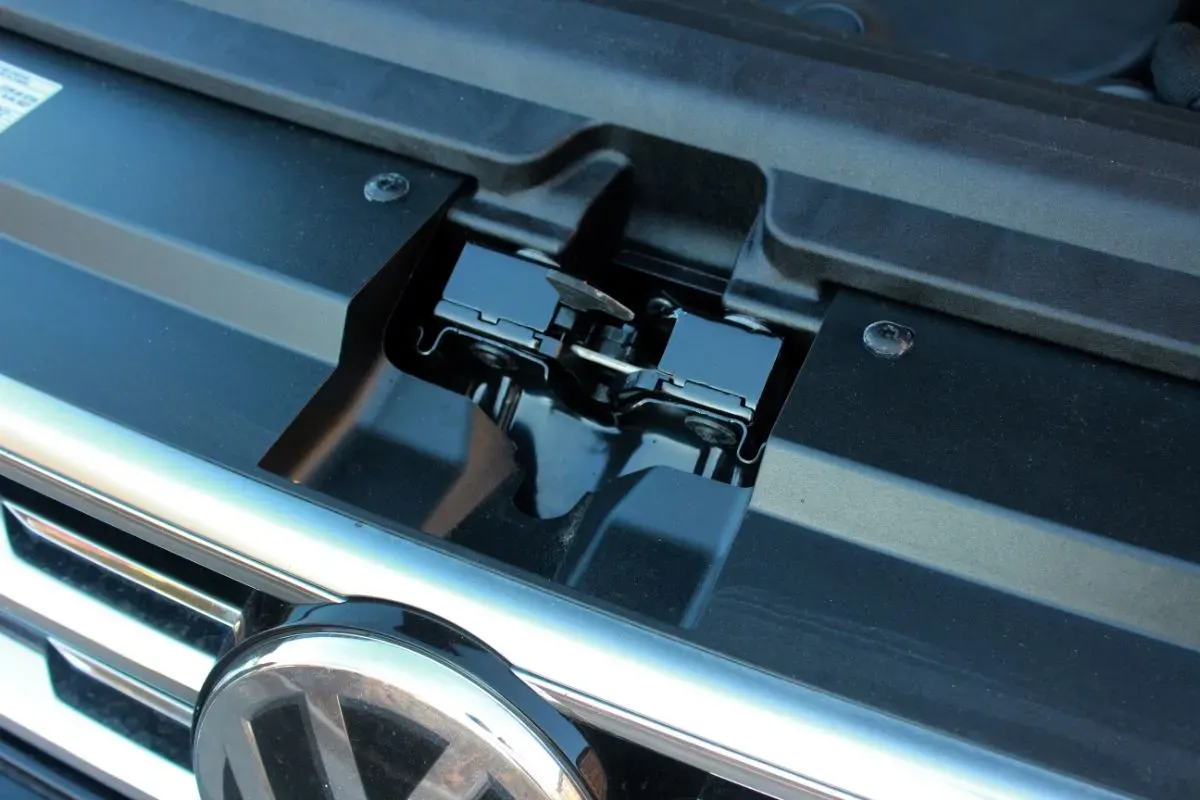
- A car that looks like it’s seen a lot of care and attention will indicate to potential thieves that there might be something valuable under the hood.
- There is plenty of damage that can be done without getting into the hood, and an intelligent thief who was determined can eventually bypass the lock.
- Still, hood locks add an extra sense of security and an indication to potential thieves that you are likely to have other security methods, stopping them from even trying.
VI) Hood Ornaments
- For something that represents a significant investment of time and money, a little vanity is warranted. An ornament is like a figurehead for your land cruiser, so it can convey a lot of personality but gives no performance benefits.
- Stiff ornament stands can cause additional damage in the case of an impact, so opt for a collapsing stand, check your local regulations, and use common sense before sticking extra dangerous options on the front of your vehicle.

9. PEDESTRAIN SAFETY
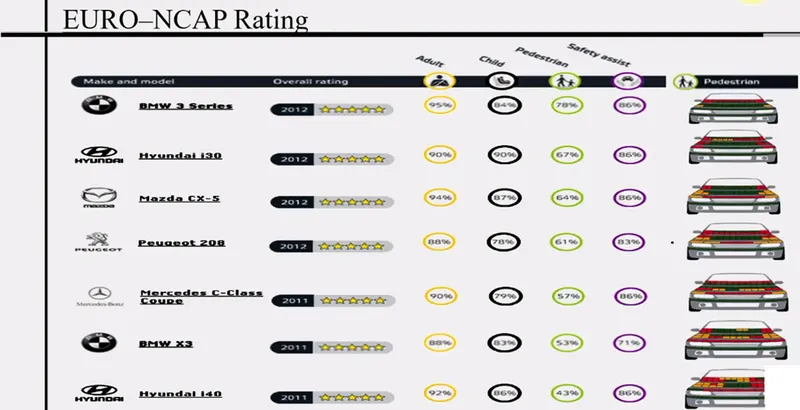
Nowadays many people deaths in the world were reported from vehicle traffic accidents that involved with pedestrian impact in higher percentage. This percentage may increase if there is no strong attention to the pedestrian safety from automakers and authorities. This study will focus on the analysis of pedestrian head impact on a car hood with different types of materials; also the hood thickness will be analyses with different measurements during the head test impact using the numerical simulation analysis which is available in ANSYS finite element software. The pedestrian head and front hood will be modelled using CAD software.
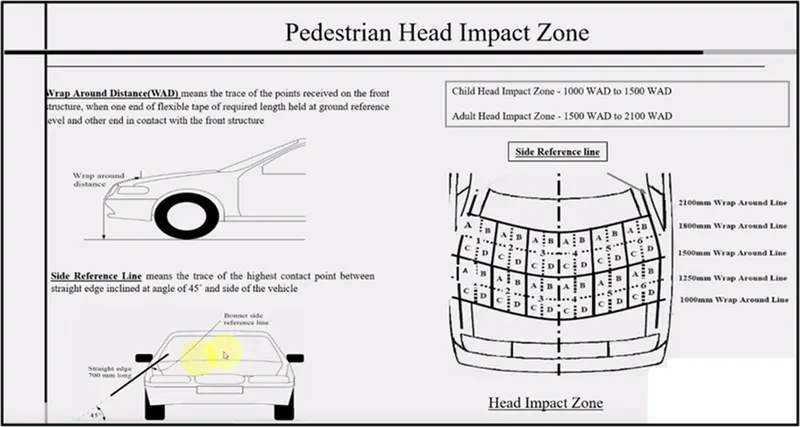
The impact of characteristics in Euro NCAP tests in terms of mass and impact velocity were the same as in European Directive 2003/102/EC which two head forms considered such as a child head with a mass of 2.5 kg and an adult head with a mass of 4.8 kg. The impact angles of the head forms are set to 50° measured from the ground reference line for the child head and to 65° for the adult head. Both head forms should impact the bonnet with a velocity of 40 km/h. Two head finite element models (FEM) have been used for the head impact simulations, a standard pedestrian head model and an anatomical head FEM model.
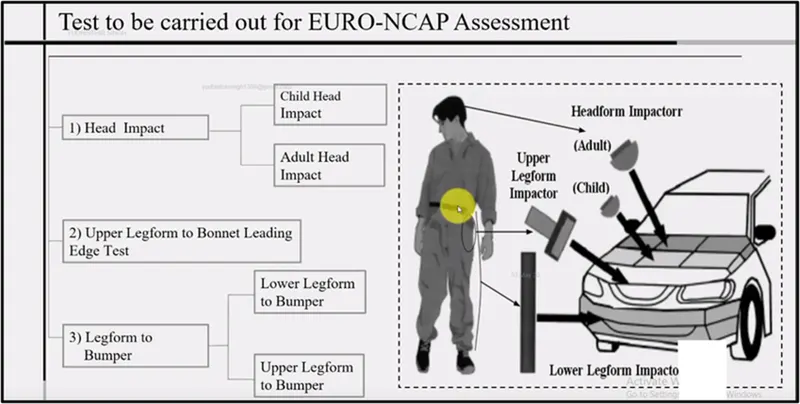
In another research, Bhaska studied comparison of steel, aluminum and composite bonnet in terms of pedestrian head impact. The new finite element model was capable to simulate head impact phenomenon between head form impactors and composite bonnet. This study also focused on the behavior of three identical bonnets made of steel, aluminum and composite. The results demonstrated that the energy absorption of aluminum bonnet was less than steel and composite ones and for keeping the aluminum bonnet at the same level of stiffness, therefore it was necessary to increase the thickness.
RESULTS
A) MATERIAL DEFORMATION
The observation from shows that the steel hood deforms at 0.32288mm for 1 mm of thickness. But for 3 mm thickness the deformation is 0.35267 mm. The front hood made from aluminum at the middle of the point of impact in red color it deform at 2.7559 mm but the area surrounding it in orange color which at 0.62766 mm, and this is for 1 mm thickness. However for 3 mm thickness the deformation is 0.30893 mm. For the type of magnesium at 1mm, the maximum value of deformation is 1.6953mm which overall the front hood is deform at maximum stage. On the other hand 0.57886mm of deformation produced from 3 mm, and the minimum value is -18.06 mm of deformation
B) EQUIVALENT STRESS
The stress of steel material for 1 mm the maximum stress is 270.9MPa. But for 3 mm thickness of steel the indicator shows 220.73MPa of maximum stress. In aluminum front hood case at 1 mm thickness, there is stress in interval of 25.15MPa to 50.255MPa according to the colors dissipate in this stress test. For 3 mm thickness the stress is distributed entire the front hood during this test, and stress occurred at 37.433MPa to 49.892MPa. For magnesium material, the stress tends to occurred in range 23.882MPa to 41.786Mpa and few places plot at 47.754MPa when the hood thickness is 1 mm. 34.217MPa to 47.889MPa of stress range for magnesium hood of 3 mm thickness, and the maximum stress plots 61.562MPa.
C) ENERGY SUMMARY
In this study, many types of energy are available and only internal energy is taken into consideration which produced inside the material itself that can hold the force exerted on it. The internal energy increases untill 1.6218x10^5 mJ and decreases back to 87654mJ for 1 mm thickness of steel hood. In case of 3 mm thickness, the internal energy fluctuates between 1.5345x10^5 mJ and 75608mJ. However for 1mm thickness of aluminum front hood during impact, the internal energy at peak point was 2.5010x10^5 mJ and it decrease until at 29128mJ, and it produces peak value of 2.0731x10^5 mJ and decreases until 46345mJ for 3 mm aluminum hood. In the last type of material it shows graph of internal energy in bell shape, the internal energy graph reaches 2.4521x10^5 mJ and minimum value of -223.87 mJ for magnesium 1 mm hood. Finally for 3 mm thickness of magnesium hood the internal energy inclines almost 2.3323x10^5 mJ and decreases back until 27326 mJ.
CONCLUSION
- Based on the data result produced by the Ansys software, the observation shows that by using different thicknesses of same material can affect their deformation values, internal energy, and stress values. Aluminum had total deformation much similar with magnesium and steel had the lowest total deformation among the materials.
- As conclusion, each material has its own characteristics. therefore for manufacturers in order to reduce the cost of production and they will evaluate the materials that are cheaper or they can build or design a safety front hood by using the same material but with different design which includes different thicknesses suitable for pedestrian safety.
- Furthermore future recommendations that can help the automotive industry for choosing a suitable material for front hood that comply with pedestrian safety. It is observed that each material has its own properties and ability that can cope with the demand of manufacturers especially in automotive field.
- Based on this study for pedestrian safety, the deformation of front hood must increases especially in crumple zone of the engine bay section, therefore it is suggested to use aluminum or magnesium because of their deformation performance during the event of crash.
- Design of Hood involved design of inner panel with necessary reinforcements and embosses and hemmed with outer panel. Hemming involves joining of two surfaces and hemming adhesives are widely used to give improved strength, part stiffness, crash performance and corrosion protection.
- Optimization is carried out to get a safe design and to produce the part with optimal cost. It provides a unique design solution and requires less space with with compact dimension.
ASSEMBLY OF HOOD